| The
Midland Airsho in Texas is one of America's three best warbirds shows,
along with the Chino airshow in California and the Thunder Over Michigan
airshow in, of all places, Michigan! Visitors from Europe come
to both Chino and TOM, but only Midland has an organized commercial tour
group in attendance, a sign of its drawing power. Here's one
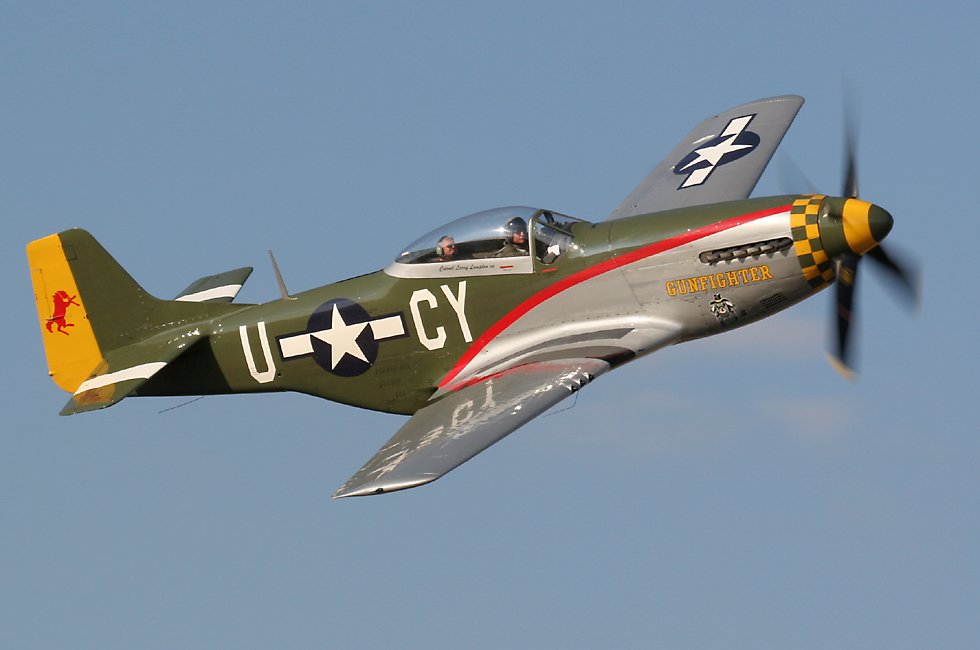
of those British tourists, taking a ride in "Gunfighter", a P-51D Mustang
belonging to the Great Plains Wing of the Commemorative Air Force, the
organization which runs the Midland show. |
 |
| Gunfighter
flew in perfect conditions on Friday, but cloud started arriving on Saturday
and by Sunday the sky was well and truly gunked up. Located
on the plains of Texas, Midland is noted for variable weather - one year
the temperature was below freezing and another year it hit 98 degrees Fahrenheit
(37 degrees Celcius). If you visit, make sure to bring both
shorts and a fur coat! |
 |
| One
of the attractions of Midland is the opportunity to see large numbers of
warbirds in the air, including many unique or nearly unique types which
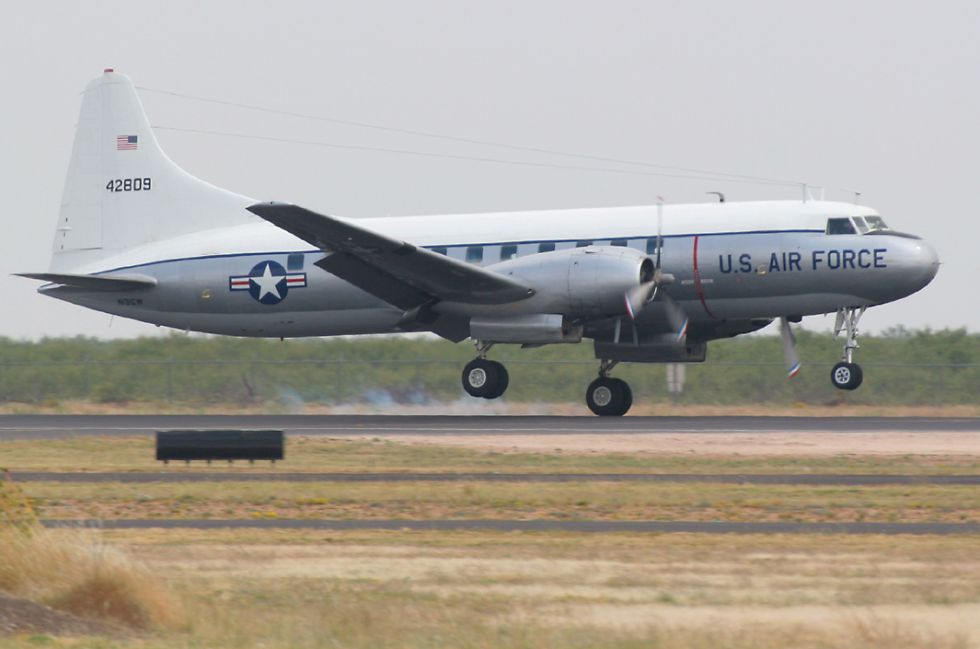
are rarely seen flying anywhere, such as this C-131 Samaritan, making a
rather interesting landing in a crosswind. This aircraft has
the very appropriate civil registration N131CW, just to leave no doubt
of its identity. |
 |
| There
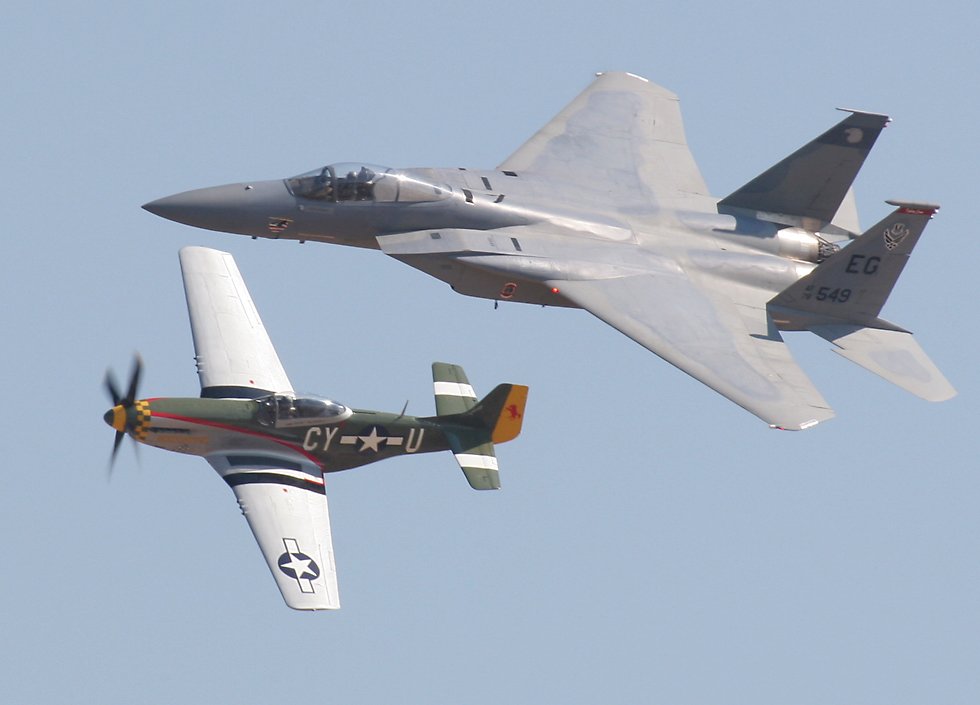
were two P-51s in attendance at the 2006 show, and Gunfighter flew on Friday
and Saturday in an air force "Heritage Flight" with this F-15C from Eglin
air force base in Florida, fitted with conformal fuel tanks like the "E"
model "Strike Eagle". |
 |
| There
were plenty of air force types flying at this year's show.
As well as the two P-51 Mustang fighters, there were also two B-25 Mitchell
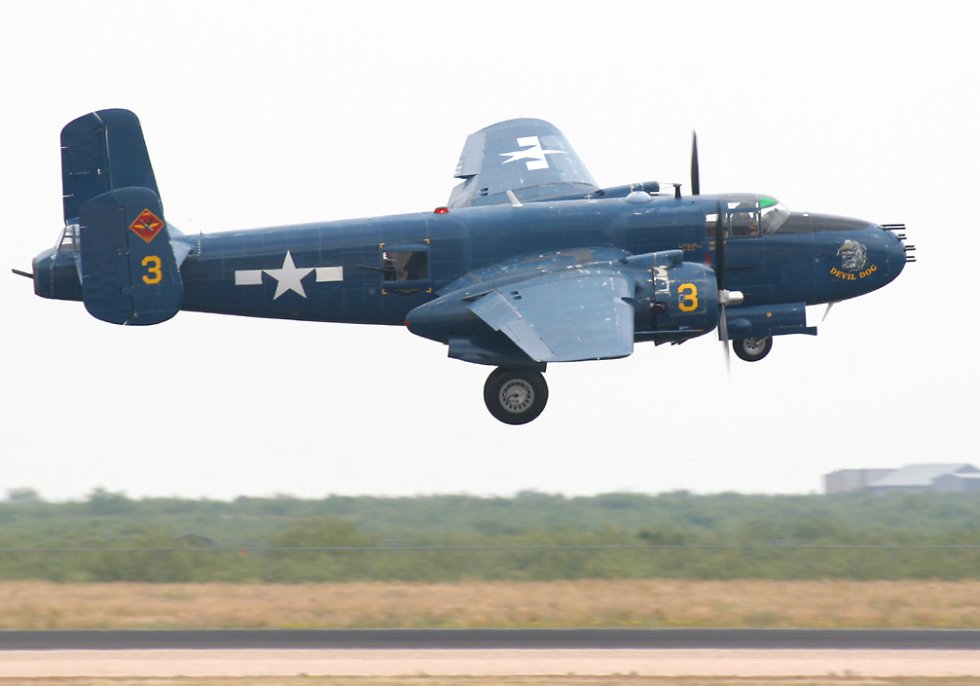
bombers, though this isn't one of them. Devil Dog is a PBJ-1J,
the marine corps version of the Mitchell. Since they were mostly
used at low altitude in the Pacific theater, the marines traded their glass
bombardier's noses for solid noses fitted with eight .50 caliber machine
guns for strafing; some even had a 75mm cannon for attacks against shipping. |
 |
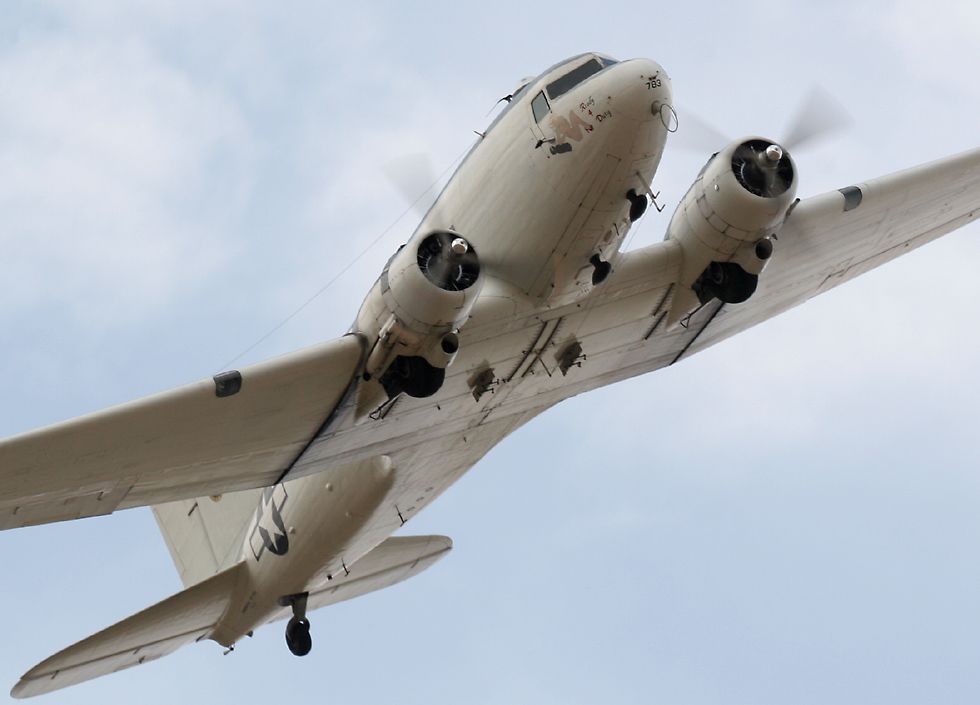
| Devil
Dog isn't a B-25 and the aircraft Ready 4 Duty shown here isn't a C-47
Skytrain, or even a DC-3 Dakota. To figure out what it is,
shorten the name down from Ready 4 Duty to R4D and you'll realize that
it's the navy version of the Skytrain, designated the R4D.
This particular aircraft was one of only thirty R4D-6S models, fitted with
depth charge racks and air-to-surface radar; you can see one of the radar
antennas on the side of the nose, below the cockpit side window.
One of these aircraft sank a surfaced German submarine off the coast of
Brazil in February of 1945. |
 |
| The
2006 Midland show was even richer in naval aircraft than it was in air
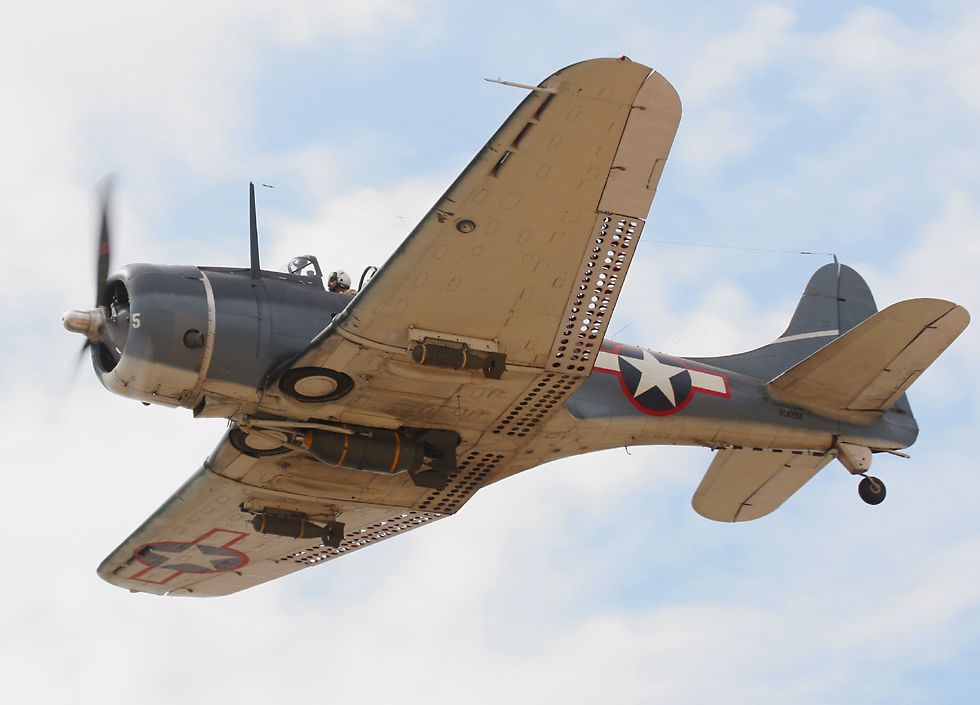
force types. This Douglas SBD Dauntless dive bomber is one
of very few in the world still flying, and the only one I've seen with
bombs fitted. Although many people considered the Dauntless
obsolete by the time of the Pearl Harbor attack, it was actually the first
American aircraft to shoot down a zero fighter, and proved very effective
throughout the war against shipping, most notably at the battle of Midway,
where it sank four Japanese aircraft carriers. It ended up
sinking more Japanese shipping than any other aircraft, earning it the
nickname "Slow But Deadly". |
 |
| Here's
the intended replacement for the Dauntless, the Curtiss SB2C Helldiver.
As with the Dauntless, the perforated dive brakes at the back of the wings
indicates that it's a dive bomber, however it didn't achieve the performance
that was hoped for it, and crews unkindly decided that the SB2C designation
actually stood for "son of a bitch, 2nd class". This example
is the only one in the world which is still flying, here demonstrating
the folding wings which made for easier storage on a cramped aircraft carrier. |
 |
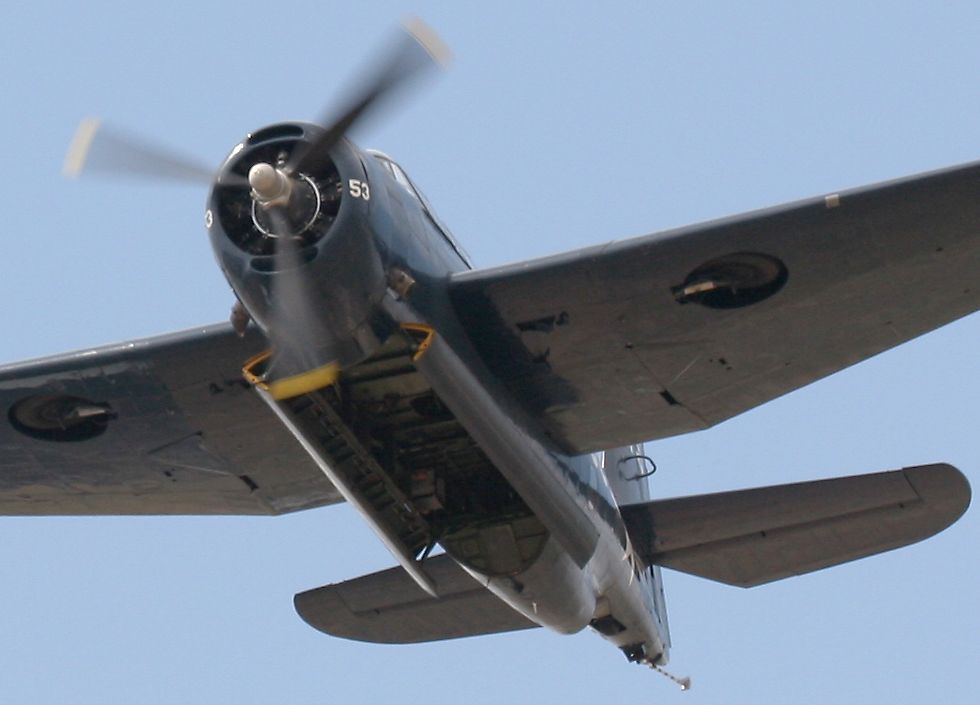
| The
Avenger is another large single-engined naval attack aircraft of the second
world war, but it was primarily designed as a torpedo bomber, although
later versions were fitted with under-wing rockets and also did ordinary
bombing of land targets. The Avenger's first outing, at the
battle of Midway, was very inauspicious, with 5 of the 6 aircraft sent
out shot down, and the
survivor returning totally shot up, with one crew member dead and the
other two wounded. Perhaps the most famous Avenger pilot of
the war was George
Bush senior, who became the 41st president of the United States. |
 |
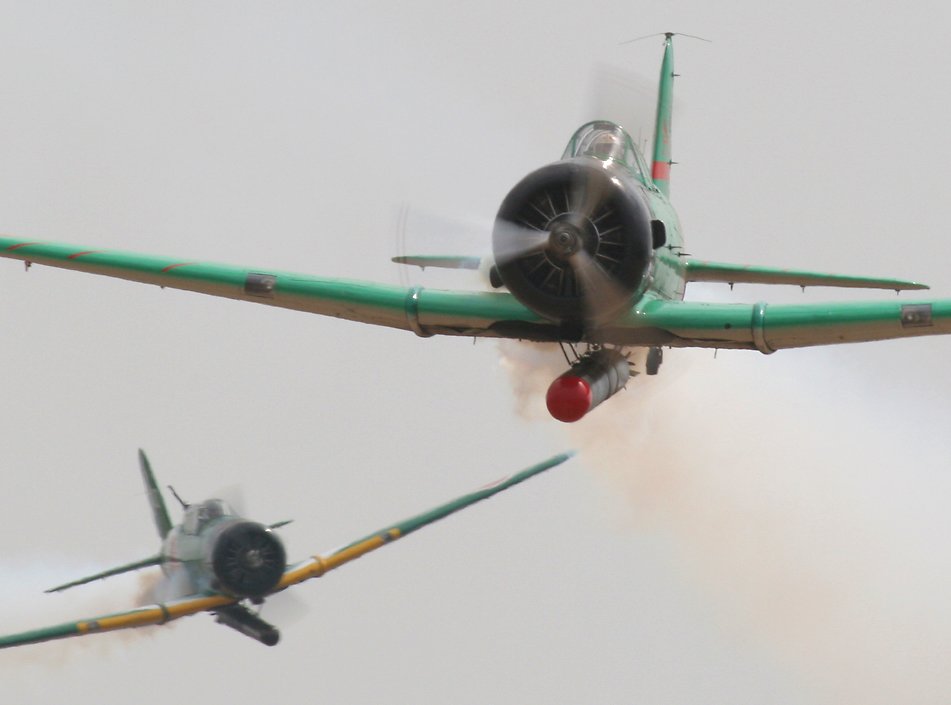
| The
Tora, Tora, Tora display team fly at many airshows around the United States,
but Midland is their home base, and so this show has the largest number
of replica "Kate" torpedo bombers, "Val" dive bombers and "Zero" fighters
in the air at one time. It's an exciting show, complete with
pyrotechnic blasts and Japanese aircraft going up in smoke after being
jumped by American fighters. |
 |
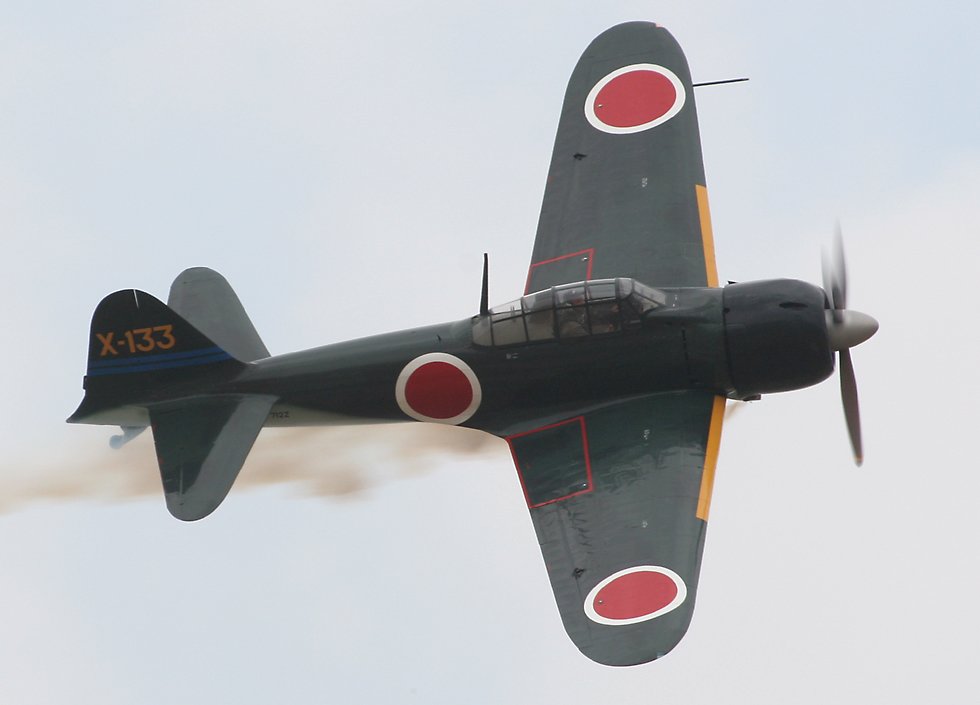
| The
"Tora" Zeros might be replicas, but this one is the Real Deal, or at least
the Pretty Real Deal. It's an authentic Mitsubishi Zero from
the Commemorative Air Force wing at Camarillo in southern California, though
it does have an American built Pratt and Whitney radial engine. |
 |
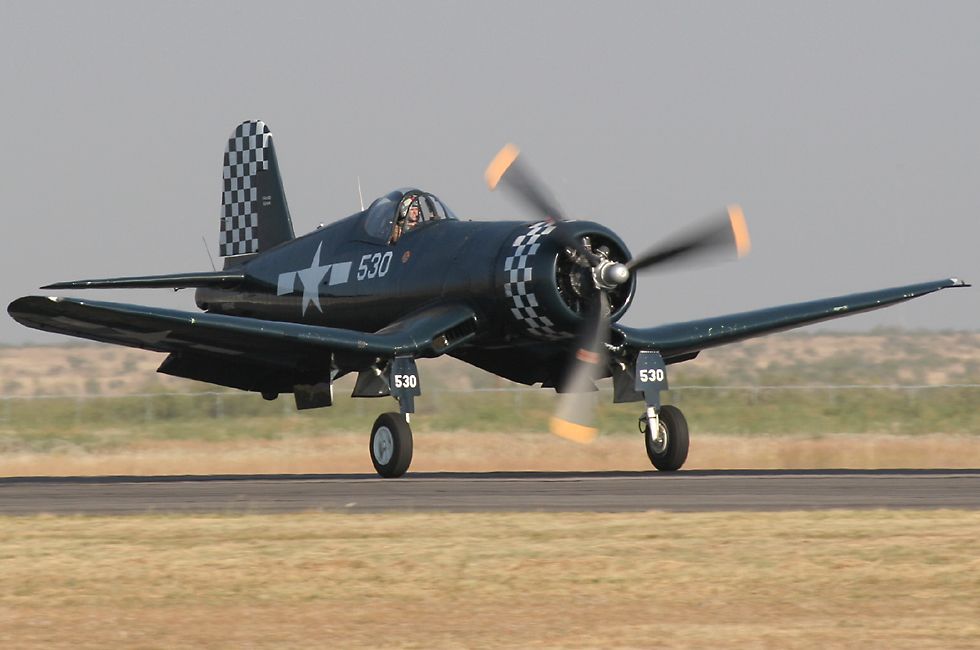
| The
Chance-Vought F4U Corsair was one of the hot-rods of the war, when it first
flew in 1940 it was the first single-engine American aircraft capable of
400 mph in level flight. The lack of visibility past its long
nose made it difficult to land on an aircraft carrier, resulting in it
being used by the marines from land bases but not from carriers.
The British came up with the solution of landing their aircraft in a broad
turn rather than in a straight line, a technique which the US navy later
adopted. Like the Avenger, the Corsair was also operated by
the Royal New Zealand air force in the Pacific, and after the war. |
 |
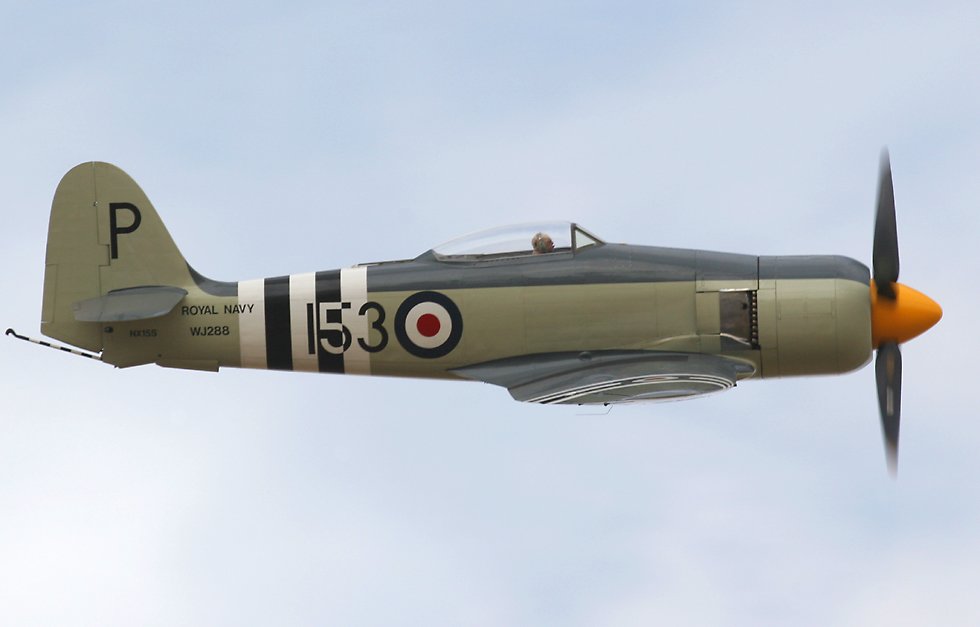
| This
British-designed Sea Fury was even more of a hot-rod, its 2500 horsepower
Bristol Centaurus radial engine giving the streamlined fighter a top speed
of 460 mph (740 km/h). It was the last propeller driven fighter
in the Royal Navy, entering service after the end of the world war two,
but remaining in service until 1955 with the British, and even later with
the ten other nations which bought it, including Iraq and Cuba, which used
them against the Bay of Pigs invasion. The Sea Fury's speed,
maneuverability and cannon armament enabled it to shoot down at least one
MiG-15 jet fighter during the Korean war, and this type became very popular
on the American racing circuit right up to the present day. |
 |
| The
British theme continued with this F4F Wildcat naval fighter painted in
a British Atlantic color scheme. Known as the Martlet in British
service, this aircraft type became the first American fighter to down a
German aircraft during the war, when a Ju 88 bomber was destroyed over
the Scapa Flow naval base in Scotland. It was America's primary
naval fighter during the early years of the war and, although its inferior
armament and maneuverability made it a challenge to outperform the Zero,
the Wildcat's superior ruggedness sometimes made it a difficult aircraft
for the Zeros to shoot down. |
 |
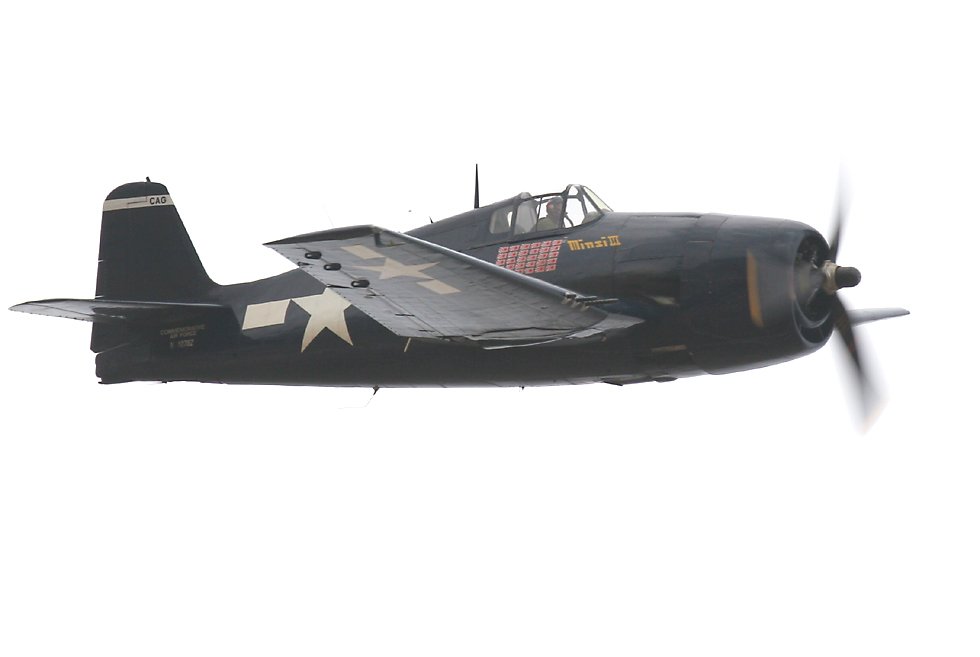
| Like
the Zero that flew at Midland, this F6F Hellcat called "Minsi III" also
made the long trip out from the Commemorative Air Force wing based in Camarillo.
The Hellcat was the successor to the Wildcat, more capable than the Zero
in almost every way, allowing it to achieve an eventual 19 to 1 kill ratio
against Japanese aircraft. Hellcats accounted for more than
half of the naval and marine corp victories of the war, though by the latter
stages of the war they mostly flew against inexperienced pilots. |
 |
| This
F8F Bearcat is another Camarillo bird. Powered by the same
engine as the Hellcat, the Bearcat was lighter, significantly faster and
had a 30% better climb rate. The F8F arrived too late for combat
in world war two, but it was used by the French air force in Indo-China,
and later by the South Vietnamese air force. |
 |
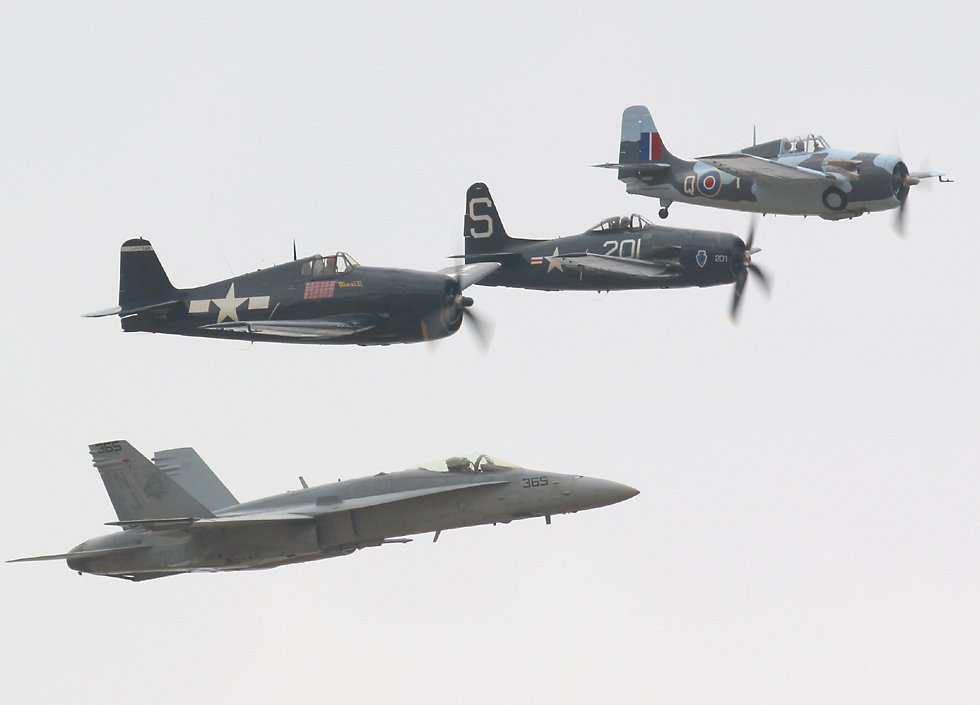
| Here
are the three Grumman fighters in a picture perfect naval "Legacy Flight"
formation with an F-18C Hornet. |
 |
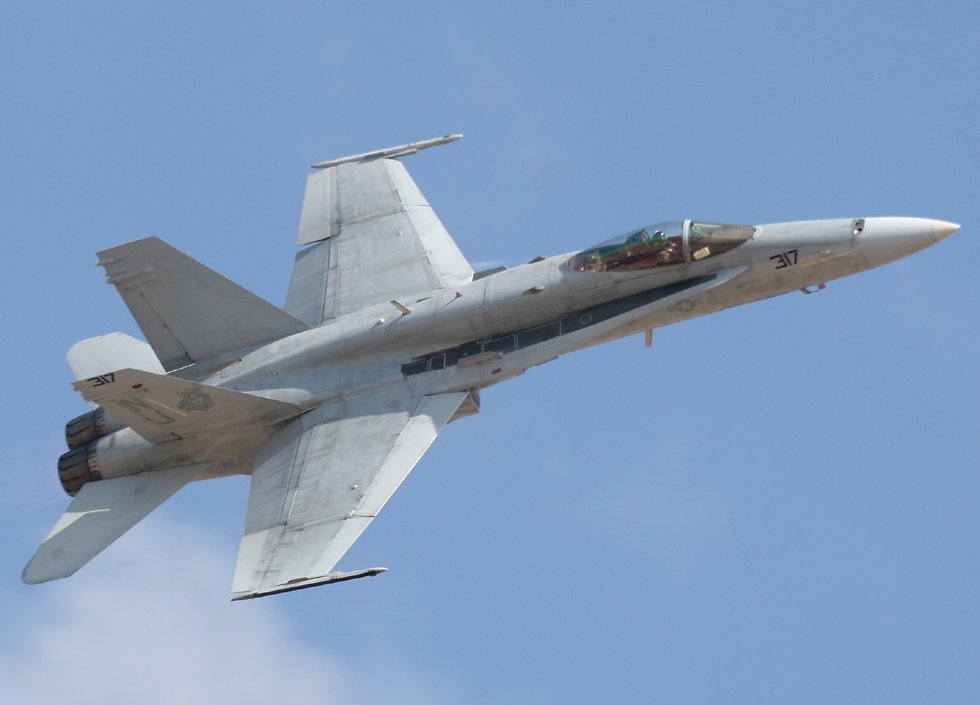
| There
were a pair of Hornets at the show; as well as the Legacy Flight the audience
was also treated to an excellent solo display. |
 |
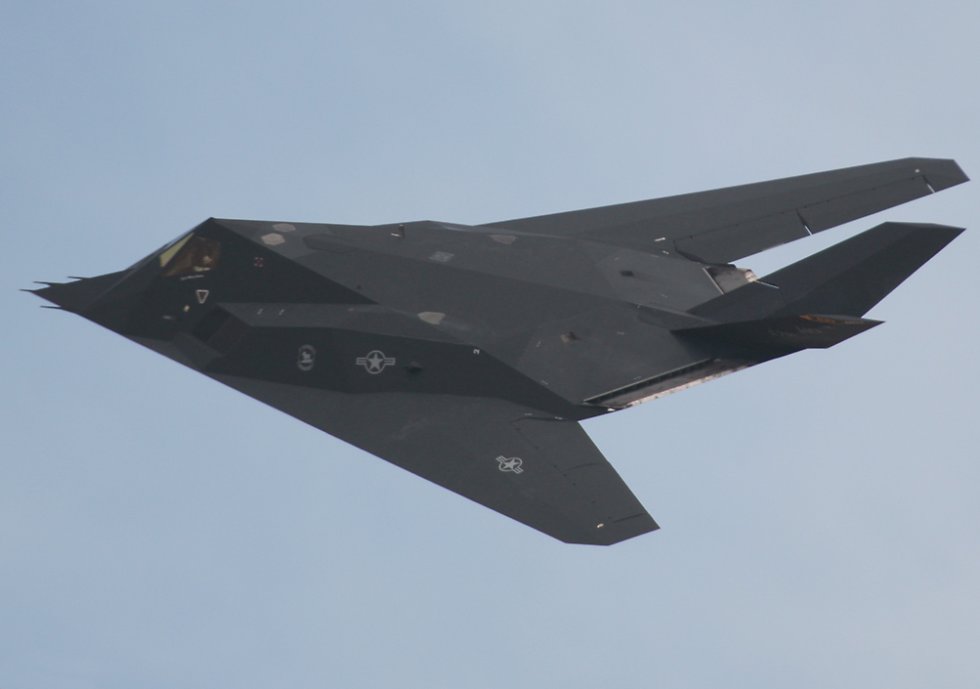
| The
F-15 Eagle also put on a solo display, and a trio of local Air National
Guard F-16 Fighting Falcons strutted their stuff. This wasn't
the end of the good news for fans of modern hardware, an F-117 Nighthawk
"stealth fighter" putting on a brief but very worthwhile demonstration,
including the banked passes that have become a welcome trademark of the
type's last two years on the airshow circuit before retirement. |
 |
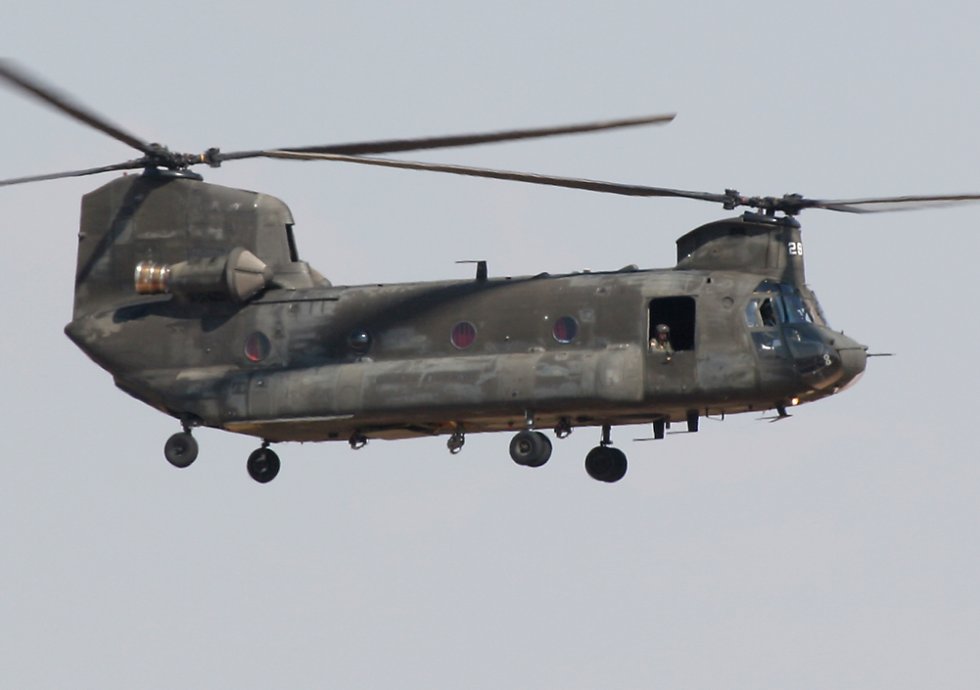
| It's
a sad fact that the army doesn't get much opportunity to participate at
American airshows, unlike the air force, navy and marines.
This Chinook is the first one I've seen flying during more than 50 airshows,
and even it didn't get to do a demonstration, just flying in for the static
display on Friday. |
 |
| However,
this show does deserve a lot of credit for putting helicopters onto the
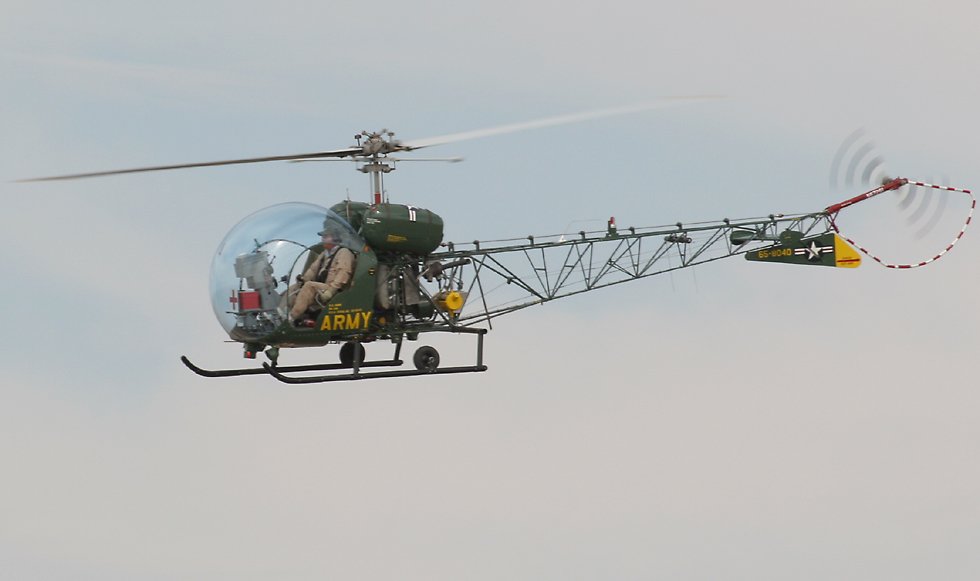
list of performers, a relative rarity in this country. Here's
an H-13 Sioux, a variant of the Bell model 47, which in March of 1946 became
the first helicopter certified for civilian use. Although used
by the air force, navy and coast guard, it became most familiar in the
H-13C and H-13D models fitted with external stretchers, which flew injured
soldiers from the front line to mobile army surgical hospital (MASH) units. |
 |
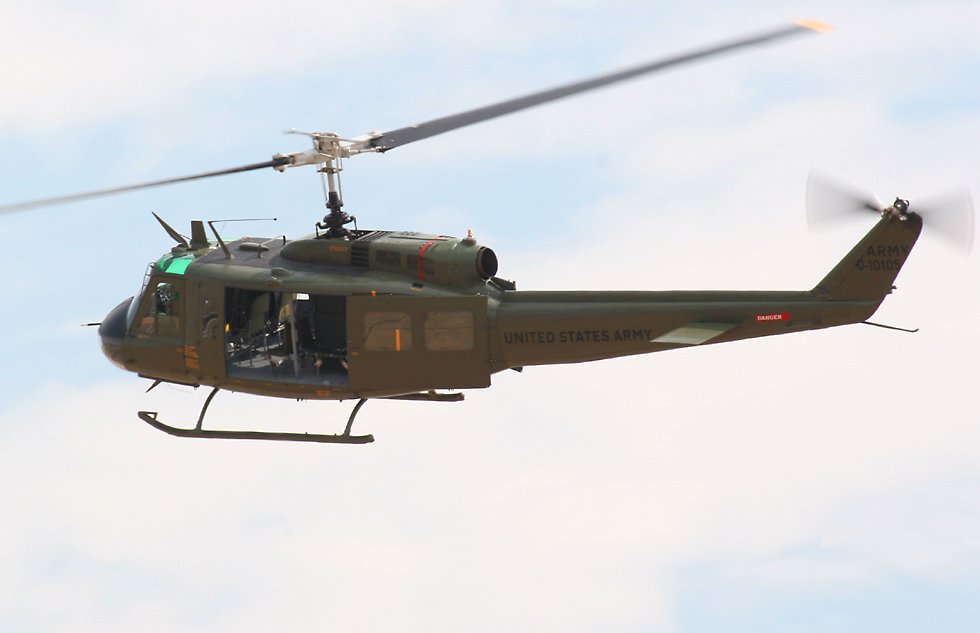
| The
UH-1 Iroquois, better known as the "Huey", is another army helicopter recognized
even by those who aren't particularly interested in aviation.
Jet powered versions of the Sioux were already in use when the army commissioned
Bell to design a jet powered helicopter for the medical evacuation role.
It soon became clear that the Huey was suitable for more than just that
task, and it became an indispensable Jack of all trades, including troop
insertion and acting as a gunship, with rocket pods or miniguns. |
 |
 
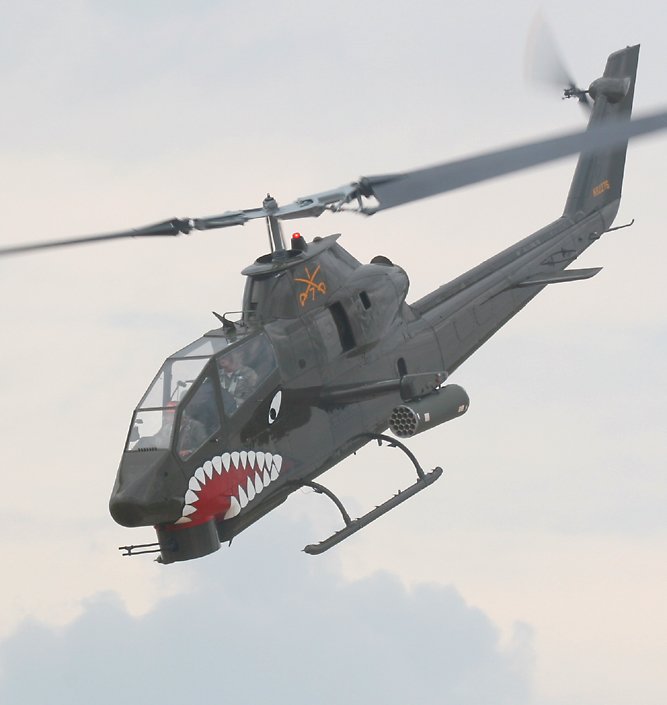
The Huey performed fairly well as a gunship, however the Bell company decided
that a helicopter designed specifically for that role would be even better,
so they started a private venture project to develop a specialized gunship.
Strangely, the army wasn't too interested in the project, they passed over
Bell and instead asked Lockheed to develop what became the AH-56 Cheyenne,
an extraordinary heavy battlefield "compound" helicopter with revolutionary
technology such as stub wings and a pusher propeller on the tail for increased
speed. In spite of interesting performance, the Cheyenne project
was eventually cancelled in 1972.
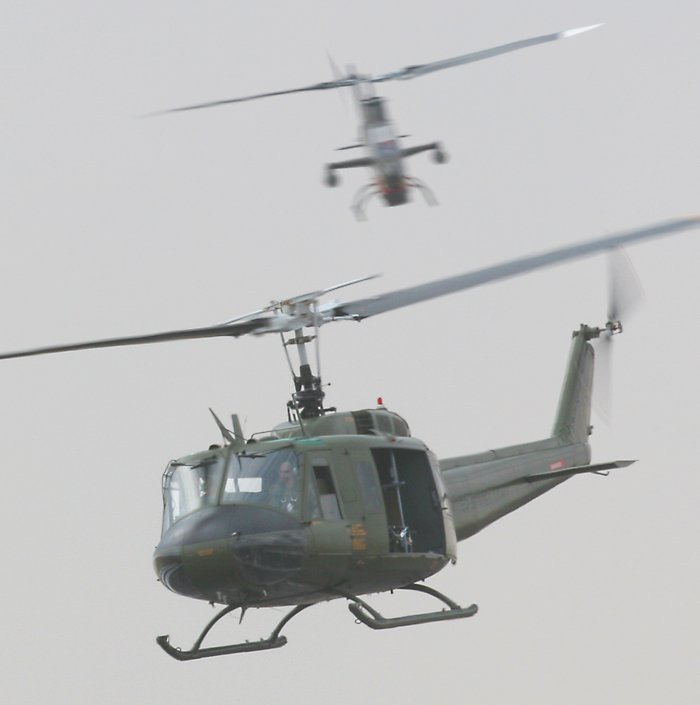
Bell started their gunship development with a helicopter based on the Sioux,
which first flew in 1963. The army felt that the Sioux Scout
was too underpowered for the role, so Bell started again, using the Iroquois
as the basis. The result was the AH-1 Cobra, seen here flying
behind its predecessor. |
 
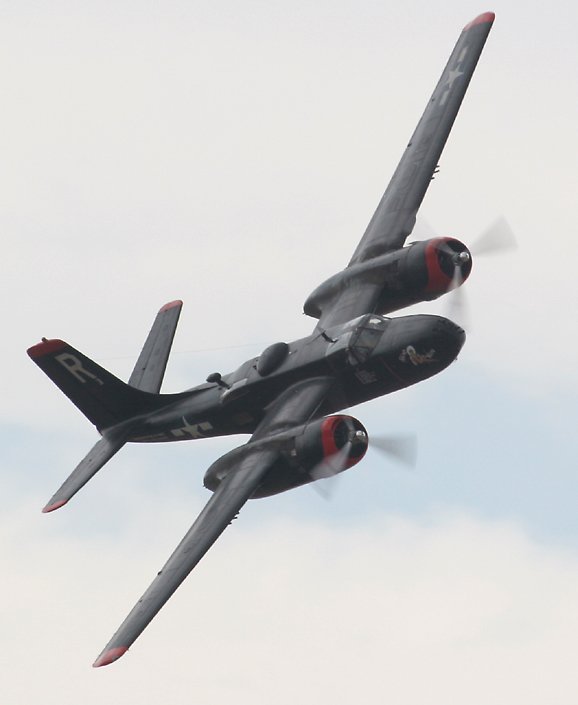
Here's another of the unusual types which Midland manages to pull out of
its hat each year, a world war two A-26 Invader light attack bomber called
"The Spirit of Waco".
Actually the Invader had an unusually extended service life stretching
all the way to 1972, which is why I've put it here with other Vietnam era
aircraft.
The Invader also had an unusually confusing sequence of names during its
lifetime, all self-inflicted, first by the US army air force and later
by the US air force. They first used the name "Invader" which
had already been attached to another attack aircraft, the A-36 dive bomber
version of the Mustang fighter; the A-36 was also known as the "Apache".
Incomprehensibly, after the war the air force changed the Invader's designation
from A-26 to B-26, causing endless confusion with the retired world war
two B-26 Marauder medium bomber. The Invader was then used
in Korea, with the French forces in Indo-China and during the Bay of Pigs
invasion in Cuba. At the same time as this last episode was
unfolding, the Invader was being used in Vietnam, where it was re-renamed
back to A-26 Invader, because the government of Thailand wouldn't allow
"bombers" to be based in their country.
The Invader's longevity is an indication of its effectiveness, some people
considering it one of the best aircraft designed in world war two.
It was unusual, with a single pilot, and turrets remotely controlled by
a gunner. A glass-nosed model equipped with a Norden bombsight
allowed medium altitude precision bombing, or solid nosed versions like
Spirit of Waco, fitted with six or eight .50 caliber machine guns, made
it a terrifying strafing weapon. In spite of its late arrival
during the war, its simplicity and utility ensured that it was operated
by many air forces around the world. |
| The
A-1 Skyraider is another of the anachronistic propeller-driven aircraft
which had a very long service life and performed long and valuable work
in Vietnam. The Skyraider was known as "Sandy", "Able Dog"
and many other nicknames in Vietnam, and gained fame as a member of combat
search and rescue teams picking up downed American pilots. With a
ten hour loiter time and an equally remarkable 8000 pound weapon payload,
a pair of Skyraiders would work together with HH-3 "Jolly Green Giant"
helicopters to extract pilots, the Skyraiders strafing and bombing enemy
positions to allow the helicopters to do their work. After
the war, captured Skyraiders were incorporated into the communist air force,
you can see a
Skyraider at the Vietnamese air force museum in Hanoi. |
 |
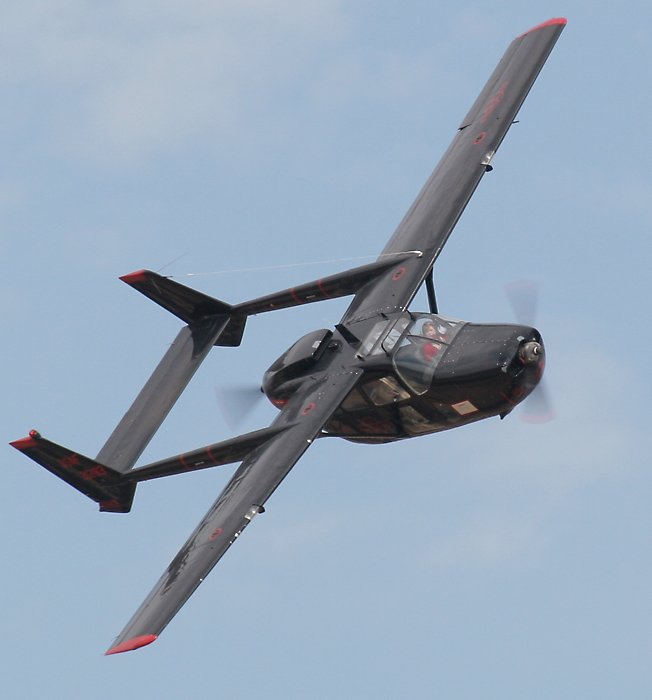
All of the pilots flying during the Vietnam war were brave, but it took
a special kind of bravery to fly a Cessna at low-level into the middle
of enemy territory.
Actually, the Cessna O-2 Skymaster was a significant improvement on its
predecessor, the single-engined O-1 Bird Dog, which also served in Vietnam.
The Skymaster at least had a chance of returning if one engine stopped
working.
Even with this advantage, the Skymaster was one heck of a plane to go to
war in, with no pilot armor. Not only that, but its role as
a forward air controller required that the Bird Dogs and Skymasters skim
over the jungle at treetop level to spot enemy troops and, often, to deliberately
draw their fire. They would then fire smoke canistors onto
the enemy position and call in a ground strike by a Phantom or other "fast
mover". |
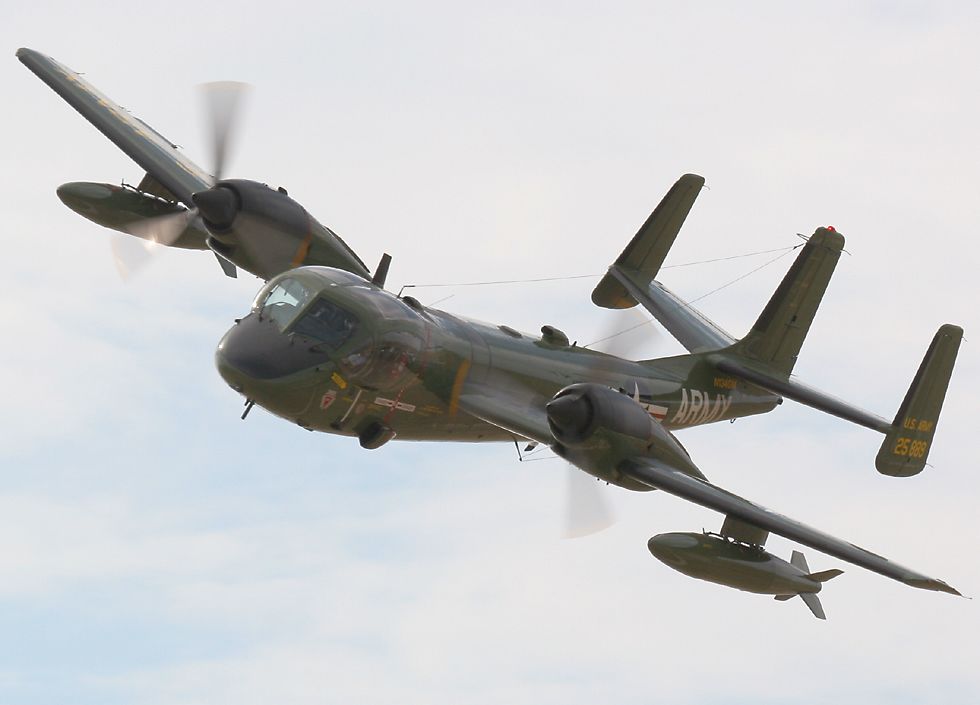
| The
Bird Dog and the Skymaster were both basically off-the-shelf civilian designs,
but the army realized that something better was needed, and came up with
this aircraft, the OV-1 Mohawk. The bulged canopy windows provided
better visibility than its predecessors, armor was provided to protect
the pilots, and the two turbo-prop engines provided much greater speed.
The Mohawk also had the ability to attack ground targets by itself, using
rockets and heavy machine guns mounted in a pod. One Mohawk
operating in Laos even managed to shoot down a North Vietnamese MiG-17
fighter jet. |
 |
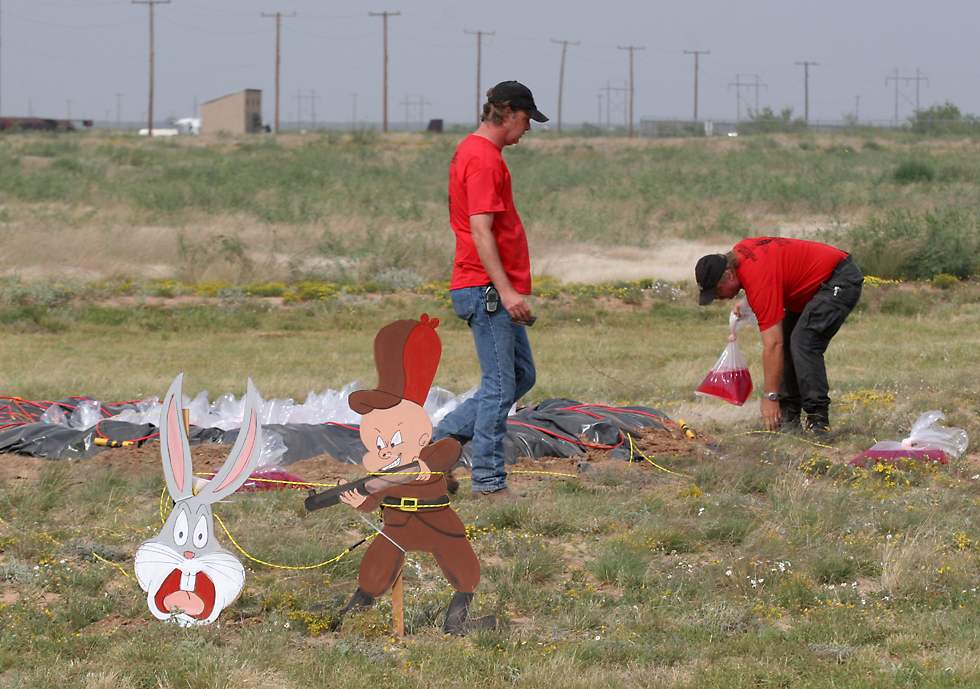
| At
Midland the men and women of the Commemorative Air Force's "Explosive Ordnance
Detachment" combine with the Blastards pyro team to put on what must surely
be the largest and best choreographed pyrotechnics display of any airshow
in the United States. Fifty or sixty trained volunteers control
dozens and dozens of explosive setups, culminating with the "atom bomb"
blast which you can see being prepared here. Over the two days
of the show, 1400 pounds of explosive and 3500 gallons of gas split up
into 2.5 gallon bags goes up in a tightly choreographed routine, timed
to the diving and buzzing of the Tora, Tora, Tora display team, and other
routines during the show. |
 |
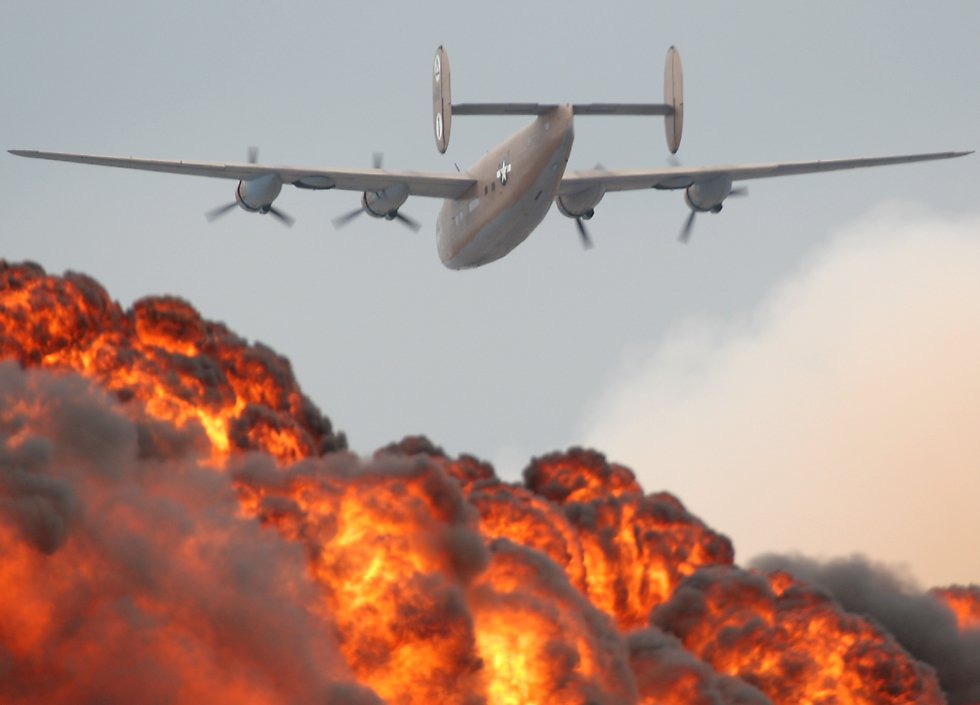
| The
atom bomb blast with its massive and realistic mushroom cloud, is normally
performed by the B-29 Superfortress Fifi, however in 2006 Fifi was down
for repairs. However the atom bomb simulation is only one of
the pyro highlights, the other being a massive Wall of Fire, "ignited"
this year by the B-24 Liberator "Diamond Lil". It was a great
climax to one of the world's great warbird events. |
 |
Check
out the Highlights of
the 2007 Midland Airshow.
  |