| Oshkosh
AirVenture 2002 World War Two Aircraft Highlights |
| The
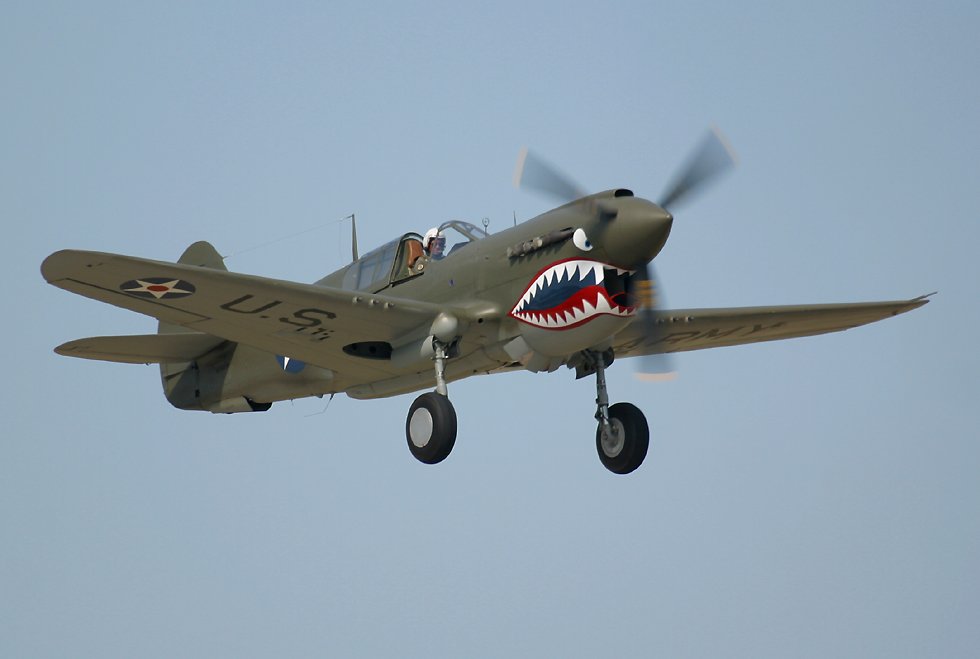
P-40 Warhawk is best remembered as the plane used by the American "Flying
Tigers" fighting the Japanese in China. Unfortunately, it was
no match against the Luftwaffe in the European theater, though it was used
by the British in North Africa and by New Zealanders in the Pacific.
In these places the plane was called either the "Tomahawk" or the "Kittyhawk",
depending on the version. |
 |
| The
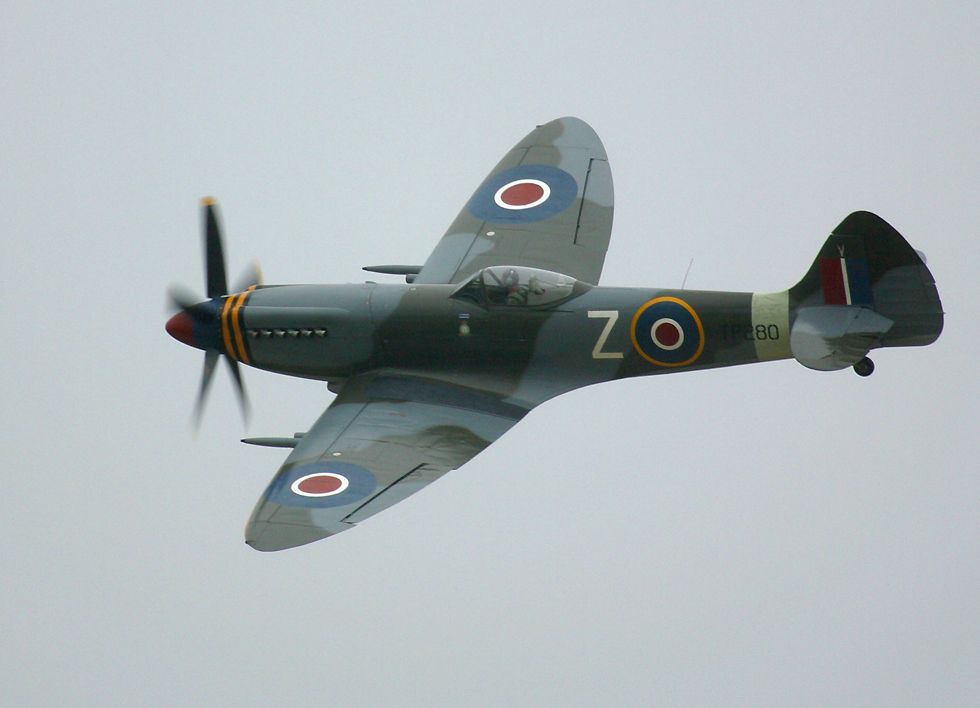
Supermarine Spitfire was Britain's premier fighter of world war two, and
it even equipped a few American squadrons. It received continual
development throughout the war, in an ongoing struggle for supremacy with
its arch rival, the Messerschmitt Bf 109. Unusually, the Spitfire's
predecessor was a racing floatplane, a winner of the prestigious pre-war
Schneider Trophy. Like the Hurricane, right from the beginning
the Spitfire carried tremendous firepower, as you can see from the cannons
mounted on this Mark XVIII. |
 |
| The
P-51 Mustang is the classic American fighter of world war two, but it was
originally designed for the British. When the RAF asked the
North American aviation company to produce P-40s under license, North American
replied that it could produce a superior aircraft. Although
under desperate pressure at this point in the war, the British accepted
the plan as long as the plane would be flown within 120 days.
When the P-51A arrived, the British were disappointed by its performance
at altitude. The problem lay with the Alison engine, so when
it was fitted with the same Rolls Royce Merlin engine used by the Spitfire,
its speed increased dramatically, primarily because the Merlin could produce
more power at 25,000 feet than the Alison could on takeoff.
The first Mustangs ordered by the USAF were a dive-bombing version called
the A36 Apache, also called the A-36 Invader. Most Mustangs
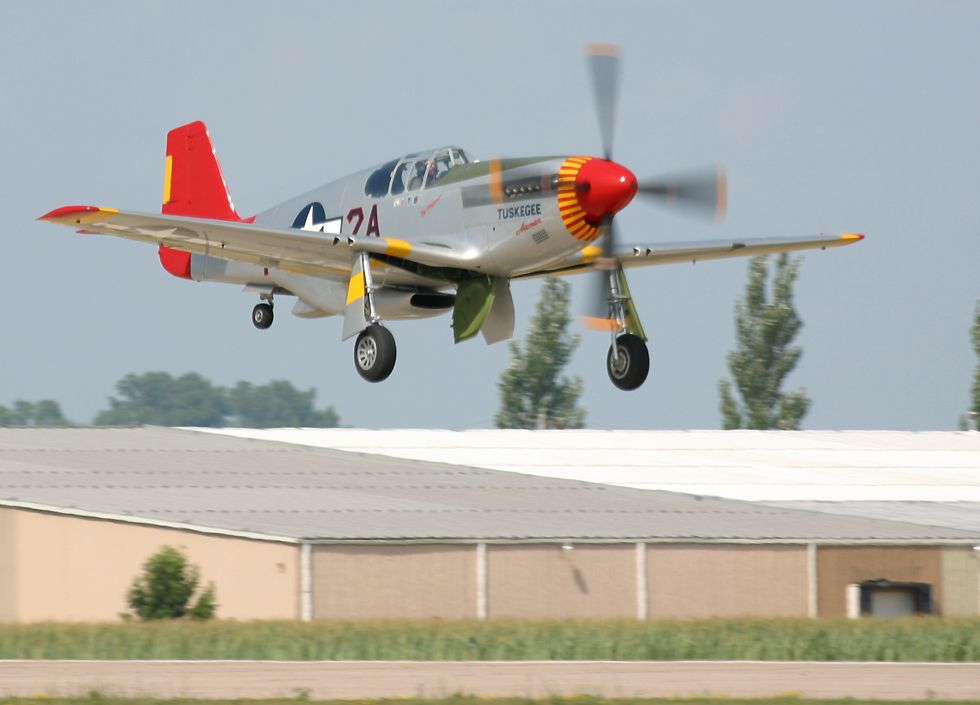
were P-51Ds, with a bubble canopy, but the one you see here is a much rarer
P-51B, with a high back which joins the top of the canopy.
It's in Tuskegee Airmen colors, as flown by the first African American
squadron to see combat. It's said that no American bomber was
ever lost to enemy fighters while escorted by this squadron. |
 |
| Naval
fighter aircraft have special requirements, which is why land-based aircraft
were only rarely used in this role. In particular, they need
a very strong undercarriage to survive heavy deck landings, their wings
need to fold so they can be stored more efficiently in cramped spaces,
and they need good low-speed handling to simplify takeoffs and landings.
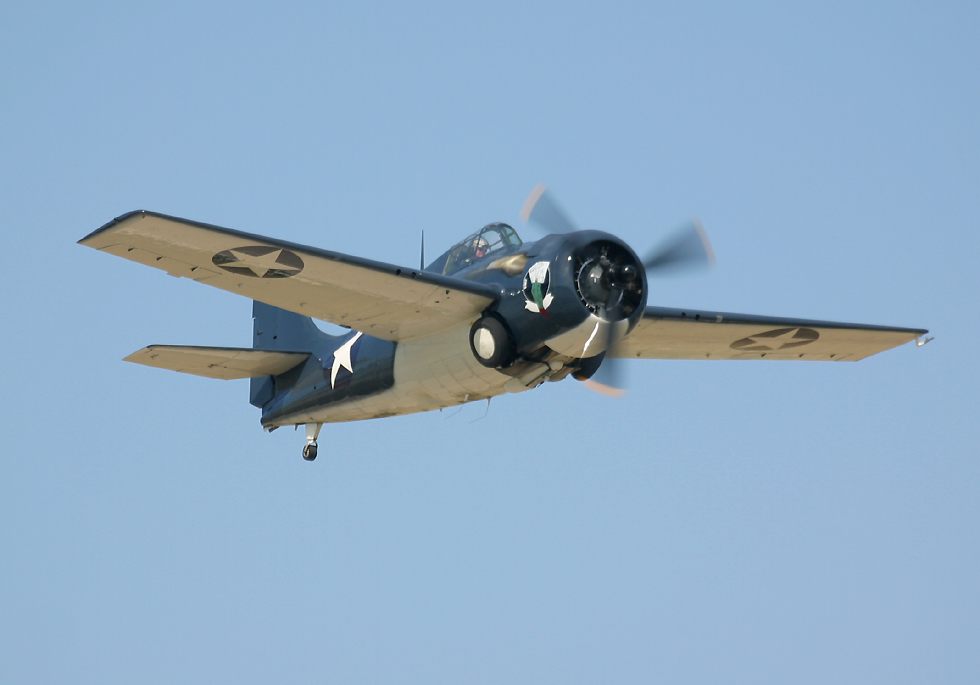
The F4F Wildcat was America's best carrier based fighter at the start of
the war, and was also flown by the British, who called it the Martlet.
A British Martlet was the first American-made aircraft to shoot down a
German aircraft, in December of 1940. The Wildcat was eventually
superseded by the F6F Hellcat, but there are still 19 Wildcats flying today. |
 |
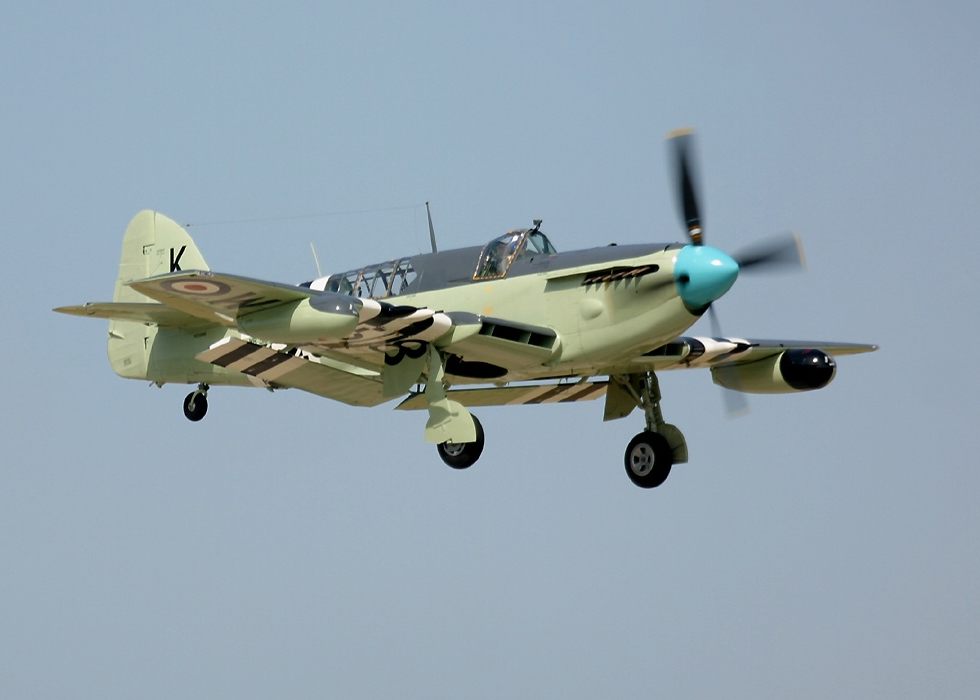
| This
Fairey Firefly is my favorite warbird from the Oshkosh 2002 airshow, because
aircraft of this type make such a rare appearance on the circuit.
It might look slightly archaic compared even to the Wildcat, but in fact
it had a powerful engine which enabled it to carry up to two 1000 pound
bombs in addition to the four 20mm cannons it used in its fighter role.
The Firefly wasn't top dog in the speed stakes, but it remained in service
far longer than the Wildcat, being delivered in March of 1943 and continuing
in operation until 1956. The high lift devices you can see
deployed in this photo made it handle very well at low speeds. |
 |
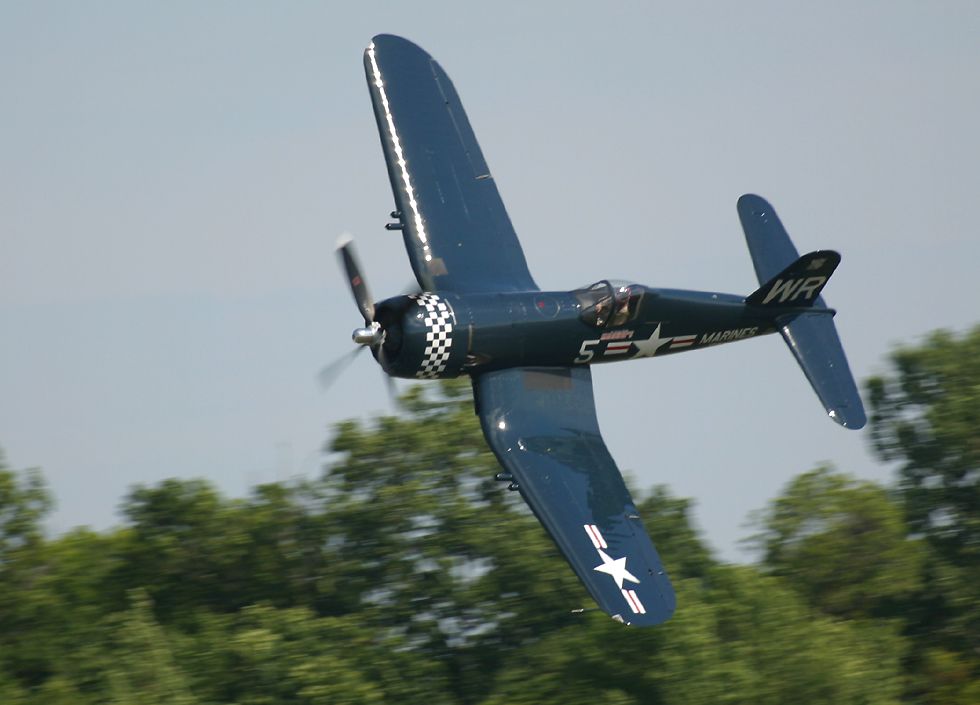
| The
F4U Corsair was the first American fighter to exceed 400 miles an hour,
which is remarkable considering that it was designed to operate from aircraft
carriers and therefore had certain compromises in its design, none more
obvious that the bent "gull" wing, which was necessary to ensure sufficient
clearance for the huge propeller as the plane landed on a heaving deck.
Ironically, despite the plane's excellent flight qualities the navy refused
to use it from carriers for more than a year after its introduction, instead
employing it only from land bases. The main problem was that
the pilot had very little forward visibility to enable him to land on deck,
since he was seated so far back and the nose was so long. In
a continuing tradition of aircraft carrier innovations, the British resolved
this problem by instructing its pilots to fly a curved approach path to
land, instead of the straight-in approach used by other aircraft types,
and in this way the pilot could look out the side of his window to judge
his landing. It seems an unlikely solution, but in practice
it worked well, and eventually the US Navy adopted the same technique. |
 |
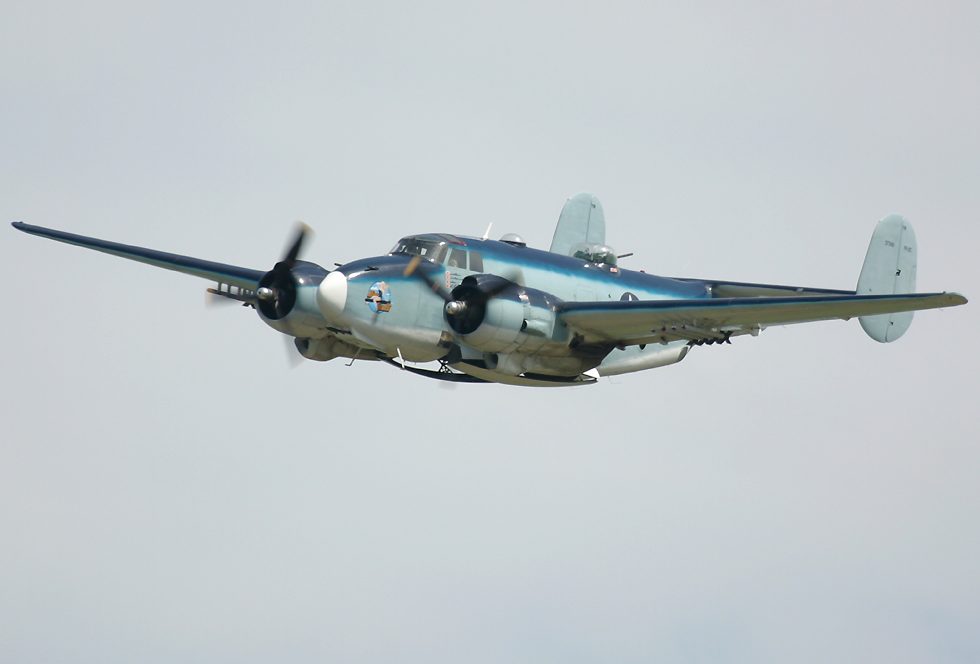
| The
PV-2 Harpoon maritime patrol aircraft was a development of Lockheed's Electra
airliner, which also spawned the Hudson light bomber and Ventura military
transport. The Harpoon was used by the RAF and the US Navy
in an anti-shipping role, armed with bombs, rockets and gun packs in the
nose for strafing. The USAAF also used them, but referred to
them as B-34 Lexingtons. |
 |
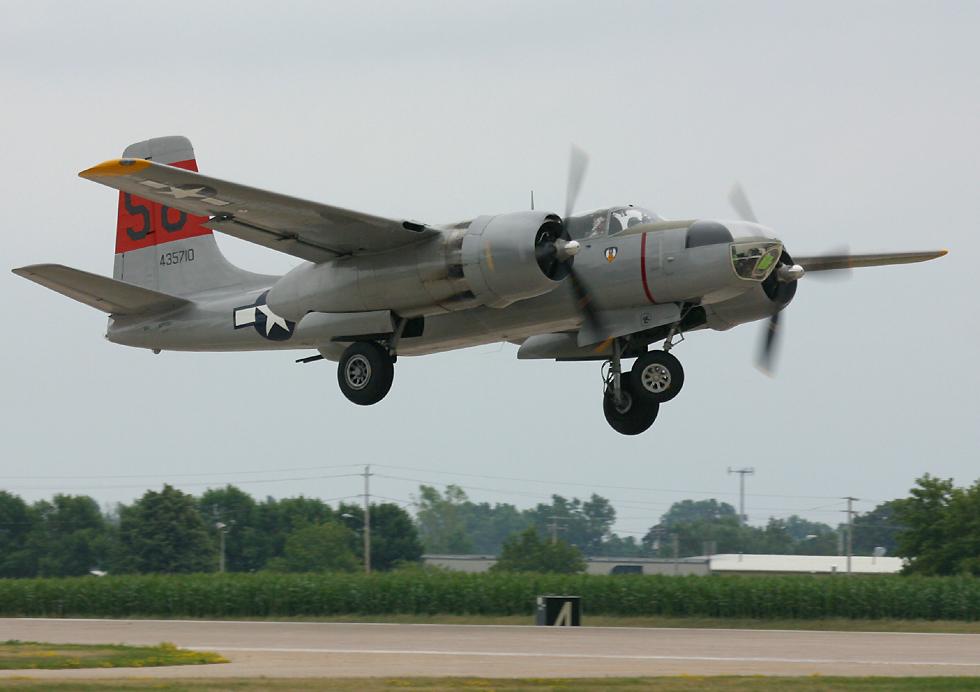
| Introduced
in November of 1944, the A-26 Invader was the fastest American bomber of
world war two. Invaders were also used extensively during the
Korean and Vietnam wars, only being retired in 1969. Interestingly,
Invaders flew both the last combat mission of the war in Europe and of
the Vietnam war. The designation of the Invader has caused
a lot of confusion; it started as the A-26, then in 1948 it was redesignated
as the B-26, a designation previously used by the B-26 Marauder, which
had been retired by that time. Then in the mid 1960s it was
redesignated as the A-26 again, to allow it to be based in Thailand, which
had a policy of not allowing bombers to be based in its territory! |
 |
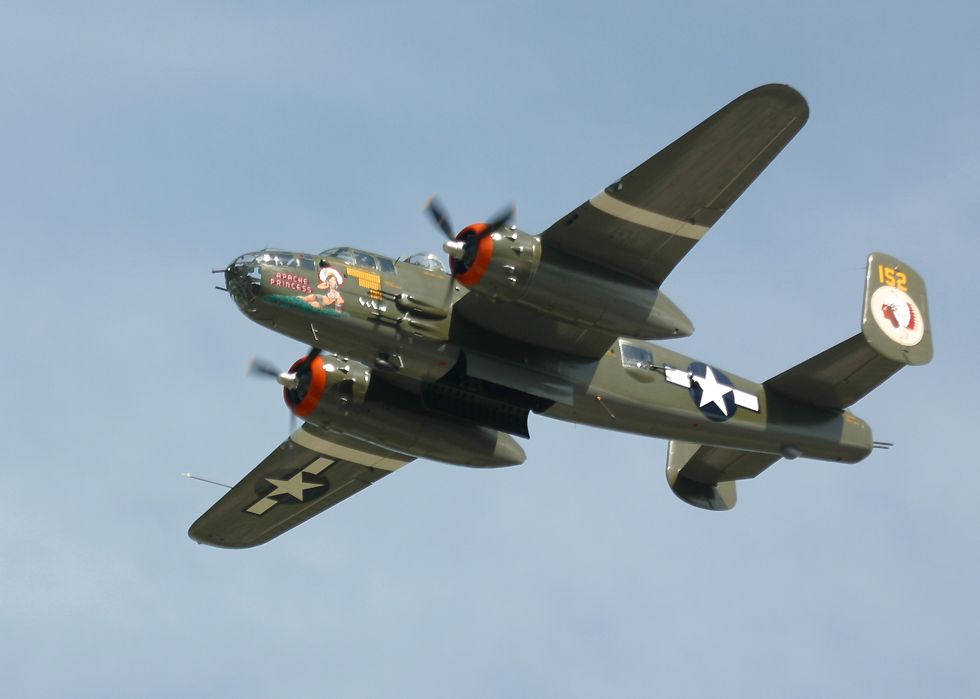
| In
April of 1942 sixteen B-25 Mitchells became the first American aircraft
to bomb the Japanese mainland, in what is known as the "Doolittle Raid",
after the man who devised and led it. The attack was of little
real significance except as a morale booster, and it came at quite a cost
- the planes took off from the aircraft carrier USS Hornet, but they were
far too large to land back on the carrier, so the crews mostly bailed out
over Japanese-occupied China. Most of the 90 men escaped with
the aid of the Chinese, but eight crewmen were captured by the Japanese
and three executed. |
 |
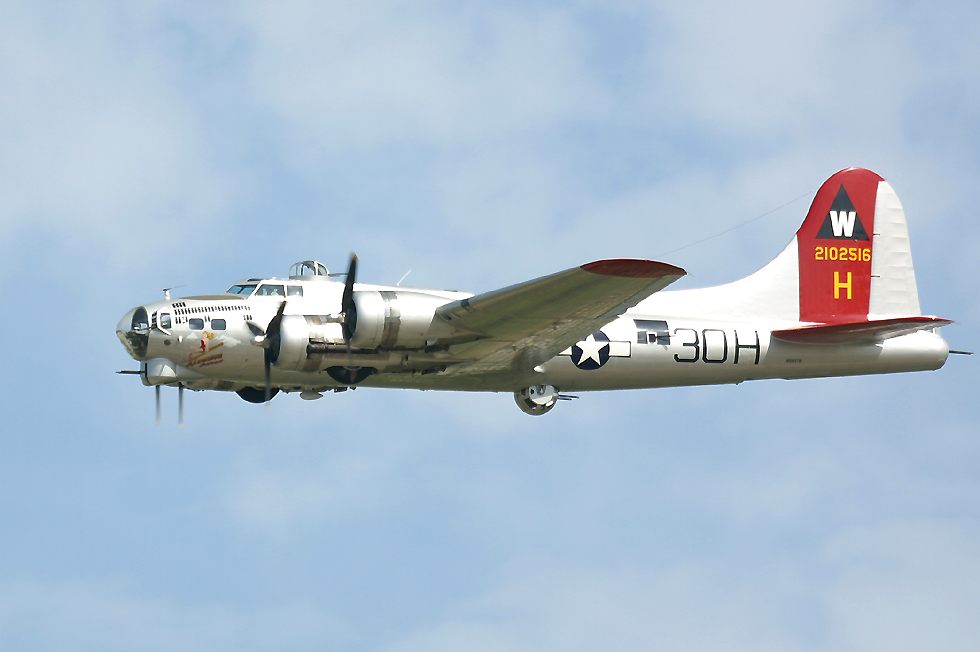
| The
B-17 Flying Fortress is the classic American bomber of world war two.
In fact more B-24 Liberators were built, and aircraft like the Avro Lancaster
could carry a far greater bombload. Nevertheless, a mystique
developed around the Flying Fortress which never departed, and it was certainly
a rugged plane which was easy to fly and could absorb a lot of battle damage
and still return home. The early American optimism about precision
bombing and mutual defense against enemy fighters took quite a beating
early in the war, and daylight operations were even halted for a period
when the loss rate became unsustainable. But the bomber crews
continued on, and long-range escort fighters like the P-51 Mustang eventually
tipped the balance in favor of the Americans. Today there are
significantly more B-17s on the airshow circuit than B-24s. |
 |
 |