| Prescott
Air Fair 2004 Highlights |
| After
an absence of 15 years, a one-day airshow in Prescott, Arizona was organized
by local enthusiasts. Perhaps reflecting a certain rustiness
of organizational skills, they omitted to tell anyone what aircraft would
be flying, apart from a few aerobatic planes and the rarely-seen high performance
Cold War F-104 Starfighter jet. Armed with this lack of knowledge,
I made the nearly 600 mile (960 kilometer) round trip from southern California
in the hope of seeing this one aircraft, but it was not to be - the Starfighter
wasn't able to come because of mechanical problems. However,
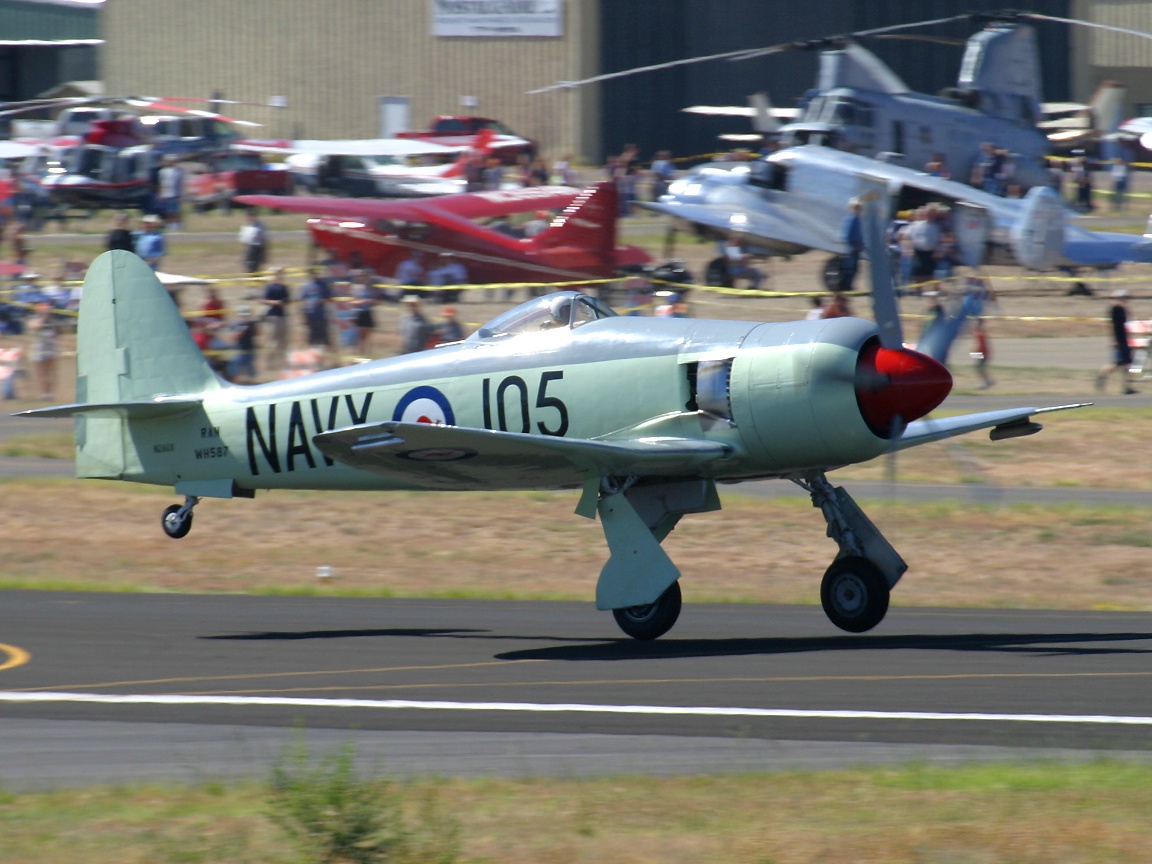
one of the many unannounced aircraft quickly filled the Starfighter's shoes,
a British-built Hawker Sea Fury in Royal Australian Navy colors. |
 |
| The
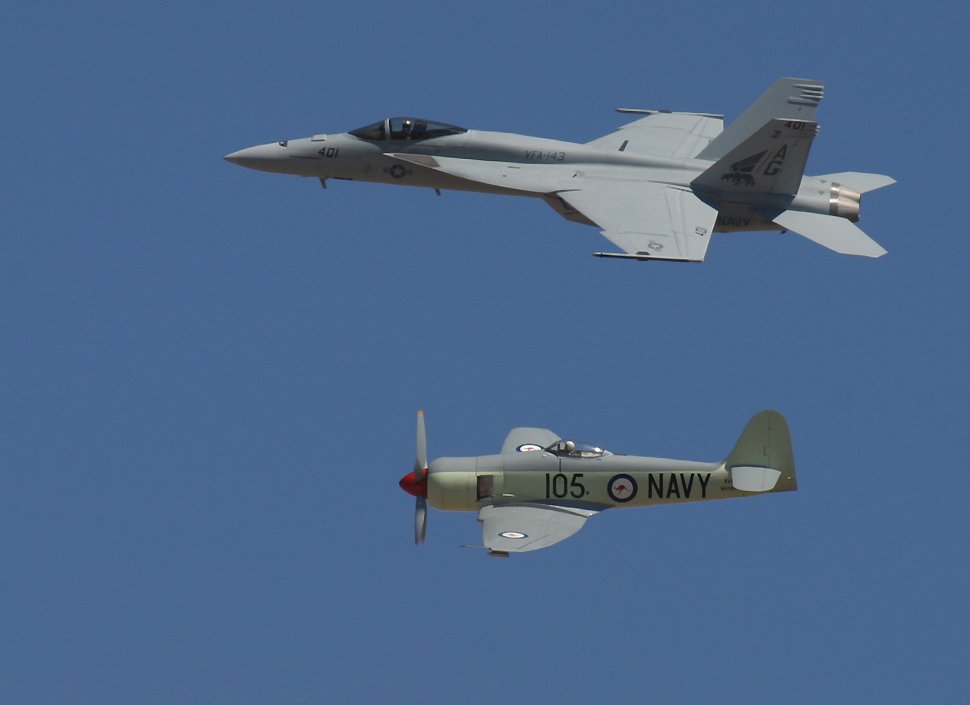
Sea Fury first flew in February of 1945 and entered service in 1948 as
the Fleet Air Arm's last piston-powered fighter. Although it
was soon outclassed by jets, the British continued to use it as their primary
single-seat naval fighter until 1953, and it was exported to countries
as diverse as Australia, Canada, Holland, Egypt, Iraq, Pakistan, Burma
and Cuba. Here you see it in a US Navy "Tailhook Legacy Flight"
with a rather more modern carrier fighter, an American F/A-18E Super Hornet
(click the following links to open new windows with photos of the
Super Hornet at the Dayton airshow and the
Point Mugu airshow). |
 |
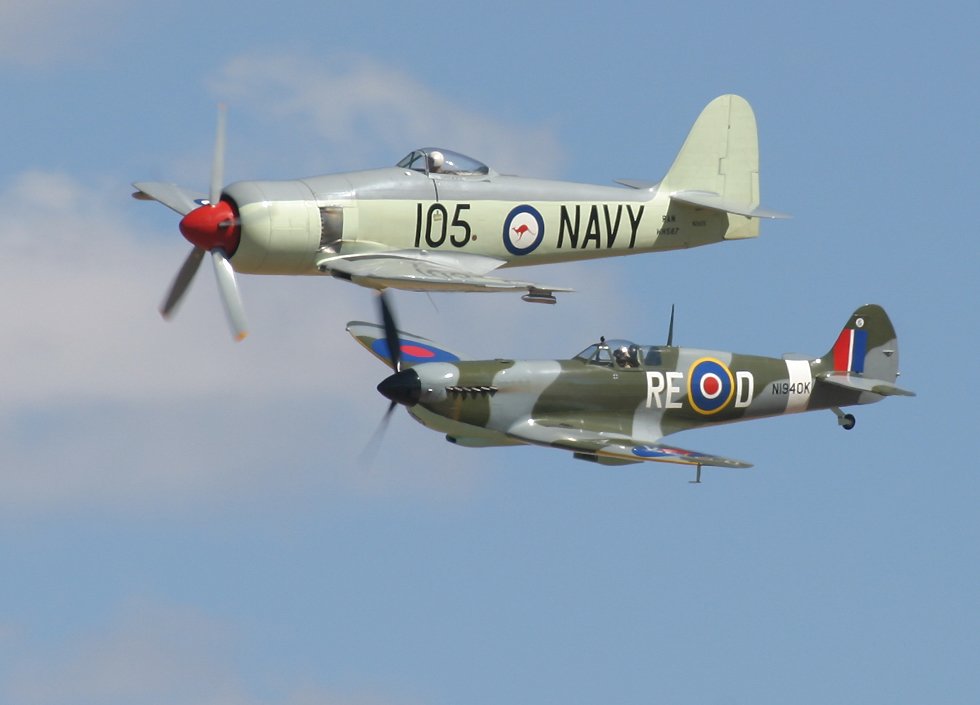
| British
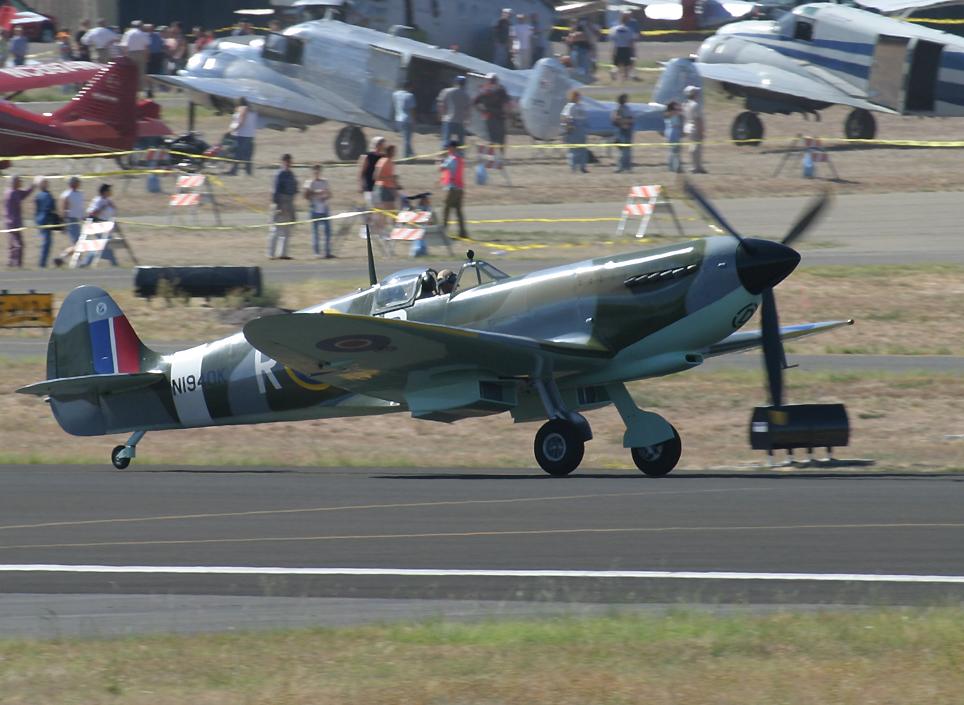
aircraft aren't too common at American airshows, so it was a real treat
to also see this Spitfire flying. Unfortunately, it's a replica
rather than the real thing, but it sure looks like an authentic Mk IX.
The engine isn't the classic Merlin or Griffon, instead it's an American
Allison engine of the type that powered the P-40 Warhawk, and the propeller
is from a DC-3 Dakota! |
 |
| It
might not be authentic, but it certainly looks pretty up in the air with
the Sea Fury. You can click on this photo, or any other photo
on this website with a border, to open a new window with the photo in computer
wallpaper format. |
 |
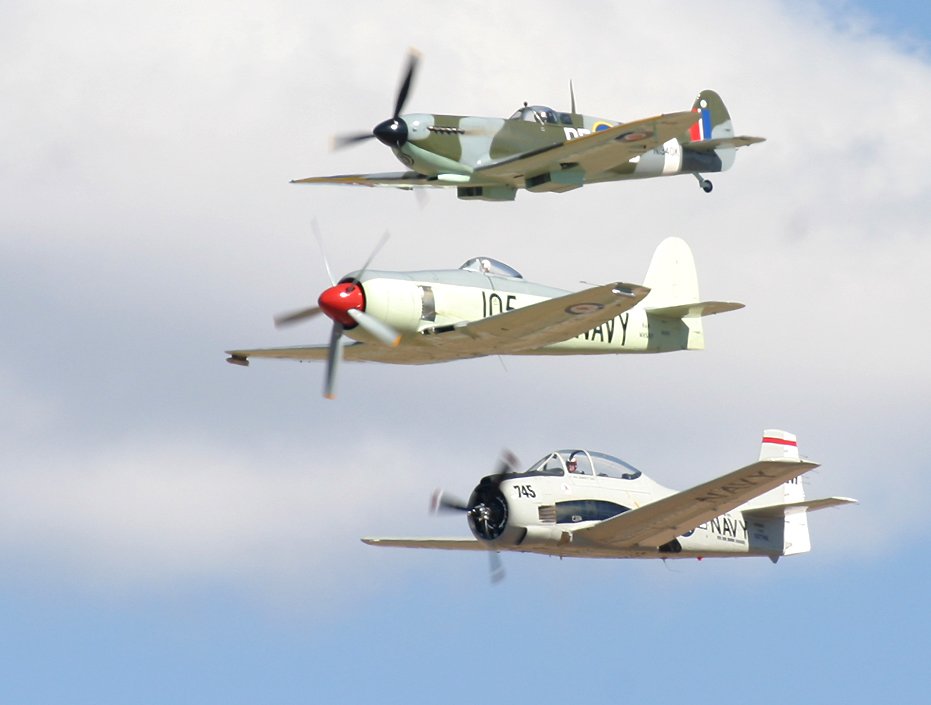
| Here's
what I mean when I say that the Sea Fury became the star of the show -
they put it in formation with nearly everything it could be put in formation
with! The aircraft at the bottom is an American T-28 Trojan,
which was originally an Air Force trainer but later entered service with
the Navy fitted with machine guns, rockets, bombs and napalm.
It fought like this during the "secret war" in Laos, which was a tragic
side show to the main event in Vietnam. |
 |
| T-28 Trojans are
just one of the military training aircraft which civilian warbird enthusiasts
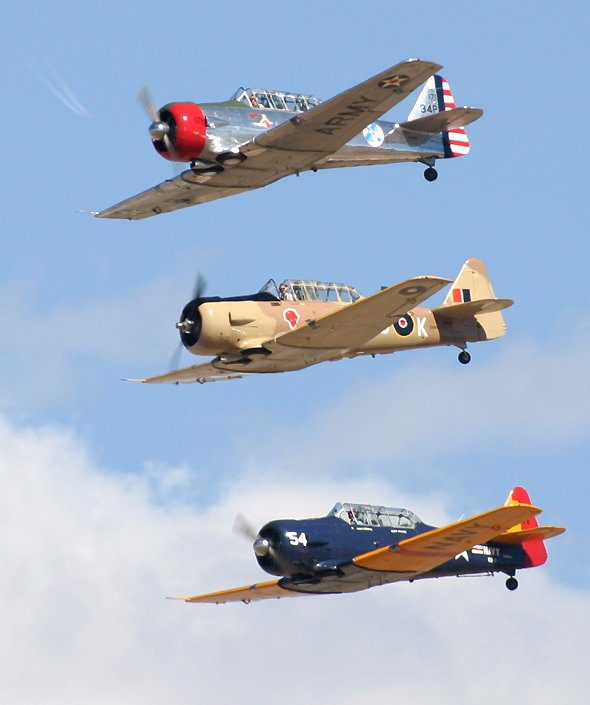
have been buying and flying in recent years. The T-6 Texans
shown here were the primary trainers during world war two, and continued
in this role until replaced by the Trojan.
Technically, only
the top one of these aircraft is a T-6 Texan; the middle one is in British
colors, so it's more accurately called a "Harvard", and the bottom one
is in US Navy colors, so it's an "SNJ". |
 |
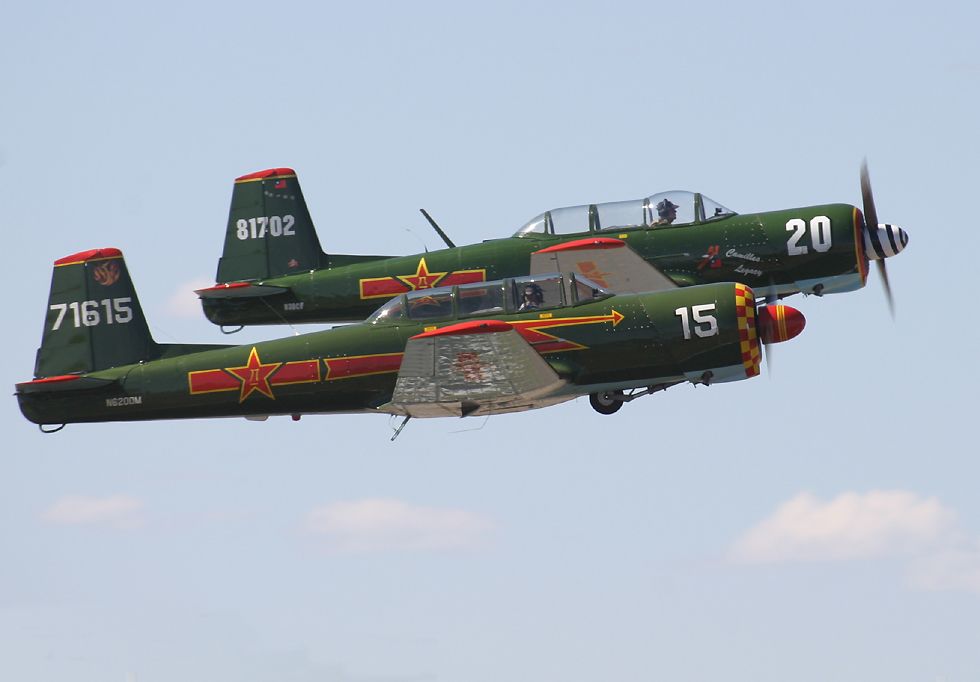
| Not
all of the trainers are American made - foreign models like these Chinese
Nanchangs CJ-6As are often cheaper to run and keep in operation, since
American aircraft tend to be more sophisticated with more parts to break
down and become obsolete. Although very similar in appearance
to the Russian Yak 52, the CJ-6A is almost entirely a Chinese design, although
both it and the Yak 52 can trace their lineage back to the Yak 18.
The CJ-6A might look pedestrian, but it's capable of performing military
style maneuvers and aerobatics between 6.5Gs and -3Gs. One
with a three-bladed propeller did aerobatics at Prescott, and other modifications
are sometimes made to the plane, too - you can see that the more distant
plane has a rounded canopy, which is a concession to the greater average
height of Americans, and it also allows better all-round vision.
Personally, I prefer the appearance of the original canopy, but then I
don't have to fly these things! |
 |
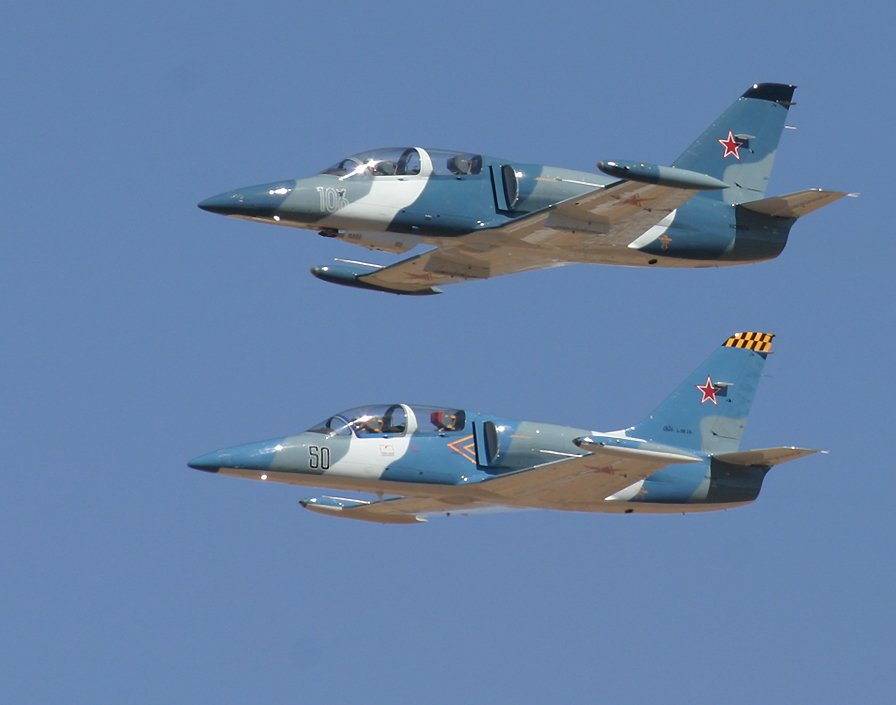
| OK,
here's the ultimate in trainers used by civilians - a pair of Czechoslovakian
L-39 Albatros jets. The Albatros was the standard jet trainer
for the Soviets, and some were even fitted with rockets and bombs on pylons
like the ones you can see under the wings of the top plane.
Although it's obviously expensive to keep a jet flying, there are over
200 of these planes flying in the United States and they're a common sight
at airshows - one performer flies one called "Capitalist Pig", and there's
even a civilian jet aerobatic team called the
Patriots. |
 |
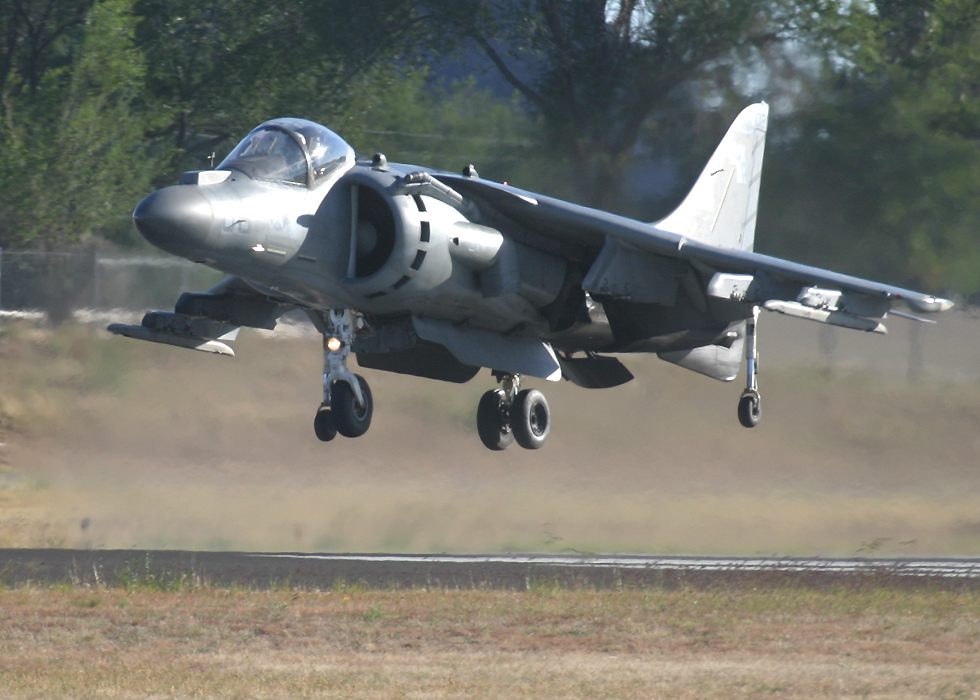
Here's a plane you won't be seeing in private hands anytime soon - a United
States Marine Corp AV-8B Harrier, a significantly more powerful version
of the original British designed Harrier. The marines love
its vertical takeoff and landing ability, which allows them to fly off
their (relatively) small LHA or LHD amphibious assault ships, and from
poorly prepared forward air bases in captured territory, as happened frequently
in Iraq. The British use both versions of the aircraft, and
it's also used by the Spanish and Italian navies, none of whom can afford
to operate the giant aircraft carriers which the US Navy maintains.
The
plane you see here was flying after the show with three others, it's
not coming in completely vertically, instead it still has a small amount
of forward speed on it, as the position of the jet exhaust nozzles indicate.
You can see the aerial refuelling probe above the jet intake, and one other
funny little feature is the wind vane directly in front of the canopy,
which is apparently very useful for the pilot when the plane is hovering!
The wind vane is a quirky little low-tech solution to a technical challenge,
as are the wheels under the wings, which don't fully retract but just fold
backwards into a recessed shroud. Unusually for modern front-line
fighter and attack aircraft, the Harrier is sub-sonic, but it proved itself
to be very effective both in Iraq and when the British used it during the
Falklands war. |
 |
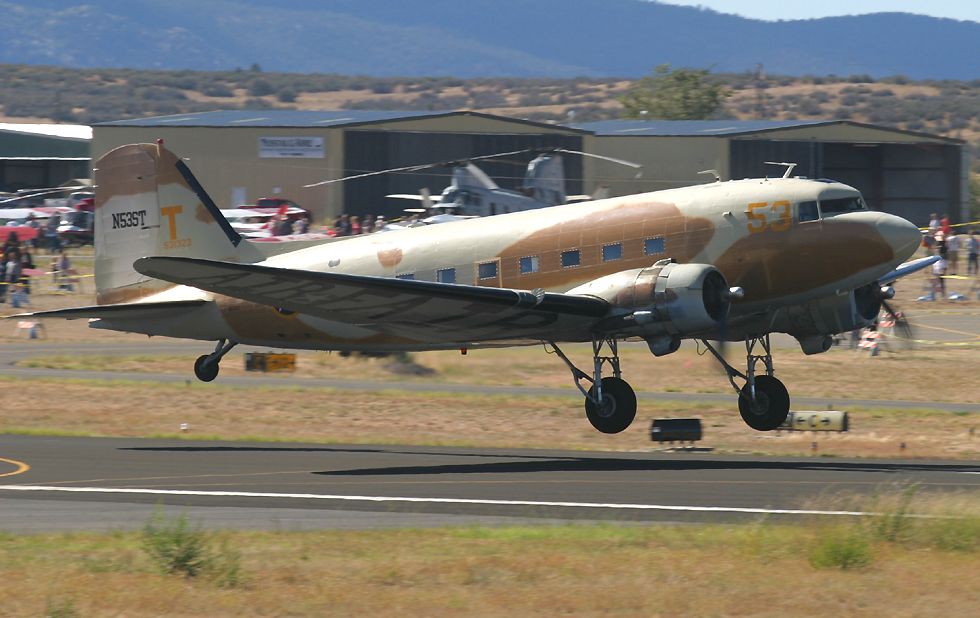
| Prescott
is the current home town of this C-47 Dakota. It wasn't technically
a performer at the show, but they were offering rides for $20, so there
were plenty of opportunities for photos throughout the day - or for photos
of it landing and taking off, anyway, since they didn't do any flypasts
while I was there. The Dakota, or "gooney bird" as it was affectionately
known during the second world war, is one of the most successful aircraft
ever built. Some of them are still being used commercially
today, and it's earned a reputation as a solid aircraft which can be kept
going with a minimum of maintenance. Before being pressed into
military service they were used extensively as airliners, as was another
aircraft doing paid rides during the show, a Ford Trimotor, which is an
even older bird which is said to "take off at 90 miles an hour, fly at
90 miles an hour and land at 90 miles an hour". |
 |
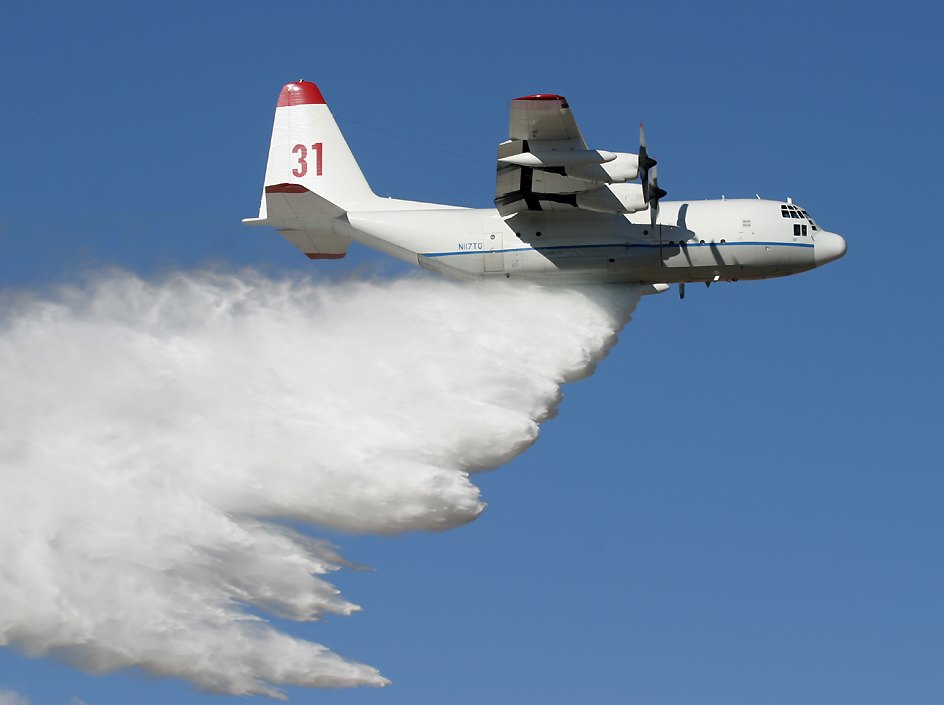
The printed flight schedule at this airshow quickly lost touch with what
was happening in the air, so it became impossible to know what would or
wouldn't be flying. This C-130 was supposed to do a fire-fighting
demonstration just before the show finished at 4 o'clock, but in the end
it flew an hour late, when most of the crowd had already left.
Interestingly enough, this is said to be the oldest Hercules in the world
which is still flying. It was built in 1954, making it 50 years
old this year, it originally flew with the USAF and then for a while with
the South Vietnamese Air Force, but it now divides its time between Arizona
and Spain. In the 1960s this particular plane was damaged by
a small tornado or wind storm of some type while it was parked at Dyess
air force base in Texas. Funnily enough, it's government registration
currently says that its approved operations are "agriculture and pest control";
as one person said, they must have some big melon patches in Arizona to
justify such a large crop duster!
The aerial firefighting industry in the United States has always used a
wide variety of ex-military aircraft, but the industry is in turmoil right
now because of a flurry of accidents which resulted in various band-aid
pieces of legislation being rushed through by publicity conscious politicians.
The issue of safety standards came to the public's attention after a C-130A
just like this one crashed while someone was videotaping it.
As the plane flew along at low altitude, the main spar broke and the wings
simply folded up and left the rest of the plane to spiral into the ground. |
 |
See
the
2005 Prescott airshow and the
2006 Prescott airshow.
 |