Riverside Airshow 2005
|
The Riverside airshow
near Los Angeles is one of several one day shows which are staged early
in the year in the southern California area. All three shows - Yuma
(which is actually just across the border in Arizona), El Centro and Riverside
- have the viewing area on the south side of the runway, which makes them
ideal for photography, since the sun is behind you all day.
The Los Angeles smog can be a definite hazard to shooting at Riverside,
but the snow-covered mountains to the north and east provide backdrops
which add a lot of interest to photographs which might otherwise be rather
ordinary.
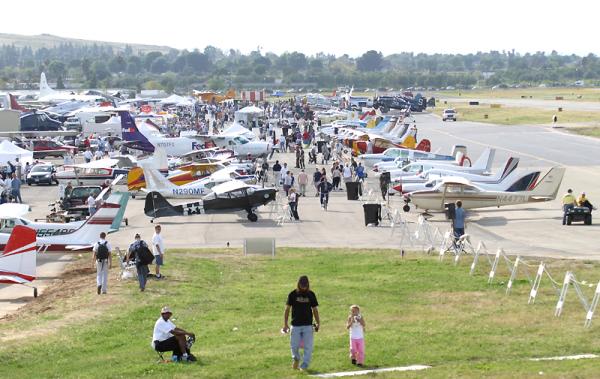
Riverside itself is an unusual little airport, since it's in a suburban setting and the single runway has quite a pronounced slope to it. Again this works out to the advantage of the photographer, since you can get a good shot of aircraft on the runway by positioning yourself at the top end, near the air traffic control tower. There aren't many people up there, because show center is much further down the runway, so the area near the air traffic control tower is also much less crowded. As usual, being at one end or the other of the runway allows you to get interesting takeoff or landing shots. Another excellent reason for a photographer to avoid show center is that many of the static aircraft and the performers are parked between the crowd and the runway, as you see in this photo! For hardcore aviation enthusiasts, one of the highlights of the show was a series of flypasts by a C-141 Starlifter from the nearby March Field air reserve base. This was a particularly special occasion because it was one of the last displays of this aircraft type before it is finally retired. In 2005 only March Field and Wright-Patterson Field in Ohio had Starlifters still in service, and March's C-141s were all being retired later in the year in favor of C-17 Globemaster III transport planes. A KC-135 Stratotanker from March Field also did some nice flypasts, and hopefully we'll continue seeing them for some years to come. Apart from the Starlifter and the Stratotanker, the air force also provided a display by an F-117 Nighthawk, better known to many people as the "stealth fighter". Unfortunately the display followed the usual pattern of two flat passes with all banking done well out of camera range, so it was difficult to get too excited about what could be a very special demonstration. The navy, however, put on a much better display with one of their two-seater F-18D Hornet fighters. In fact, they did two separate displays, one by each of the pilots. Carrier aircraft like the Hornet can operate from fields as small as Riverside, so we were treated to two takeoffs as well as two landings, both of which were of the standard naval "put it down hard and make sure it sticks" variety. Unlike the poor old stealth fighter pilots, the navy also gives their display crews considerably more leeway in how much maneuvering they're allowed to do at airshows, so we saw some nice banking and minimum radius turns with afterburner. The classic warbird community was also quite well represented for such a small show. The Palm Springs Air Museum B-17 Flying Fortress stayed on static display, but there was a strong naval fighter contingent, including an F4U Corsair, F6F Hellcat and F8F Bearcat, as well as one of the few Mitsubishi Zero fighters still flying, though with an American Pratt and Whitney engine. Since the pilots of the American fighters are all certified in the naval "Tailhook Legacy" programme, we got to see several passes by the Hornet flying in formation with the Corsair, Hellcat and Bearcat, though the angles didn't work out to provide a first-rate photo of the event. The Hornet also did a much looser formation with the Zero, which is rather an interesting sight from a historical perspective! Just as the Hornet had done earlier, the Corsair, Bearcat and Zero all did several very well executed banking passes, but the Hellcat pilot seemed more intent on positioning himself for his next turn, so he repeatedly passed straight over the top of us, which didn't provide any good photographic opportunities. Several of America's top aerobatic performers put their aircraft through their paces, including Ed Hamill in the Air Force Reserve Pitts Special biplane, Julie Clark doing lots of low-level passes in her bright yellow T-28 Trojan called "Top Banana", as well as veteran performer Eric Beard in his Yak 54 "Russian Thunder" and a typically dazzling performance by Rob Harrison with his aircraft "Tumbling Bear". These propeller-driven displays were augmented with a three-ship demonstration by the Thunder Delfins in their Czechoslovakian built L29 Delfins, which for many years were the standard Soviet military jet training aircraft. John Culver did his typically excellent display in the T-6 Texan "War Dog", and there were formation maneuvers by four other T-6s. An unusual display was done by a Riverside Police helicopter, which took part in a high-speed car chase with a police car chasing a baddie around the runway and taxiway! As with most airshows, many interesting aircraft remain on static display during the day. In 2005 the list of static aircraft included a massive single-engined Soviet biplane, the Antonov An-2 "Colt", as well as a Convair C-131 Samaritan and several helicopters, including the world's only flying H-21 "Shawnee", a large twin-rotor with a single radial engine which has the nickname "flying banana" because of its bent shape. Since the show ends relatively early, around 4:30 in the afternoon, most of these planes make a relatively quick exit after the show so they can get back to their home bases, providing a good opportunity to photograph them without having to take a day off work and make another trip to the airport. Security at this fairly small airport isn't overbearing, so it's easy to find a good location to capture the departing aircraft without being shooed away. In 2005 departing aircraft were taking off from east to west, so that meant relocating from the east end of the runway to the west end. Since daylight saving started the day after the show, the sun was quite low by this time, which meant that the light had a nice golden glow to it. |