
Early British Military Jets at Duxford
|
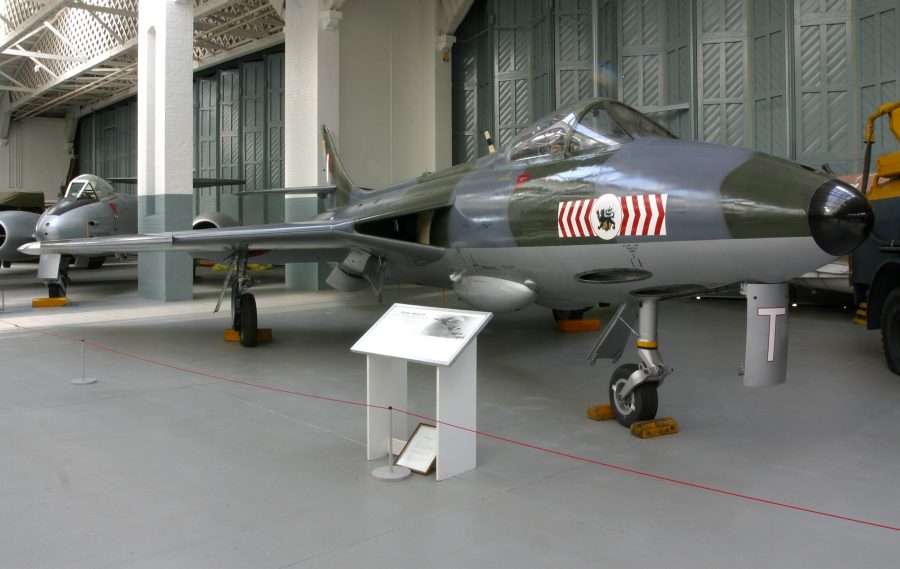
Designed by Sydney Camm of Hurricane fame, the Hawker Hunter replaced the Meteor, Vampire, Venom and F-86 Sabre in RAF service, and became an absolute classic British jet. This very clean and attractive design was a tremendous success, being sold to nineteen different air forces, including Switzerland, Chile and Zimbabwe, which still had some in service in 2002 when I photographed this aircraft. The Hunter first flew in 1951 and In 1953 it set a world speed record of 728 mph (1170 kilometers per hour). After being superseded by the Lightning the Hunter continued on in a ground attack role and by the time production ended in 1966 a total of 1972 aircraft had been built. |
 |
|
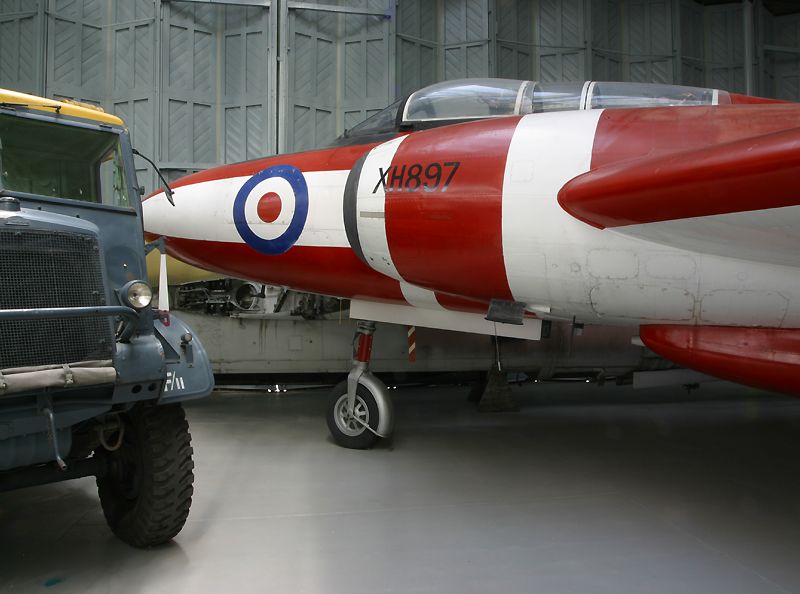
Squeezed in amongst some of the other displays, this Gloster Javelin is yet another of the British military jets on this page to fly for the first time in 1951. It was a twin engine delta-winged fighter with detached engine inlets similar to the Buccaneer, which give it a slightly unwieldy appearance, as does the oversized tail. The Javelin was designed as an all-weather high altitude interceptor capable of bringing down enemy nuclear bombers. It famously went supersonic over London, with the sonic boom causing quite a commotion, but it was soon replaced by the Lightning and was the last aircraft by Gloster to enter production. |
 |
|
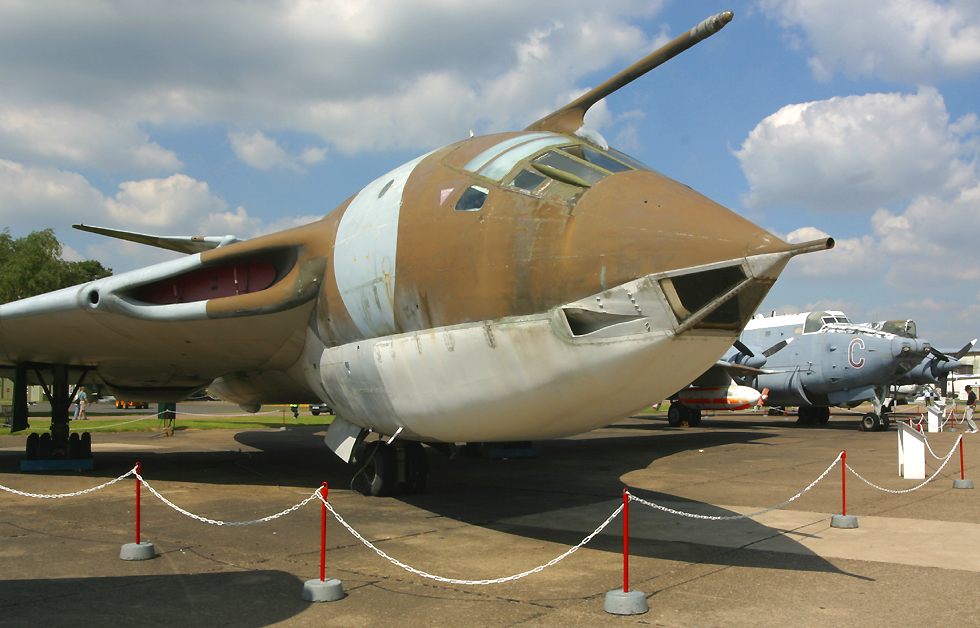
The Handley-Page Victor was the last of the British "V" bombers to enter service, after the Victors Valiant and the Avro Vulcan. All three were strategic nuclear bombers. The Valiant was a very conventional straight-winged jet which was developed as "insurance" in case the more radical delta-winged Valiant and Victor programmes failed. As it turned out, all three were successful and enjoyed long service, and all three first flew at about the same time - the Valiant in 1951, and the Victor and Vulcan in 1952. The Victor had the largest bomb bay of the three, a very distinctive shape because of the large bulge under its nose which housed radar and other equipment, and it was even capable of going supersonic in a very shallow dive. |
 |
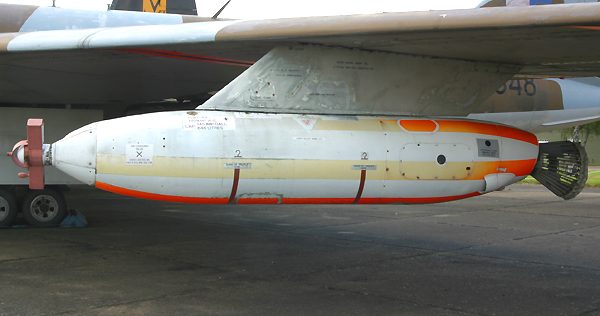
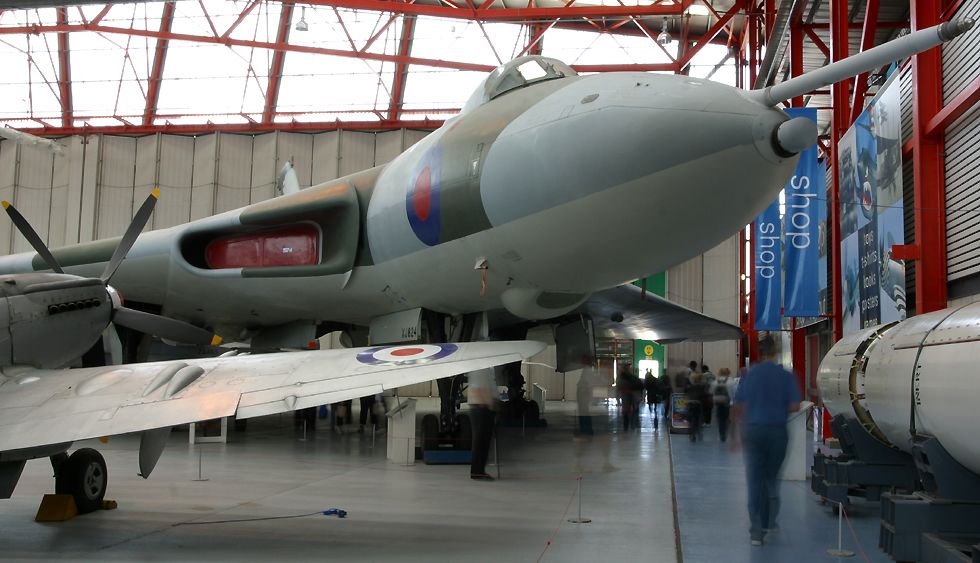
Victors gave up their nuclear capability in 1975 and some, like the one at Duxford, were converted into in-flight refuelling tankers, serving in this role into the 1990s, including missions in the combat zone during the first Gulf War in Iraq. Here's a view of the refuelling pod, with a "drogue" at the back of the pod which is situated at the end of the hose carrying the fuel into the matching "probe" fitted to the front of the aircraft being refuelled. This is the same system used by the United States Navy and Marines, but the United States Air Force prefers the "flying boom" technique with a rigid tube which is maneuvered down into the receiving aircraft's fuel receptacle. An advantage of the Victor's "probe and drogue" technique is that they can refuel three aircraft at once, one under each wing and one directly behind, whereas flying boom tankers can only refuel one. Victors were even used to refuel American navy and marine planes during the first Gulf War. As you can see in the first photo, the Vulcan itself could be refuelled in mid-air, a capability which was used during the Falklands war (see later). |
|
The Vulcan was the most modern-looking of Britain's V-bombers, though the more pedestrian-looking Victor could outperform it for speed, altitude and bomb load. The Vulcan was a very maneuverable aircraft, it was actually fitted with a fighter-style joystick rather than a bomber-style yoke, and it was claimed in 1958 that at its operational height it could outperform any fighter in the world. This ability was amply demonstrated in 1955 when a Vulcan did a complete roll at the Farnborough air show. |
 |
|
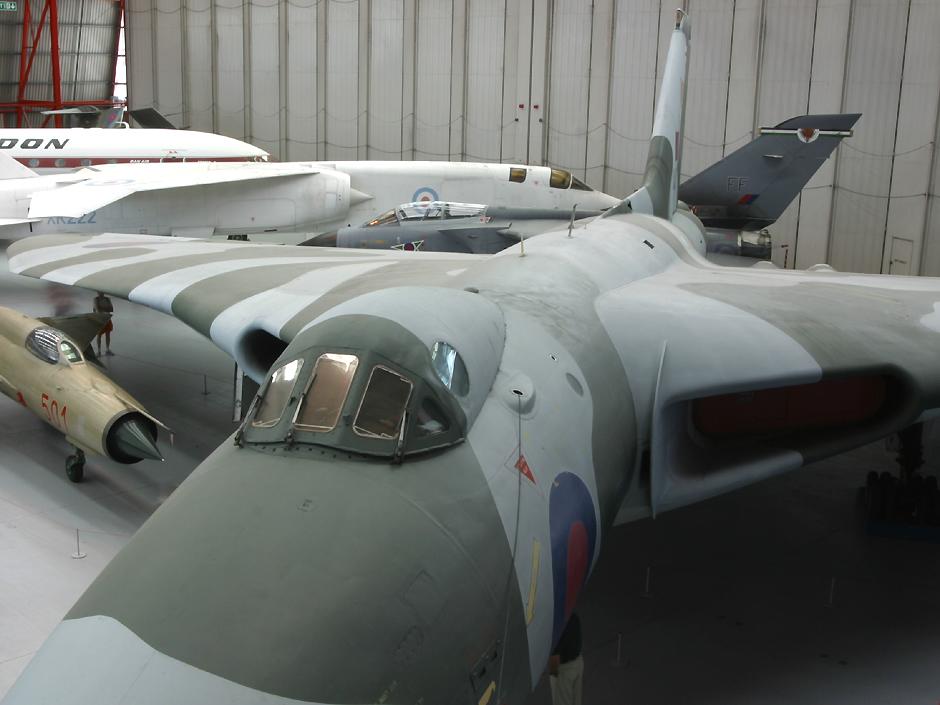
The same Vulcan, from above. As you can see, like the Concorde (one of which is kept in this same hangar) it has no horizontal tail surfaces. And, like the Concorde and many of the other aircraft shown on this page, Vulcans served on for many years. Their only use during wartime came during very long range strikes against Argentine airfields and radar on the Falkland Islands - during the first raid eleven Victor tankers were used to get one Vulcan to the Falklands and back. All eleven Victors took off from Ascension Island at about the same time as the Vulcan, with some of the Victors refuelling other Victors and the Vulcan until only one Victor was left, which refuelled the Vulcan and headed back. When it got within 300 miles of the Falklands the Vulcan went down to 300 feet above sea level until it got within 40 miles, at which point it rose to 10,000 feet and dropped 21 bombs diagonally across the runway. Apparently these raids weren't too successful, since Argentine aircraft were still flying in and out until shortly before the British regained control. On a later raid the refuelling probe of a Vulcan, shown at the top-right corner of the previous photo, broke off and the plane had to make an unplanned emergency landing in Brazil, which was a diplomatic embarassment to both Brazil and the United Kingdom. |
 |
|
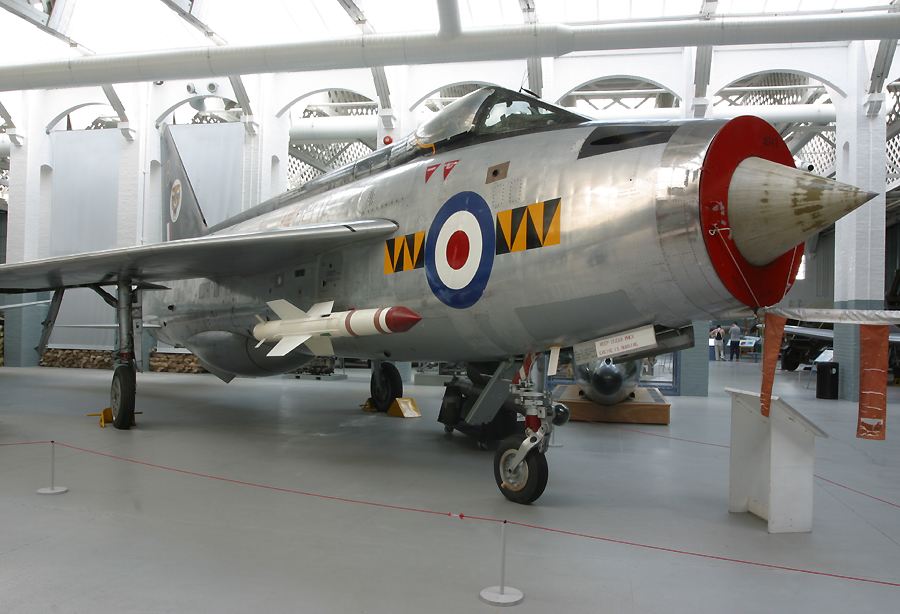
The English Electric Lightning was a huge leap forward compared to the aircraft it replaced, the Hunter and the Javelin. While these two aircraft were only just capable of supersonic flight, the Lightning could fly at over mach 2 and could climb at an incredible 50,000 feet a minute. In 1954 it went supersonic in level flight on only its third test flight, without even lighting the afterburners on its unusually positioned "above and below" engines. Thus the Lightning was so-called "super cruise" capable about 50 years before the F-22 claimed this as a "first". With its afterburners lit the Lightning could exceed mach 2, making it at least as capable as the American F-104 Starfighter. The Lightning was also used by Kuwait and Saudi Arabia, who had rocket pods mounted on top of the wings, a development which had been preceded by over-wing auxiliary fuel tanks necessitated by the Lightning's high rate of fuel consumption. It was a much more complex aircraft than previous RAF fighters, which made it more difficult to maintain, but its high performance ensured that it remained in front-line service until 1988. It became the last all-British jet fighter to enter and remain in active service. |
 |
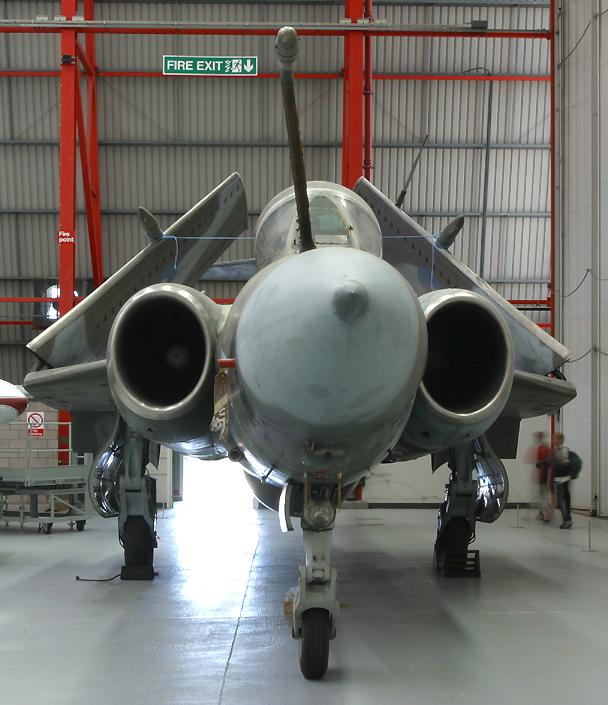 |
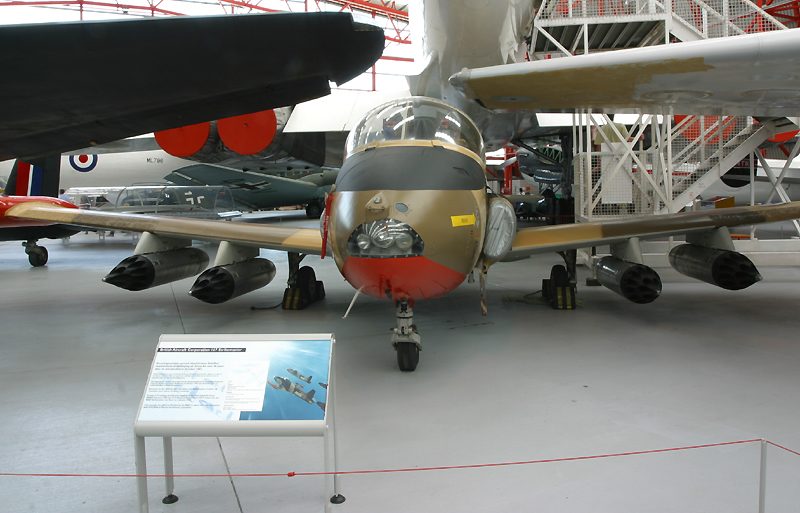
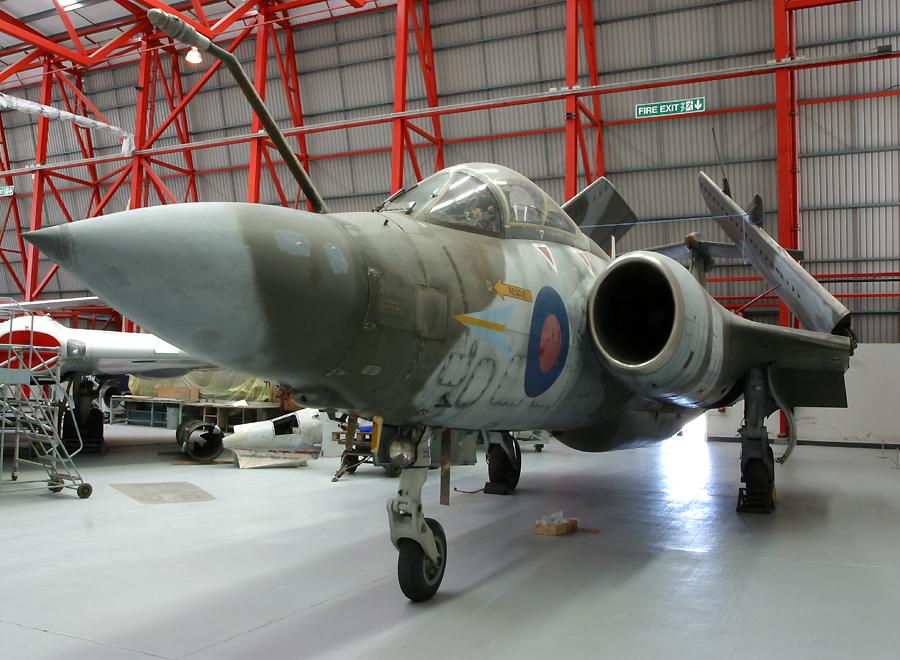
Despite the Royal Air Force's initial hostility towards using a naval plane, they eventually procured them, but only after the TSR.2 programme was cancelled and a long drawn-out arrangement to buy the American F-111 also came to nothing. Buccaneers continued in service with the RAF until 1994, performing well during the first Gulf War, where they dropped bombs and also acted as laser designators for Tornado fighter-bombers. |
|
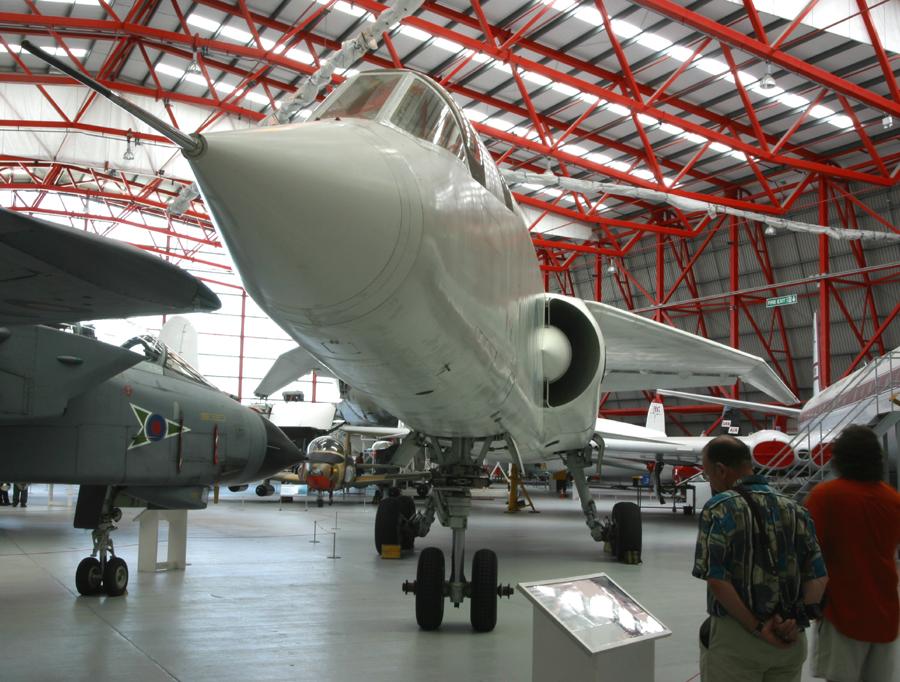
The TSR.2 is emblematic of the decline of the military aviation industry in the United Kingdom. The cancellation of this might-have-been contender for the position of world's best tactical bomber still provokes strong reaction among British aviation enthusiasts. The famous aircraft designer Sydney Camm said "All modern aircraft have four dimensions: span, length, height and politics. TSR.2 got the first three right". At the time the aircraft was being specified in the late 1950s as a replacement for the Canberra, the government became convinced that manned aircraft were about to become obsolete, and so they forced the consolidation of the industry until there were only two viable players left - the British Aircraft Corporation (BAC) and Hawker-Siddeley. Government bureaucracy led to poor communications between the groups which had been forced to work together, one result being that the engines wouldn't fit into their housings on the first attempt. There were also too many conflicting requirements (such as a need to operate from short and semi-prepared airfields) to produce successfully in a single aircraft. Schedule delays and cost overruns eventually resulted in the TSR.2 being cancelled in preference to the American F-111 swing-wing fighter-bomber, which was soon to enter production. However the F-111 was itself an over-ambitious project spawned by politicians, being intended for both navy and air force use, and was eventually delivered at a cost several times greater than that projected for the TSR.2 and ten years past schedule. The Australians bought the F-111 but by this time the British had lost interest and the Buccaneer and Tornado (the aircraft on the left of this picture) filled the tactical bomber role. |
 |