
Philippines Sea Slugs and their Friends

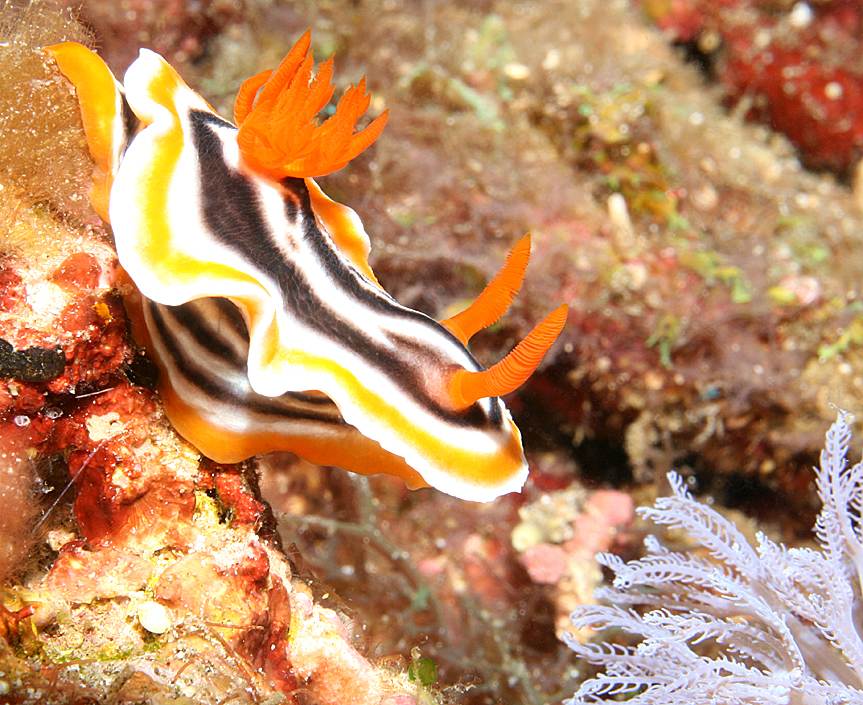

Chromodoris annae (Anna's chromodoris) seems to have a particular liking for the leathery sponge that I found this individual on, because most of the photos I've seen of this species show it on the same background. Apparently they can reach about 5 centimeters in length, but I think this one was a little smaller. It obviously considers this stuff delicious, you can see that it was taking a mouthful as I took the photo, and there's another hole behind it where it had previously satisfied its cravings. Unlike land slugs, all sea slugs are carnivorous, however they both eat using a rasp or "radula", a tongue-like ribbon with rows of teeth made of chiton. These teeth are constantly being worn out, so new rows are always being added as the old ones are discarded. |
|
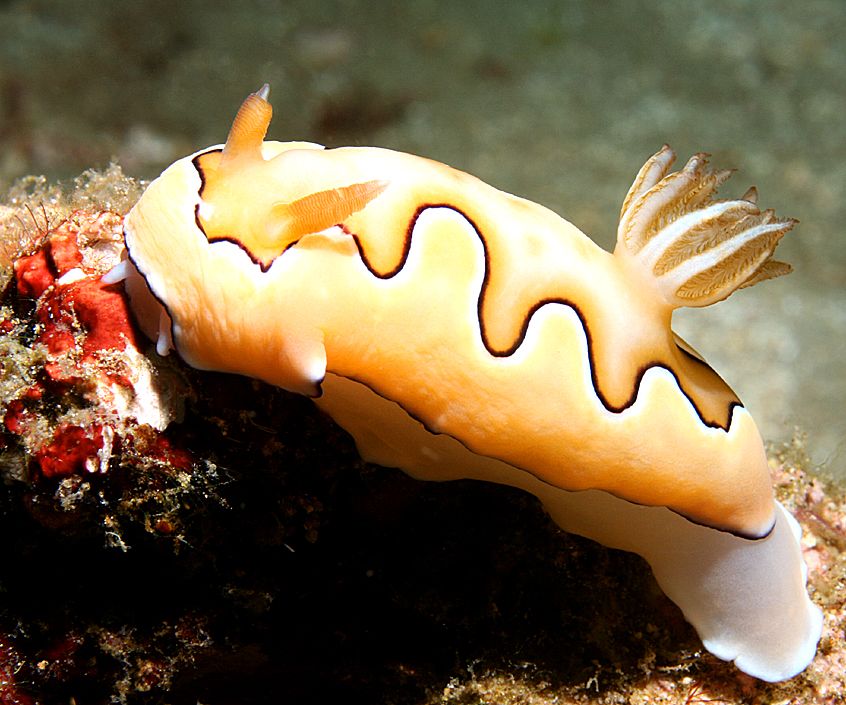
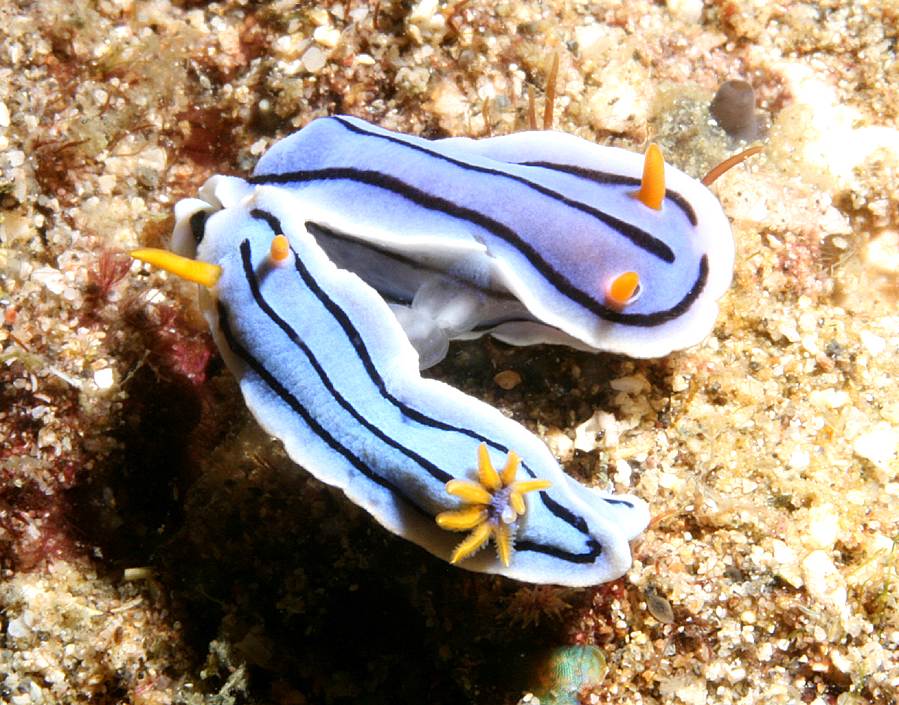
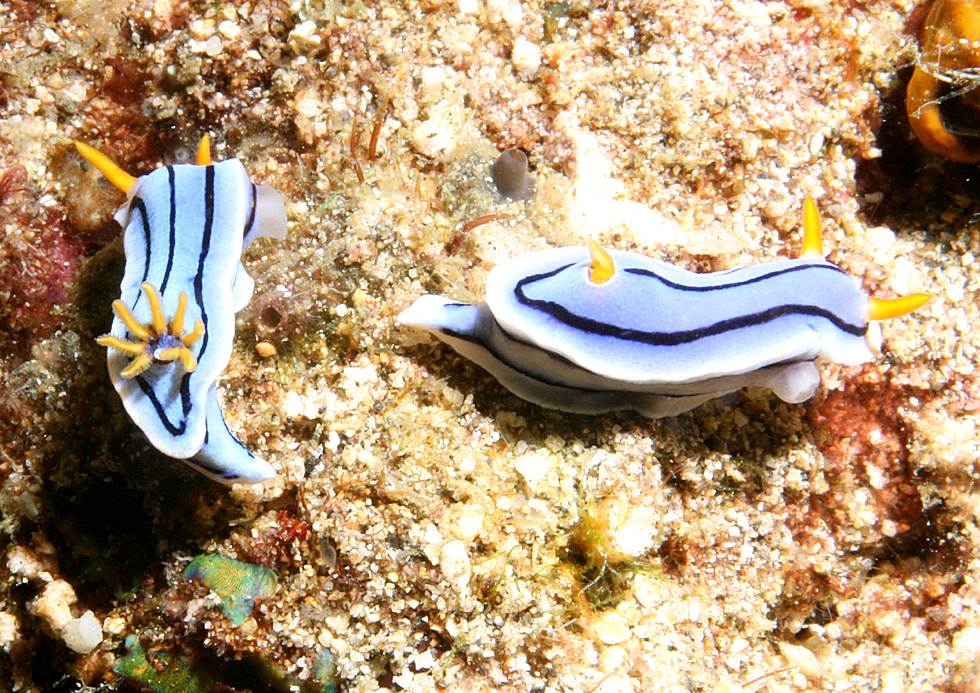
Chromodoris coi has a rather understated elegance, it might not have lots of different colours but the clearly delineated markings on its back are very striking. |
|
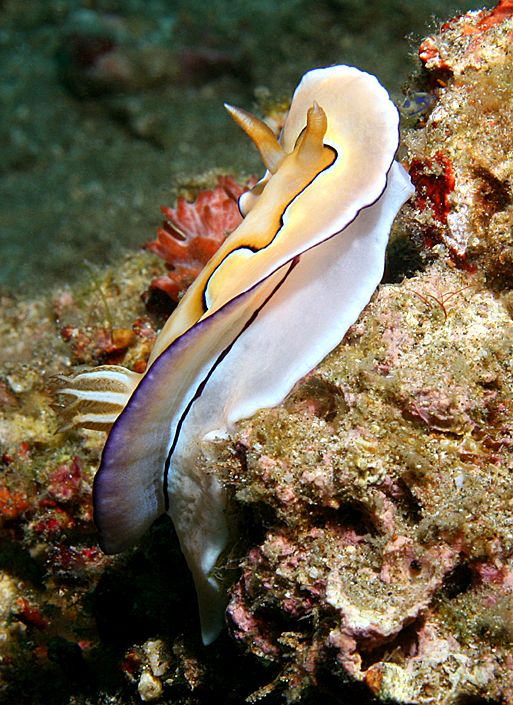
The elegance continues below, with a distinct purple line around the outer edges of the mantle merging into a diffused mauve band under the mantle. Then just to drive the fashion statement home, there's a clear line extending all around the animal just above the foot it uses to glide around the reef. This species is known for the way it flaps its mantle rhythmically up and down as it moves, eating sponges and reaching up to 6 centimeters in length. Chromodoris annae and Chromodoris coi aren't the only slugs on this page which eats sponges, in fact sponges are what all of the Chromodoris slugs eat. It's the largest genus of nudibranchs, which must be a pretty depressing thought if you're a sponge. |
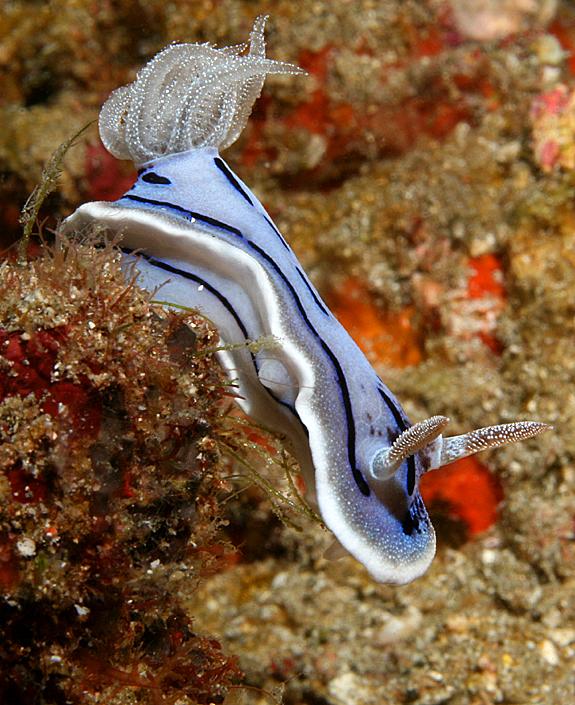
Unless you're particularly lazy, unintelligent or unobservant, you've almost certainly noticed by now the frilly or tentacle-like projections on the backs of all of these nudibranchs; these are the "naked gills" which give nudibranchs their name. The things at the front aren't the eye stalks which you see on land slugs and snails, instead they're called "rhinophores", which is a mixed Latin and Greek word meaning "carrying noses" - which just means that they house the organs of smell, a useful thing for critters which often roam around at night. This species is Chromodoris willani, there are several species with similar blue and black colouring, so the white specks on the gills and rhinopores are the surest way to recognise it. And that funny looking lump on the animal's side? Well, you'll find out soon enough what that is! |
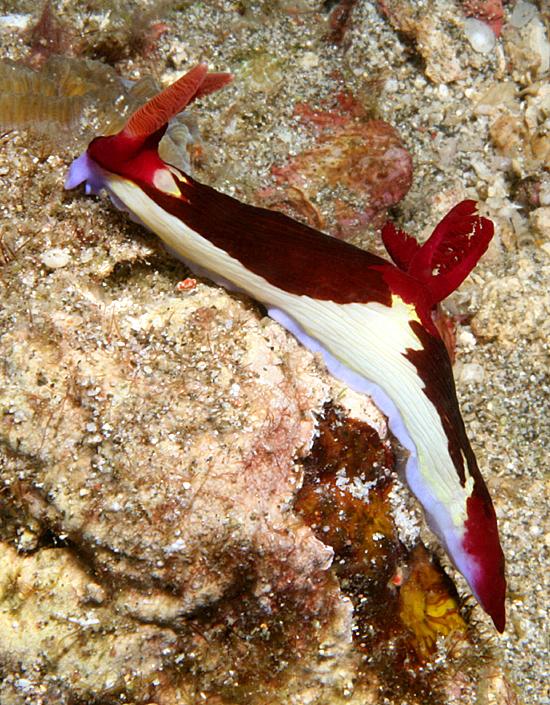
Nembrotha chamberlaini is one of the few nudibranchs I saw with large amounts of red coloration. The reason there might be so few red nudibranchs is that this is the first color to be lost by the "selective absorption" of light underwater - below about 5 meters almost all of the red light has been absorbed by the water, which is why divers who cut themselves are usually surprised to see that the blood which comes out looks black! Red is a good warning color in very shallow water, but nudibranchs tend to live a bit deeper than that, which is why I only saw three of them in the ten or more years while I was freediving, but all of the ones on this page in my first scuba dives. Anyway, this is a very attractive species, but it's found only in the Philippines and Indonesia, and although I saw quite a few of them they were only scientifically described as late as 1997. |
|
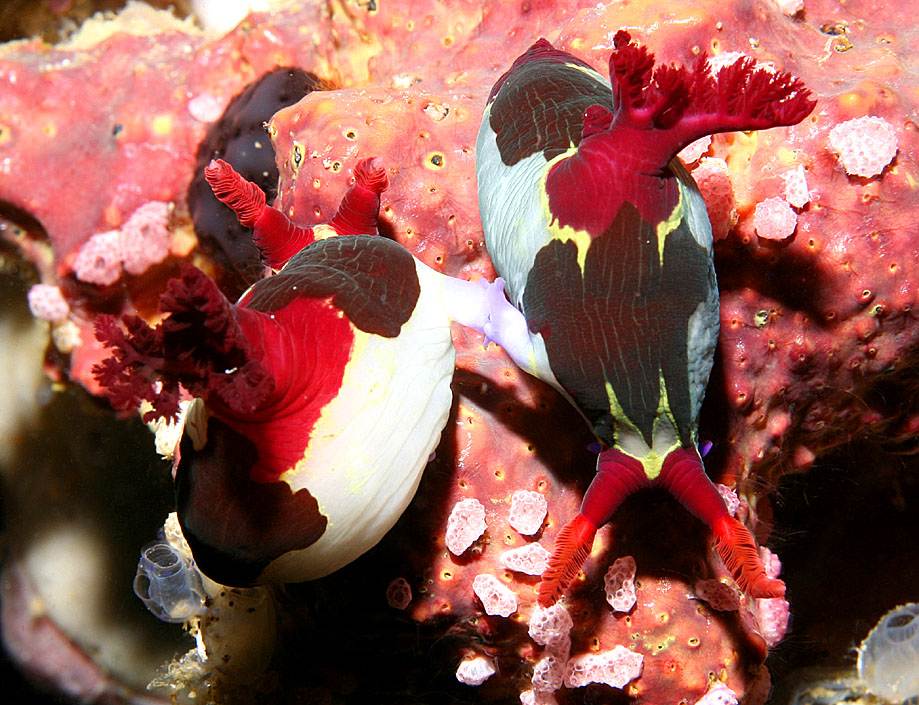
Oh my word, here's two of them together and they're... they're... joined together! It might look like they're just holding hands, but in fact things have gone much further than that, and this is actually a photo of them mating. Sea slugs are hermaphrodites, each individual is both male and female, and during mating they each give and receive sperm at the same time, and then later they will both lay eggs. This species feeds on ascidians, one of which you can see in the bottom-right hand corner of this photo, and another near the bottom-left, though these two slugs seem to have other preoccupations at the moment. |
 |
| Or has it? That same nudibranch had had quite enough fun for one day, so it made its exit, and as it did so, its gills started to pop up from the protective pouch where they'd been withdrawn. |
 |
|
With its gills pretty much fully restored, this slug meanders off to have a cigarette, or whatever the nudibranch equivalent is. Sex is about the most complicated thing most sea slugs are capable of, though they're obviously also outfitted to track down their favorite foods, which in the case of some nudibranchs means actually following the slime trails of other nudibranchs and then eating them! |
 |
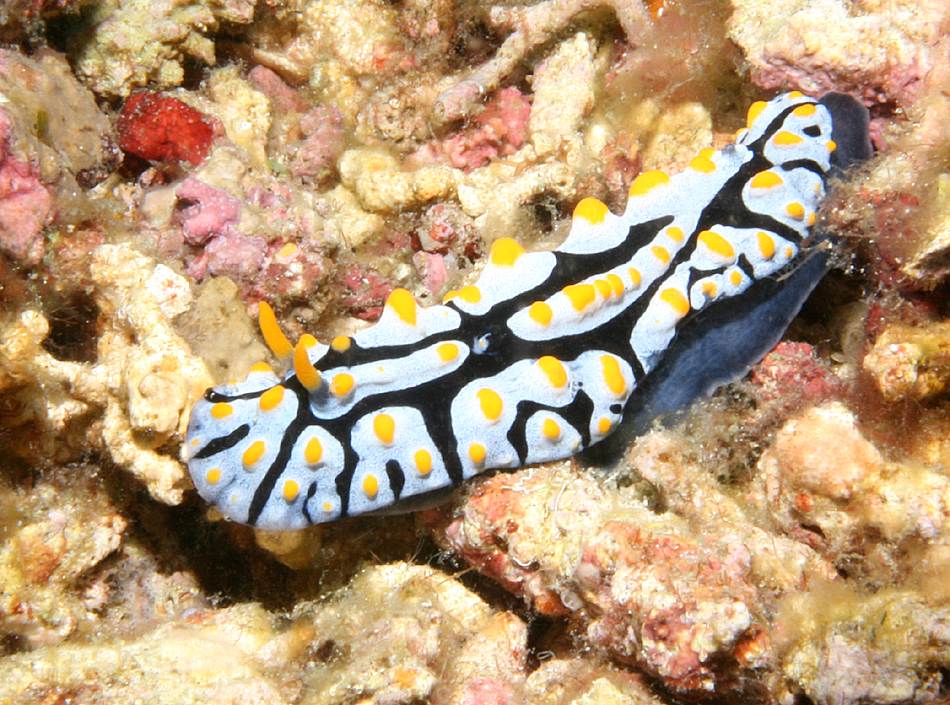
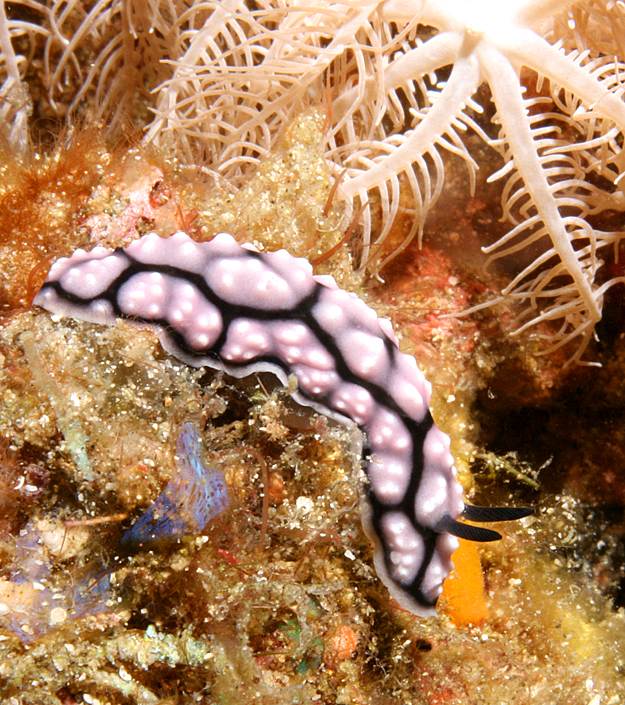
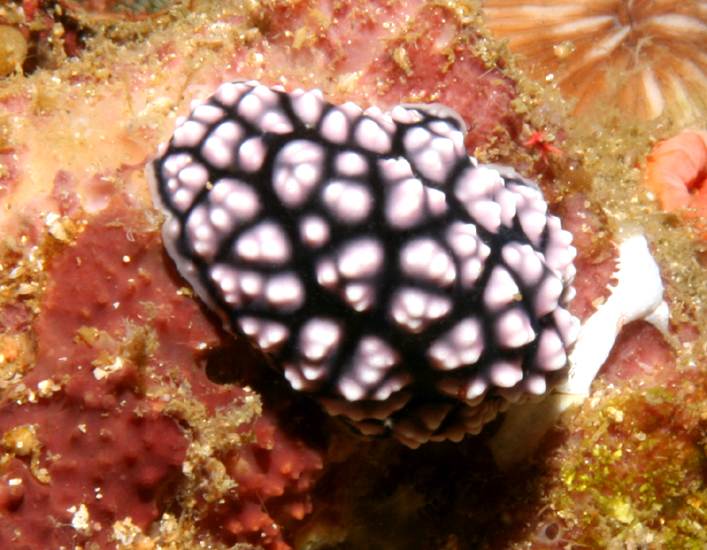
More nudibranchs without feathery gills. I've never seen a "cf" in the middle of a scientific name before, but Phyllidiella cf. annulata proves that there's a first time for everything. The "cf" is short for "compare to" in Latin, and this Latin name means "I'm not quite sure what this thing is, but it obviously belongs to the genus Phyllidiella and if you compare it to Phyllidiella annulata you'll see that it's very similar". This is really an indication of how little is known about many of the nudibranchs, including what are the ranges of different species, and what they eat. |
|
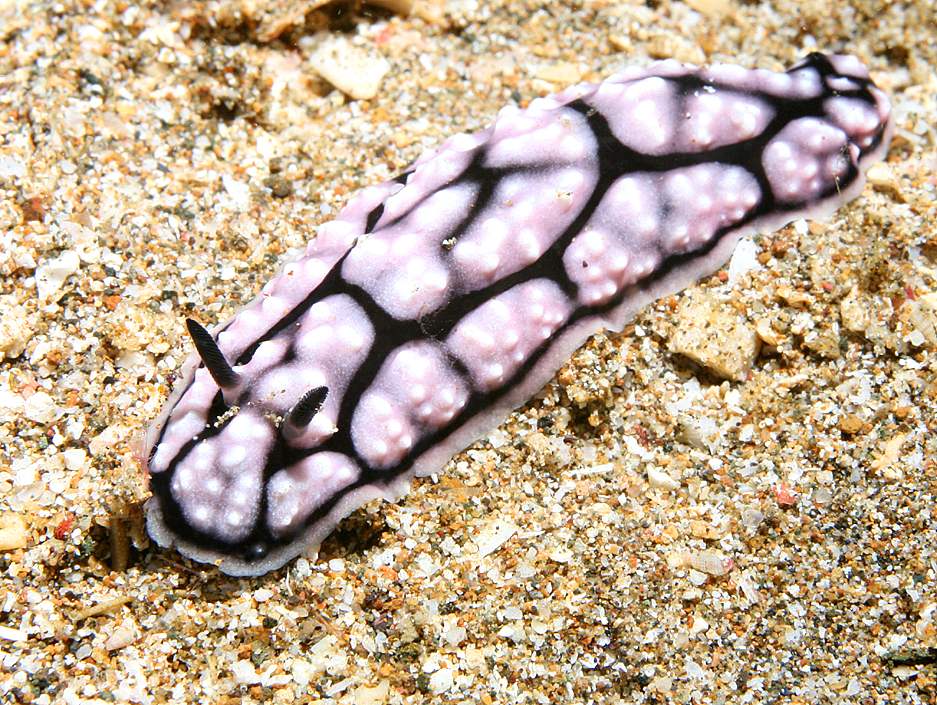
Some nudibranchs prefer to live on hard surfaces and some like to live on sediment, and even bury themselves while waiting to go out on their next feeding foray. Like regular slugs and snails, they exude a slime which allows them to slide over rough surfaces like sand and coral. |
 |
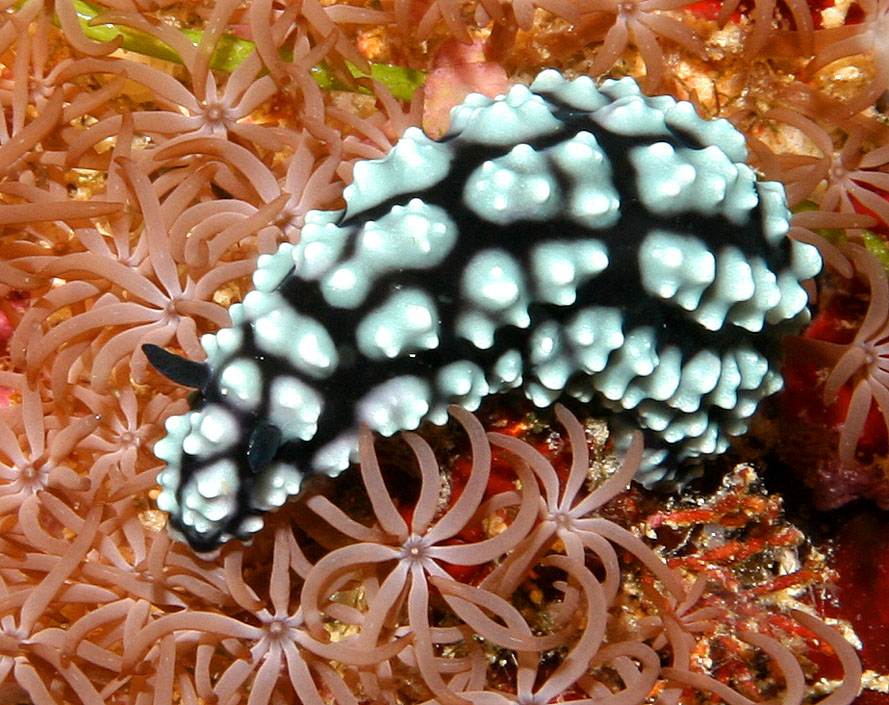
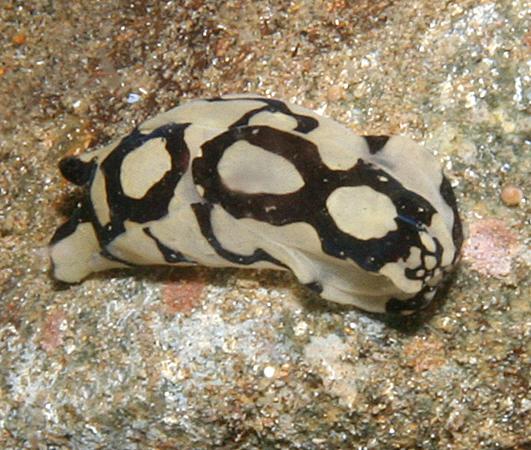
This isn't much of a photo and I normally wouldn't include it on a page like this, but it seemed interesting because it's a different color form of the last nudibranch, Phyllidiella pustulosa. There's often a tremendous amount of variation in coloration and patterns between individuals of the same species, which makes identification even trickier. |

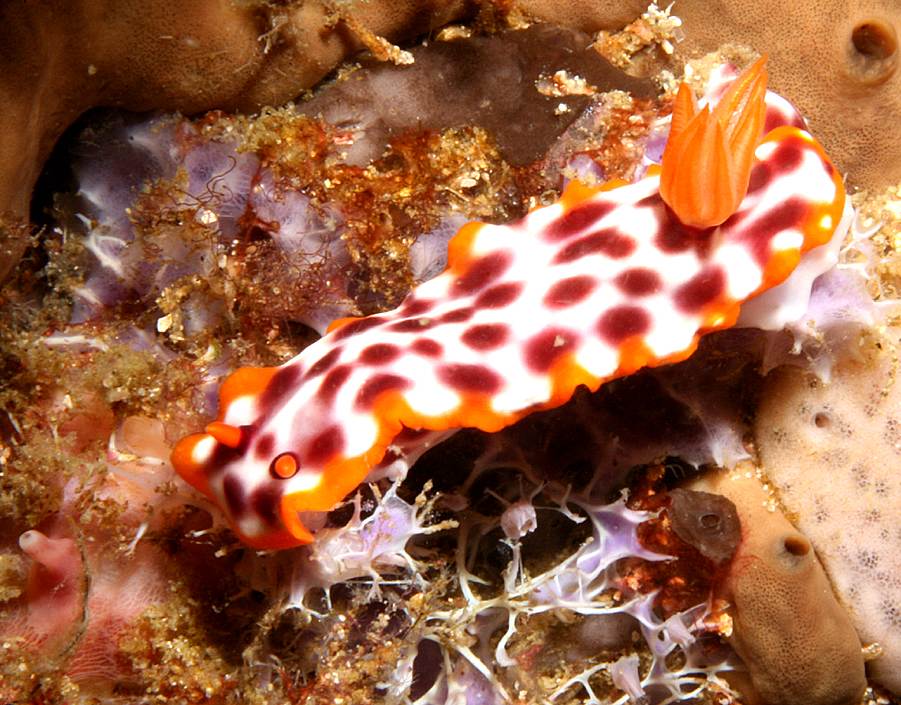
This Philinopsis pilsbryi was moving quite fast when I found it during a night dive in less than two meters of water at Anilao, though it was being knocked around a bit by the surge. Unlike most of the other species you've seen so far on this page, this one hunts prey which has some small hope of escaping - small worms living in the sand or other substrate. |

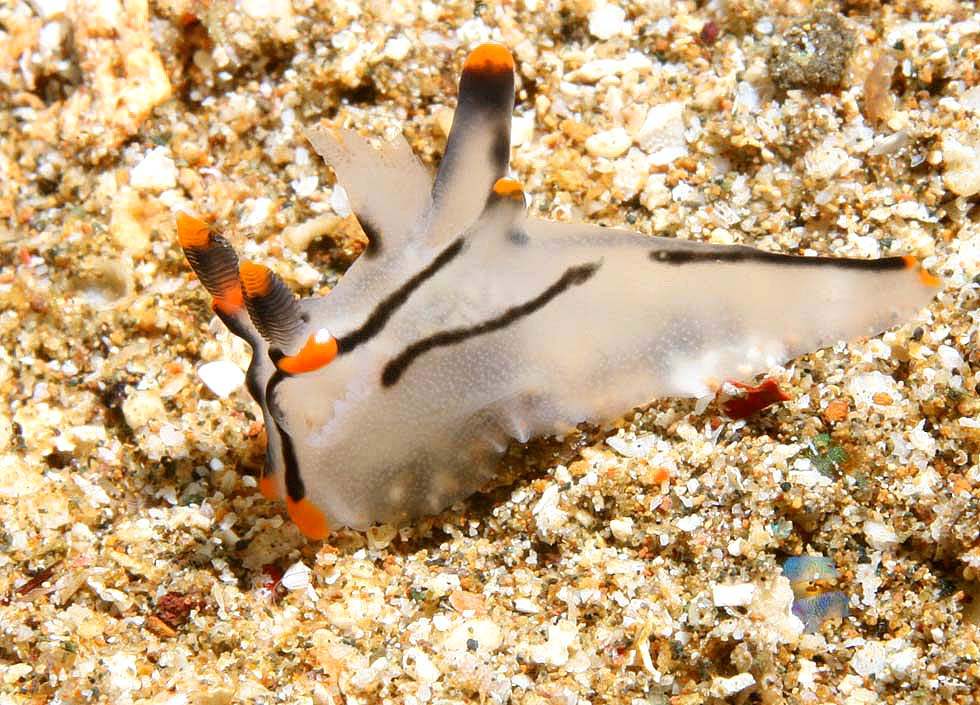
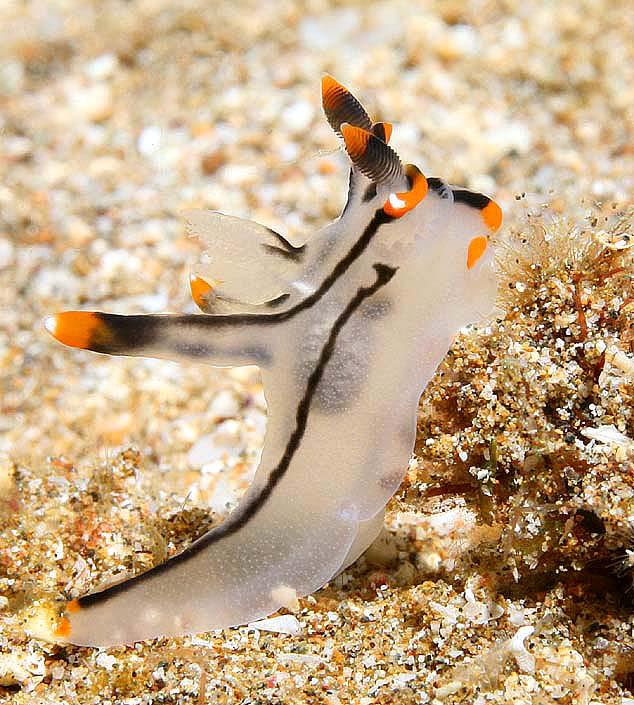
The thing I really like about this species is the way you can see its internal organs through the translucent body, a characteristic feature of this genus, as are the long horns on its back, which in some species can be extended and retracted. The greyish lump you see inside this animal is the gut. Most of the nudibranchs with feathery gills on this page have them near the back of the body, but here they're closer to the front. |
|
Another worm, this time a bristle worm called Chloeia fusca. Bristle worms are also called fire worms because the thousands of hairs on their bodies are hollow and filled with poison, providing protection against predators in a similar way to the irritant hairs on many caterpillar species. The most spectacular fireworm of all isn't particularly hairy, instead it's an iridescent creature which lives in long holes in the sediment and reaches up to 15 meters in length and 2.5 centimeters in diameter! They feed by poking their head out of their burrow, with vicious looking grasping jaws around the mouth, a feature which earned them the rather fearful name of "bobbit worm", after the guy who had his penis cut off by his wife. |
 |