| Highlights
of the 2006 Chino Airshow |
| For
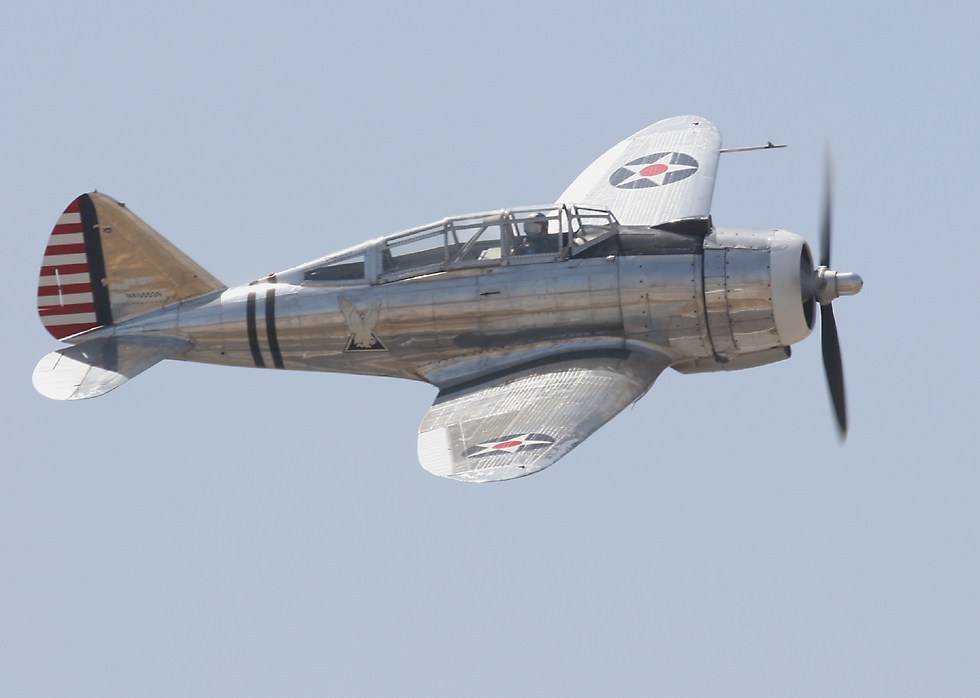
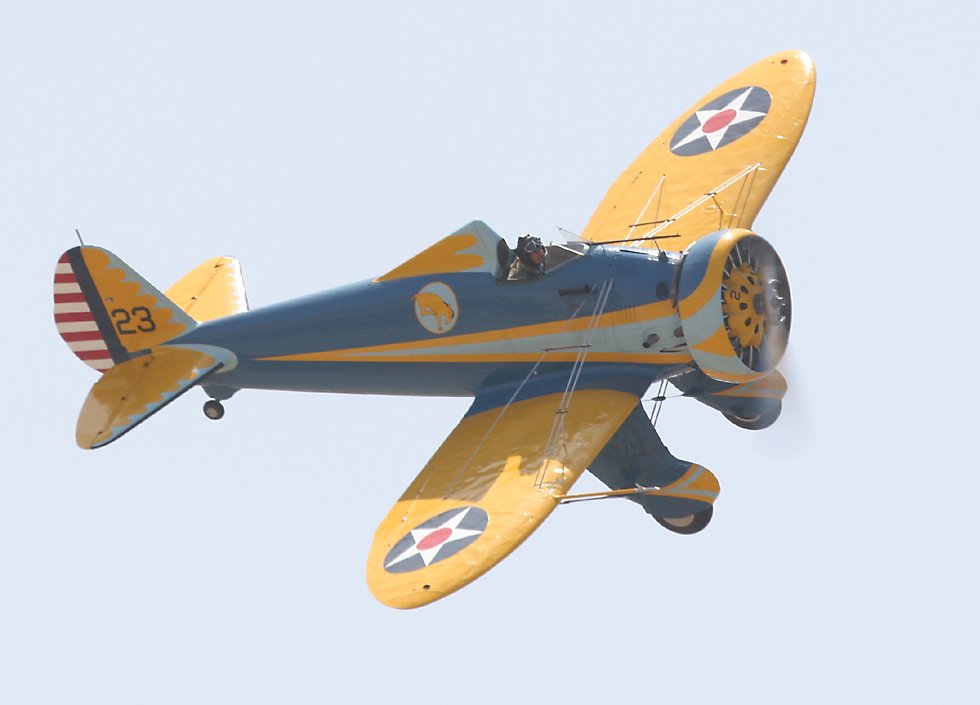
many people this recently restored P-26 Peashooter was the highlight of
the 2006 airshow at Chino in the Los Angeles basin. First flown
in 1932, the P-26 was America's first all-metal monoplane fighter, and
some were still serving with the Philippines army in 1941, and even managed
to shoot down some Japanese aircraft. |
 |
| This
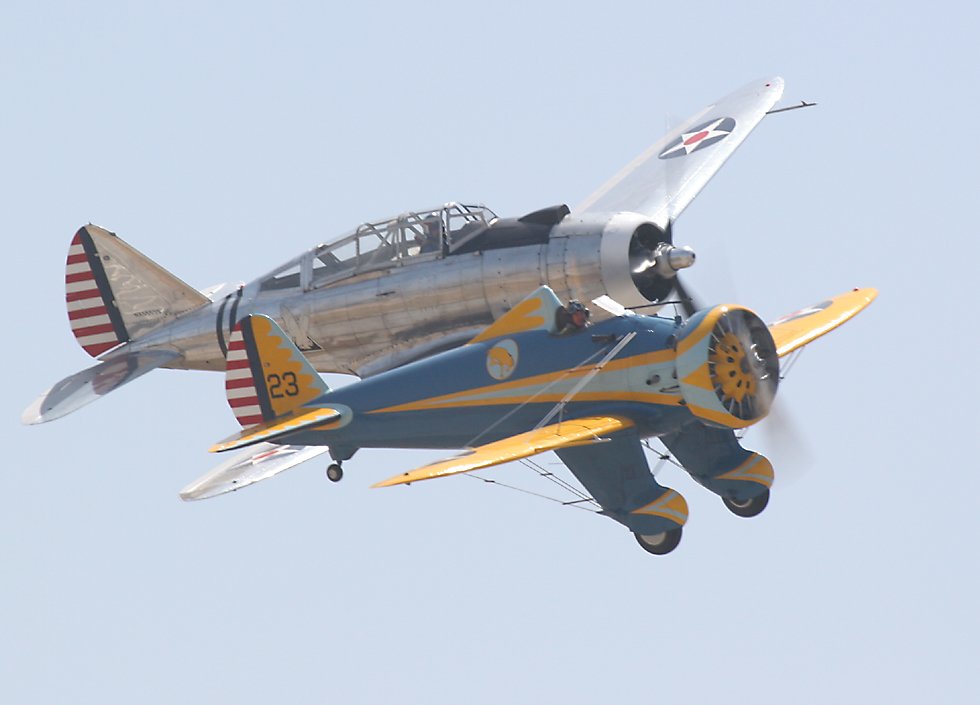
Seversky AT-12 Guardsman trainer is another aircraft which the Chino air
museum has recently returned to flying condition. The Seversky
aviation company won a US army air corps contract for its P-35 fighter
in 1936, but they also developed a two-seat version called the 2PA with
a rear gunner which was exported to Sweden, Russia and Japan.
An embargo by the US government prevented many of the Swedish aircraft
from being delivered, and they were eventually appropriated by the USAAC
as the Guardsman advanced trainer. The long canopy of the AT-12
is unusual, but the elliptical wing and other features clearly foreshadow
later aircraft from the company like the P-47 Thunderbolt, developed after
the company was renamed Republic. |
 |
| The
Japanese didn't think much of the 2PA, but some P-35s were used against
them during the Philippines campaign, so this formation of the AT-12 and
the P-26 is quite appropriate. |
 |
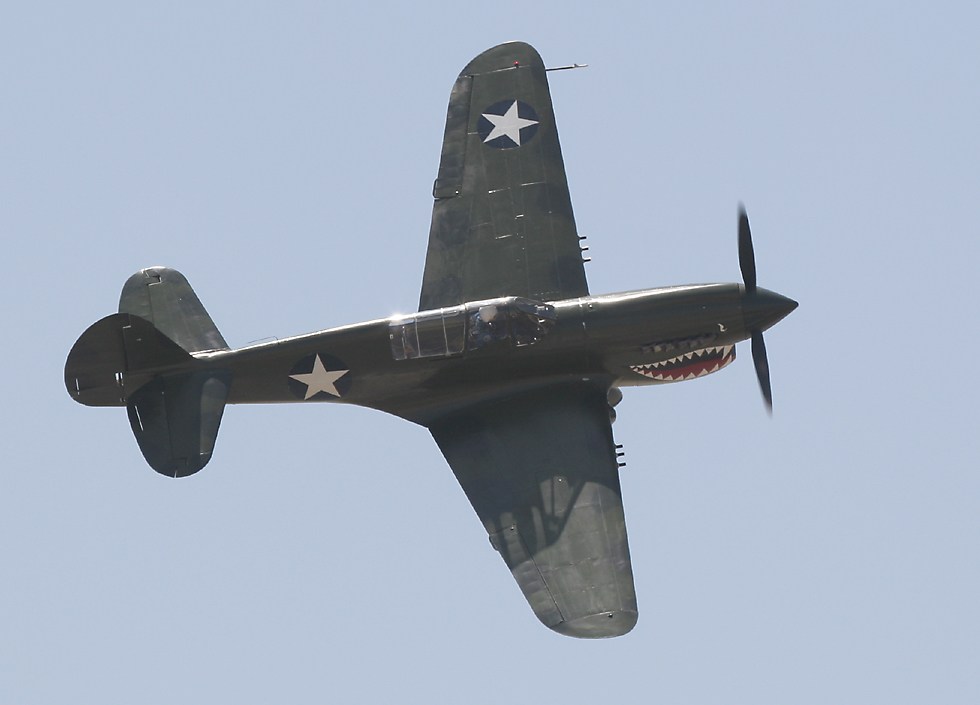
| Aircraft
design was advancing rapidly and by 1938 P-40 Warhawks like this one had
been developed, with a top speed of 360 mph compared to the 310 mph of
the P-35. Even so, the P-40 was no match for Luftwaffe fighters
like the Bf 109, so it was mainly flown in secondary theaters like China,
the Pacific and North Africa. The British were the first to
use the shark's tooth motif, which was later adopted by the Flying Tigers
piloted by Americans in China. |
 |
| When
it was delivered in late 1941 the P-38 was by far the fastest fighter in
the US inventory and it also had excellent range, however in the European
theater it failed to make as much impact as the P-51 Mustang or P-47 Thunderbolt.
It was much more successful in the Pacific, where its long range was put
to good use, mostly memorably in the long-range interception of a transport
aircraft carrying admiral Yamamoto, architect of the Pearl Harbor attack.
The P-38 was also the aircraft used by army air force pilot Richard Bong
to score all 40 of his victories, making him the highest scoring American
ace of the entire conflict. |
 |
| When
the British asked North American aviation to build Curtiss P-40s under
contract, North American said that they could produce a superior aircraft
in about the same amount of time, and so the P-51 Mustang was born.
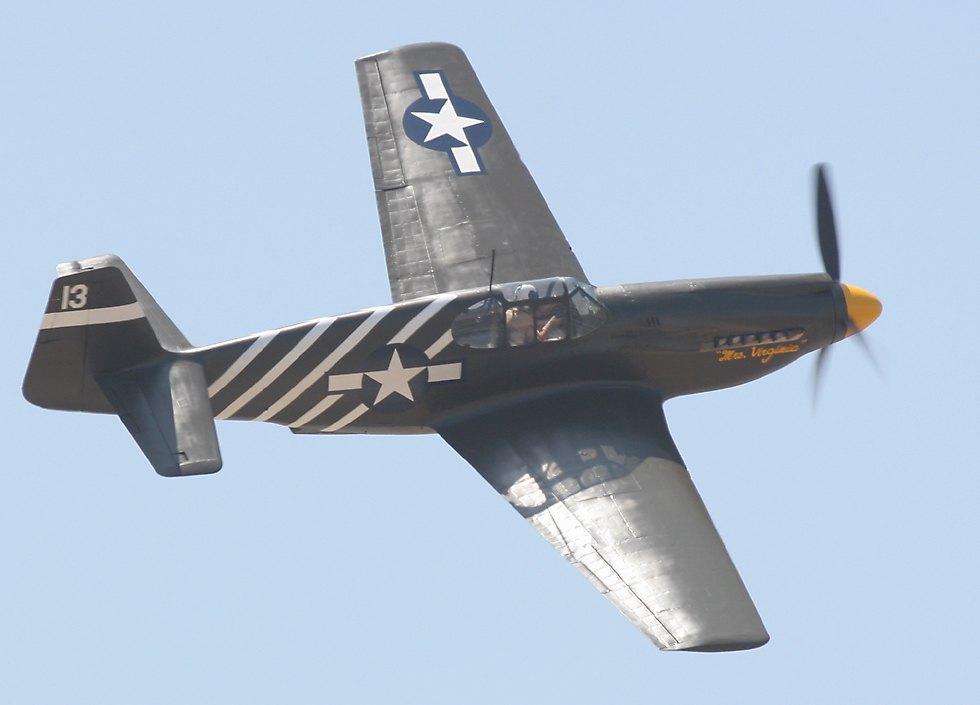
This Mustang is a very rare P-51A, the first production version, which
like the P-40 was powered by an Allison engine. Unfortunately,
the high back behind the cockpit obscured rearward visibility, a significant
liability in a dogfight. |
 |

The Allison engine was another major impediment to successful use of the
Mustang in Europe, because it didn't perform as well at high altitude as
British or German engines in aircraft like the Bf 109 and the FW 190.
However the aircraft design was basically sound, and the excellent fuel
capacity gave it the range not only to escort bombers to Berlin, but also
to travel the long distances required in the war in the Pacific.
The British came up with solutions to both problems plaguing the Mustang,
first by fitting it with the same Rolls-Royce Merlin engine that powered
the Spitfire, and then by modifying some Mustangs with the Malcolm Hood,
a bulged canopy which provided better visibility. The new B
and C models were therefore all fitted with Merlins, which enabled the
Mustang to fight it out with the best of Germany's aircraft, while escorting
bombers at high altitude.
The British later improved on the Malcolm Hood by coming up with a teardrop
shaped canopy, which was trialled on the Hawker Tempest.
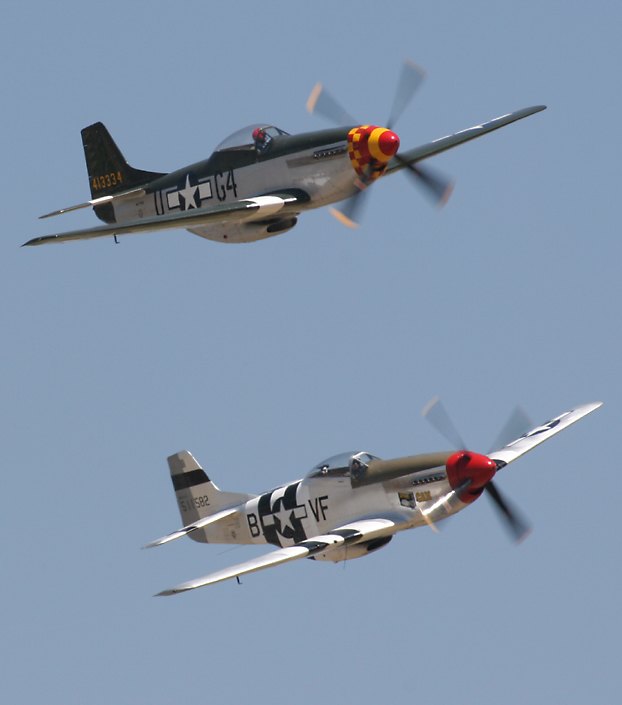
The two Mustangs you see here are both P-51Ds, the definitive model with
both the Merlin engine and a bubble canopy. The high back had
to be eliminated, and to improve stability a strake attached to the fuselage
was added at the front of the tail. |
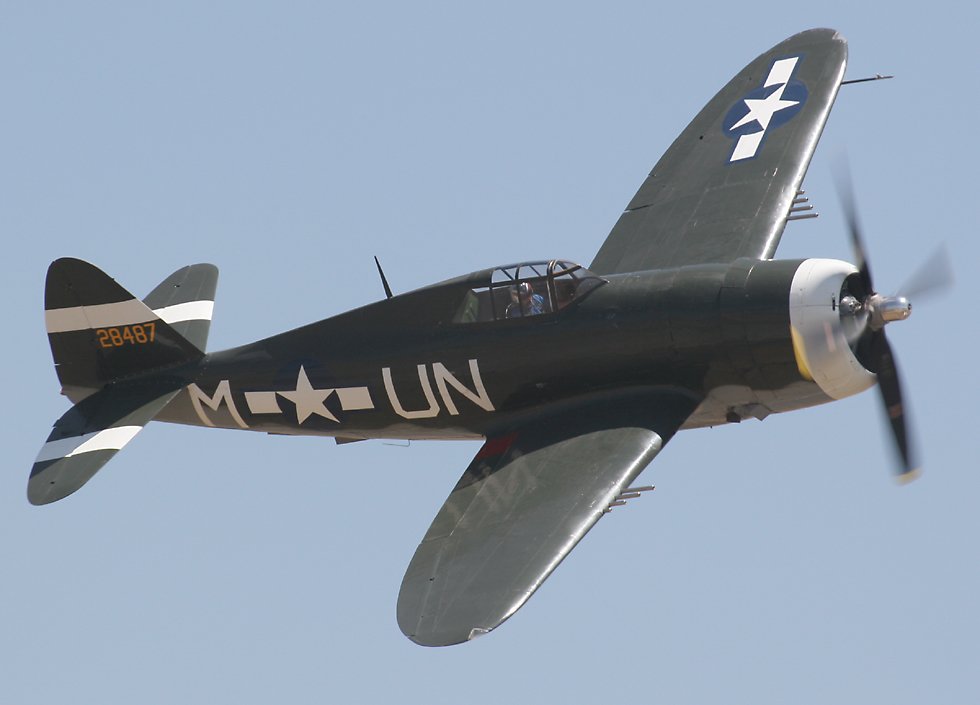
| Like
the P-51A Mustang, early model P-47 Thunderbolts had a high back which
tapered down to the tail, which in the case of the Thunderbolt earned it
the nickname "razorback". This is the only razorback Thunderbolt
still flying, making it yet another one of Chino's one of a kind aircraft. |
 |
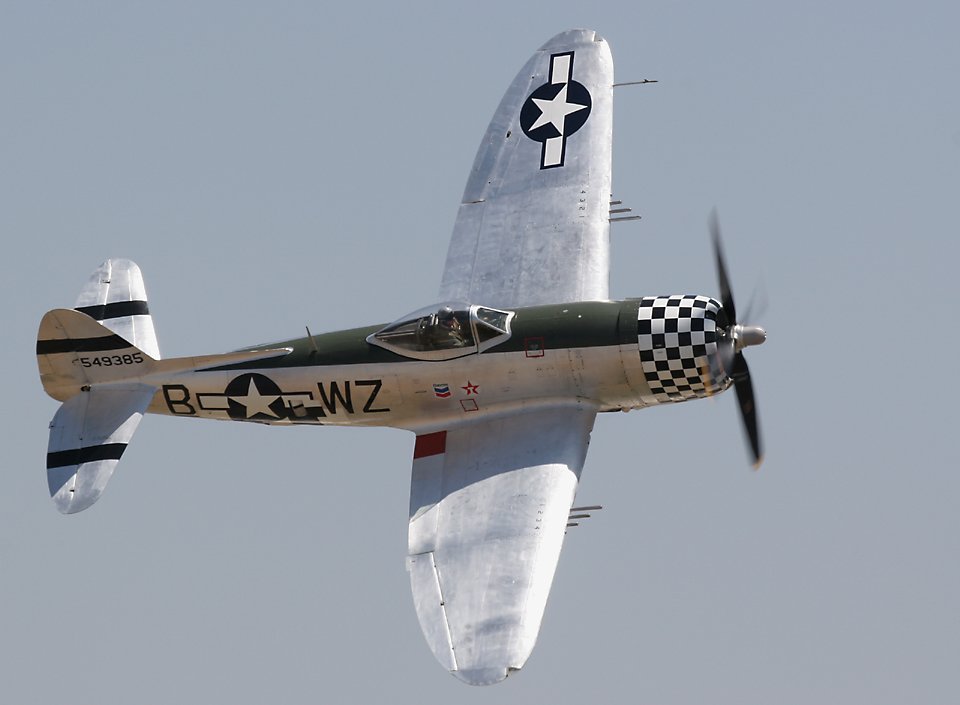
| However
it wasn't the only Thunderbolt at the show! Last year there
were five flying, but I didn't see them because I was at the
Selfridge airshow. This year there were two, the razorback
and this more definitive model with the same sort of bubble canopy as the
P-51D. Like the P-51D, Thunderbolts fitted with the bubble
canopy also have a strake attached to the tail. However, the
Thunderbolt is a much larger aircraft than the Mustang, with a maximum
takeoff weight 17,500 lbs, compared to the Mustang's 12,100lbs. |
 |
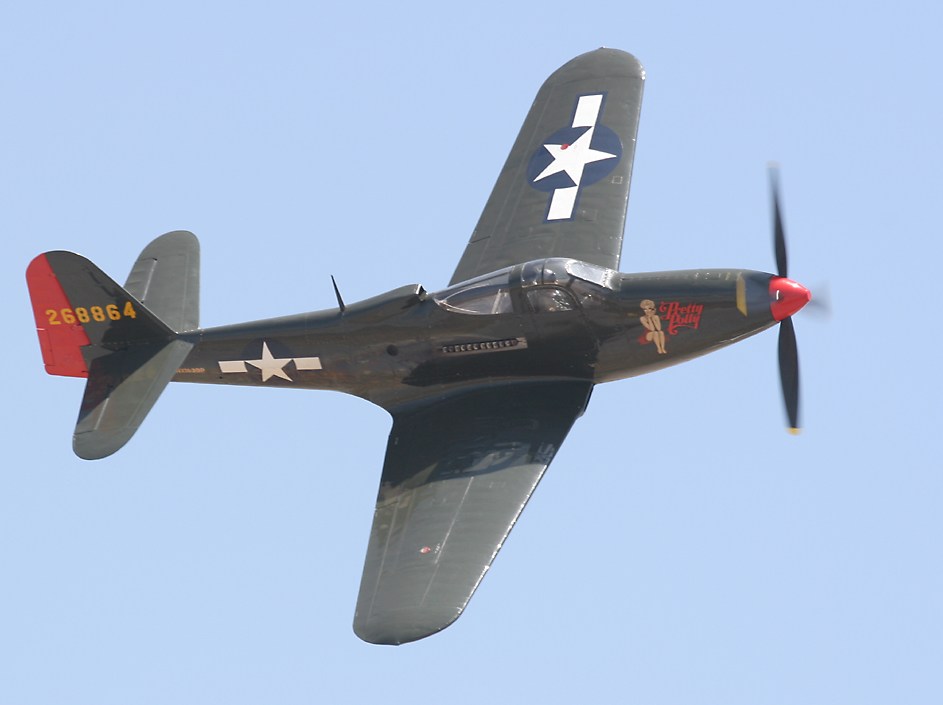
| Not
all of the rare types at the show belong to the Chino air museum; this
P-63 Kingcobra is part of Bob Pond's collection on display at the Palm
Springs air museum. The Kingcobra is the larger brother of
the P-39 Airacobra, both of which were powered by Allison engines.
For this reason, just like the P-40 and the P-51A, the western allies
didn't consider the P-39 and the P-63 to be suitable for the European theater
of operations. However the Russians loved them, buying 4773
Airacobras and 2400 Kingcobras under a lend-lease agreement, using the
powerful 37mm cannon mounted through the propeller spinner against ground
targets as well as against enemy aircraft. It was the size
of this cannon which necessitated both the unusual mid-engined configuration
and the tricycle landing gear. |
 |
| There
were plans to have a Russian designed Polikarpov I-16 fighter from the
early part of world war two at this year's show, but in the end it wasn't
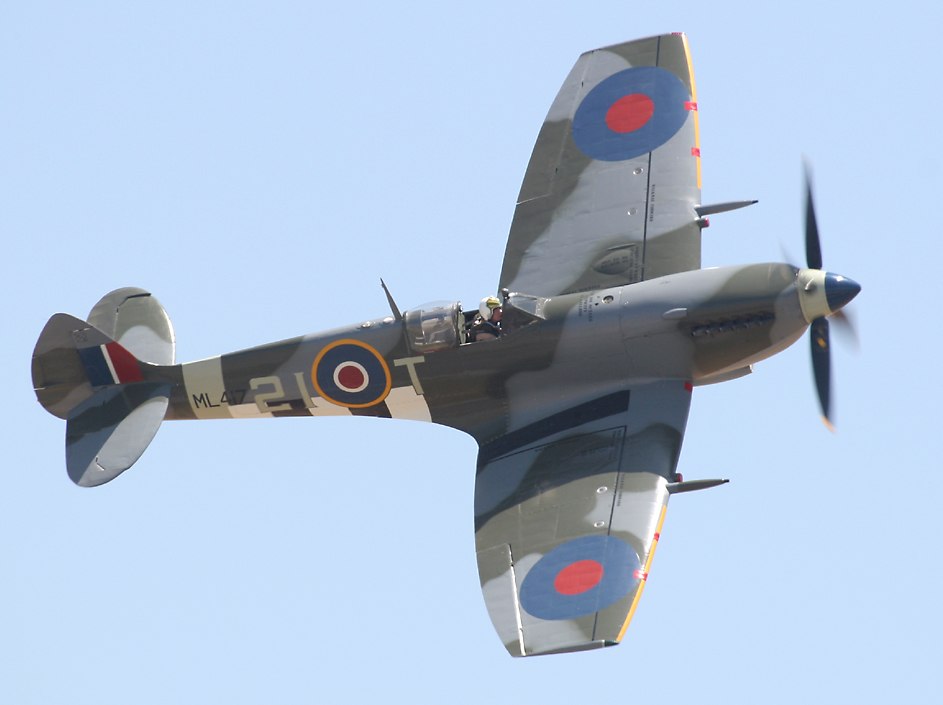
able to make it, so this clipped wing Mk IX spitfire was the show's only
foreign air force type from world war two, though as you'll see later,
there were plenty of British naval aircraft on display, a welcome reminder
that the UK, Australia and New Zealand all fought in the Pacific alongside
their American ally. This spitfire is fitted with the Malcolm
Hood mentioned earlier and, unlike early models armed with only .303 machine
guns, this one also has cannons like most German fighters of the time. |
 |
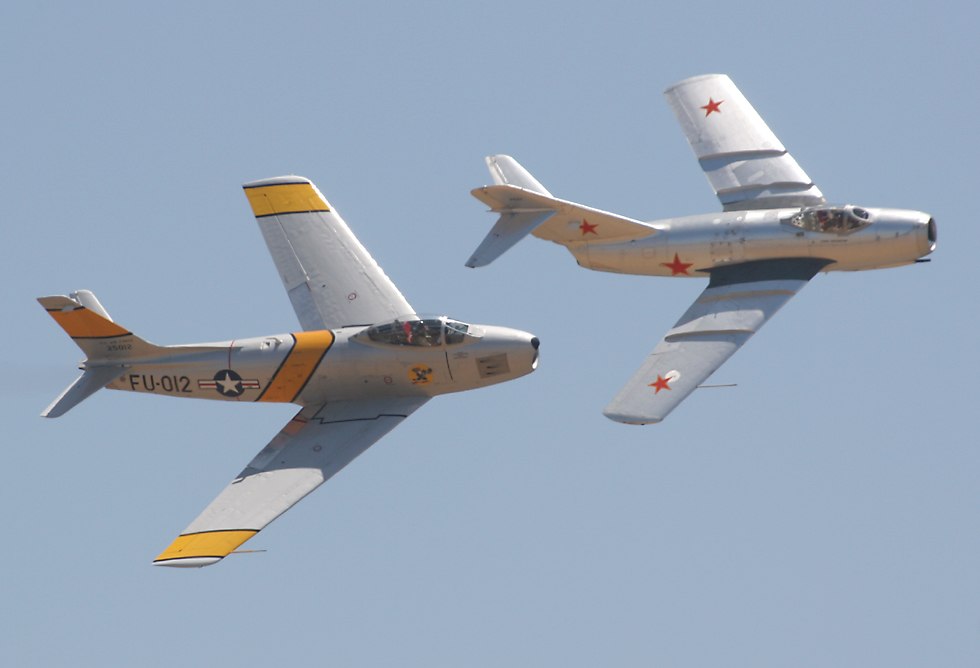
| In
the absence of the Polikarpov, the only Russian aircraft at the show was
this MiG-15 "Fagot", flying with its Korean war adversary the F-86 Sabre.
Although the MiG was far more heavily armed than the Sabre, and was also
a very rugged and dependable aircraft with performance characteristics
about equal to the Sabre, the superior training of American pilots allowed
them to achieve a roughly 10-to-1 kill ratio over the MiGs. |
 |
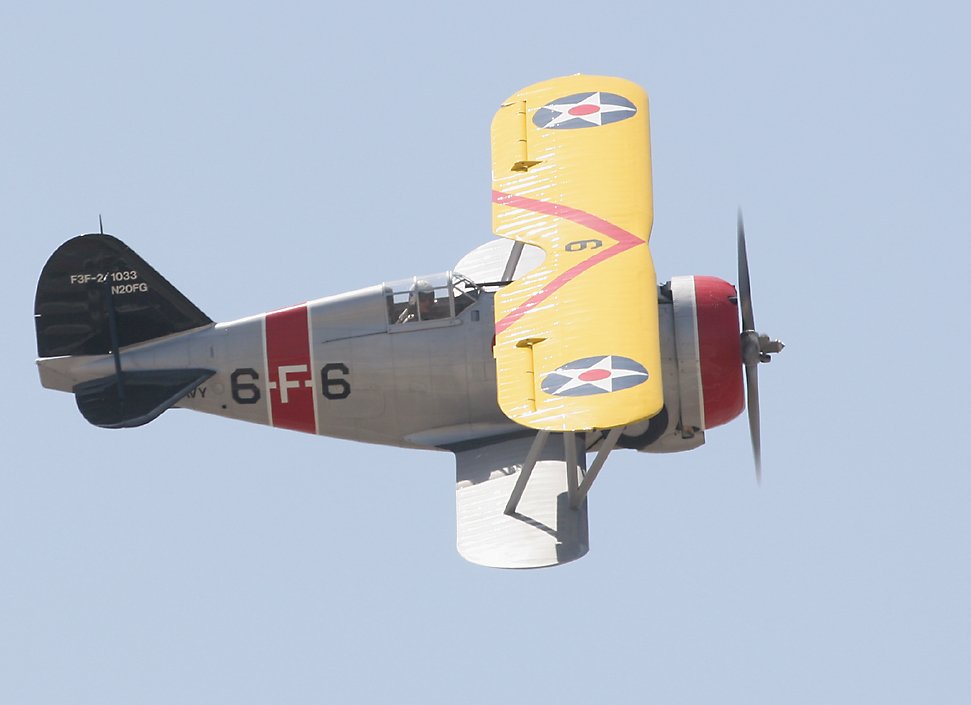
| Moving
from air force types to navy types, this year's airshow had a real treat
in store for us with another very rare aircraft which has recently been
returned to flying status, the Grumman F3F. It was the last
American biplane fighter and the direct progenitor of the F4F Wildcat,
the navy's main front-line fighter at the start of the war.
The resemblance between the F3F and the F4F is clear, with the same barrel-shaped
body and narrow-track undercarriage, which was hand operated in both aircraft. |
 |
| The
F3F might look archaic, but in fact it entered service as late as 1937
and was only withdrawn in 1941, having been superseded by the Brewster
Buffalo and the Wildcat. It's lucky that it was out of service,
because with a top speed of only 265 mph and armament of only two 0.30
caliber machine guns, it wouldn't have been much of a match for Japanese
naval fighters of the time. |
 |
| Here's
the F3F's replacement, an F4F Wildcat in loose formation with another Grumman
aircraft, the F8F Bearcat. There were two Wildcats flying at
the show, but I like the paint scheme on this one the best, so here it
is! As well as being considerably faster than the F3F, the
Wildcat was also armed with four 0.50 inch machine guns, which more than
doubled the firepower, since 0.50 inch guns were vastly more lethal than
0.30 or 0.303 weapons. |
 |
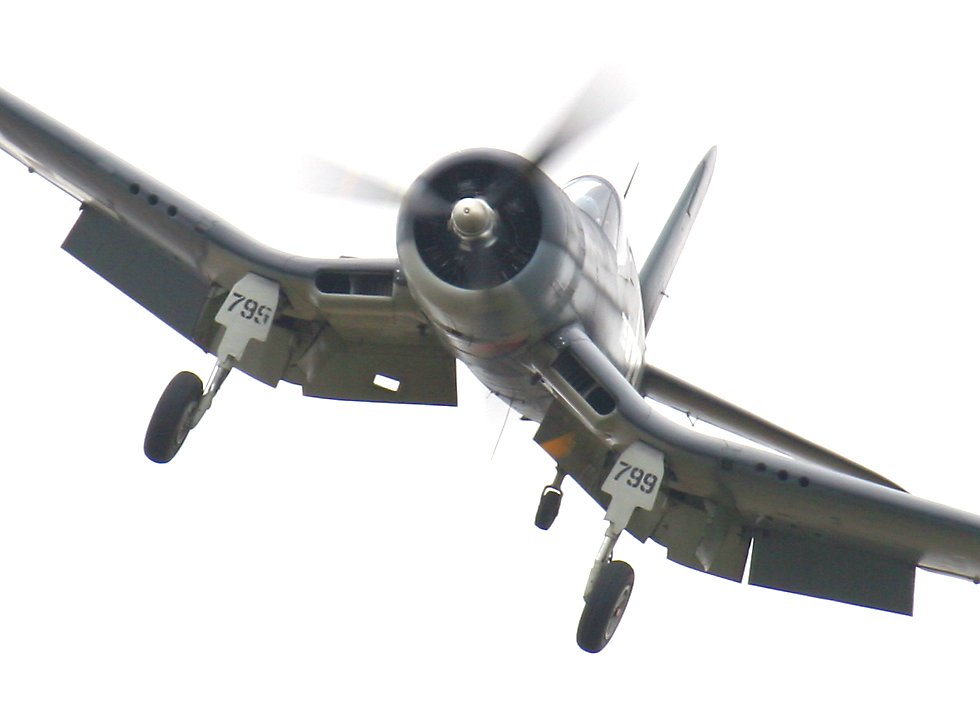
In the US navy aircraft designation scheme, the leading "F" stood for "fighter",
and the trailing letter of a fighter designation signified the manufacturer,
a trailing "F" meaning "Grumman". I never could figure why
the navy decided to have more than one "F4" fighter, but here it is, the
F4U Corsair, manufactured by Vought (later Chance-Vought).
Later yet another "F4" came along, the F-4 Phantom II, but in the meantime
the navy muddied the waters further by using a totally different designation
scheme for aircraft manufactured by a company other than the designer,
such as FM-2 for Wildcats built by General Motors, F3A for Corsairs built
by Brewster and FG-x for Corsairs built by Goodyear.
The
Corsair was an extremely fast and effective aircraft, however its very
long nose made forward visibility poor when landing on an aircraft carrier,
and it was mostly used from land bases until the British developed the
curved approach which you can see being demonstrated here. |
 |
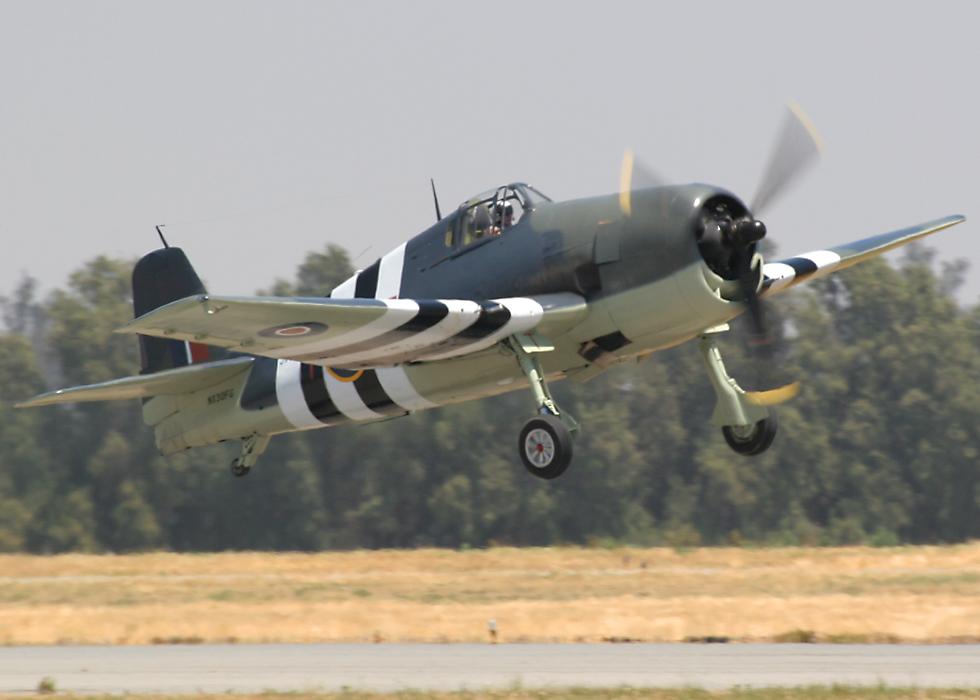
| This
F6F Hellcat in a British Fleet Air Arm color scheme provided the only real
scare of the show. After takeoff it became clear that the pilot
wasn't able to fully retract the landing gear, and it appeared that he
also had trouble extending the gear for landing. However, he
got down safely and to everyone's surprise went up again later in the day
for another display. |
 |
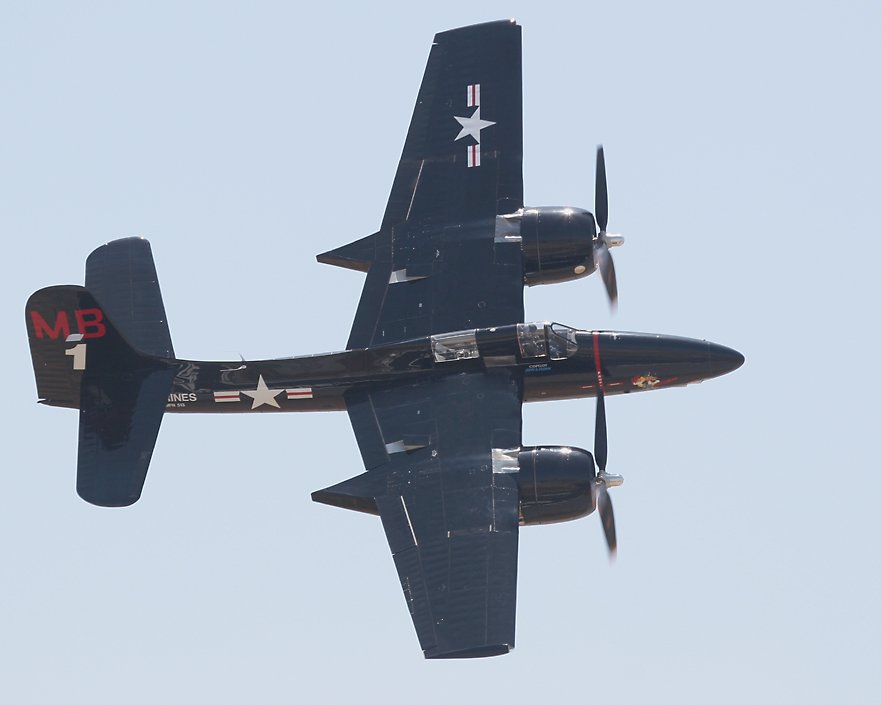
| The
F7F Tigercat was the navy's first twin-engined fighter, and also the first
navy plane with a tricycle undercarriage. It was extremely
fast, with a top speed of 460 mph at sea level and also extremely well
armed, with four 20mm cannon and four 0.50 inch machine guns.
However it failed aircraft carrier qualification trials several times because
of problems with its tailhook, insufficient strength for brutal carrier
landings, and a lack of directional stability when flying on one engine.
It was also too large to operate from older American aircraft carriers.
These problems prevented it from seeing combat in world war two, though
it did serve in the Korean war. |
 |
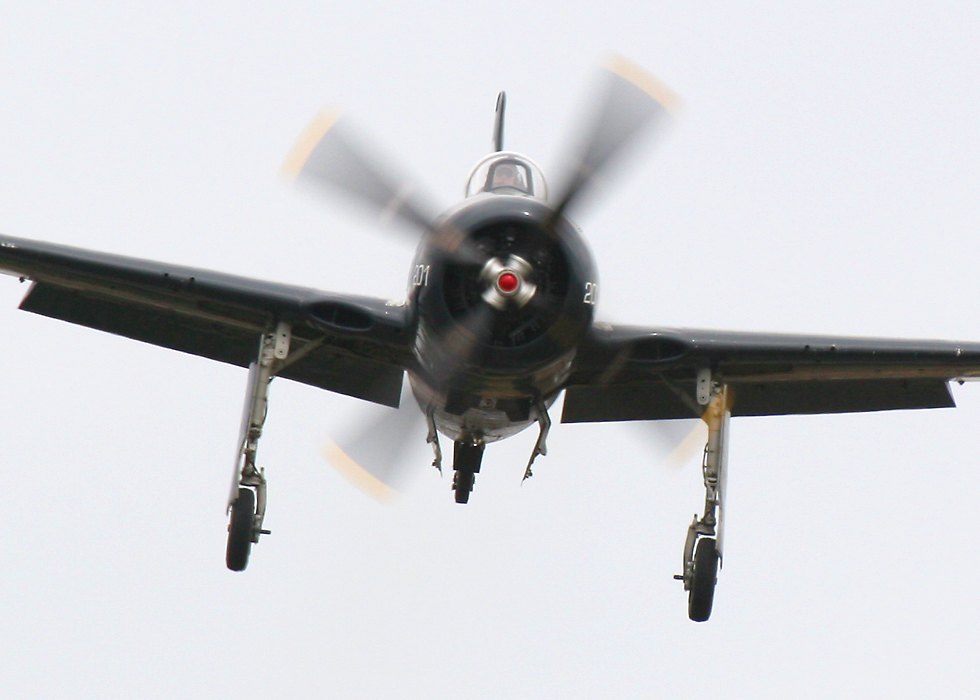
| The
F8F Bearcat was Grumman's last piston-engined fighter, arriving just too
late to enter combat in the second world war, though many of them saw service
with the French Armee de l'Air in Indo China. Although the
Bearcat used the same engine as the Hellcat, the Bearcat was 50 mph faster
and could climb 30% more rapidly. A modified Bearcat called
Rare Bear holds the world record for the fastest piston engined aircraft
in the world, with a speed of 528 mph set over a fixed course in 1989. |
 |
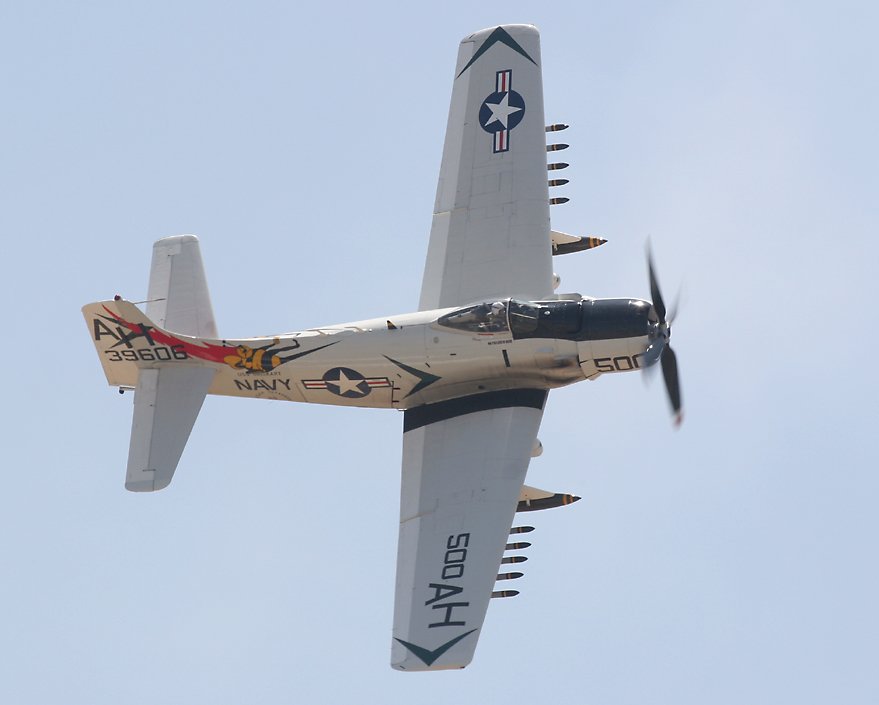
| Although
it first flew a few months before the end of hostilities, the A-1 Skyraider
is another US navy type which arrived just too late for service in world
war two. However its huge ordnance carrying ability, long loiter
time and stability as a weapons platform allowed it to thrive well into
the jet age, with many serving throughout the Vietnam war in a ground attack
role. When it entered service the Skyraider was the largest
single seat military aircraft to go into production, though later versions
like the AD-5 (later redesignated the
A-1E) had a crew of 4 and could even seat an additional 12 passengers
in the rear fuselage. The Skyraider's heavy hauling ability
also made it the only propeller driven aircraft in the US inventory certified
to carry and deliver nuclear weapons. |
 |
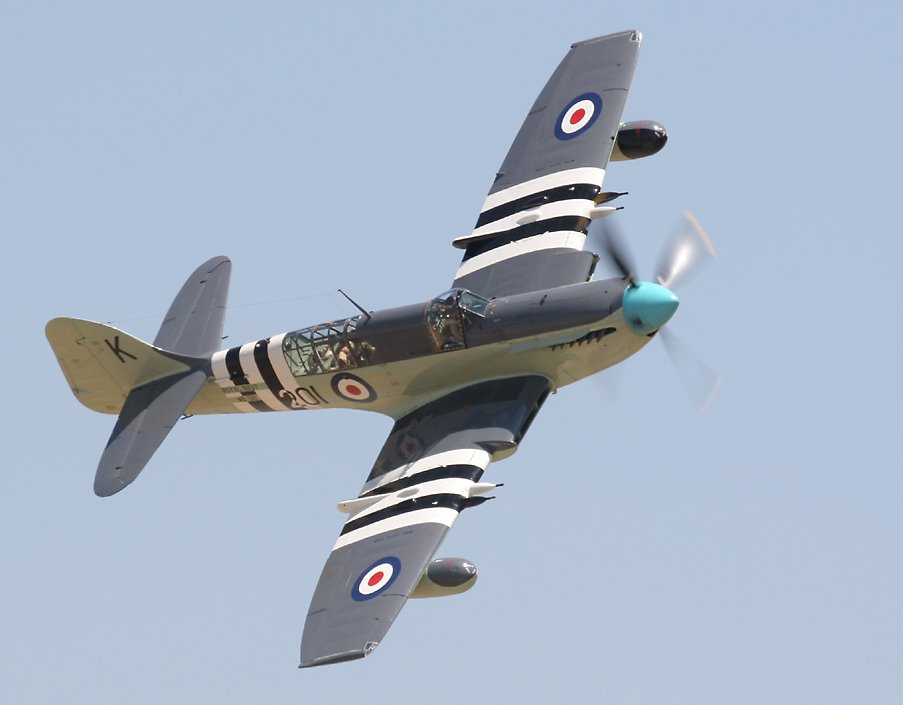
| As
well as the Spitfire and the Hellcat in British navy colors, there were
also a pair of British designed naval fighters. Captain Eddie Kurziel
flew his beautifully restored Fairey Firefly, a two-seat fighter which
served with the royal navy and the Australian navy. Although
it had a 2,250 horsepower Griffon engine the Firefly was relatively slow,
with a maximum speed of only 386 mph, however it was extremely maneuverable
and heavily armed with four 20mm cannon. |
 |
|
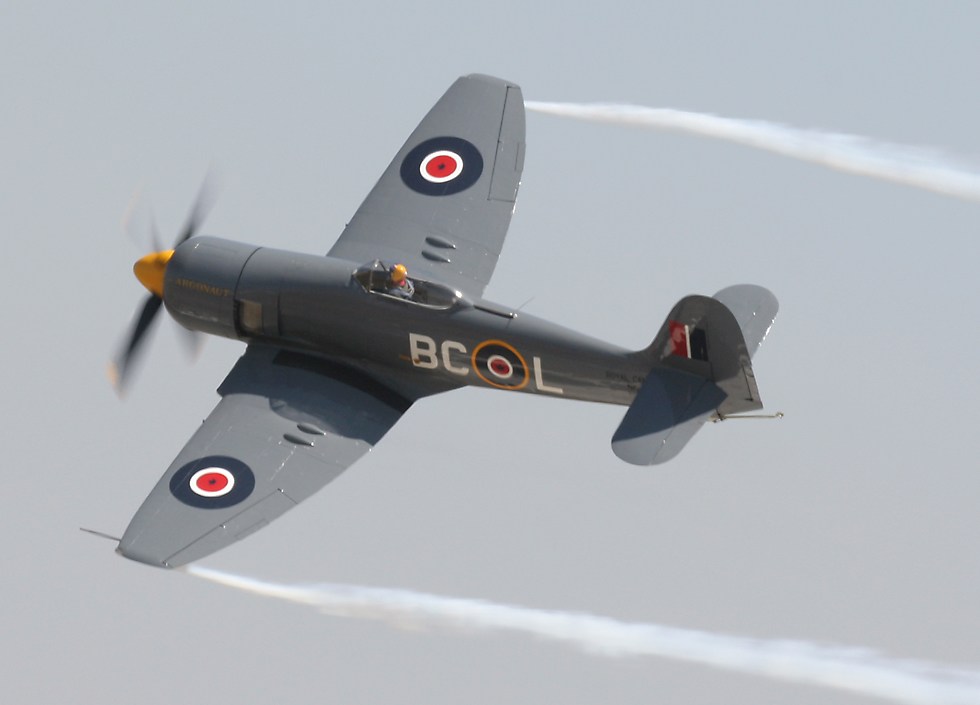
The Hawker Sea Fury came along later than the Firefly, it had similar armament
but a 2,480 horsepower Bristol Centaurus radial engine in a very streamlined
package which provided a top speed of 435 mph. Originally developed
as an air force fighter, the Fury was a lightweight development of the
Tempest, however the war finished before deliveries began.
The air force cancelled its orders but the navy still wanted the carrier
version and eventually 860 Sea Furies were built, with many being exported
to Australia, Burma, Canada, Cuba, Egypt, Germany, Holland, Iraq and Pakistan.
In one incident during the Korean war four Sea Furies were jumped by eight
MiG-15s and British pilot Peter Carmichael was able to shoot down one of
them; two more of the MiGs were damaged and the four Sea Furies completed
the mission without being hit.
This Sea Fury put on an aerobatic display complete with smoke generators
during the forming up of the mass flyby at the end of the show. |
 |
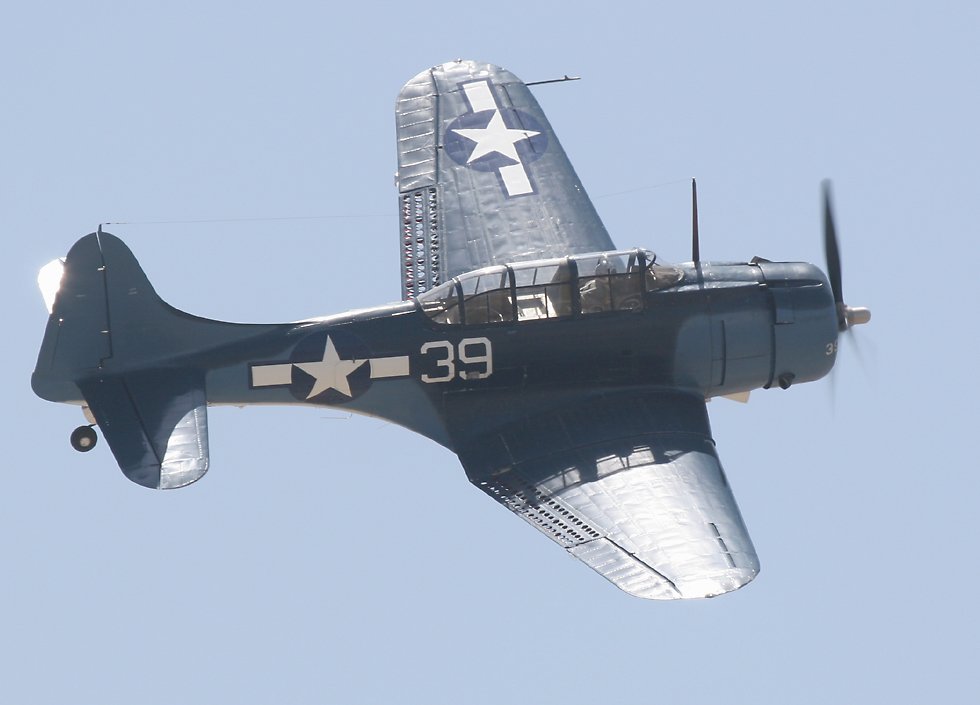
| The
Douglas SBD Dauntless dive bomber was America's most powerful weapon in
the war against Japan, sinking more ships than all other weapons combined.
It did a great deal to turn the tide of the war early on, sinking one Japanese
aircraft carrier in the battle of the Coral Sea and four more at the battle
of Midway. Although an attempt was made to replace the Dauntless
with the
SB2C Helldiver, the new aircraft was not as well liked by its crews,
and nor was it as successful as its predecessor. |
 |
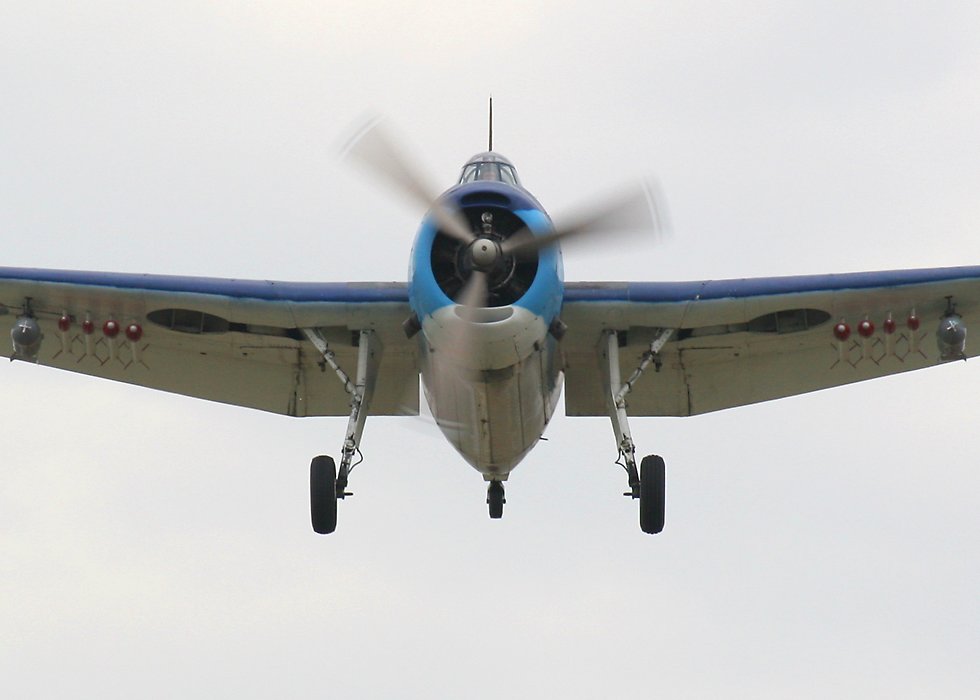
| The
Grumman Avenger torpedo bomber received its baptism of fire when it was
used for the first time at the battle of Midway. Of the six
Avengers that were sent out, only one
badly shot-up aircraft returned, with one member of the three man crew
dead and another injured. One Avenger pilot who became rather
famous after the war was called George
Bush, later 41st president of the United States. He was
shot down while flying his Avenger over the island of Chichi Jima but was
rescued by a submarine. |
 |
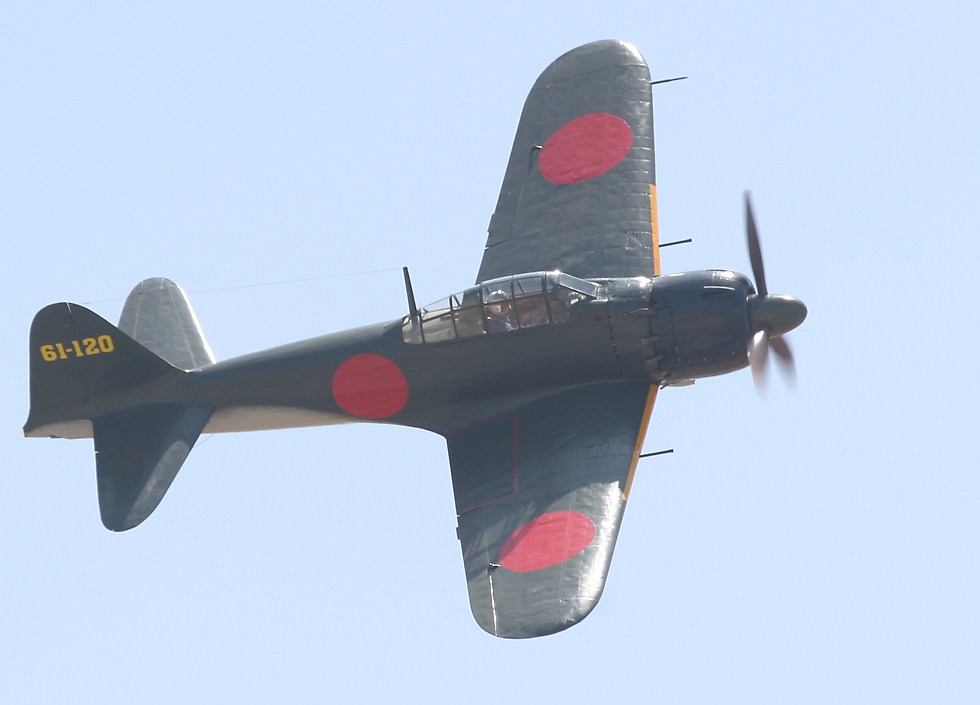
| Chino's
extraordinary collection of rare aircraft types includes this original
Mitsubishi Zero fighter, one of only two in the world still flying and
the only one with a Japanese engine. The Zero was 25 mph faster
in level flight than its main American opponent, the Wildcat, and was also
more maneuverable and more heavily armed, with two 20mm cannon and two
7.7mm machine guns compared to the Wildcat's four 0.50 inch machine guns.
However the Zero was much more lightly constructed and therefore more vulnerable
to enemy gunfire. |
 |
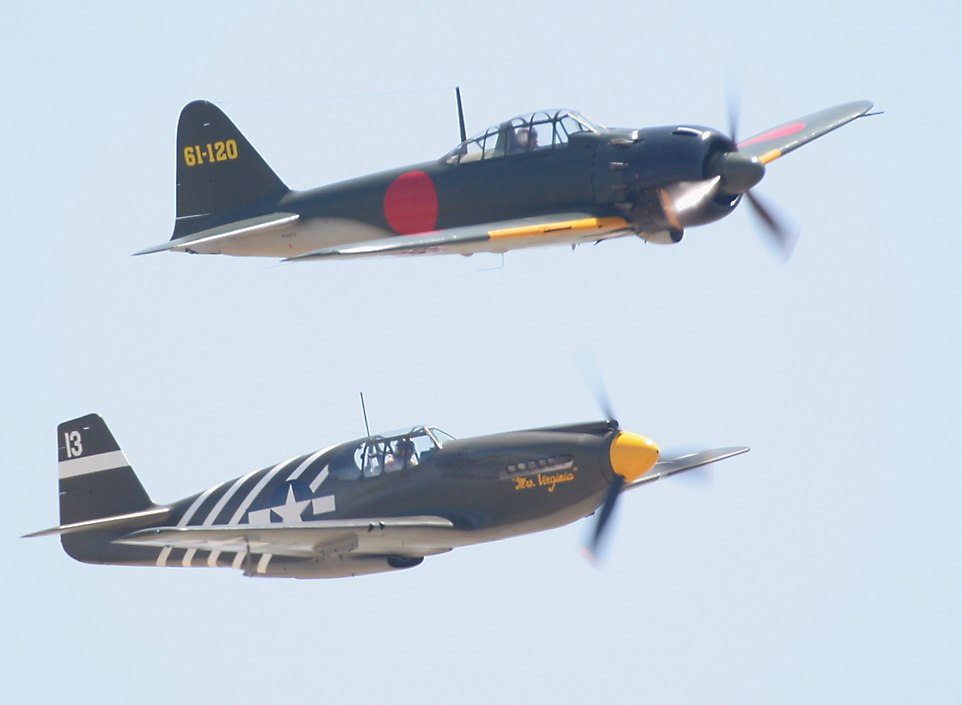
| Here's
one of the more unusual formations you're ever likely to see, the Zero
with the P-51A Mustang. It's a bit incongruous since the Mustang
entered service considerably later than the Zero and was an air force type,
whereas the Zero was primarily a naval fighter. |
 |

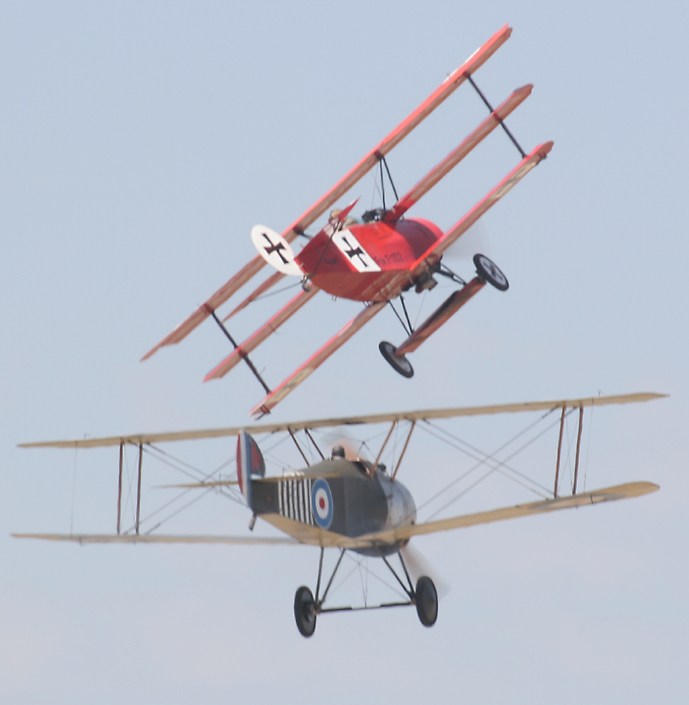
The Chino airshow excels in world war two military types, but other displays
were also flown to keep the crowds happy, like this world war one pairing
of a British Sopwith Camel fighter in hot pursuit of what was probably
the most famous German fighter of the period, the Fokker Dr.1 triplane,
painted in the scheme used by the famous Flying Circus commanded by Baron
von Richthofen. Actually, though, Richthofen made the great
majority of his kills in other aircraft types, and the Germans eventually
grounded the Dr.1 after several broke up in mid-air because of structural
failure. With only 320 built, no original Fokker triplanes
survive.
With
about 5,500 built the Camel was far more successful than the Fokker, however
the Camel was a very nasty plane to fly and killed many of its pilots.
Both the Fokker and the Camel had rotary engines, which meant that the
propeller was attached to the engine, which spun around while the crankshaft
was attached to the fuselage and remained stationary. However
this type of engine had a strong gyroscopic effect on the aircraft, making
it turn sharply to the right with a nose down attitude, but also making
it turn only slowly to the left with a nose up attitude - and even when
turning right the pilot had to use left rudder to counteract the plane's
natural tendencies. When flying level the Camel was noticeably
tail heavy, and if it stalled then it immediately entered a spin which
it was exceptionally difficult to get out of.
Rotary engined aircraft like these had no throttles, so pilots had to "blip"
their engines in order to reduce speed enough for a safe landing.
The two aircraft at the show demonstrated this technique while they were
circling around, cutting and restarting the engines over and over. |
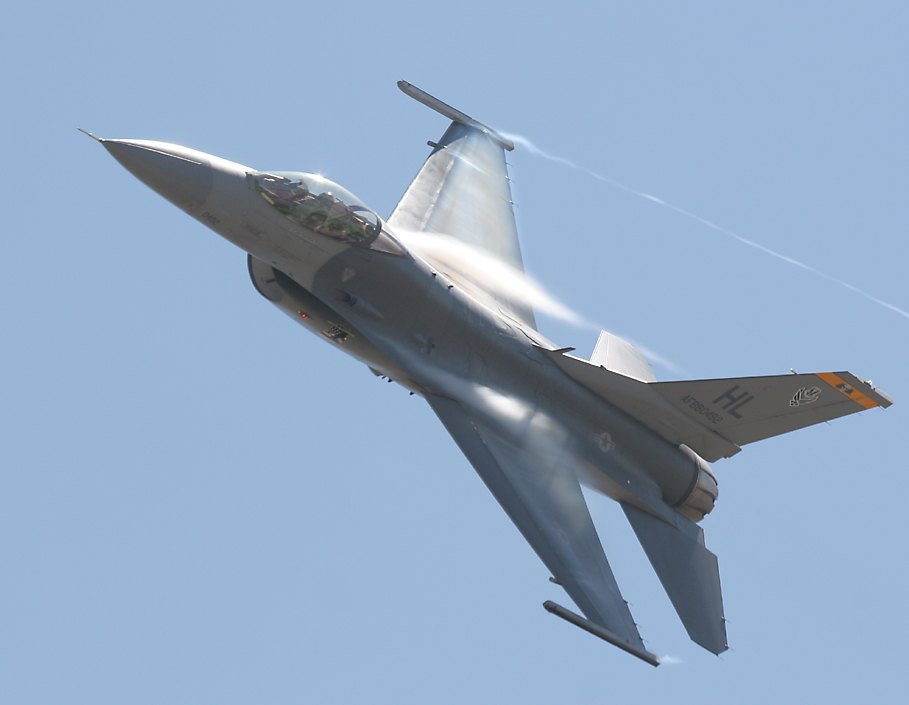
| Turning
from the ancient to the modern, there were several front line jets to thrill
the crowd and wake up the local cows living in the fields around the airport.
As well as this F-16 Fighting Falcon there was also an individual display
by an F-18C Hornet. Another F-18C flew a navy tailhook
legacy flight with one of the Bearcats, and the F-16 flew an air force
heritage flight with Chuck Hall's Mustang "Six Shooter".
The P-38 was supposed to take part in this heritage flight but on Saturday
its starter motor wouldn't operate, so this three plane formation only
took place on Sunday, when the weather was lousy. |
 |
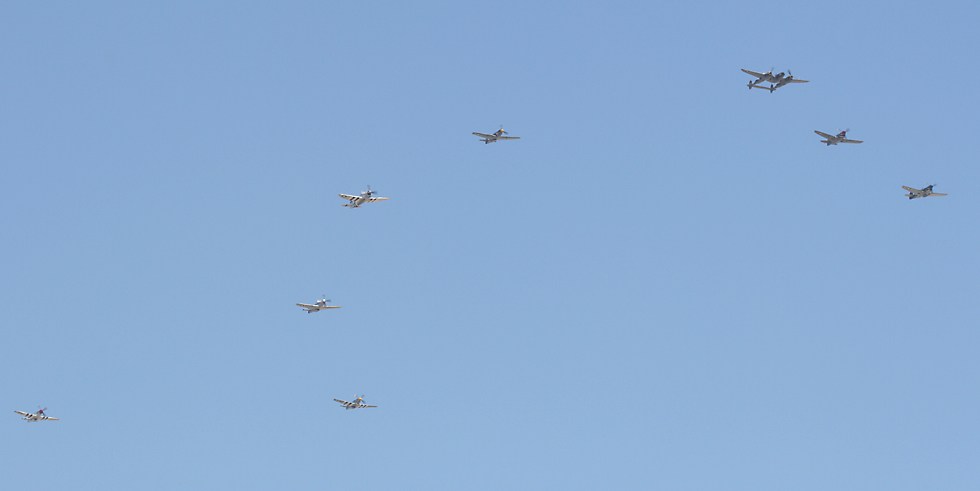
| The
conclusion of each day's show was a mass flyby of all of the planes which
had taken part in the show. Displays like this are great to
watch, but they don't make for very good photos because the planes are
too spread out to appear as anything more than dots. |
 |
Check
out highlights of the Chino airshow in 2004
and 2008.
 |