| Gidroaviasalon
2006 Highlights |
| It
was quite an exercise for me to get to Gidroaviasalon ("hydro-aviation
exhibition") held at the Beriev test center near Gelendzhik on the Russian
Black Sea, a week after the
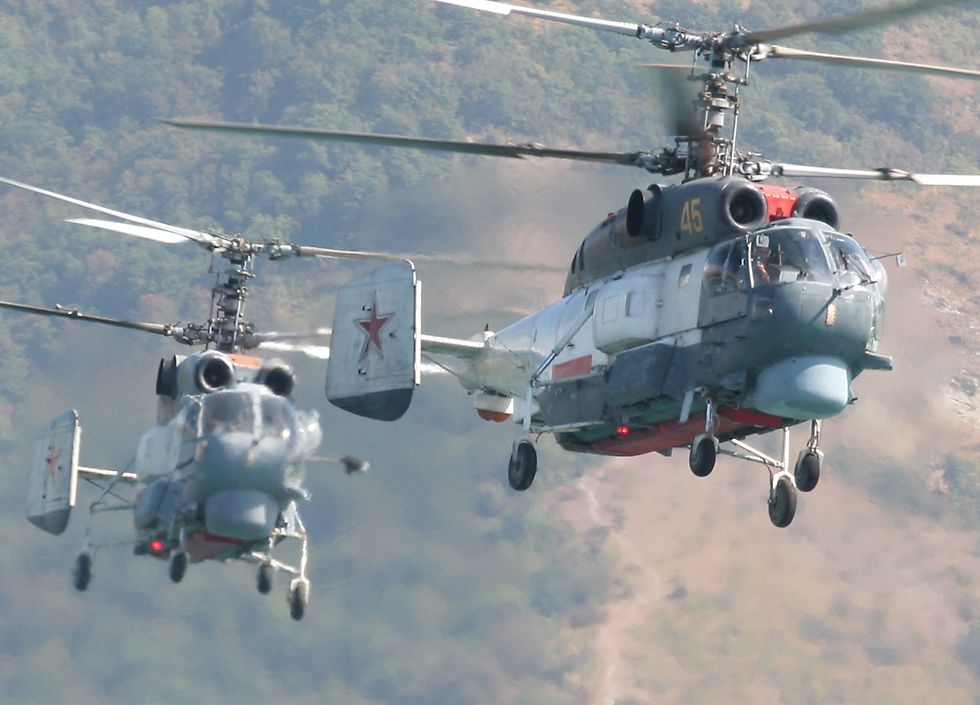
Czech International Air Festival. This pair of Kamov Ka-27
"Helix-A" helicopters opened the show on Tuesday. The Russian-designed
Ka-27 might look strange to western eyes, but this is a very successful
naval helicopter in service with many foreign countries. The
Kamov design bureau specializes in helicopters with contra-rotating rotors,
the show advertising said they'd also be displaying the Ka-32, successor
to the Ka-27, and a Ka-52 Alligator gunship, but they didn't show up.
However if you need a fix of these cool aircraft then you can take a look
at several
models of Kamov helicopter I photographed at the 2005 MAKS airshow in Moscow. |
 |

The Ka-27s only flew on the first day of the six-day exhibition, but a
Mil Mi-8 "Hip" dropped parachutists at the start of the show on several
days.
The Mi-8 is one of the most successful helicopters in the world, roughly
equivalent to the American UH-1 Iroquois, better known as the "Huey".
The Mi-8 is much larger than the UH-1, but is just as versatile and has
seen just about as much action around the world, having been exported to
more than 50 different countries.
As with the Kamovs, so too Mil was supposed to have several other helicopters
at the show, including the amphibious Mi-14 "Haze" which was derived from
the Mi-8, and the huge Mi-6 "Hook" which was on the schedule to do a fire-fighting
display. They didn't come, but you can see an
Mi-14 at the Nellis AFB Threat Training Facility, and
a
couple of Mi-6s, including one in fire-fighting configuration at the Russian
air force museum at Monino, near Moscow, and another
Mi-6 at the Vietnamese Air Force museum in Hanoi. |
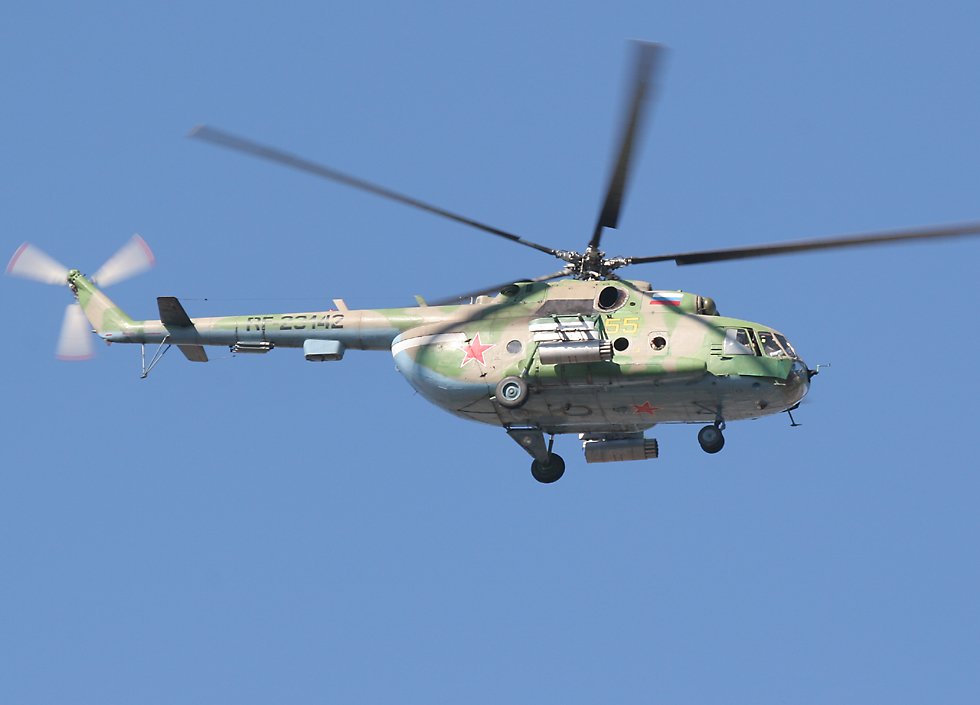
| Here's
a different Mi-8, this time armed with a pair of rocket launchers.
This particular helicopter wasn't part of the show, but flew out of the
small airport directly behind the Beriev facility where Gidroaviasalon
is held. The country of Georgia, which isn't on very good terms
with Russia, is only about 200 kilometers from here, and several disputed
former Soviet republics, including Chechnya, aren't too much further away,
so perhaps this helicopter is based in the area for that reason. |
 |
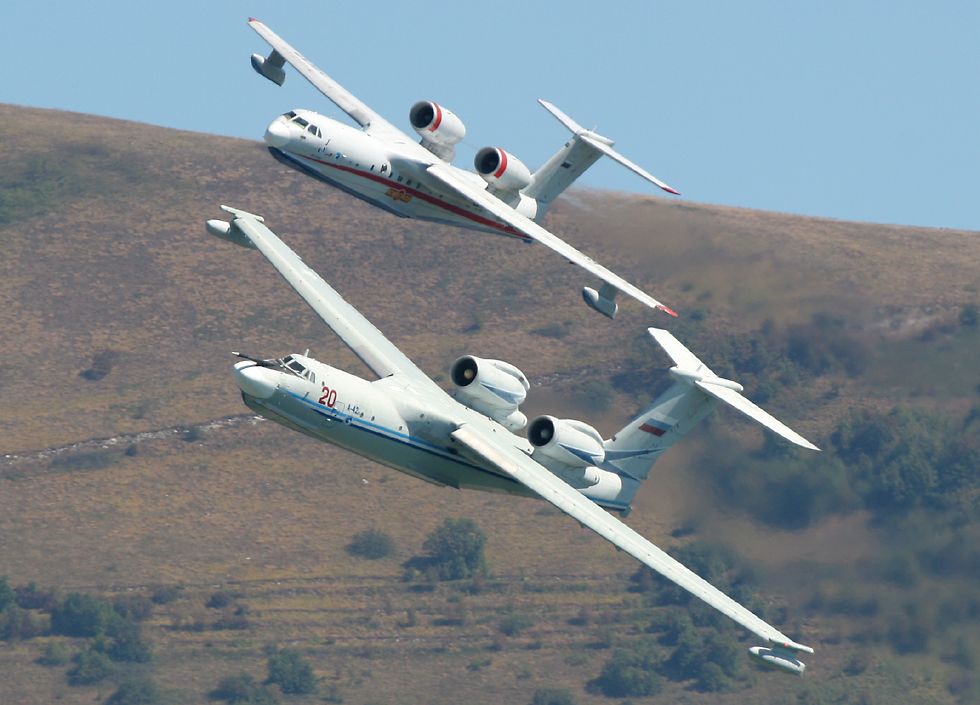
| However
I didn't come all this way just for a few helicopters! I came
because the Beriev design bureau has been designing sea planes (or flying
boats for British commonwealth readers) since before world war two, and
they're the only company which has built jet powered sea planes like the
Be-200 at the top of this photo and the A-42 "Albatross" below it. |
 |
| We
were lucky to see the A-42 flying, since it had engine trouble which kept
it on the ramp for the first few days of the show, and only doing taxying
runs on the water for one day. Still, that was better than
the propeller-driven Be-12 "Mail" sea plane which was advertised, which
was yet another no-show. |
 |
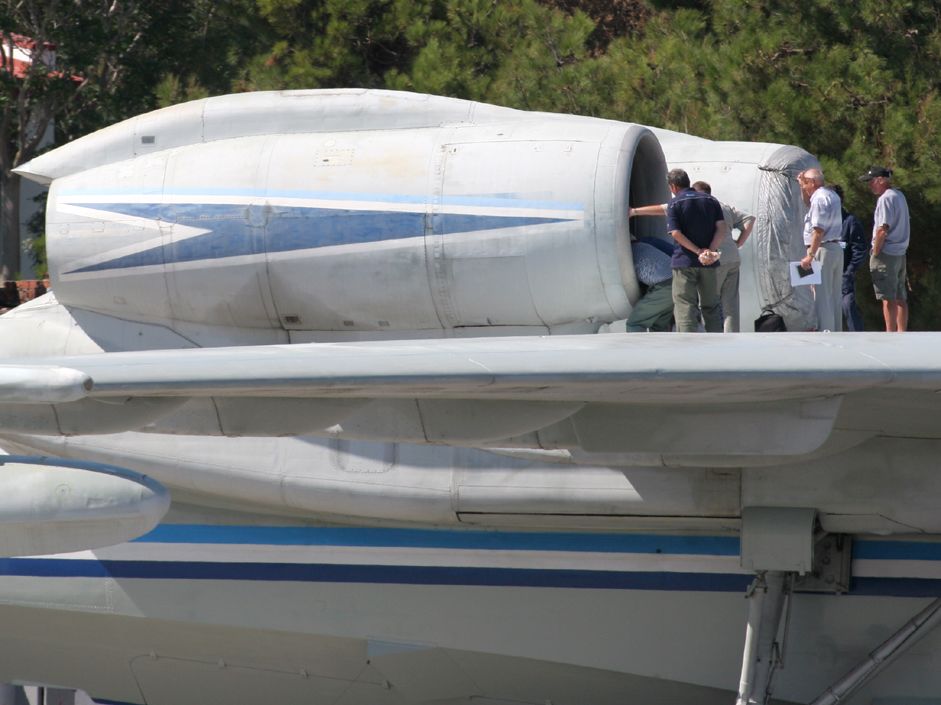
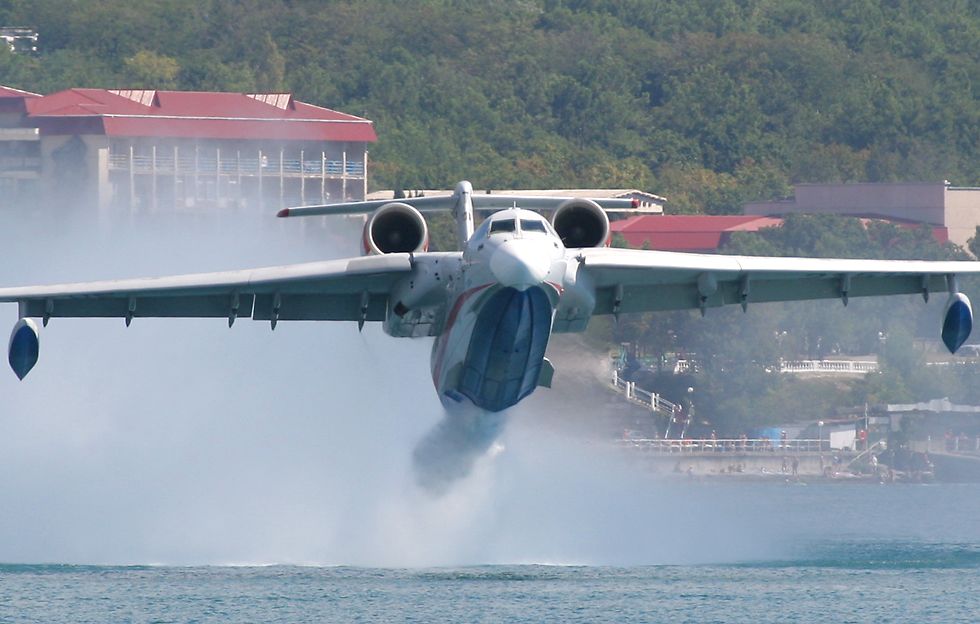
| Those
two large turbofan engines provide a huge amount of power, you can get
a real sense of that during its takeoff runs. |
 |
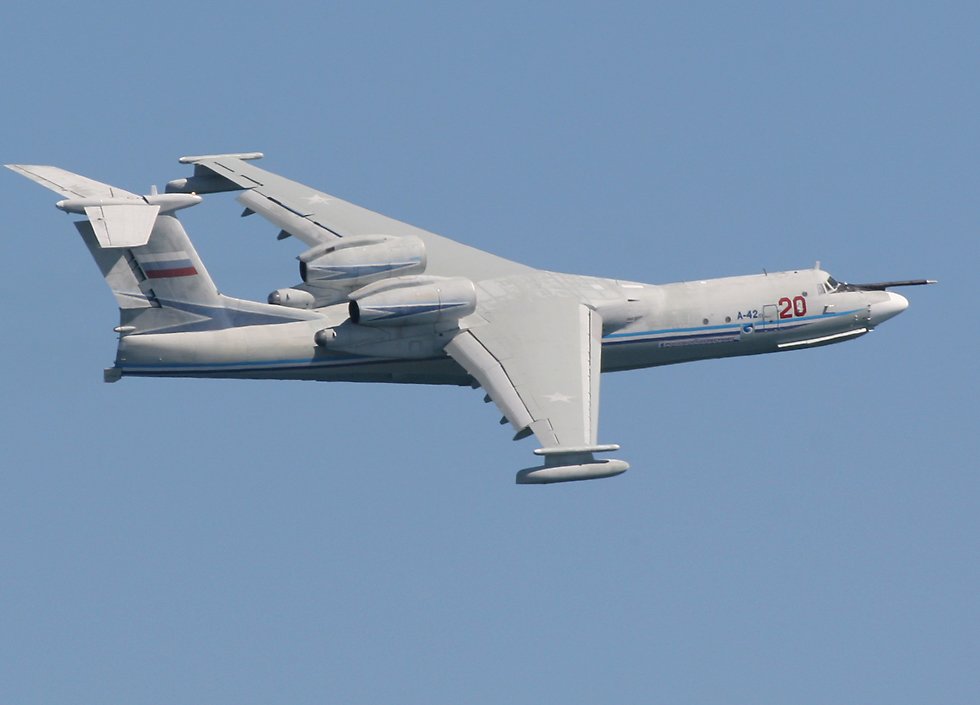
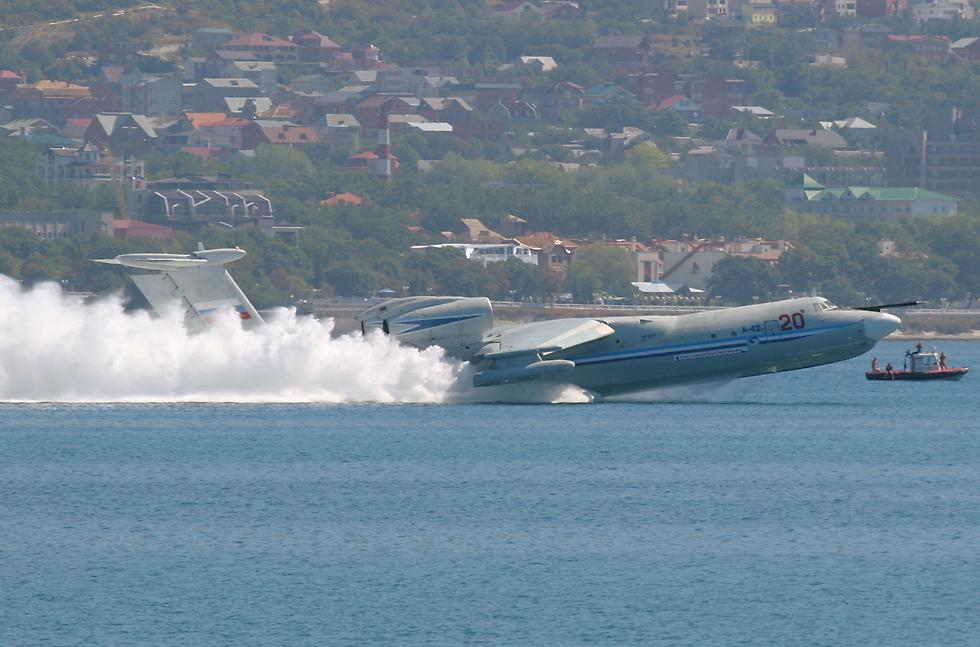
| Although
the A-42 is capable of doing fire-fighting, and there's also ample room
inside for passengers and cargo, the refuelling probe on its nose betrays
its main purpose as a military maritime patrol and anti-submarine aircraft.
However it has yet to find any buyers, so only a few test aircraft exist. |
 |
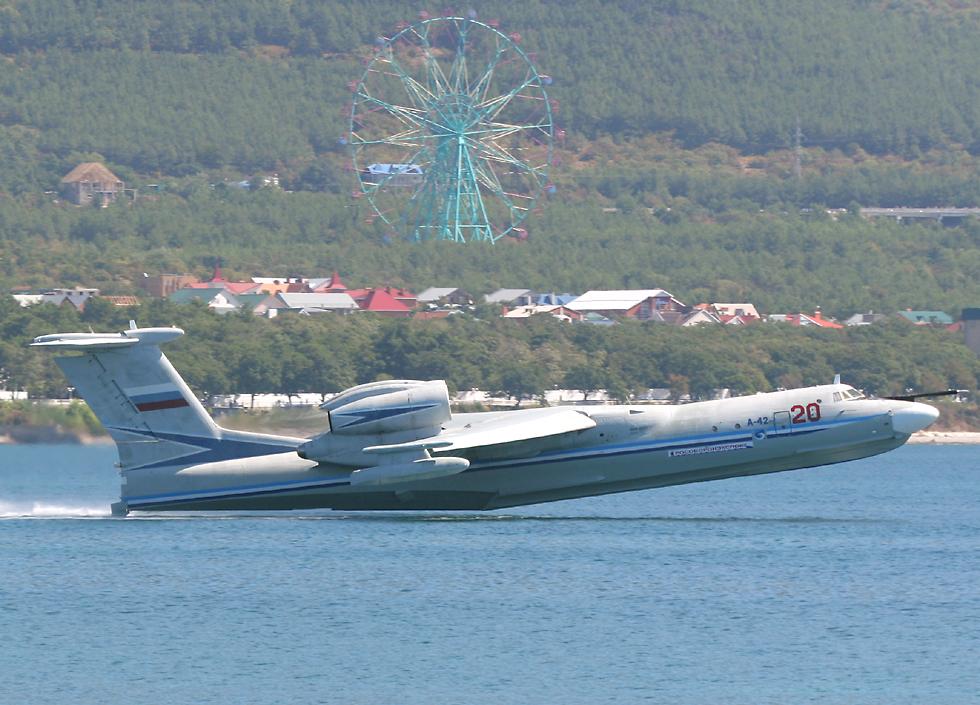
| Here
it is coming in for a landing, with its rudder already in the water.
Like many of the Russian Black Sea towns, Gelendzhik is a resort, which
explains the Ferris wheel in the background, as well as the other amusement
park trappings and holidaymakers you'll see in the background of these
photos. |
 |
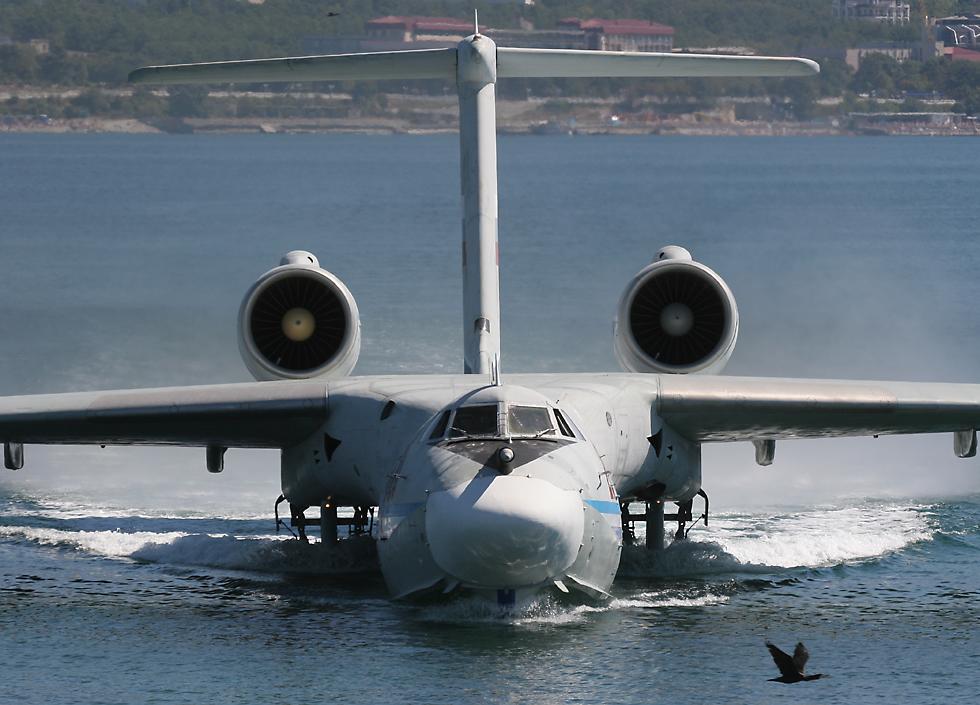
| A
cormorant makes good its escape as the Albatross nears the ramp.
The engines are mounted high and behind the wings to prevent water entering
them and causing corrosion; however the landing gear is extended soon after
the plane lands, perhaps to decrease the chances that the pilot will forget
to put them down and run aground. |
 |
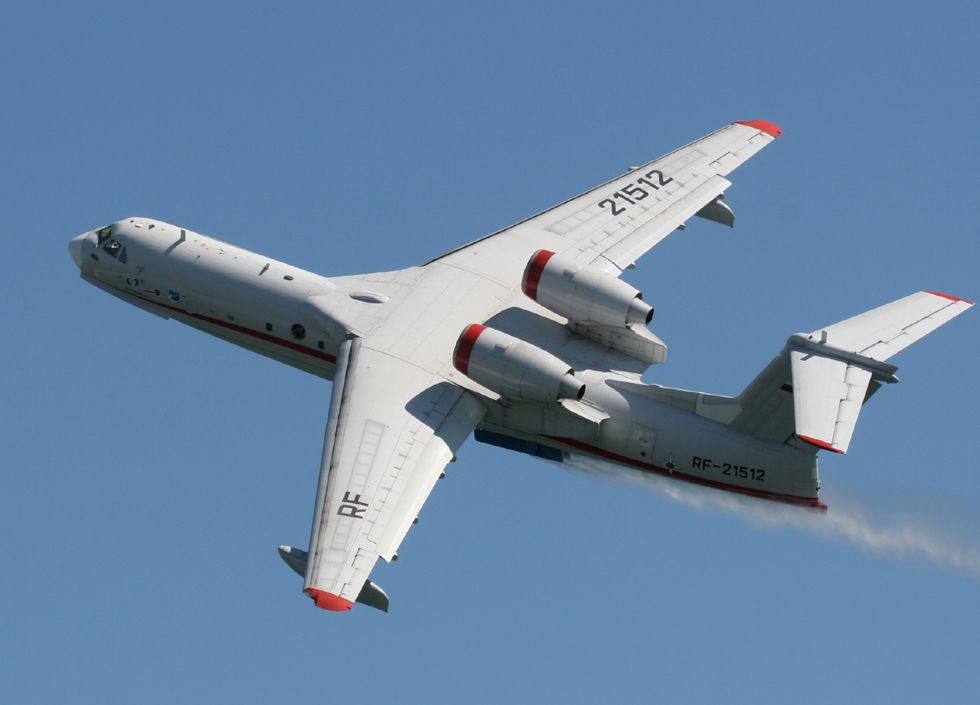
| The
Be-200 is a more recent design than the A-42, and is intended to give Beriev
a foothold in the civil market. As well as acting as a water
bomber for firefighting, it's also being marketed for cargo transport and
as a passenger aircraft, especially for maritime countries or other markets
which lack regular airports and other infrastructure, but have suitable
aquatic landing areas. |
 |
Unfortunately it's been a hard road for the company to find buyers in spite
of the obvious advantages of an amphibian over competing land-based aircraft,
perhaps because of unfamiliarity and inherent drawbacks such as greater
fuel consumption due to those drag inducing floats and a hull designed
more for hydrodynamics than for aerodynamics.
At $US25 million an aircraft, the Be-200 costs the same amount as its main
competitor, the turbo-prop powered Bombardier CL-415, based on the
piston-engined CL-215 which you can see doing a water drop in 2005.
Both the Beriev and the Bombardier have an advantage over land-based water
bombers by being able to refill on any convenient lake while still moving,
but the Be-200 can carry twice as much water as the CL-415, and its higher
speed potentially makes it capable of dropping water more often. |
 |
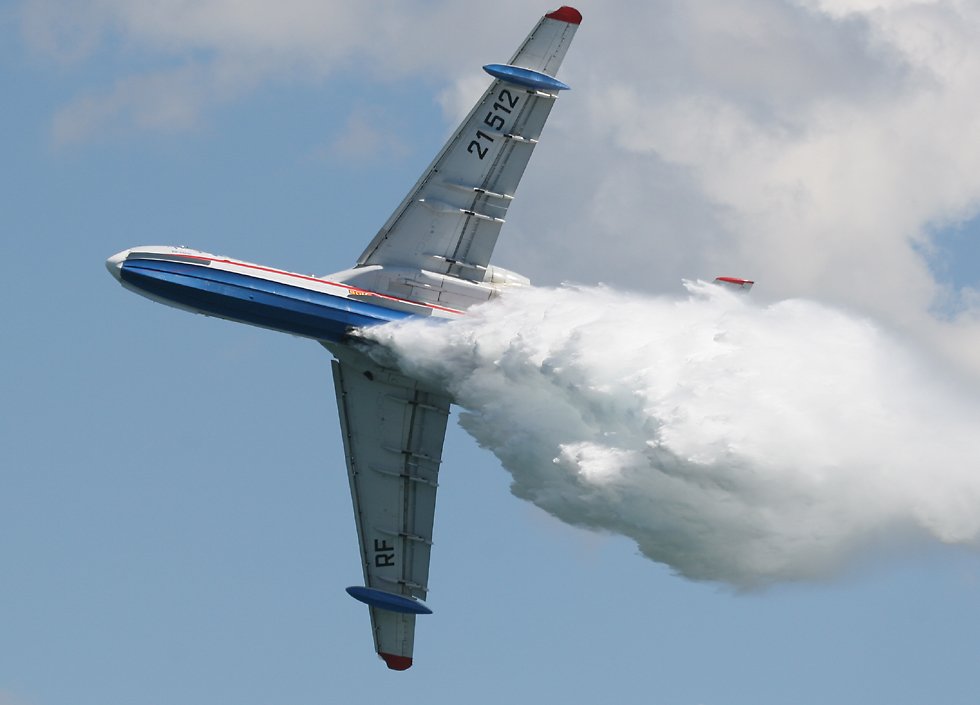
| Beriev
has sold several Be-200s to the Russian Interior Ministry (one of which
also displayed during the show) and there have been leasing arrangements
for firefighting in Italy during 2005 and Portugal during 2006.
While in Portugal the Be-200 you see here hit a tree on takeoff while fully
loaded with fuel and water. Branches from the tree entered
one engine and knocked it out, but the plane was still able to climb out
on its remaining engine and later make a safe landing. It's
not the sort of advertising Beriev was looking for, but apparently an Italian
water bomber pilot who saw the incident said that no other aircraft would
have survived such an accident. |
 |
| During
Gidroaviasalon 2006 this Be-200 set two new world records for fastest speed
around a 500km circuit and around a 1000km circuit including takeoff and
landing on water, and six other world records for amphibians taking off
and landing on conventional runways. |
 |
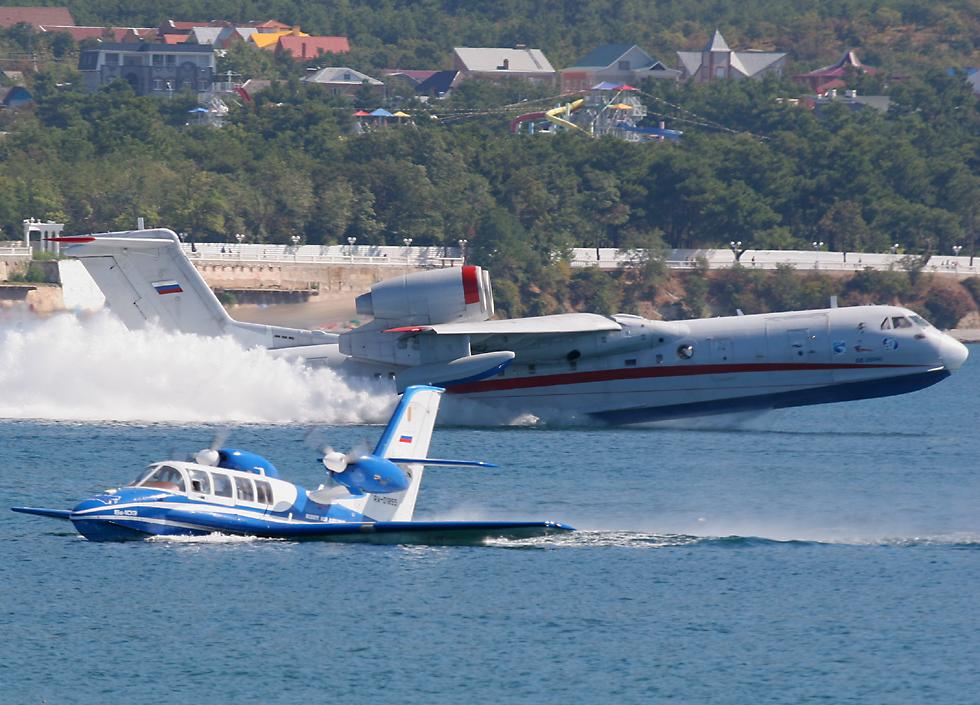
| The
small plane in front of the Be-200 is another Beriev creation, the Be-103.
Like its bigger brother, the Be-103 is an attempt to capture part of the
civil market while sticking to Beriev's seaplane knitting.
The 103 has had some successes too, it officially received its American
FAA certification at the 2003 Oshkosh Airventure show, and a small number
of them have been sold into that market. |
 |
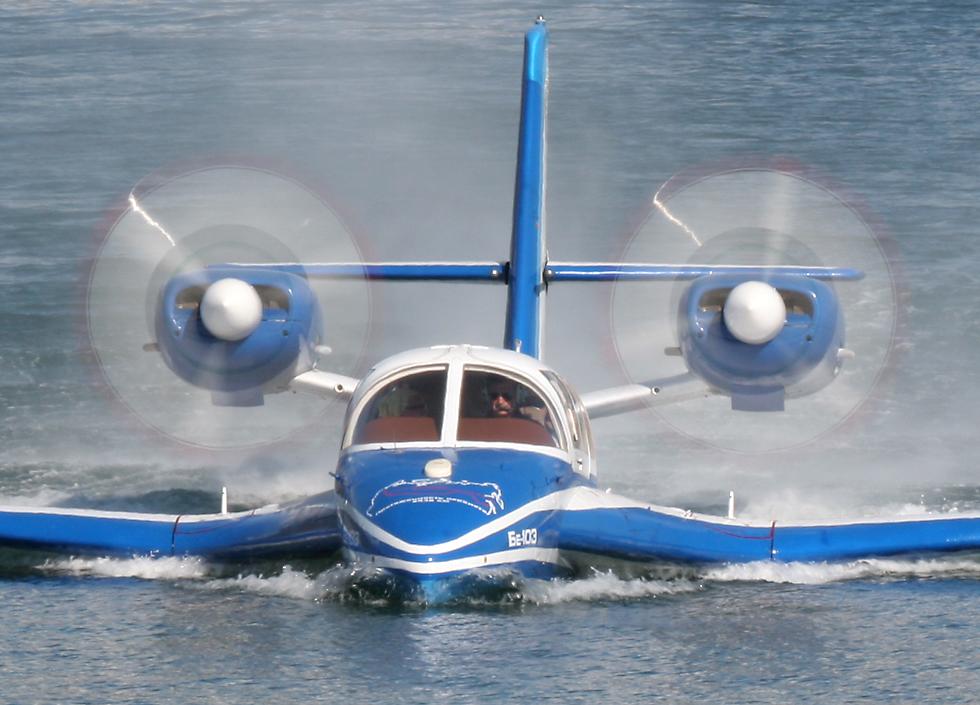
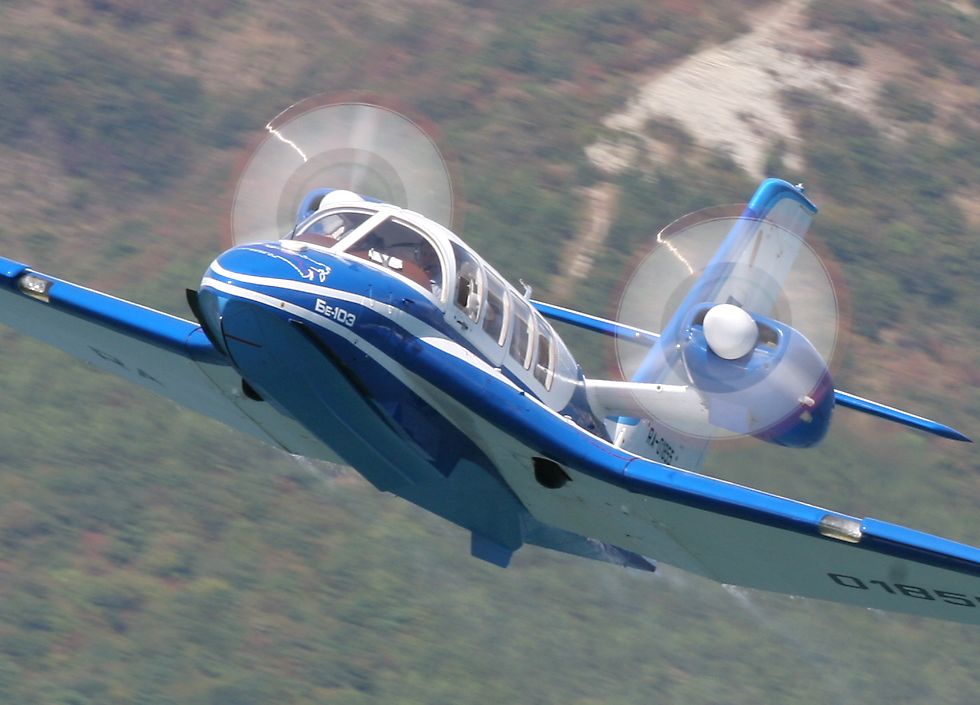
| Beriev
pitches the Be-103, which in English is called the "Snipe", as a six-seat
private or commercial transport, or as an air ambulance. Three
Snipes were in constant action during the show, doing paid rides for visitors
at about $US60 a time. I did one of these flights myself, going round
the very attractive, nearly circular bay where Gelendzhik is located, and
even taking over the controls for a while. |
 |
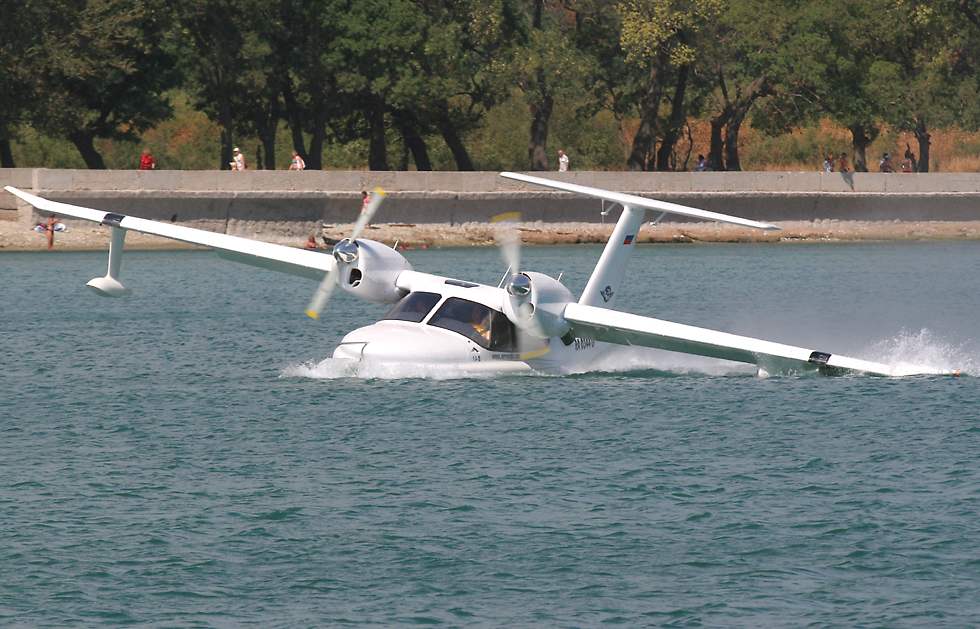
| This
exhibitor didn't have such a successful time. The aircraft
is an LA-8, not manufactured by the now defunct Lavochkin design bureau
of world war two fighter fame, but by a small company called AeroVolga.
They had a terrible show, ending up with the left float submerged on this
outing, and wallowing around in the shallows on another day, perhaps with
engine trouble. They did eventually get airborne, but it wasn't
a great confidence booster for anyone thinking of buying one. |
 |
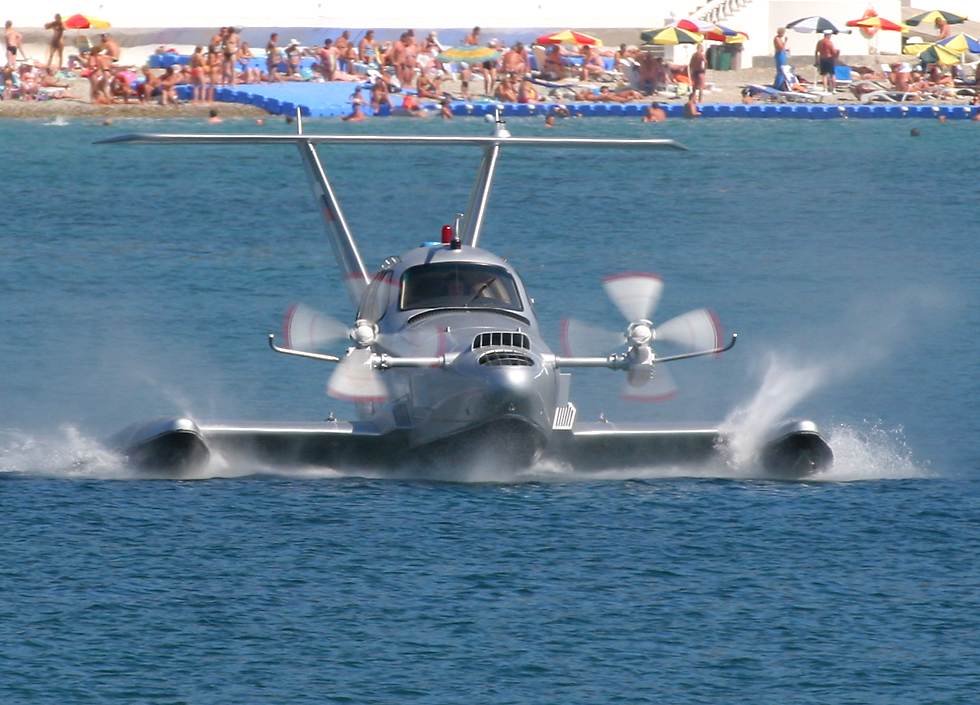
| This
strange looking beast was built by another private company and was certainly
the most unusual thing on display. The "Aquaglide 5" is a five-seat
"wing in ground-effect" vehicle powered by a gasoline engine.
Part boat, part hovercraft, when travelling at speed this craft generates
enough lift from its stub wings to fly 15 to 30 centimeters above the water.
The first such "ekranoplan" was an unbelievably large craft, over 100 meters
long and weighing 540 tonnes, but it could travel over water or flat land
at over 400 km/h powered by ten jet engines, eight mounted near the nose
which could be tilted to blow air under the wing, and two more on the tail.
Dubbed the Caspian Sea Monster by American intelligence personnel, it never
entered service, but the dream continued for the engineers working on it,
in this very scaled down form. |
 |
| Many
aircraft were missing from the display, apparently this is typical, so
the Tu-142 "Bear" and IL-38 "May" I was hoping to see didn't turn up, however
two very welcome participants which did display were the Russian air force
jet teams, the "Russian Knights" flying Su-27 "Flanker" fighters and the
"Swifts" flying MiG-29 "Fulcrum" fighters. They do a number
of things which you won't see from foreign jet teams like the US air force
"Thunderbirds" and the US navy "Blue Angels", such as simply flying together! |
 |
| Both
the Su-27 and the MiG-29 were developed in response to the American F-15
Eagle, but the Russian aircraft are very different from each other, even
though they share the twin-tail, twin-engine layout and a roughly similar
wing plan. The MiG is a much smaller aircraft than the Sukhoi,
making it more suitable for short-range point defense while the latter
is better at long-range strike and interception. |
 |
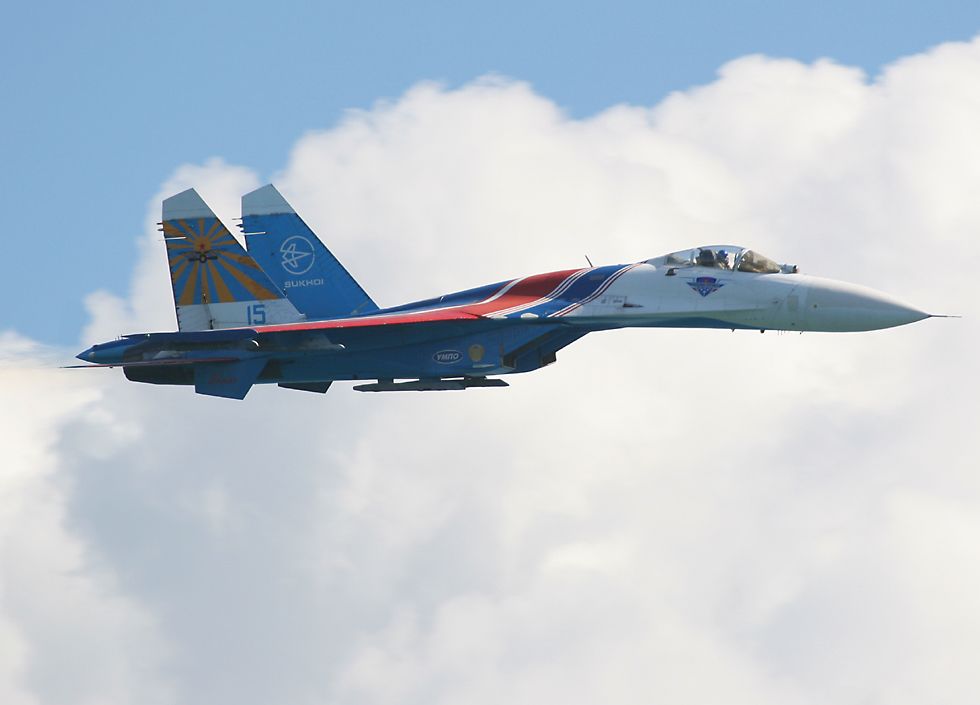
| The
Sukhoi is a very attractive aircraft, it looks something like a greyhound,
with curves that make it much more aesthetically pleasing than the square
and chunky Eagle. |
 |
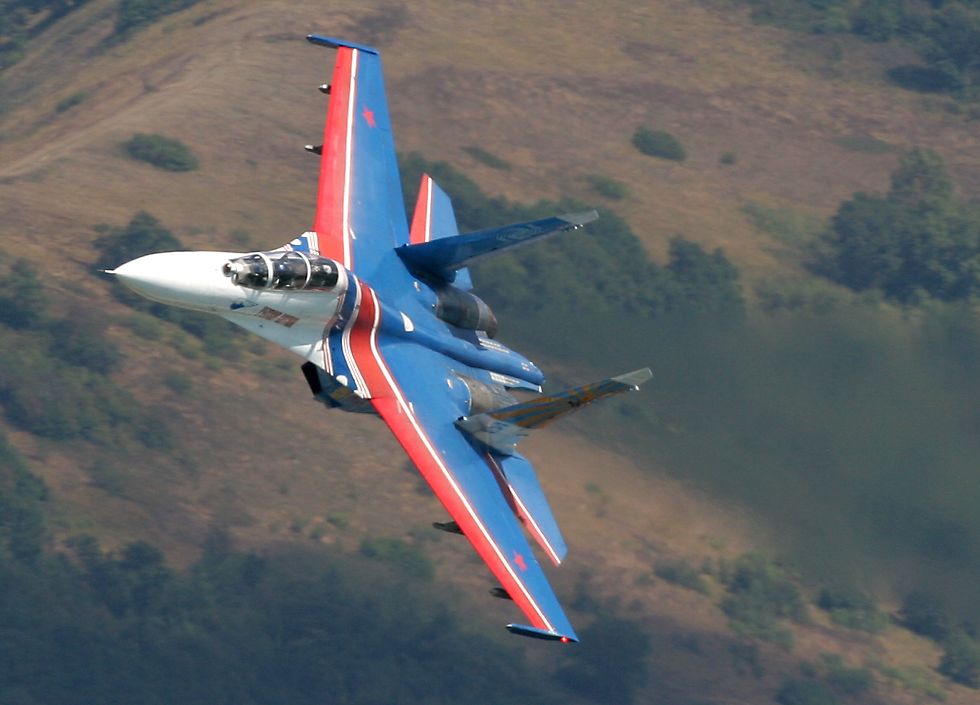
| The
Beriev facility is on the north-west side of the bay, and since the flying
happens in the morning or very early afternoon this means that most of
the displays are backlit. However, when shooting to the east
it's possible to get some nicely lit photos with the added bonus of the
hills behind the town. |
 |
| The
Knights do most of the standard airshow maneuvers, including opposing passes... |
 |
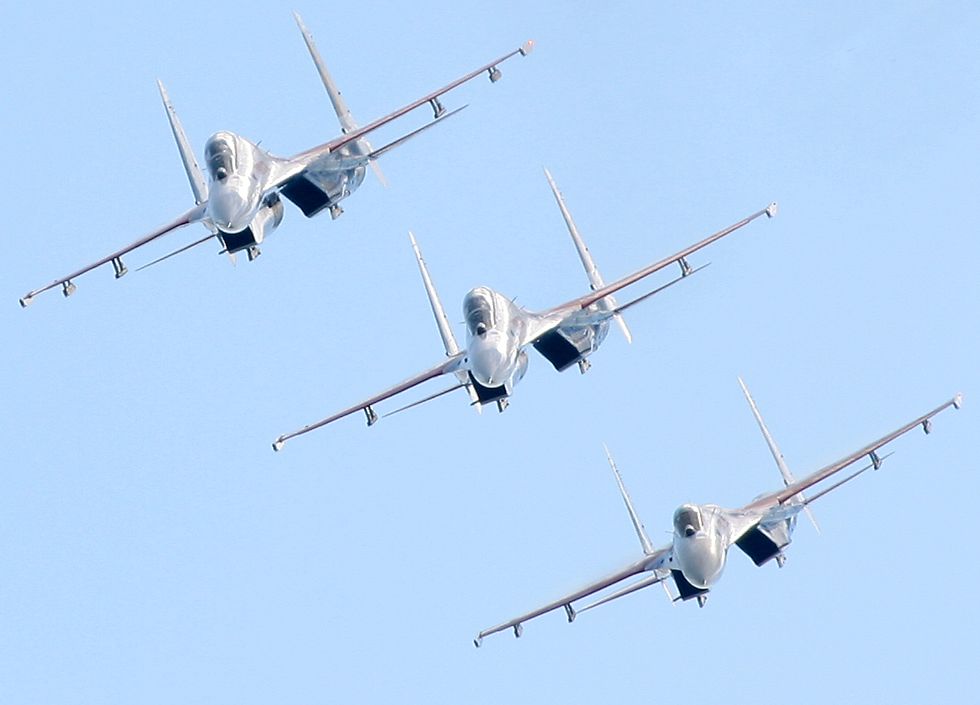
| ...formation
aerobatics... |
 |
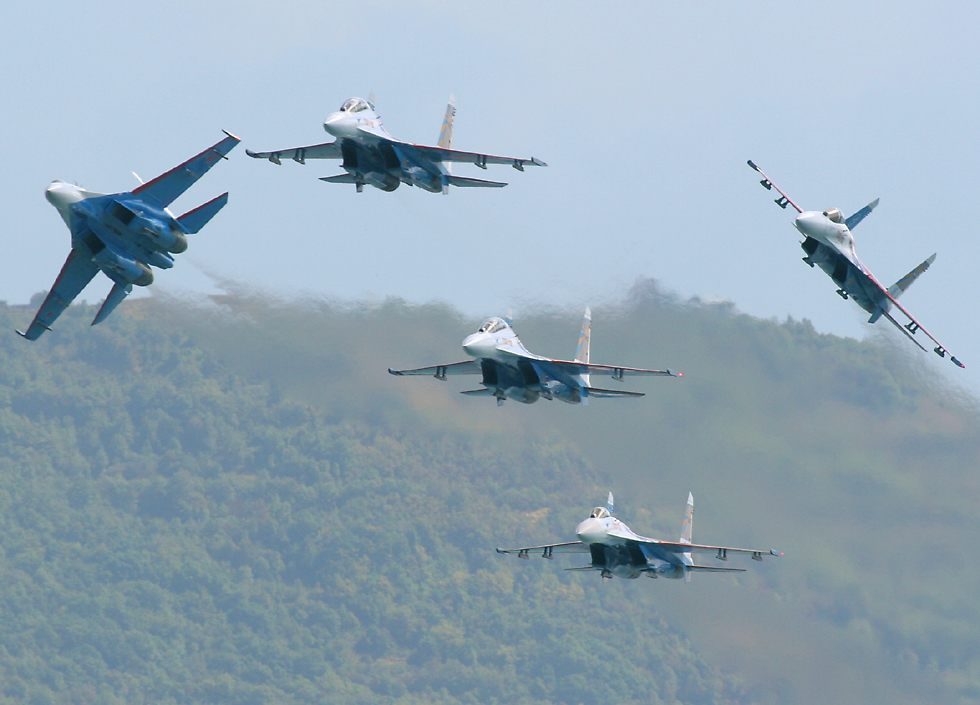
| ...and
formation breaks... |
 |
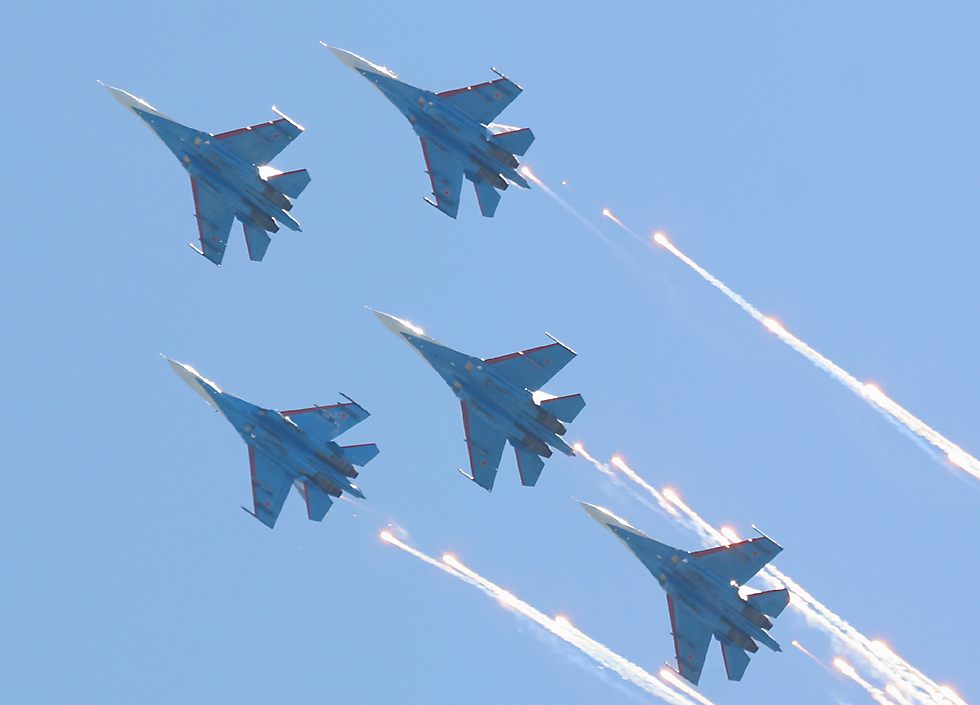
| But
they also do stuff that other teams don't do, and that American airshow
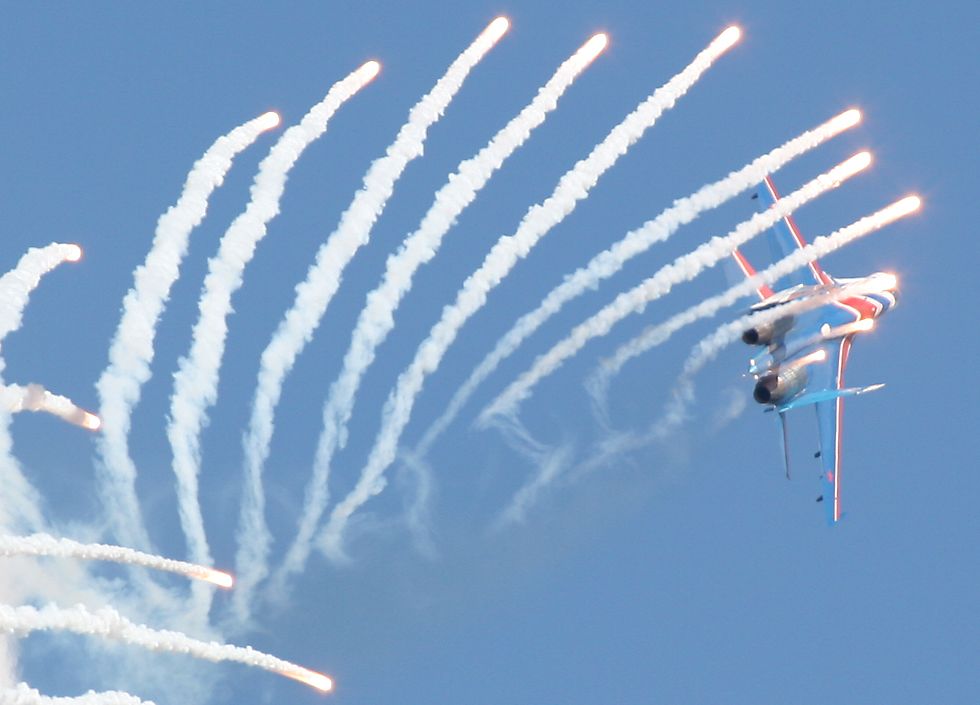
fans can only dream of, like formation passes with flares... |
 |
| ...and
spectacular solo flare routines! |
 |
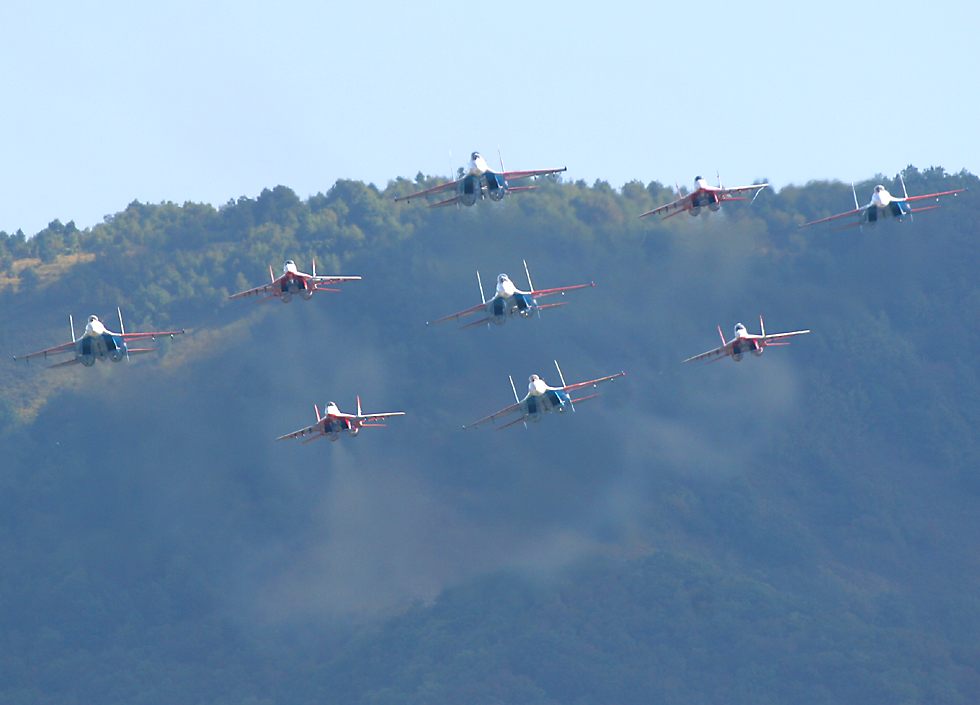
| The
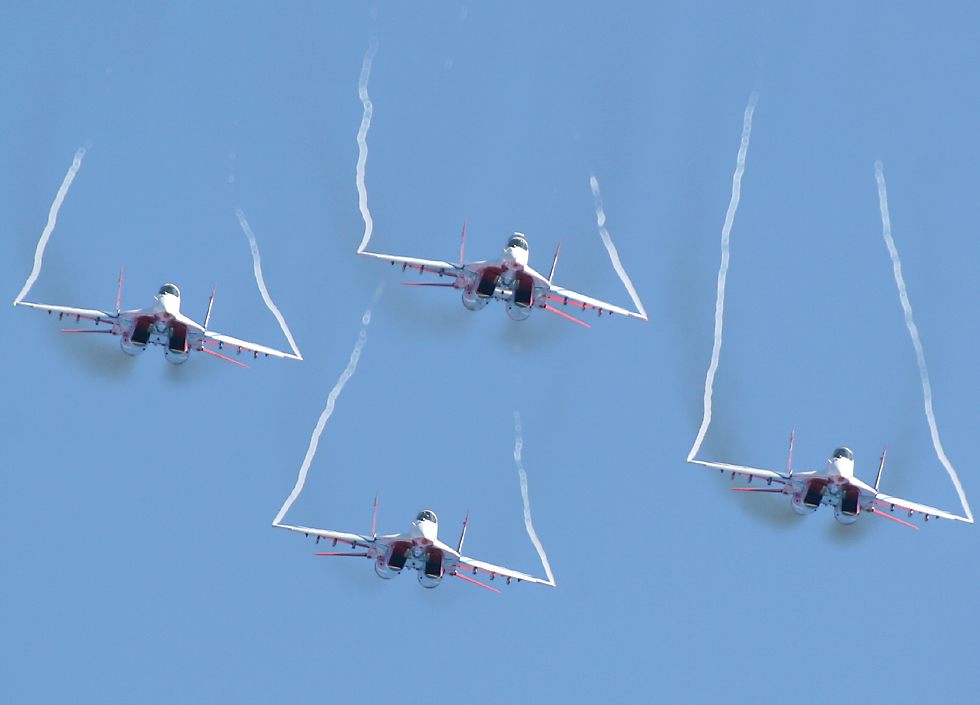
formation flying of the Russian Knights and the Swifts is nowhere near
as tight as most national teams, but they're both well worth watching.
The Swifts are noticeably more vapor prone than the Russian Knights, and
the engines are much smokier too! |
 |
| Plenty
of solo passes with afterburner to add some zing... |
 |

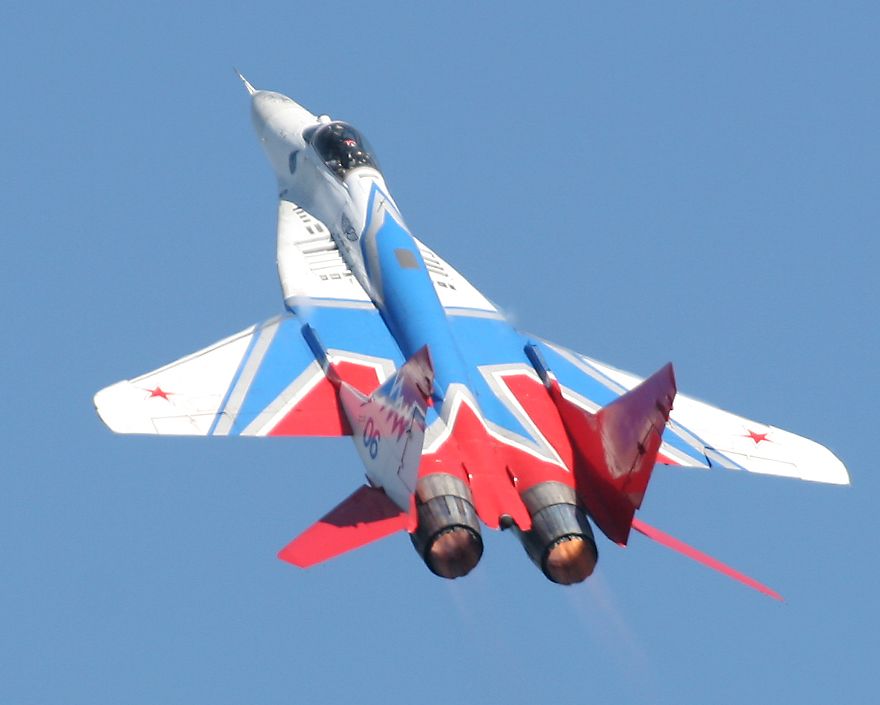
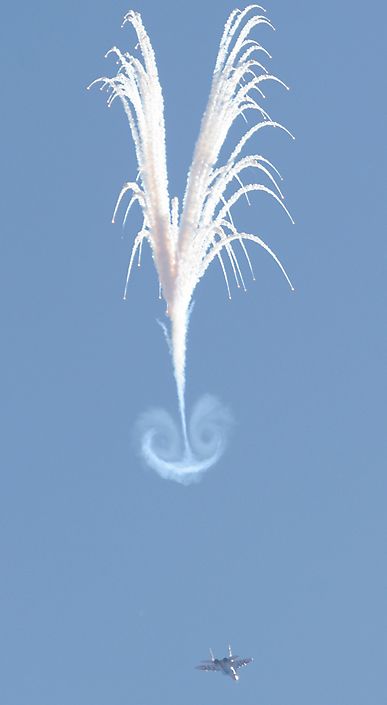
Plus a speciality which you won't see anywhere else, vertical flight up
to a stall followed by rapid firing of the flares and a tail-slide, a maneuver
which isn't done by any other team. |
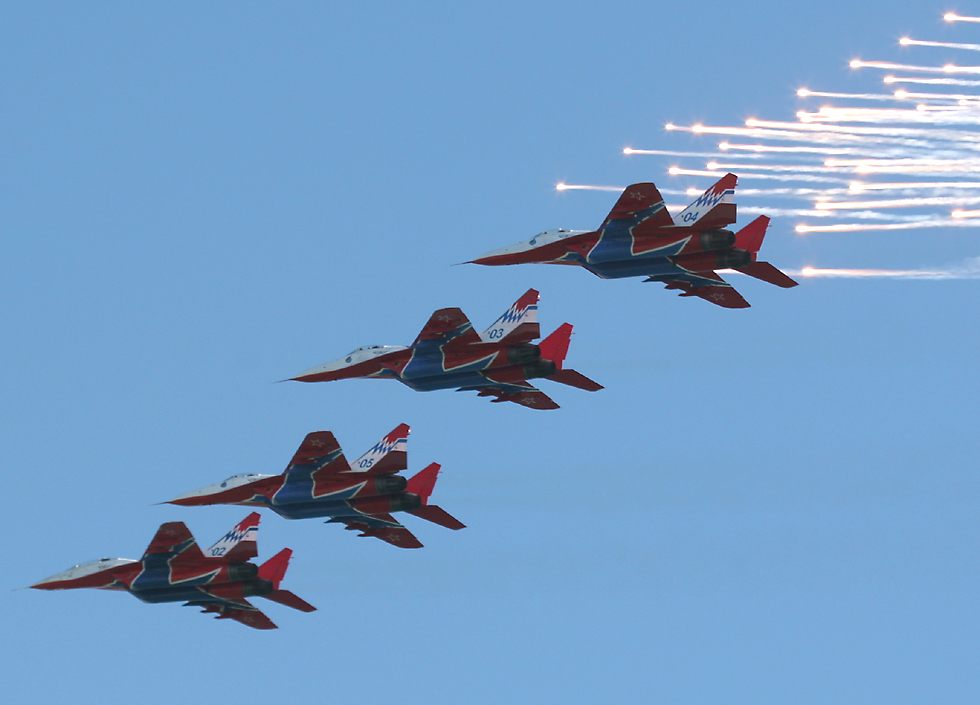
| A
few more flares to round out a frustrating but interesting show! |
 |
 Check
out the Main Gidroaviasalon 2006 Page,
or see the Highlights of
the MAKS 2005 Airshow in Moscow, or the Helicopters
of MAKS 2005.
 |