|
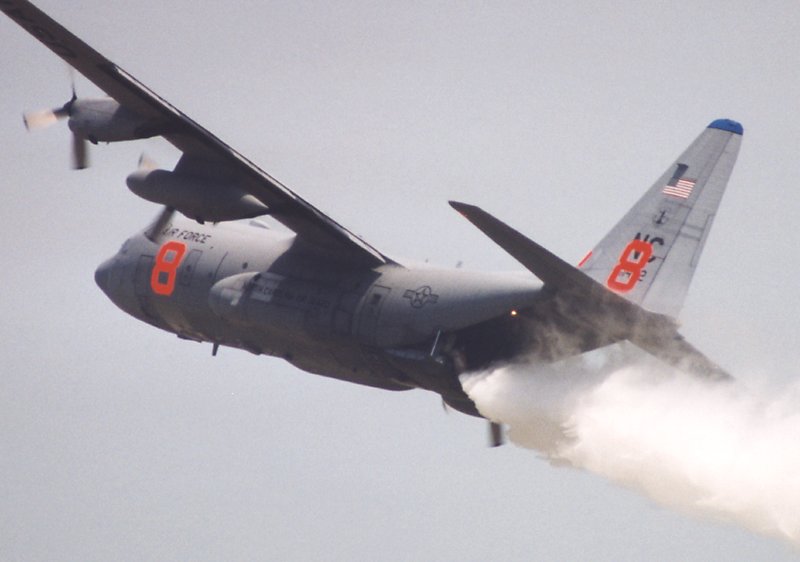
I photographed my first fire-fighting aircraft at the 1998 Andrews air
force base airshow in Maryland, about six months after I moved from New
Zealand to the United States. Unfortunately neither my equipment
nor my skills were much good back then, and the strong backlighting at
the show didn’t help either. New Zealand has a lot of forests
so there must be fire-fighting aircraft there but I don’t remember ever
seeing any, let alone photographing them. |
 |
The terms “fire bomber” and “water bomber” are both used to refer to fire-fighting
aircraft, but within the industry “air tanker” is the normal usage, though
it’s a bit ambiguous since air-to-air refuelling aircraft are also tankers.
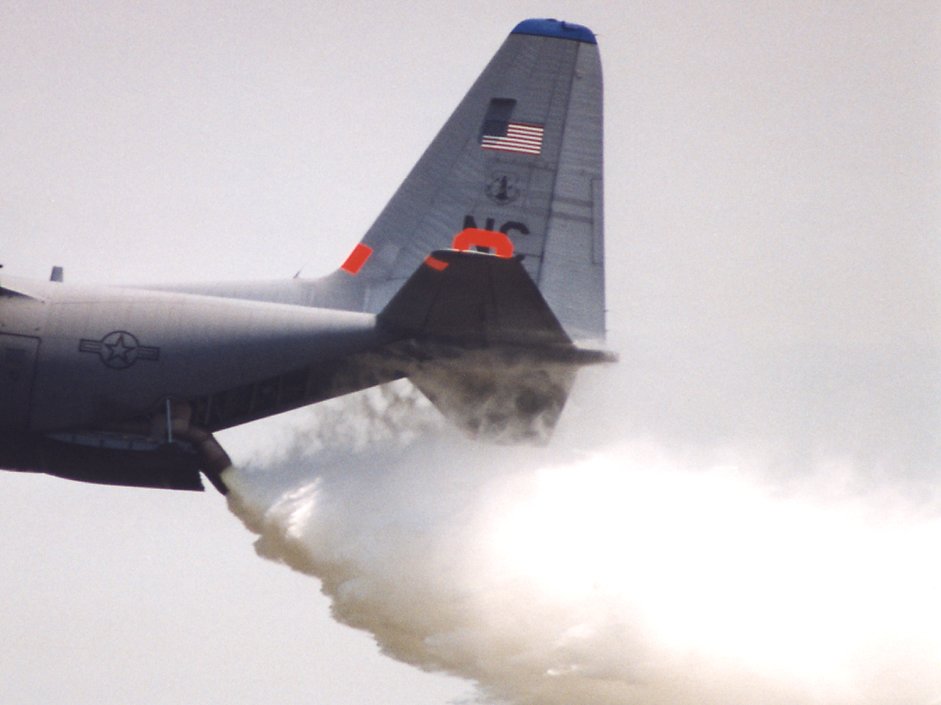
The fire bomber in these two photos is a military C-130 Hercules with a
removable water or fire retardant tank fitted in the cargo hold, and a
simple nozzle arrangement which feeds straight out the open back ramp.
It’s a fairly crude setup but has the advantage that the plane can be converted
back very easily to ordinary cargo or troop carrying duties. |
 |

Just a year later and I had an opportunity to see fire-fighting aircraft
in action on a real-life blaze.
I had moved by this time from Virginia to Chicago
and then from Chicago to the New Jersey town of South Bound Brook.
In September of 1999 Hurricane Floyd, one of the largest Atlantic hurricanes
ever recorded, came up the east coast of the United States and dumped huge
amounts of rain, causing the Raritan River which runs through South Bound Brook
to rise 40 feet and put a stream of water ten feet deep through Main Street. |
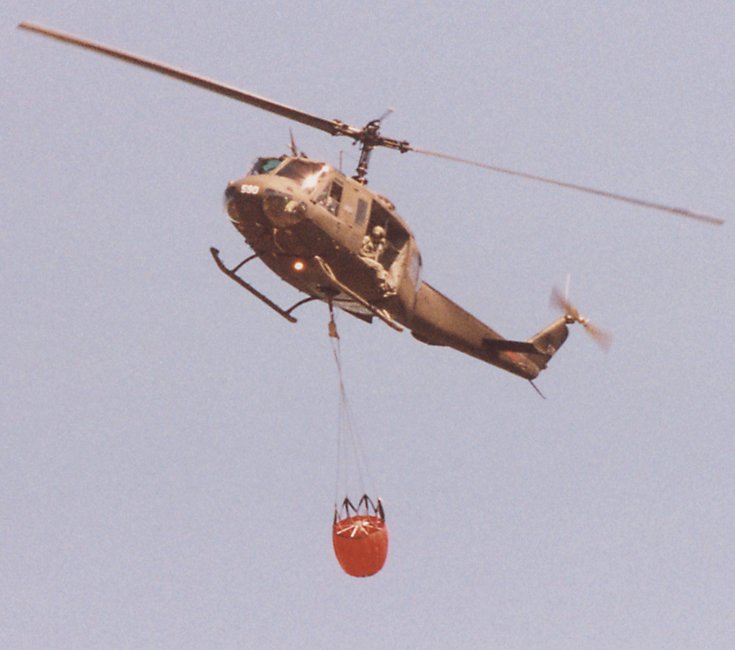
So, I can hear you saying, why were fire-fighting aircraft sent to The
Great Bound Brook Flood of 1999?
Well, somehow the Harley-Davidson motorcycle store on Main Street caught
fire and, with ten feet of water around it, the only way to put the fire
out was by helicopters using what are called “monsoon buckets” or “Bambi
buckets”. |
| Fast-forward
now to the
2004 Jacqueline Cochran airshow in the southern California desert city
of Thermal, near Palm Springs. This isn't too far from Hemet,
where the California Department of Forestry has a major fire bomber base.
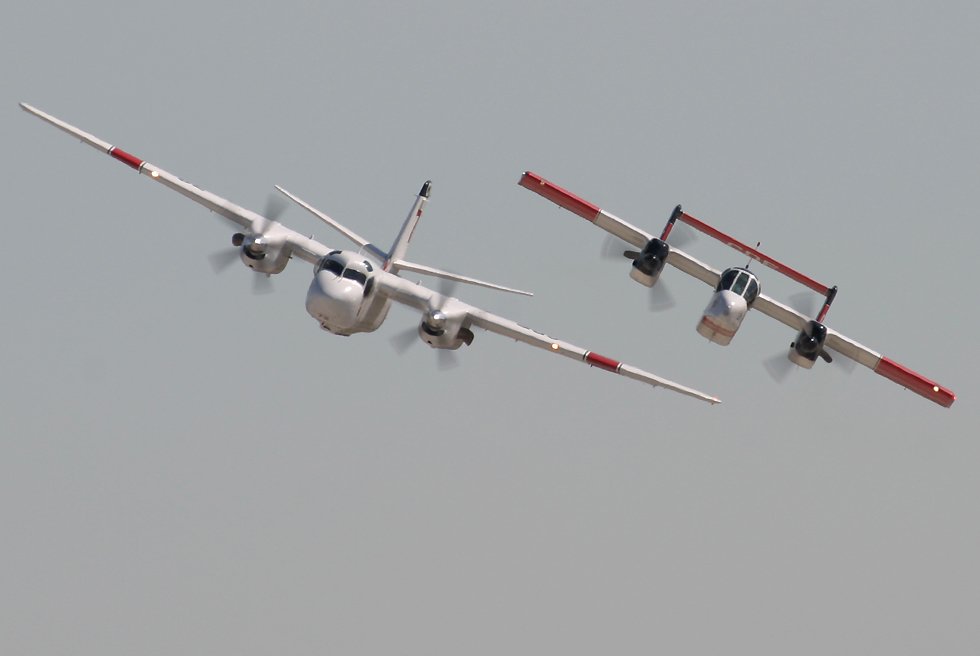
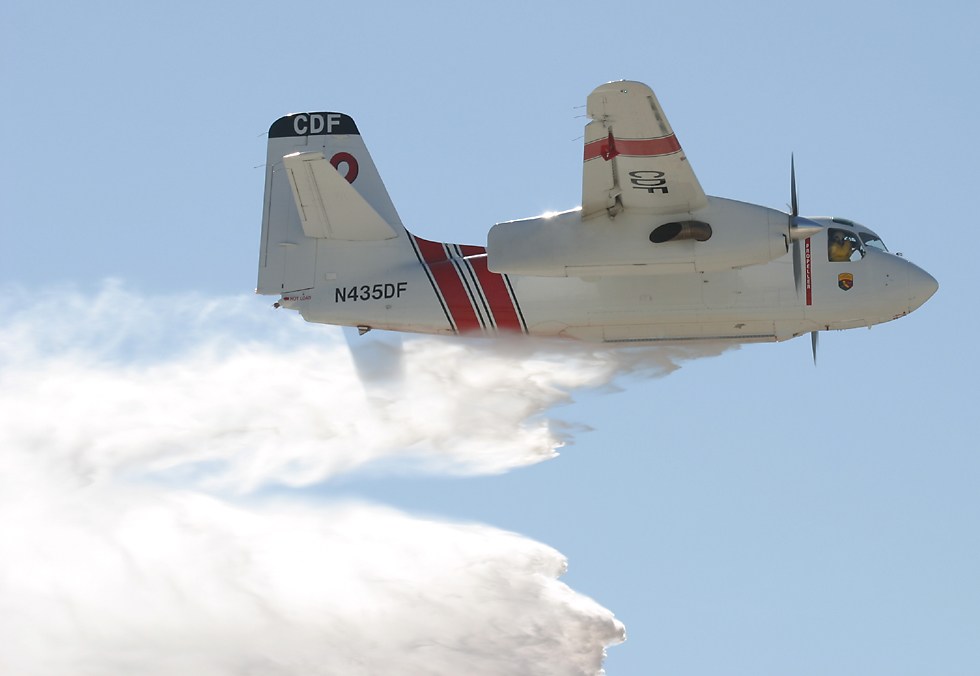
Here's one of their S-2 Trackers showing what they can do.
The Tracker is a retired naval aircraft which used to operate off aircraft
carriers, though this is the S-2T version with turbo-prop engines instead
of radials, and other modifications for its new role. In Canada
this variant is called the "turbo firecat". |
 |
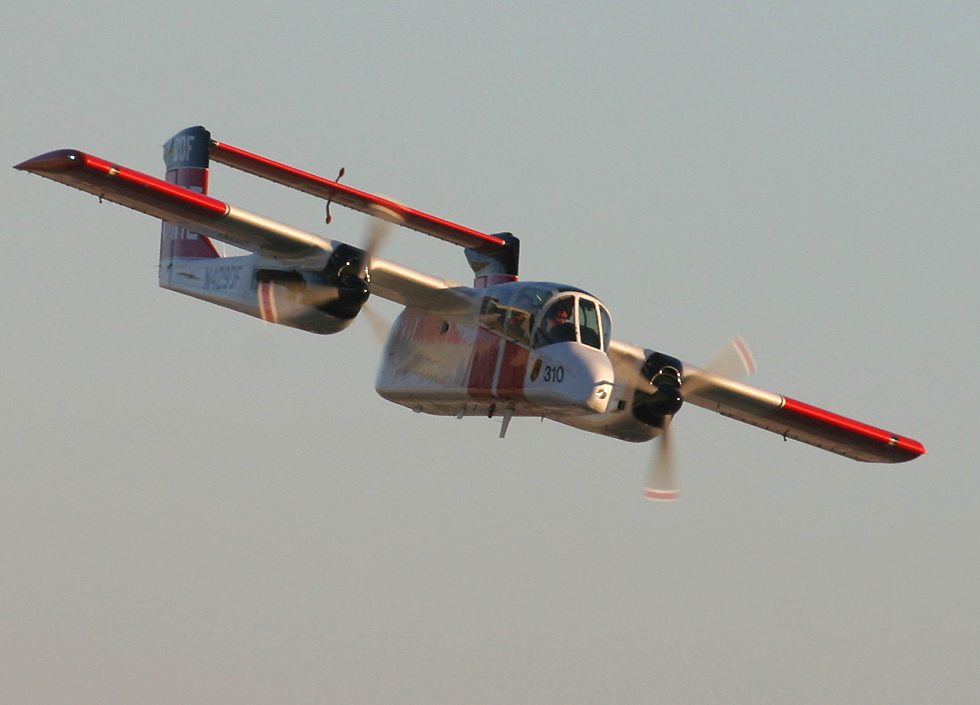
| The
Bronco was specifically designed with excellent visibility so that its
crew could watch what was happening on the ground. This also
makes it a perfect fit for the firefighting role, and so it serves on in
that capacity today, long after the American military retired the type.
The Bronco doesn't drop water or retardant on fires, instead it's used
to assess what's happening and oversee operations by the fire bombers. |
 |

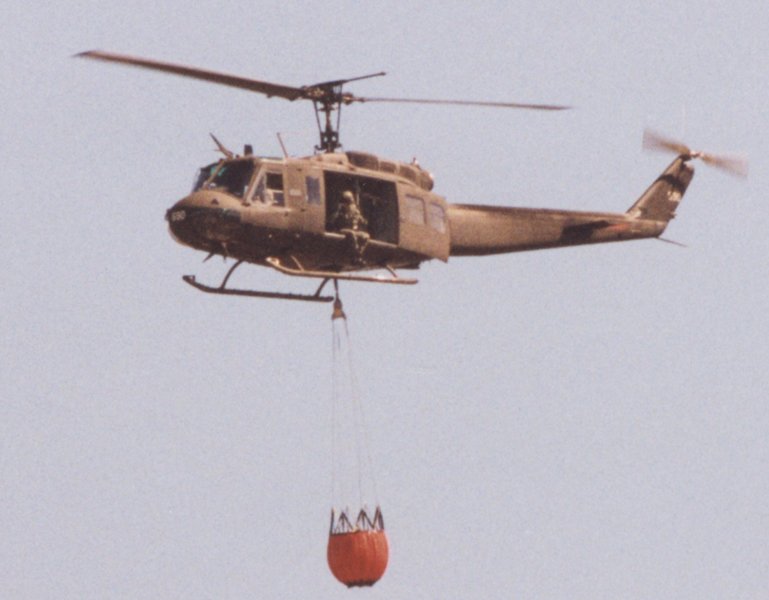
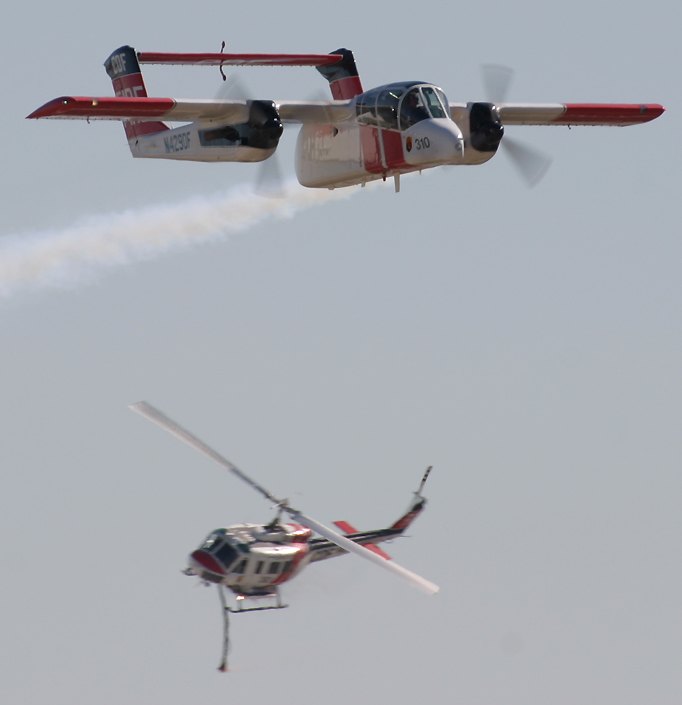
The CDF put on quite a display at this show, bringing two of their fixed-wing
aircraft as well as this Huey helicopter.
As of 2003 there were nearly a thousand aircraft fighting fires during
the US fire season, with over $US250 million dollars spent on operations
each year.
Fires have become increasingly bad over the last ten years, perhaps because
of changes caused by global warming. |
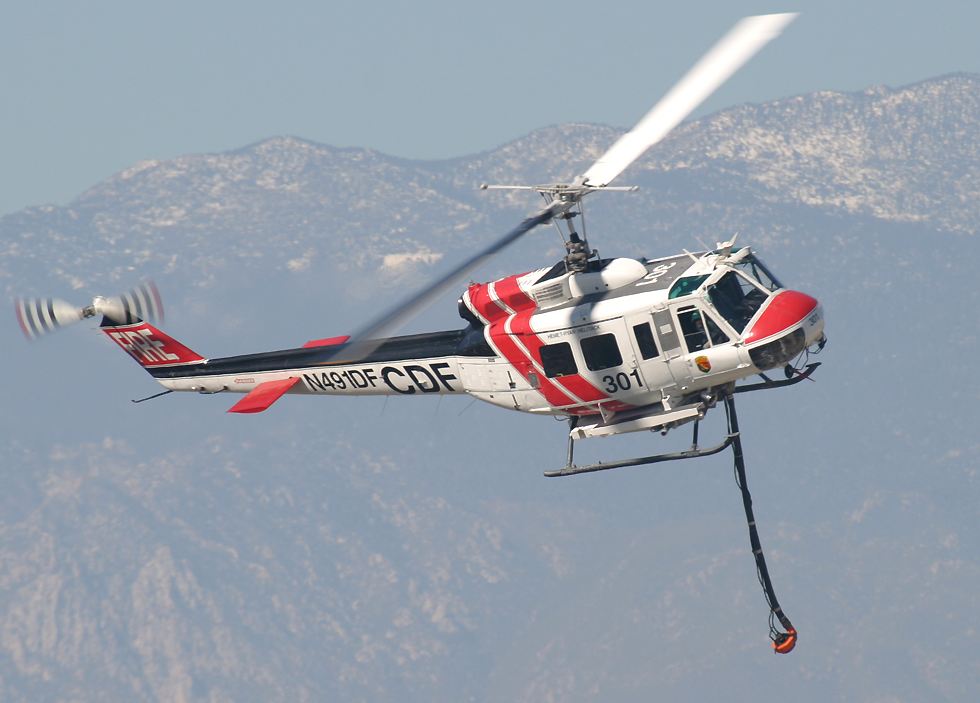
| Here's
the same Huey, with snow-covered Mount San Jacinto in the background.
It might look as if it has a giant bath plug on the line dangling beneath
it, but in fact that's the end of the hose used to suck water from a lake
or other source. Helicopters are very useful for this type
of work since they don't need an airport to operate from and they can use
small bodies of water which might be very close to the fire.
They're also able to drop water much more precisely than fixed-wing aircraft,
though of course the helicopters are limited in how much they can carry. |
 |
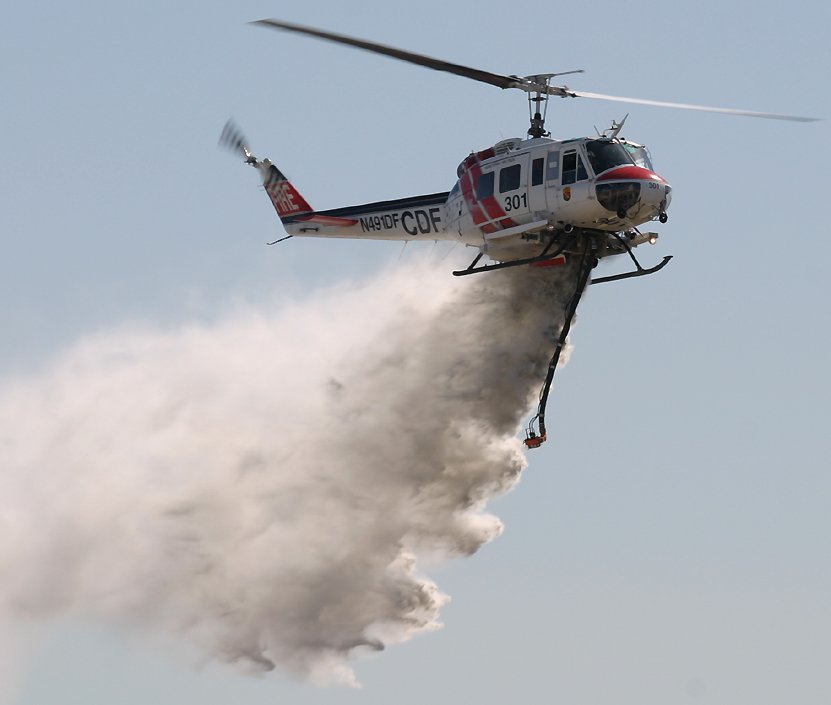
| And
here's what it can do! |
 |
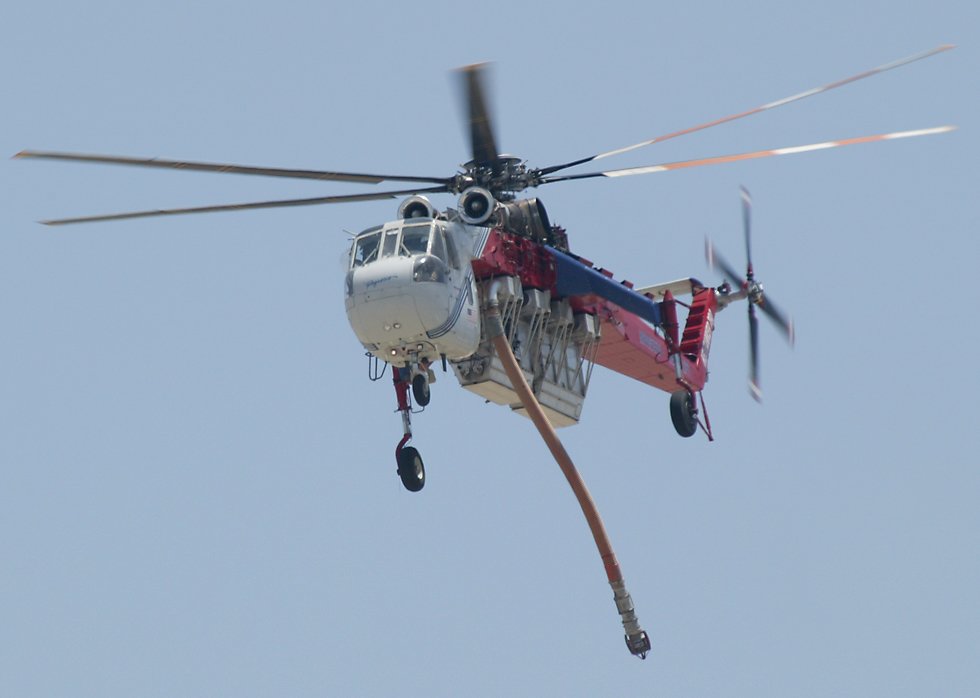
| Of
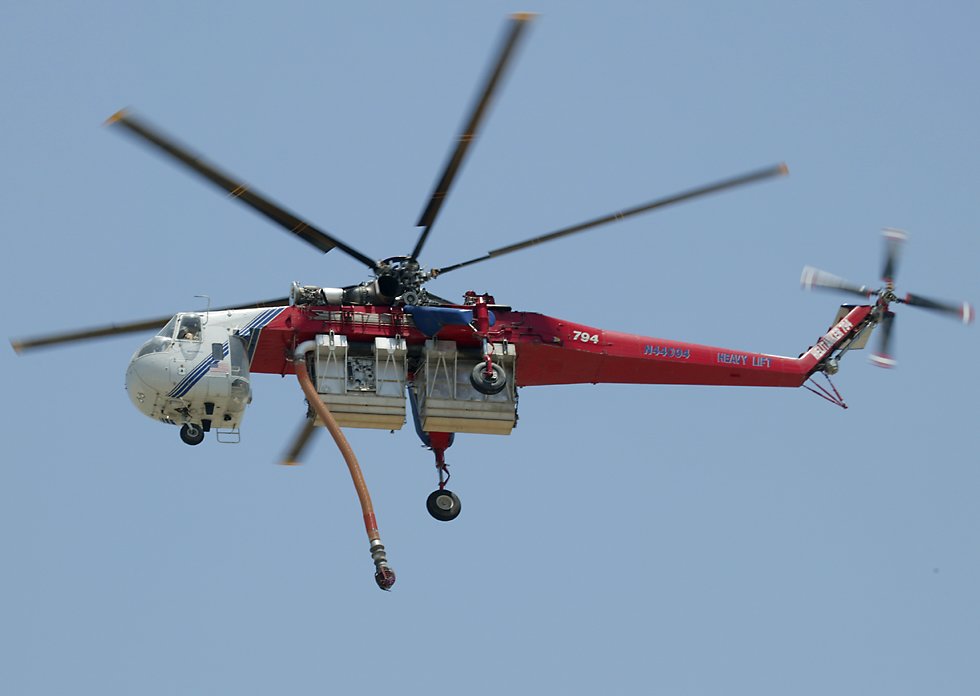
course if you want more bang for your buck, then bring a heavy lifter in!
This is an S-64 Skycrane, the civilian version of the Vietnam era CH-54
Tarhe, and it's still one of America's most powerful helicopters.
This one was based out of Palm Springs airport while fighting a fire on
Mount San Jacinto. |
 |
| In
its firefighting role, the Skycrane can lift 2,650 US gallons (10,000 liters),
using the impeller at the end of the hose to suck water from any source
deeper than 18 inches. It can also be fitted with an attachment
to allow it to scoop water as it moves across the surface of a pond or
lake. This helicopter has been so successful in this role that
Erickson Air-Crane bought the rights to it from Sikorsky in 1992 and today
even builds new aircraft, rather than just refurbishing old airframes. |
 |
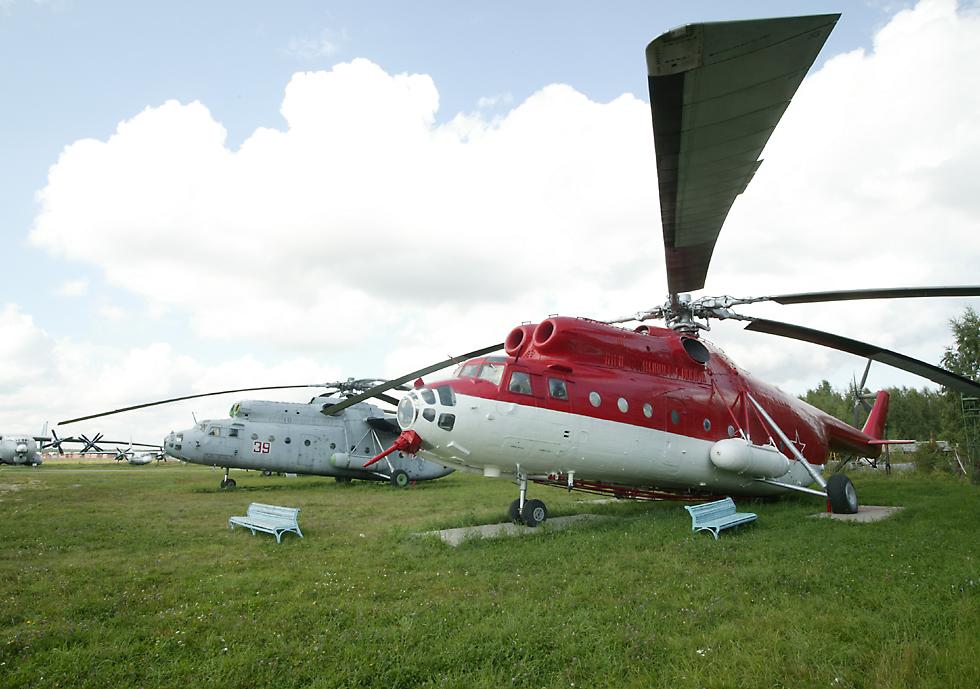
| The
Skycrane is impressive, but the Russians were and still are the champions
of heavy-lift helicopter design. This photo is from the
Russian Air Force museum at Monino, outside Moscow, which has a wide
variety of helicopters on display, including these two Mil Mi-6s, a type
which was assigned the NATO reporting name "Hook". The Mi-6
is only the fourth most powerful helicopter at Monino, the others being
the Mi-10 "Harke", the Mi-26 "Halo" and the extraordinary V-12 "Homer",
which has two Mi-6 rotors side-by-side, powered by four jet engines.
Nevertheless, even the lowly "Hook", which first flew in 1957, can lift
more than any American helicopter ever has. |
 |
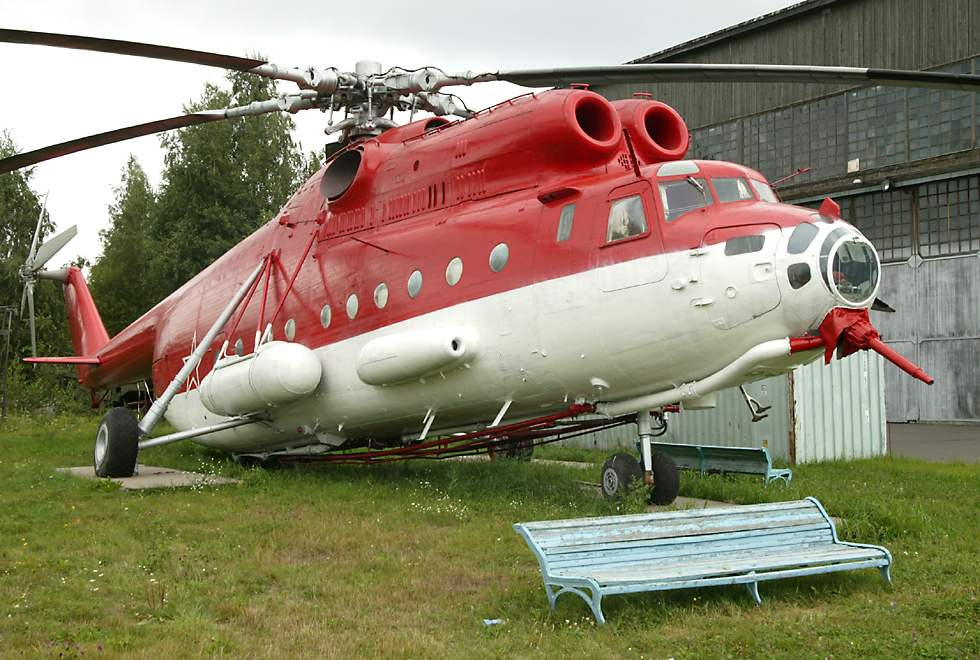
| The
grey Mi-6 in the background of the previous photo has wings with a 15 meter
span fitted, which provide about 20% of the total lift when the aircraft
is in forward flight. However fire-fighting versions like the
one in this photo don't have the wings, since they are a hindrance when
hovering over a fire. Unlike most Western fire-fighting helicopters,
the Mi-6 is fitted with a directable nozzle so the water can be aimed very
precisely at the fire. Many Russian firefighting aircraft do
share the some color scheme as American planes, the red making them easier
to spot against the green of a forest or brown soil. |
 |
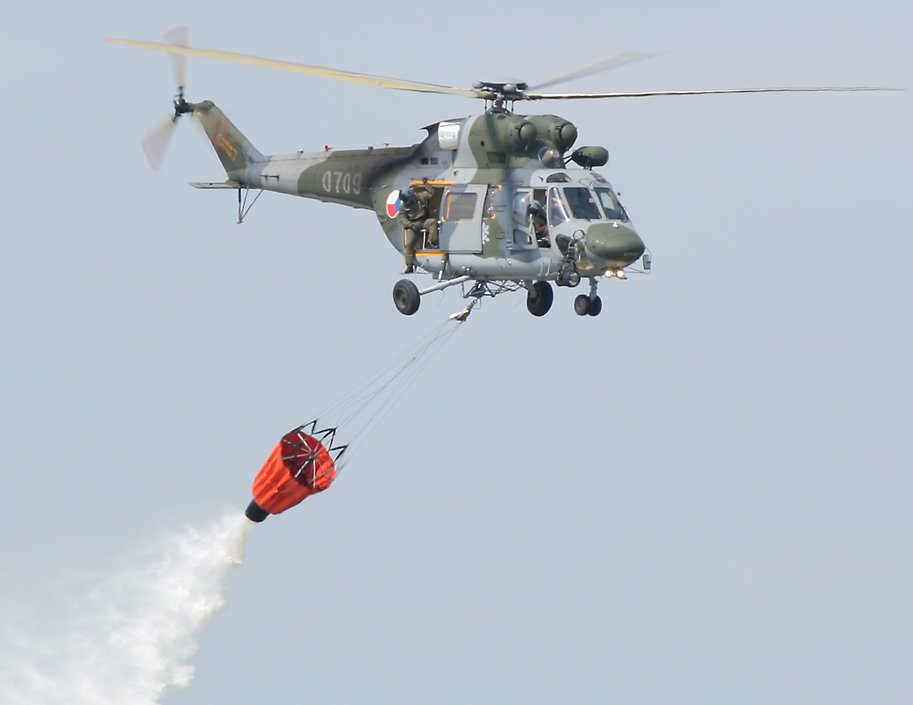
| The
Mi-6 is very old for a helicopter and there are very few of them still
operating in Russia, so I've never seen one flying, however here's a modern
eastern European type, a Polish designed W-3A Sokol operating with the
Czech air force and doing a fire-fighting display at the
2006 Czech International Air Fair. |
 |
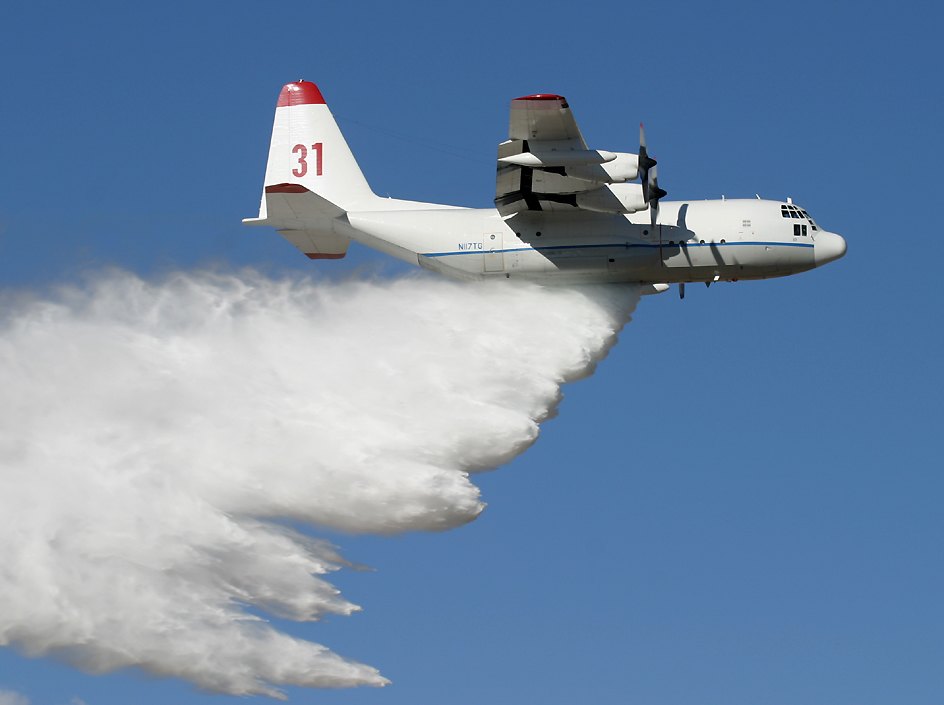
| Back
to the USA and back to fixed-wing aircraft, a C-130A Hercules at the
2004 Prescott Air Fair in Arizona. This is the 18th Hercules
off the production line, and the oldest one which is still flying, however
it has a more sophisticated water delivery system than the military Hercules
at the top of the page. Tragically, in 2002 a C-130A crashed
while fighting a fire in California, both of its wings folding upwards
as the plane made a run. The whole event was caught on video,
and together with another crash a month later caused the US to ground its
entire fleet of large water bombers. |
 |
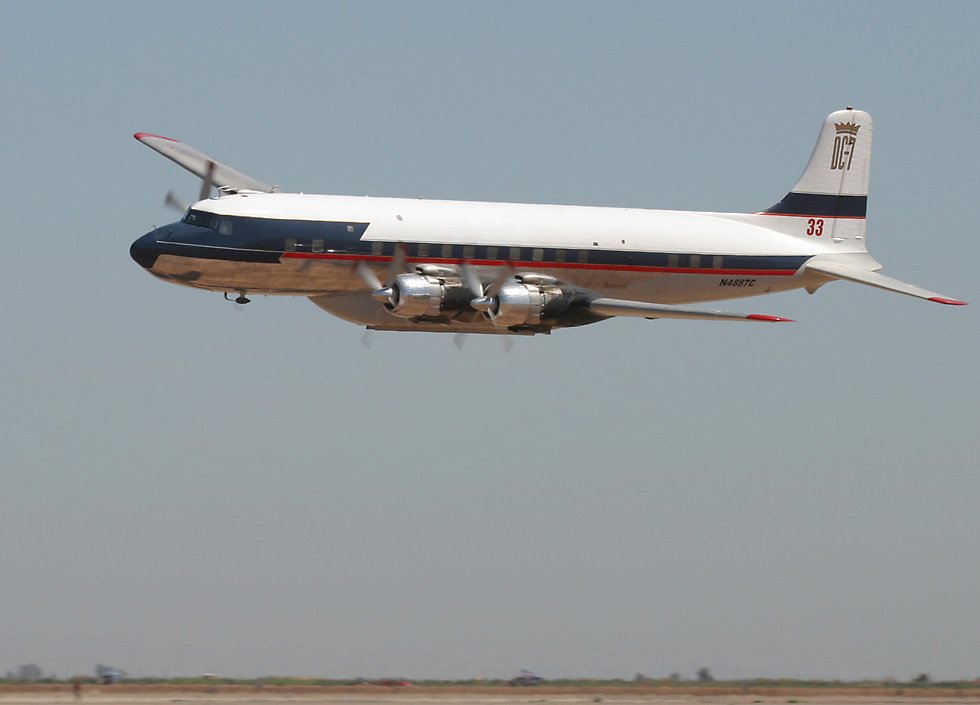
| One
of the victims of this grounding was the fleet of DC-7 tankers, including
this one owned by International Air Response, the same company which owns
the Hercules. The DC-7 was the last piston-engined airliner
developed by the Douglas corporation; this one operated with Delta Airlines
but when it was returned to that color scheme Delta complained, so their
name was removed, leaving the rest of the paint job intact.
As a tanker, this DC-7 carries 3,000 gallons of retardant in an external
tank under the belly. |
 |
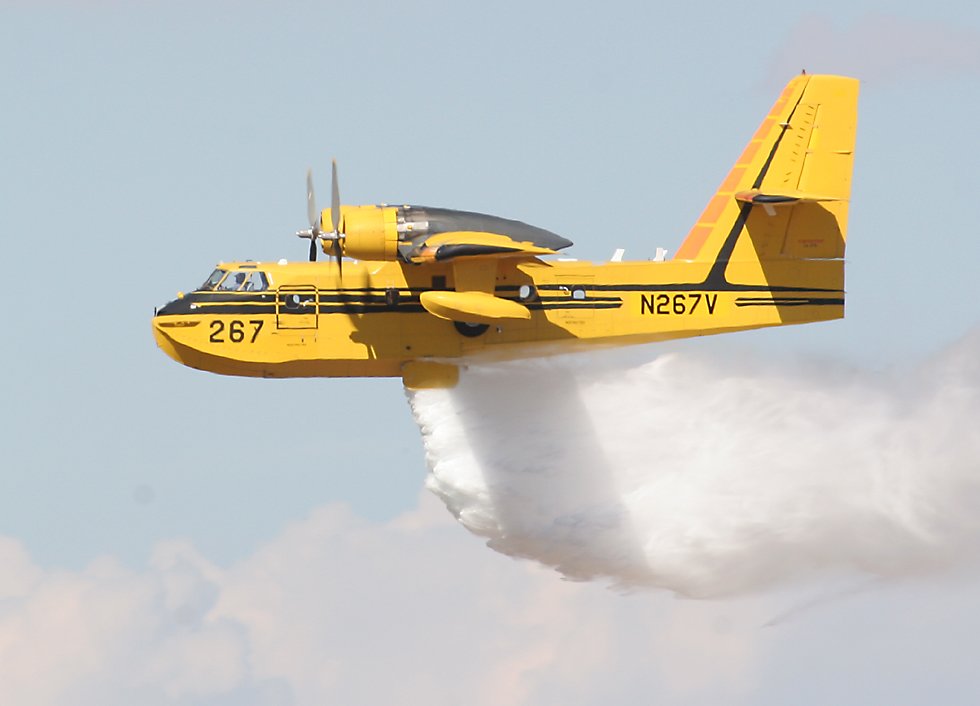
| The
2005 Prescott Air Fair included one of the few aircraft designed specifically
with fire-fighting in mind, a Canadair CL-215 known popularly, though not
officially, as a "Scooper", the later turbo-prop CL-415 variant being the
"Super Scooper". Unlike the previous aircraft on this page,
the CL-215 is a seaplane (or flying boat if you're from the British commonwealth),
able to scoop up 1,400 gallons (5,300 liters) of water in just 12 seconds
while making a high-speed run across a lake. The extremely
large tail and other control surfaces make this a very maneuverable aircraft,
a critical commodity when flying at low altitude in canyons and other obstructed
areas. Like all aerial fire-fighting, it's still a very hazardous
occupation, and there have been 21 fatal accidents around the world involving
this aircraft type. |
 |
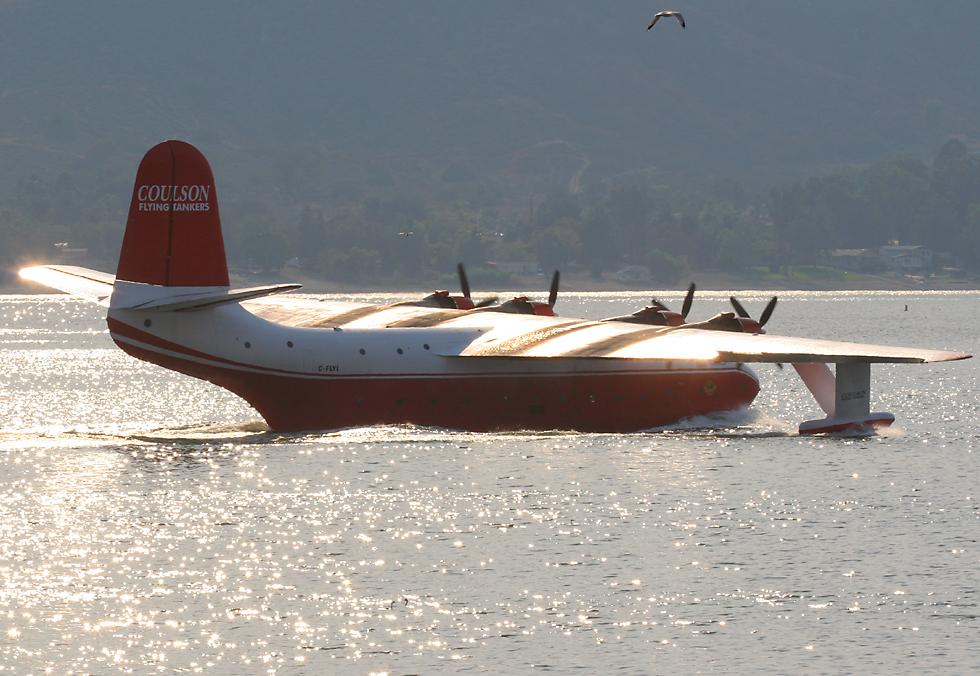
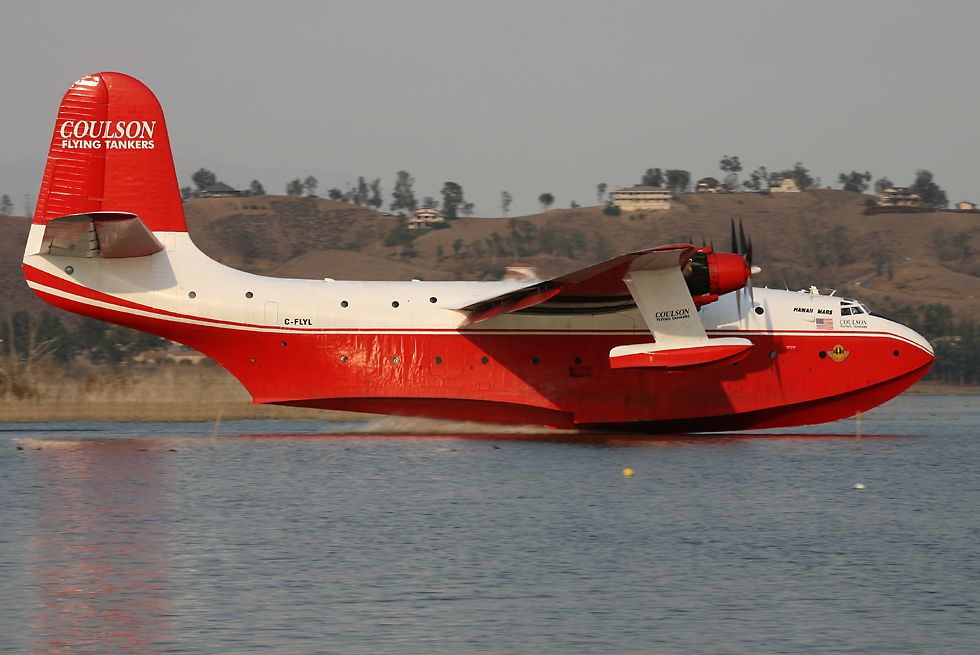
| The
CL-215 and CL-415 are not the only seaplane water bombers, and they're
certainly not the largest; the beast pictured below holds that title.
It's a world war two era Martin Mars, operating on Lake Elsinore in southern
California during the horrific series of fires in September of 2007 which
resulted in somewhere between 500,000 and 1,000,000 people being evacuated
from their homes. |
 |
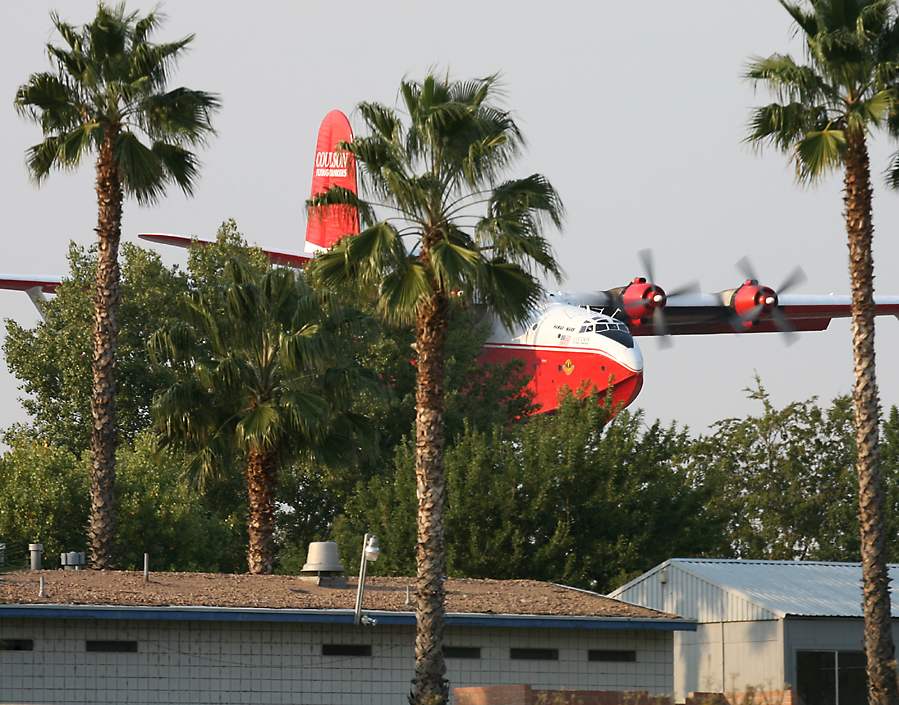
| Only
six were ever built and two now remain in service as fire bombers, based
at Sproat Lake in Canada. They were brought all the way down
to this lake south of Los Angeles, but they didn't fly very often on the
two days I visited. I was only able to capture one landing
run, as this huge aircraft with a 200 foot (61 meter) wingspan came in
low over the town, no doubt scaring the life out of more than a few residents! |
 |
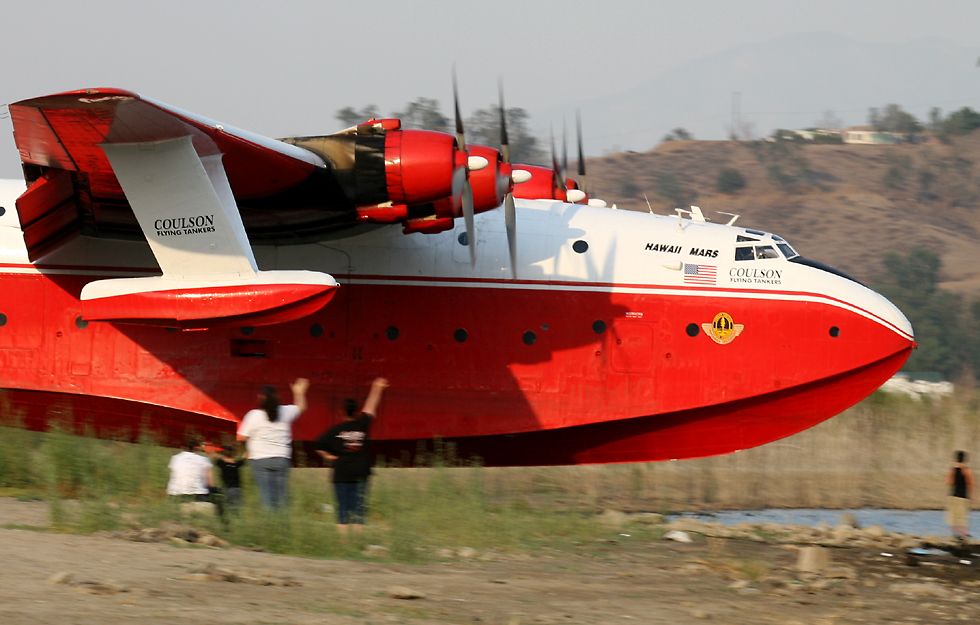
| Of
course there were also others like myself who were very pleased to see
it flying. I was amazed to see it come in so low while still
over land, but it needs the entire 3.3 miles (5.3 kilometers) of lake to
scoop water and then very slowly gain altitude. It can carry
by far the most water of any fire bomber, 7,200 gallons weighing 60,000
pounds (27,250 liters, which is also 27,250 kilograms); however because
of the lack of space at Lake Elsinore it was only able to pick up about
5,000 gallons at a time, and that was possible only because they carried
less fuel than usual. |
 |
| They
touched down scarcely past shore, where the lake is still very shallow,
a real tribute to the skill of the pilots and crew. Although
each engine generates 2,500 horsepower, this is a relatively underpowered
aircraft and not particularly maneuverable. Fires generate
a lot of turbulence and the hot air doesn't provide as much lift as regular
air, so flying such a huge aircraft under these conditions is physically
demanding, particularly since the flight controls don't have hydraulic
boost. |
 |
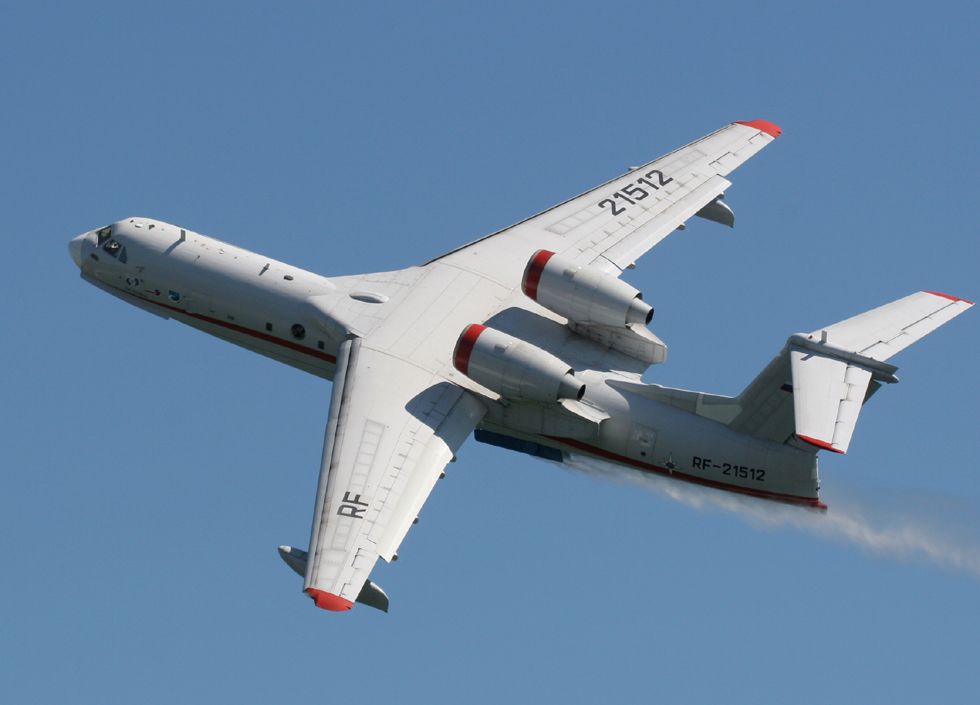
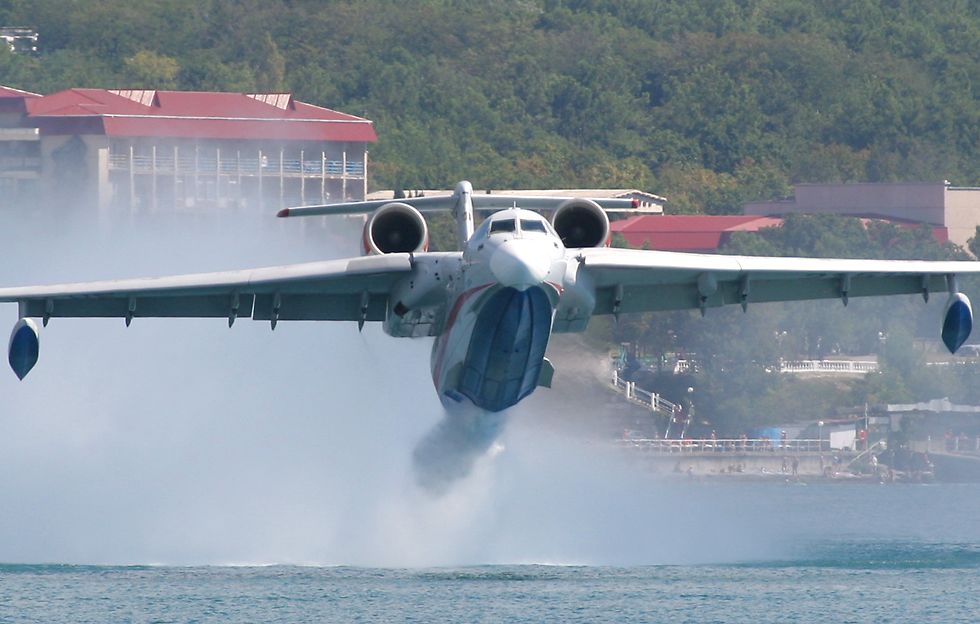
| But
here's a fire-fighting seaplane with power to spare! It's a
Beriev Be-200 Altair, one of the latest products from a long line of seaplanes
produced by this pioneering Russian design bureau. I photographed
it at the
2006 Gidroaviasalon (hydro-aviation exhibition) at the Russian Black
Sea resort town of Gelendzhik. It can only carry 3,170 US gallons
(12,000 liters) of water compared to the Mars' 7,200 gallons (27,250 liters),
but it does it relatively effortlessly and can fly at much greater speeds
between the water source and the fire. This very aircraft is
said to have hit a tree while taking off from a lake fully loaded with
fuel and water, branches went into one of the engines and knocked it out
but the aircraft was still able to climb out and execute a safe landing,
a testament to its ruggedness. |
 |
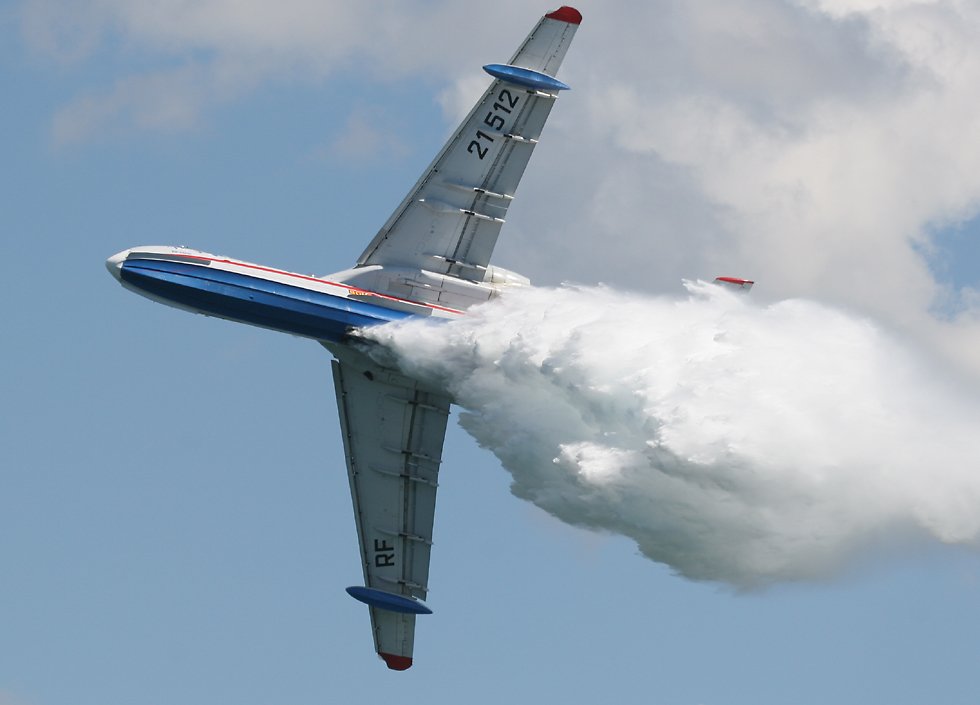
| The
accident happened while operating under lease as a firefighter in Portugal,
and it's also served in this way in Italy. The Russian interior
ministry owns a few, and it looks as if Indonesia might be buying some.
Beriev touts its flexibility as a cargo transport and airliner, and its
ability to operate without runways, a major advantage in undeveloped maritime
nations. However a jet is relatively expensive to operate and
since seaplanes are designed as much for hydrodynamics as aerodynamics,
they're not as efficient fliers as regular aircraft. |
 |
| Still
it would be great to see Beriev make a success of this aircraft, with the
decline of the Soviet Union they've been operating on a shoestring for
many years, while hoping to capture some market share with their innovative
designs. |
 |
 |