| Rare
British World War Two Aircraft at the Hendon RAF Museum |
| This
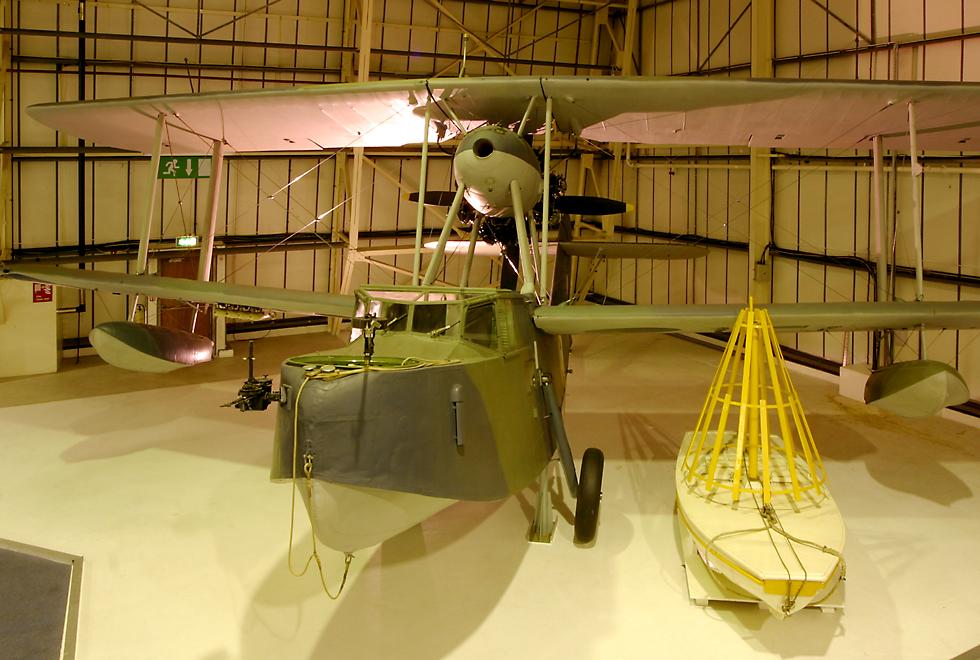
ancient looking flying boat might not seem like it belongs on a page of
world war two aircraft, but the Walrus, also known as a Seagull, served
throughout the war and production only stopped in 1944. It
might also seem strange that it was designed by the same Supermarine company
which came up with the Spitfire fighter, but in fact the Spitfire itself
was developed from a floatplane design which the company had used to win
the Schneider Cup. The Walrus was also highly innovative for
a plane which first flew in 1933, it's the first British military aircraft
with a fully enclosed cockpit and retractable undercarriage - you can just
see the wheel wells under the bottom wings of this example. |
 |
| Here's
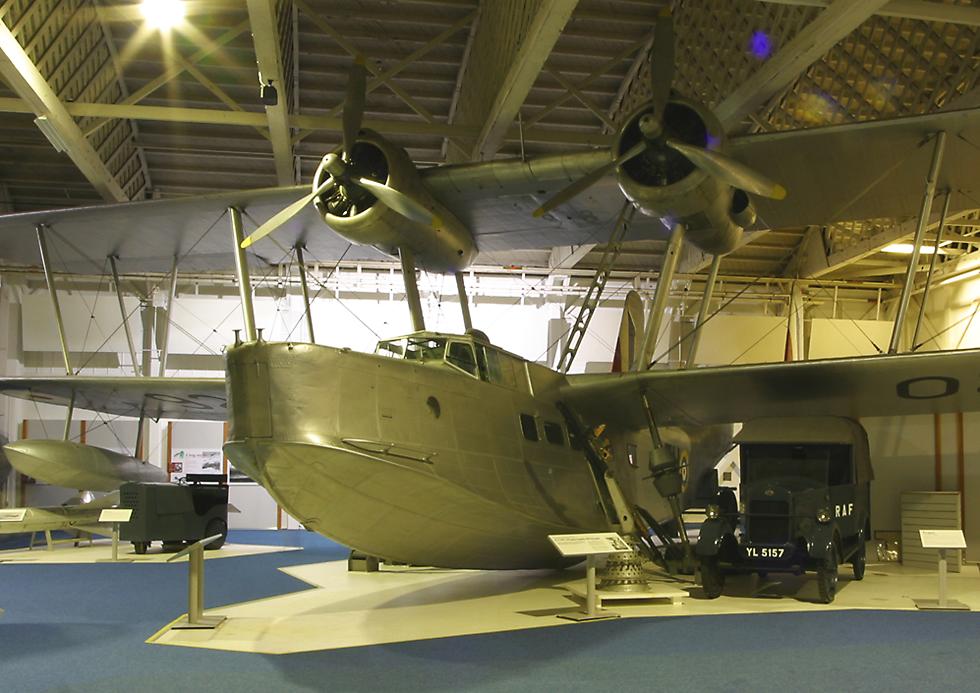
another Supermarine flying boat, the Stranraer, which bears a very obvious
family resemblance to the Walrus. Rather than doing the search
and rescue tasks of the Walrus, it operated as a reconnaisance bomber type
with a 500 or 1100 pound payload. Although developed after
the Walrus, the Stranraer was the end of the line for biplane flying boats
and had a much shorter service life than its predecessor, being withdrawn
by the British from front-line service in early 1941. The Canadian
air force used them until 1945, and this sole survivor was an ex-RCAF machine. |
 |
| Here's
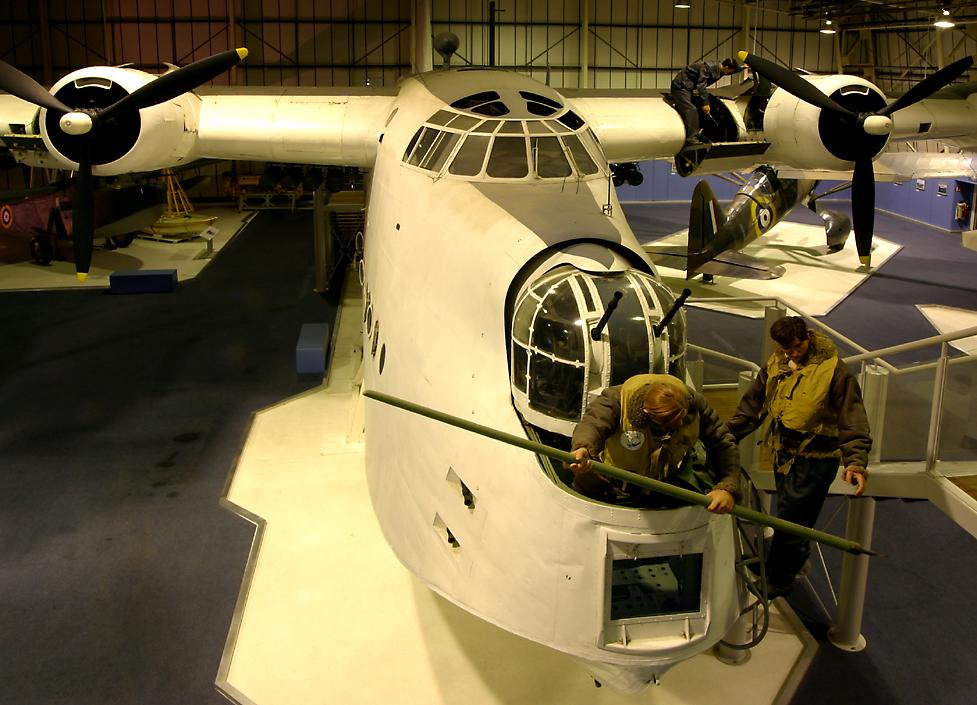
one of the main reasons aircraft like the Stranraer went out of service
even though the British were fighting a desperate and under-resourced battle
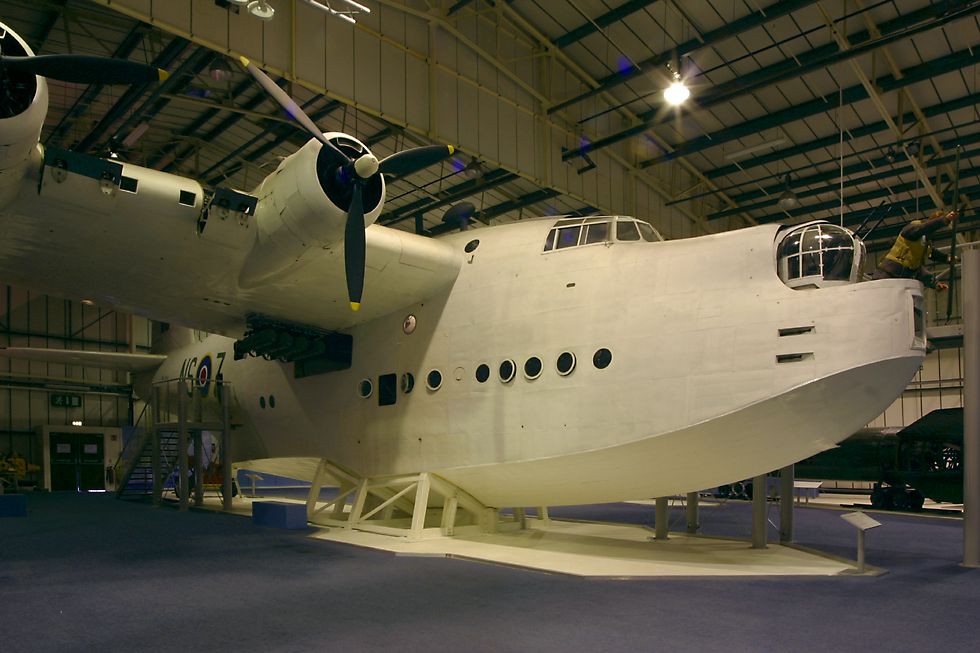
against submarines in the Atlantic. The Sunderland flying boat,
built by Short Brothers, was far more capable and represented a much more
efficient use of available aircrews. It also had several interesting
design features, including a retractable nose turret to allow easier mooring,
platforms built into the leading edges of the wings so the engines could
be accessed simply, and rails under the wings to allow up to 2000 pounds
of depth charges to be winched out from within the hull when attacking
a submarine. |
 |
| Although
it was no speedster, the Sunderland wasn't an easy target, its formidable
defensive armament earning it the name "the flying porcupine".
As well as the nose turret, most Sunderlands had a tail turret, a dorsal
turret and flexible guns on each side facing out through the square hatches
under the wings, as well as four fixed forward-firing guns under the nose
turret - a total of 18 machine guns, the most of any British aircraft.
In one incident, an Australian Sunderland was attacked off the coast of
France by eight Ju
88 fighters and, although one crewman was killed and the Sunderland
was forced to beach itself on the Cornwall coast, it managed to shoot down
either three or six of the attackers, depending on whose report you believe. |
 |
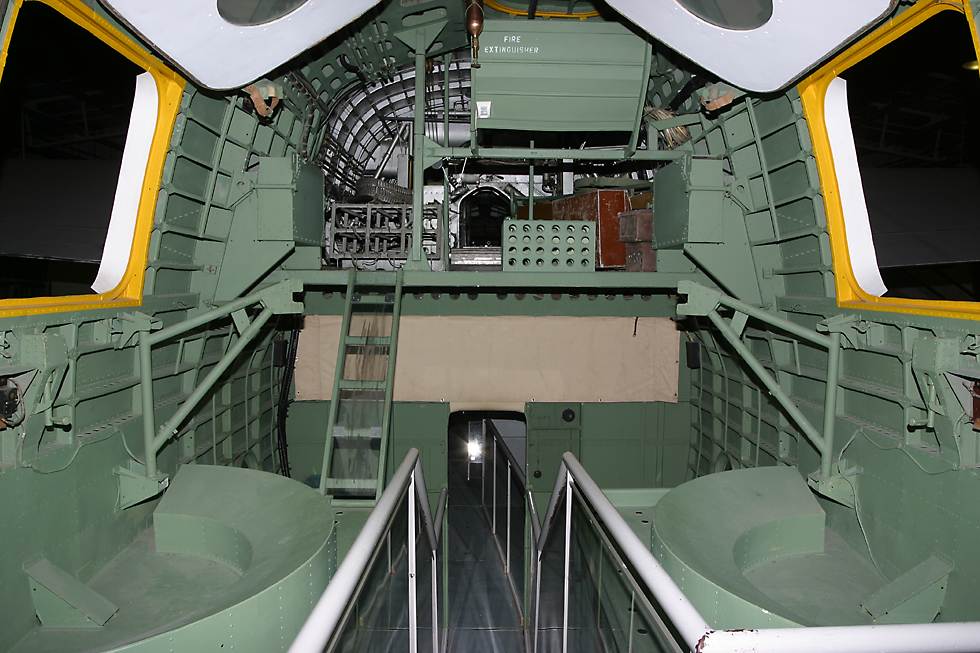
| Here's
a view of the interior, looking towards the cockpit with the side gun hatches
on either side of the photo. In the end, 749 Sunderlands were
built, serving with many Commonwealth countries during the war, and the
French navy after the war. The Royal New Zealand Air Force
operated them the longest, until 1967; my father flew with them up to Fiji
and I grew up near the seaplane base at Hobsonville where they were based. |
 |
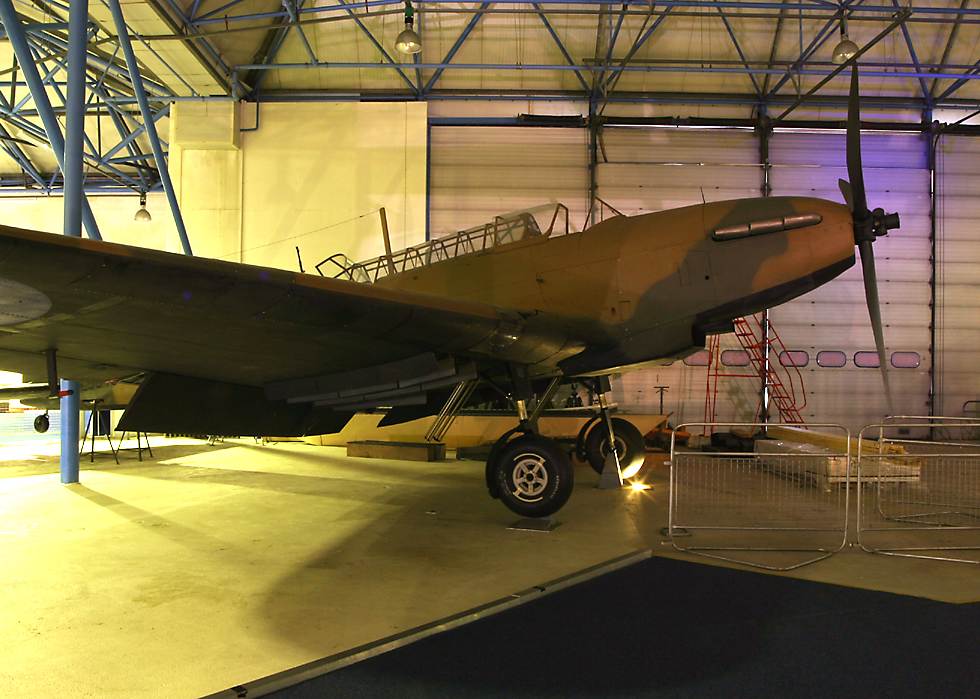
| Shifting
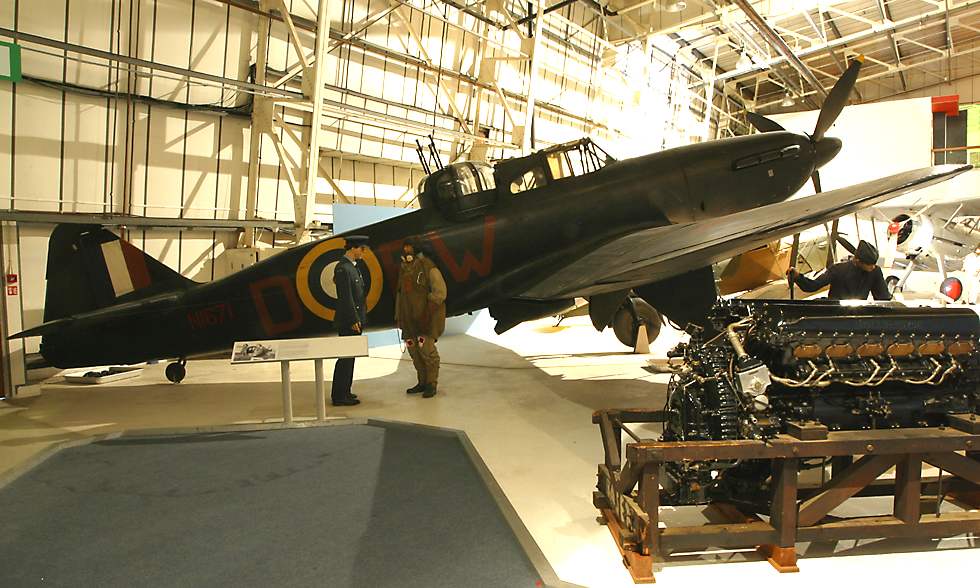
from flying boats to land-based aircraft, here's one of only three Fairey
Battle light bombers left in the world. Entering service in
1937, the Battle was far superior to the Hawker Hind and Hart biplane bombers
it replaced, but it was hopelessly outclassed by the time war broke out.
Although a Battle scored the first British air-to-air victory of the war,
against a Bf 109 fighter in September of 1939, this was an anomaly and
once Germany invaded the west in May of 1940, it was common for Battle
sorties to result in the loss of more than half the aircraft sent out.
By September of the same year the Battles had been relegated to training
and other roles, remaining in service with the RAF until 1949. |
 |
| The
Battle was hindered by the weight of its three-man crew, and this fighter,
the Boulton-Paul Defiant also suffered by having more than one crew member;
the additional weight of a turret limited its top speed to 304 mph.
Oddly, there was no forward-firing armament, the theory being that the
turret would allow it to attack unescorted bombers from angles which enemy
gunners couldn't defend against. In practice, bombers were
always escorted by fighters which were nimbler and faster than the Defiant.
Miserably, the turret was too small for the Defiant's gunner to wear a
parachute, instead he had the nearly hopeless task of retrieving it from
the fuselage and putting it on after the plane had been fatally hit.
This example is the world's sole surviving Defiant. |
 |
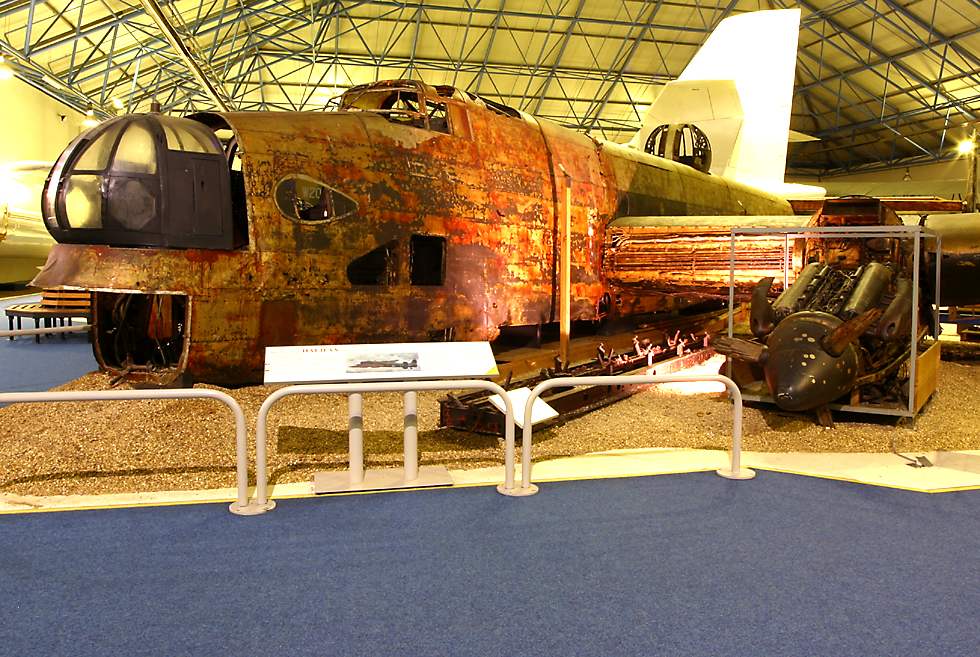
| Together
with the Stirling and the Lancaster, the Handley-Page Halifax was one of
the main four-engined bombers employed by the RAF. It entered
service a year before the Lancaster, but was soon over-shadowed by the
latter, despite being able to carry a very worthwhile bomb load of 13,000
pounds. Early on, it gained a bad reputation amongst its aircrews
because of a tendency to spin out of control if thrown about too vigorously,
and an air force requirement that it be able to fit into 100-foot wide
hangars resulted in a truncated wingspan which seriously affected its ability
to fly at higher, and therefore safer, altitudes. Nevertheless,
production continued until November of 1946, resulting in a total of 6176
aircraft, which operated in many different roles. This one
made a forced landing on a frozen lake in Norway after attacking the German
battleship Tirpitz, and was recovered in 1973. |
 |
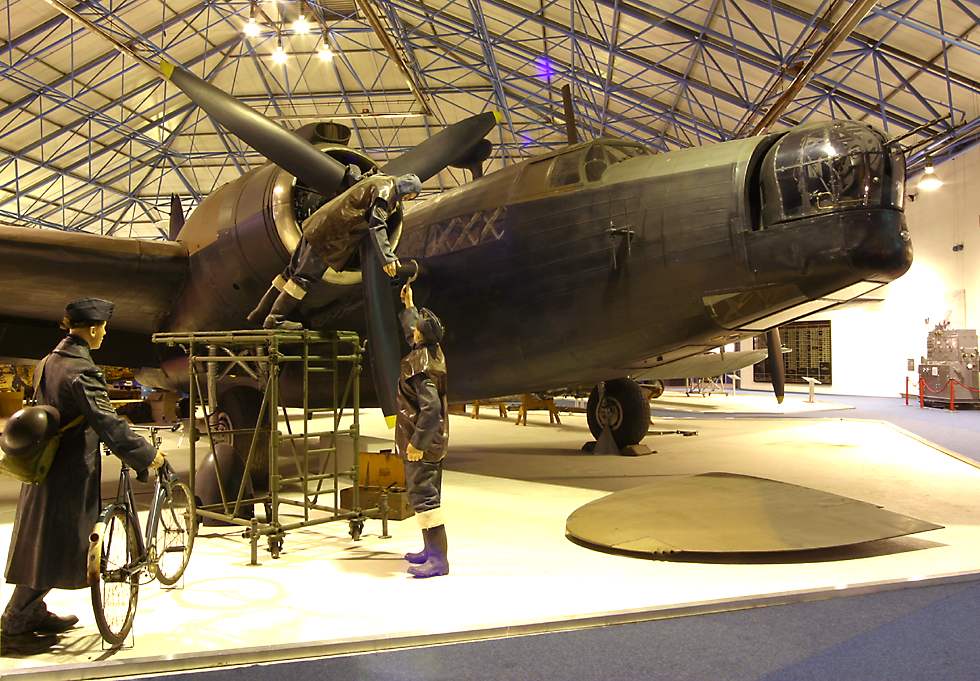
| The
Vickers Wellington was a two-engined bomber capable of carrying 4,500 pounds
of bombs, slightly more than early model B-17E Flying Fortresses, though
it was far less well defended. The Wellington's geodesic structure,
pioneered by Barnes Walles of Dambuster bomb fame, was immensely strong
and able to absorb terrific damage - you can see the characteristic criss-cross
bracing behind the cockpit. Wellingtons and their smaller counterpart
the Blenheim performed the first British bombing raid of the war on September
4th of 1939, two being lost. In July of 1941 James Ward, a
crewman on a Royal New Zealand Air Force Wellington, earned the Victoria
Cross by breaking a hole in the doped-linen outer skin as the plane was
flying and working his way across the wing to put out a fire using rags.
This particular aircraft is one of only two in existence and is the last
one manufactured, in the Autumn of 1945. |
 |
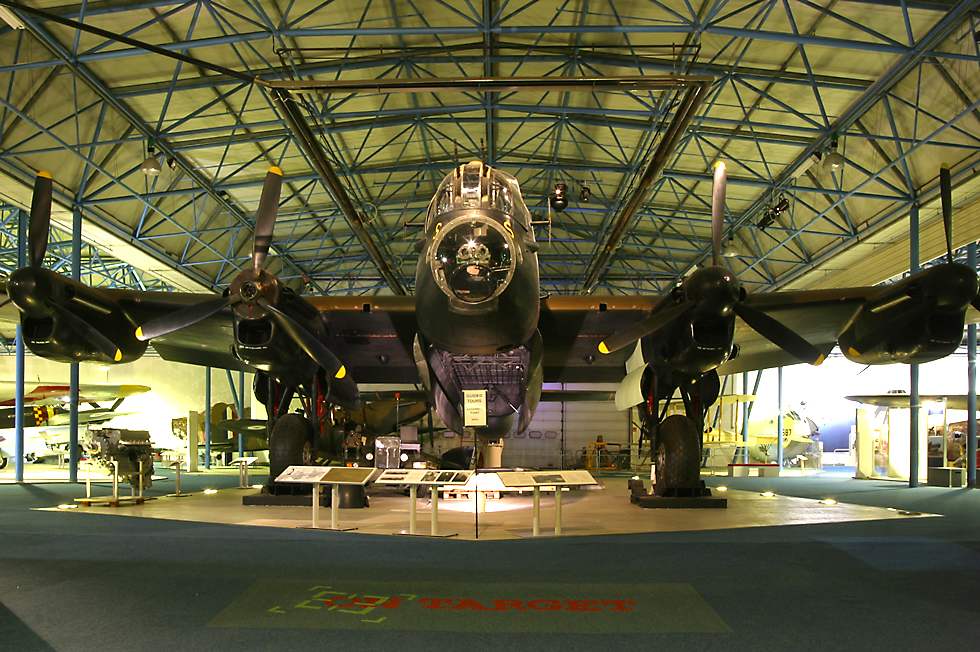
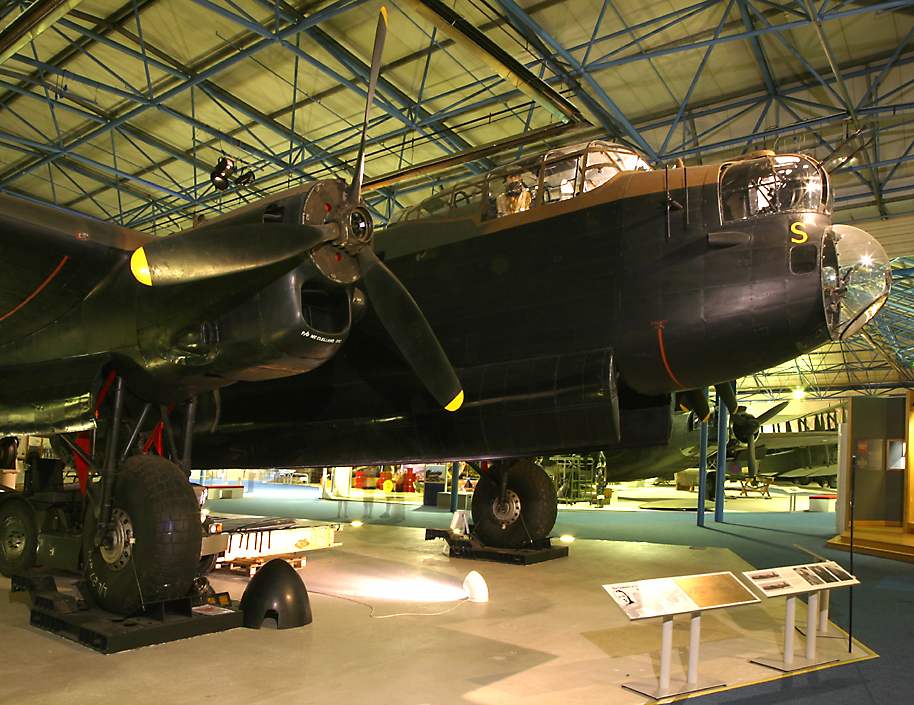
| The
Avro Lancaster isn't exactly rare, but since there are none in the United
States I feel justified in including it here. There are two
flying survivors,
the
Battle of Britain memorial flight Lancaster and the
Canadian Warplane Heritage Museum's example. The Lancaster
was the main British heavy bomber of the war, and its power and large,
undivided bomb bay allowed it to carry weapons of greater size and weight
than the main American bombers, the B-17 Flying Fortress and B-24 Liberator.
As well as the "Upkeep" bouncing bomb used against German dams, it could
also carry the 12,000 pound Tallboy and 22,000 pound Grand Slam "earthquake"
bombs. |
 |
| This
aircraft is the oldest of 17 surviving Lancasters, and also the first British
heavy bomber to survive more than 100 raids, finally achieving 137 operations. |
 |
| The
Westland Lysander was named after a Spartan general, and operated as an
army co-operation aircraft, its excellent low-speed handling and short
takeoff and landing capabilities making it the perfect aircraft to perform
clandestine operations behind enemy lines, dropping off or picking up secret
agents, resistance fighters and fugitive downed allied aircrews.
A handful still survive, and you can even see one
flying at airshows like Flying Legends at Duxford. |
 |
| The
De Havilland Mosquito was one of the most extraordinary aircraft of world
war two. Earning the nickname "the wooden wonder" because of
its very unorthodox and seemingly archaic plywood construction, it carried
no defensive armament, relying instead on sheer speed to outrun enemy fighters.
This two-man aircraft could carry up to 4000 pounds of bombs, as much as
the ten-man B-17E, and do it much faster, too. The mosquito
was extraordinarily adaptable, performing extremely well as a bomber, photo-reconnaisance
aircraft, pathfinder and even as a night interdictor shooting down German
night fighters over Germany itself, eventually claiming 600 enemy aircraft.
One mosquito ended the European war having flown the most missions of any
allied bomber, 213 in all, only to crash two days after VE day. |
 |
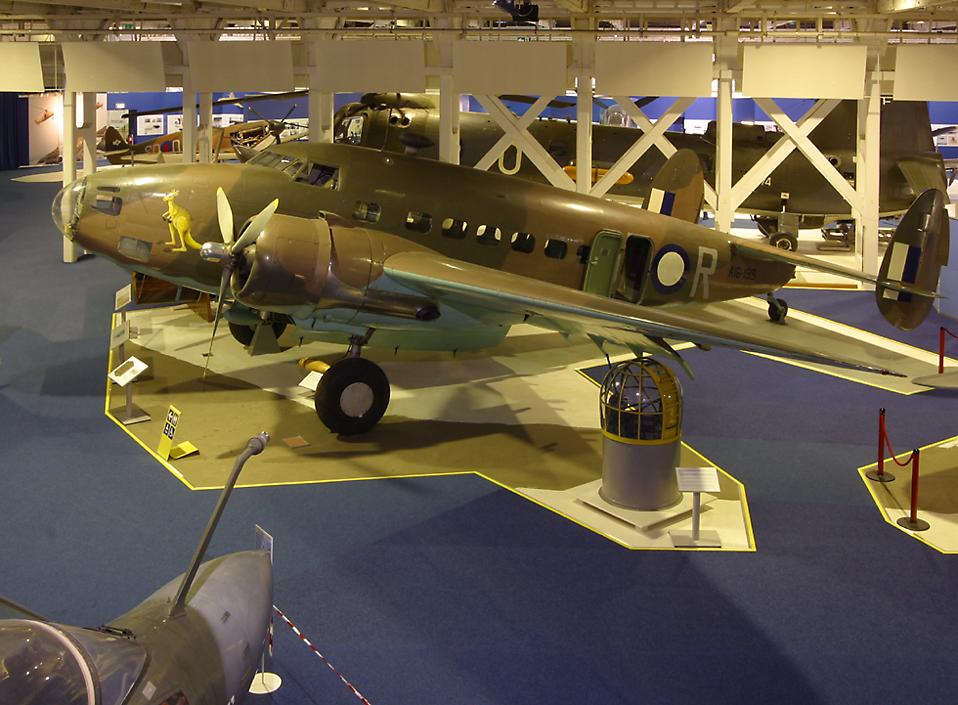
| Unlike
all of the other aircraft on this page, this is an American-designed plane,
the Lockheed Hudson, derived from the Lockheed Electra airliner.
It was used by Coastal Command for reconnaissance and search and rescue
during the early part of the war, and one even captured the submarine U-570,
which surrendered to a Hudson in August of 1941. Like this
Australian example, most Hudsons were eventually converted into transports,
stripped of armaments like the turret now displayed under its wing. |
 |
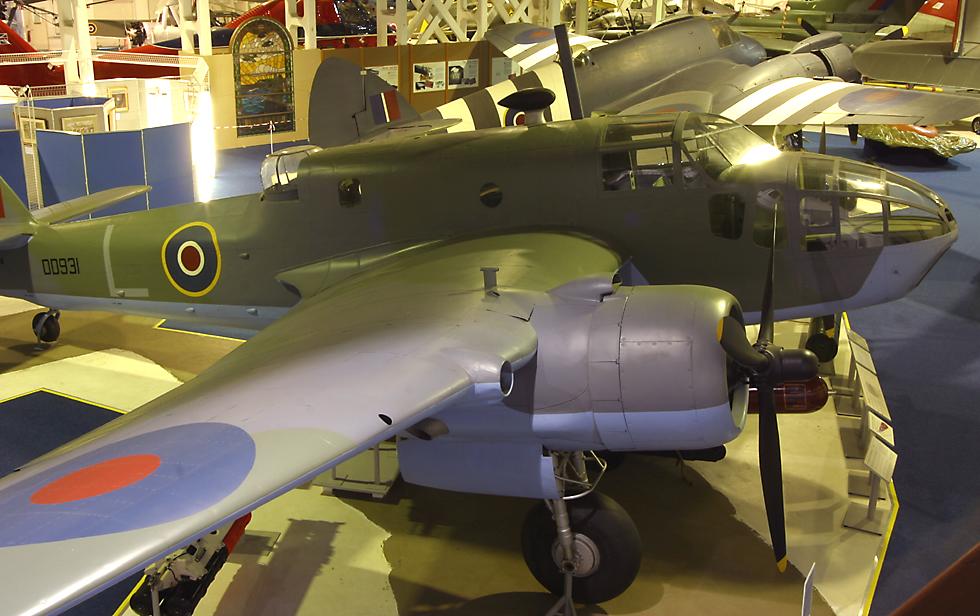
| In
1935 the British air ministry issued two specifications requesting a torpedo
bomber and a reconnaisance bomber, the latter to replace the Avro Anson.
The Bristol company decided they could satisfy both requests with a single
aircraft called the Beaufort, based on the
Blenheim bomber. The Beaufort certainly bears a strong
resemblance to its predecessor, particularly in the nose area, however
it was quite a bit larger and heavier, and the roofline is quite different,
in part to accomodate a larger crew of four men. |
 |
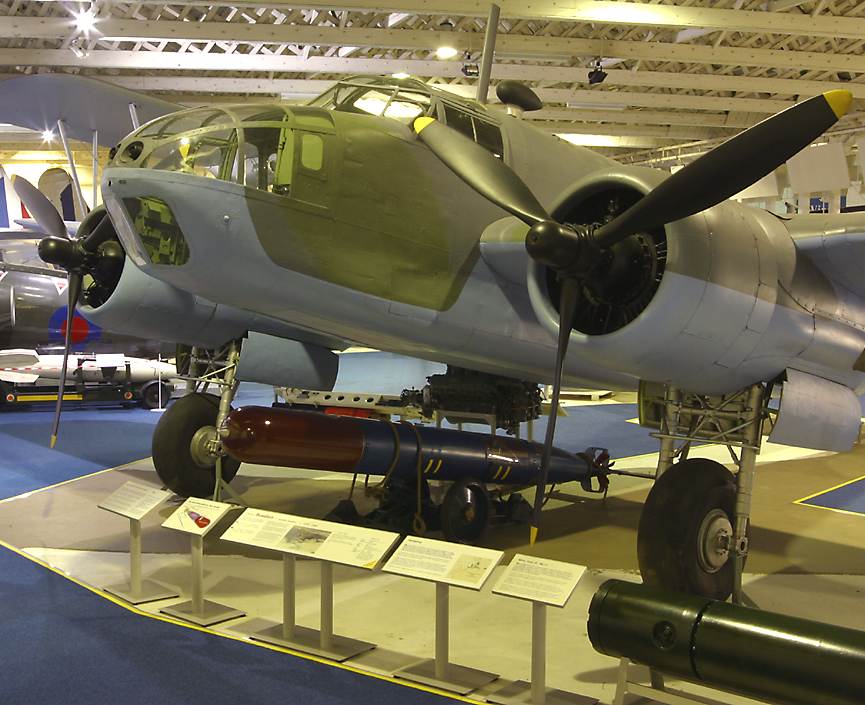
| The
Beaufort could carry a single torpedo, and it remained the main British
torpedo bomber until it was superseded by the Beaufighter in 1944.
It was used in unsuccessful torpedo attacks against the German ships Gneisenau,
Scharnhorst and Prinz Eugen, but it was as a mine layer that it had the
most effect, proving particularly effective against the shipping used to
keep Rommel supplied in North Africa. |
 |
| Ultimately
the Beaufort was only a mediocre performer, though it was undeniably more
successful than the Blenheim had been, and many in the last production
batch were converted to unarmed transports. As well as British
production, the Australians also manufactured 700 Beauforts using American
Pratt and Whitney Twin Wasp engines rather than the troublesome British
Taurus engines. Australian Beauforts were used extensively
in the Pacific, but were not particularly outstanding - the New Zealand
air force also operated some, but eventually opted for American-designed
Grumman Avenger torpedo bombers instead. |
 |
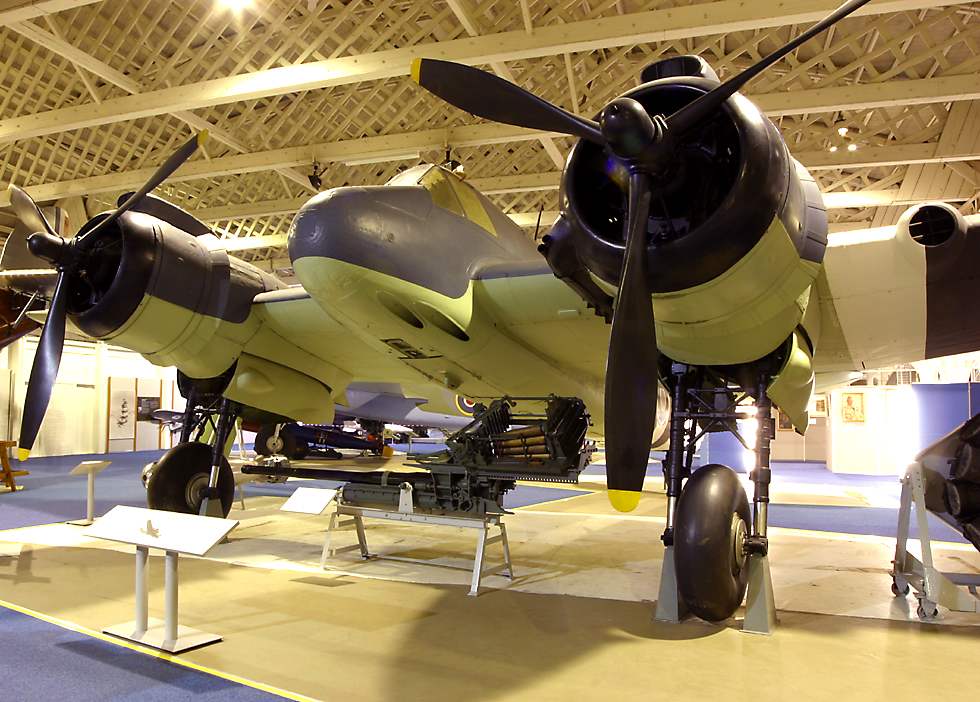
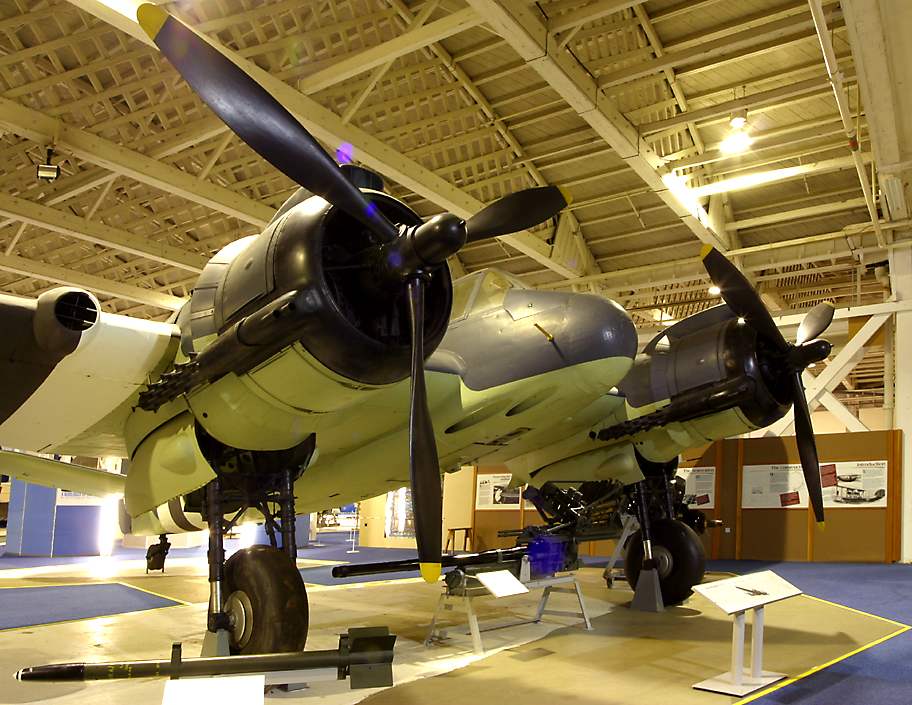
| Bristol
did further development of the Blenheim/Beaufort family and came up with
a winner, the Bristol Beaufighter. As you can see, it's considerably
more compact and streamlined than its forebears, allowing it to fly over
70 mph faster than the Beaufort. It also packed a very heavy
punch, with no fewer than four 20mm cannons mounted in the nose, behind
and below a radar set which allowed the Beaufighter to become Britain's
premier night fighter, its performance being good enough to ensure operation
by the US army air force in the same role. Faster Mosquitos
were replacing the Beaufighter by the Autumn of 1943, but America continued
operating them until near the end of the war. |
 |
| As
well as night interdiction of German bombers, the Beaufighter was also
adapted for the anti-shipping role, in which it had considerable success.
To prevention detection at night, flame suppressing exhausts were fitted
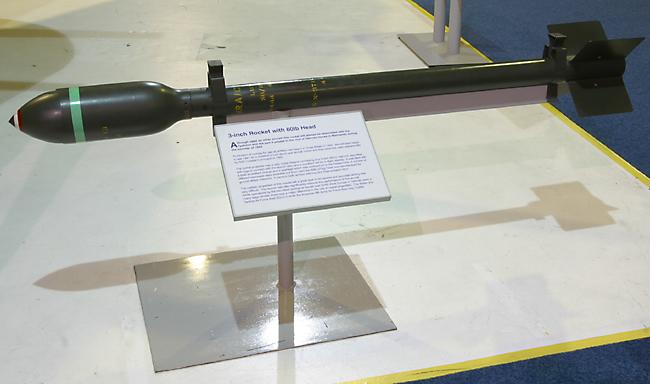
like the ones seen here. From 1943 onwards, Beaufighters were
manufactured with the ability to carry torpedoes, and they also operated
with rockets like the one displayed on the ground here. About
6,000 Beaufighters were eventually built but today only six survive, four
of which are on display in various museums. |
 |
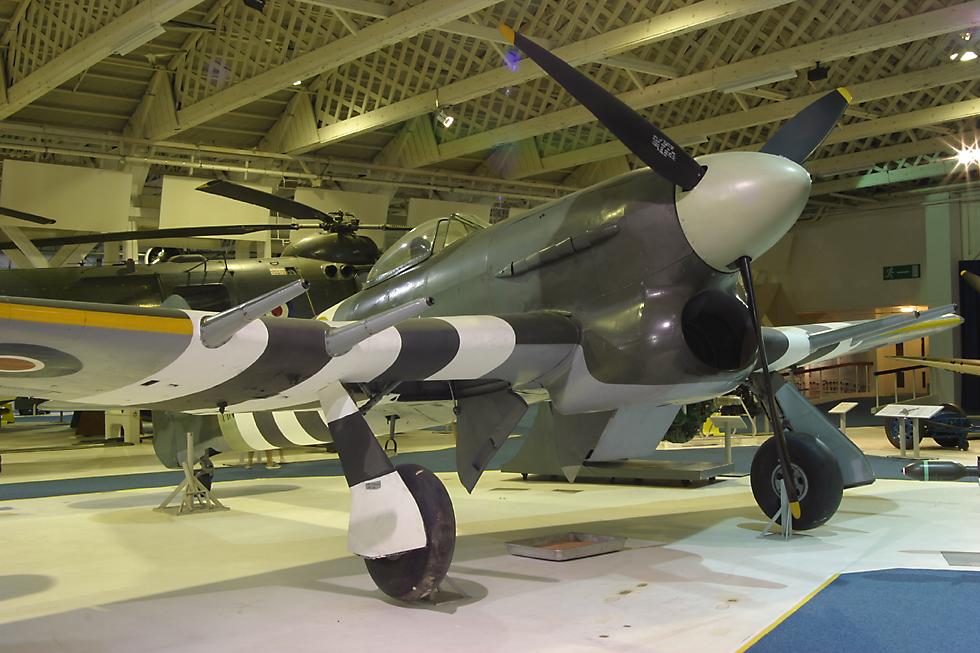
| The
Hawker Typhoon was the first British fighter capable of exceeding 400 miles
per hour, and was intended as a replacement for the same company's Hurricane
fighter, which even by 1942 was becoming rather long in the tooth.
With four 20mm cannons it had vastly greater firepower than early Hurricanes,
an important lesson which the British learned much earlier than their American
counterparts, who continued fitting even post-war jets like the F-86 Sabre
with 0.50 inch machine guns rather than the far superior hitting power
of cannons armed with explosive shells. |
 |
| At
low level the Typhoon was a match even for the Luftwaffe's excellent Focke
Wulf Fw 190 fighter, but it really came into its own as a fighter-bomber,
strafing trains, trucks and other vehicles, and also using two 1,000 pound
bombs or up to eight 60 pound rockets like this one against tanks and other
ground targets. Typhoons devastated vast quantities of German
equipment in the months after the Normandy landings, firing a total of
over 220,000 armour piercing or fragmentation rockets. |
 |
| This
particular aircraft is the only example left in the world, in early 1944
it was shipped to the United States for flight evaluation and later that
same year it ended up in the Smithsonian's national air museum!
In 1967 it was swapped for a Hawker Hurricane in time for the Royal Air
Force's 50th anniversary. |
 |
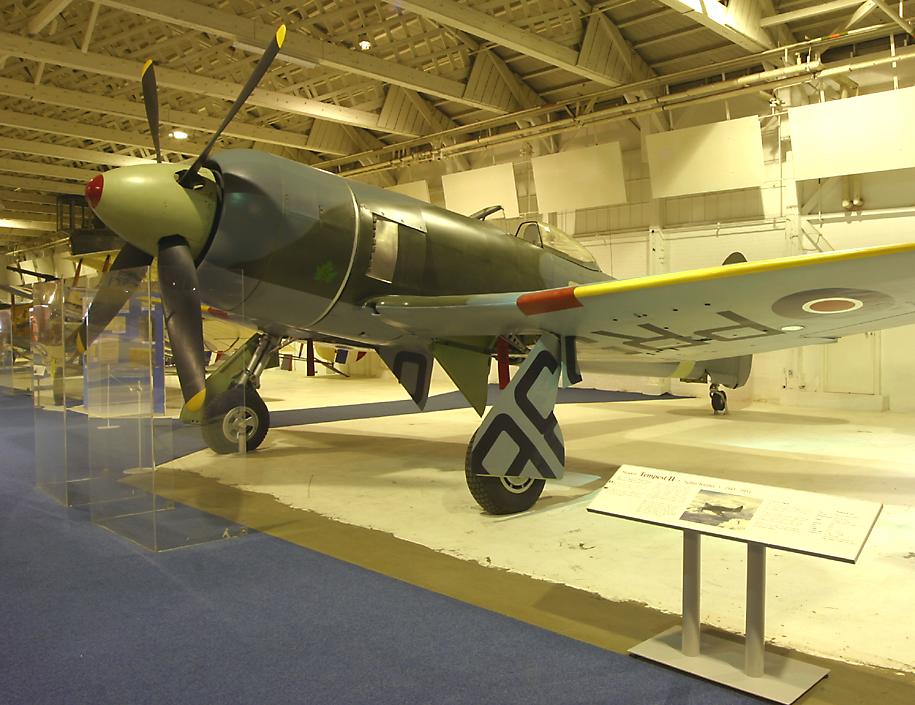
| New
Zealand provided many of the pilots flying Typhoons, so it was natural
that they were also the main user, together with the British, of its successor,
the Hawker Tempest. By replacing the bulky "beard" radiator
of the Typhoon with radiators fitted into the leading edges of the wings,
the Tempest was able to fly at 465 mph, allowing them to destroy 638 out
of the 1846 V-1 flying bombs downed by aircraft. Development
continued with various engines and different aerodynamic refinements.
This version, the Tempest II, which confusingly came after the Tempest
III, IV and V, was the fastest of all, with features adopted from the Fw
190, however it arrived too late to serve during the war. |
 |
  |