| Common
Birds of the New Zealand Forest |
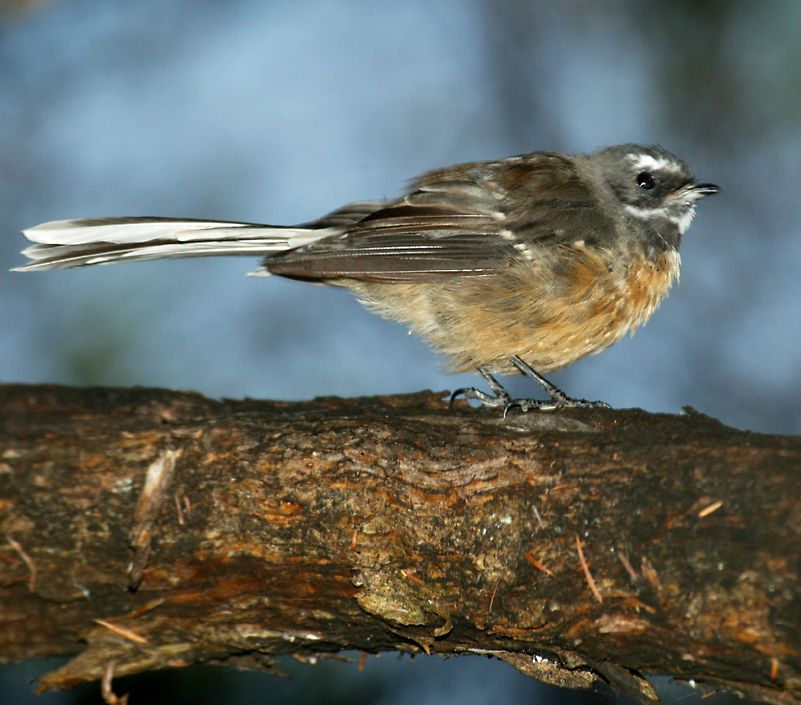
| Here's
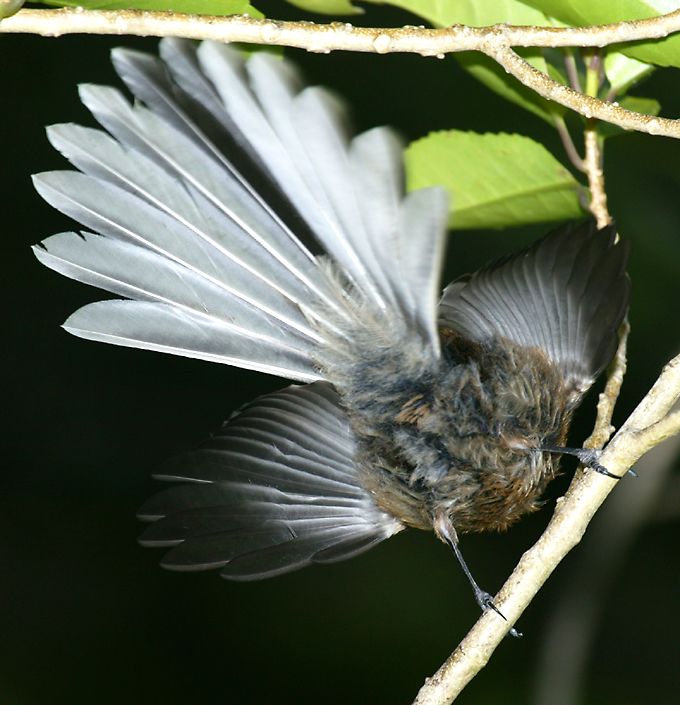
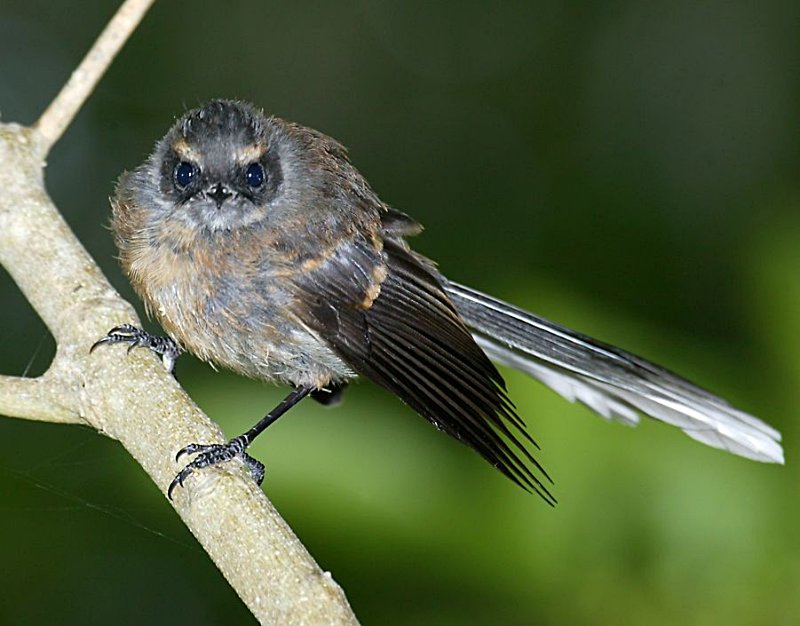
one of the most well known and liked New Zealand birds, the fantail. |
 |
| This
friendly little creature flits around the forest looking for insects and
even seeks out human contact, following people as they walk through the
bush and catching the insects which we disturb. |
 |
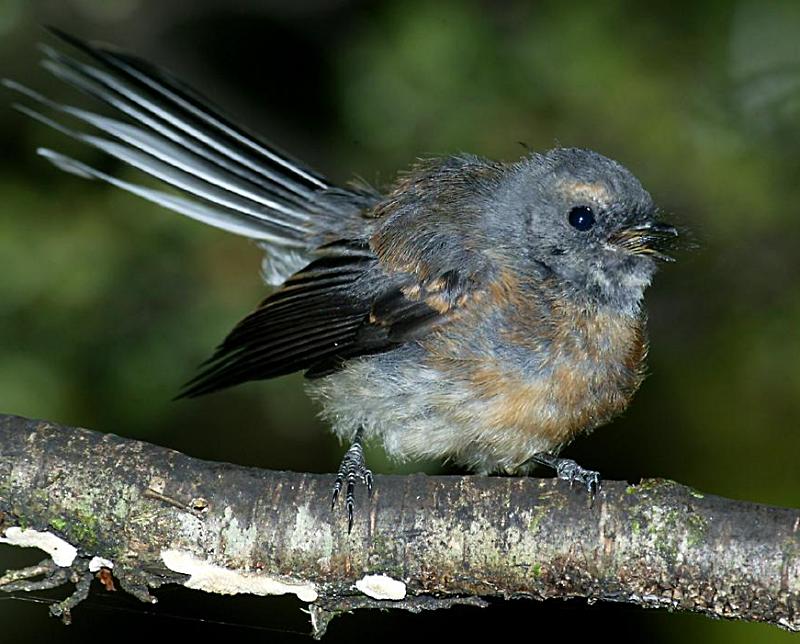
| The
fantail has several adaptations which allow it to catch and hold on to
its prey, including the stiff whiskers around its beak which you can see
in this photo. These whiskers guide the insects towards the
fantail's open mouth as it catches them in mid-air. |
 |

How wude!
Well, of course the fantail's major insect hunting asset is the tail which
gives it its name. The tail is very large in comparison to
the size of the bird itself, allowing the fantail to turn very rapidly
in flight, all the better to catch maneuverable insects. |

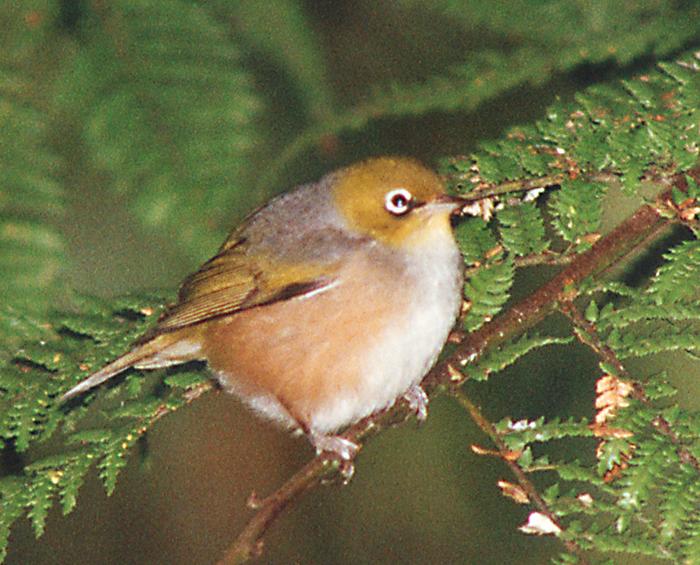
The wax-eye is another cute little bird which lives in what New Zealanders
commonly refer to as "the bush". The wax-eye is also known as the
white-eye or silver-eye, and unlike the fantail it eats berries and nectar,
which it laps up with a brush-tipped tongue.
The wax-eye is a very recent arrival in New Zealand, in fact it's thought
that it was self-introduced in the mid 1800s from Australia, perhaps when
a flock of them was blown across the Tasman Sea by a storm. |

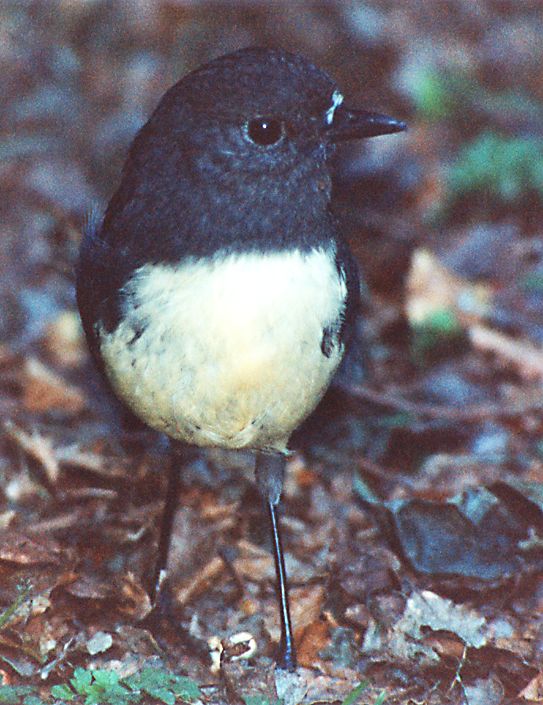
This little sweetie is a New Zealand robin or, more accurately, a South
Island robin, since this sub-species is noticeably different than
the variety that lives in the North Island of New Zealand, or the separate
Stewart Island version. All of these sub-species are endemic
to New Zealand, meaning that they're found nowhere else in the world.
Like the fantail, the wax-eye and quite a few other New Zealand birds,
the robin is very tame and unafraid of people, which is the natural result
of evolving in a country with no mammalian predators.
North Island robins aren't common, but South Island robins can be seen
regularly in the northern part of the island. This one was
by the side of the road in the Lewis pass near the tiny settlement of Maruia. |
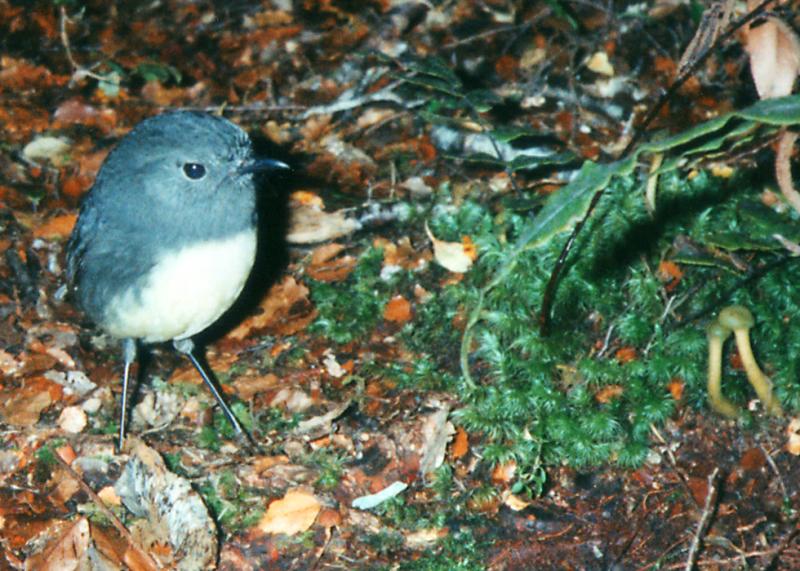
| And I found this
one on a different occasion, but in very nearly the same place.
If you look closely, then you'll realize that it's contemplating a meal
of mushrooms, which is very appropriate, since it looks exactly like an
egg itself! In reality, they eat insects which they find amongst
the leaf litter, which is why both of these photos show the bird on the
ground. |
 |
| The
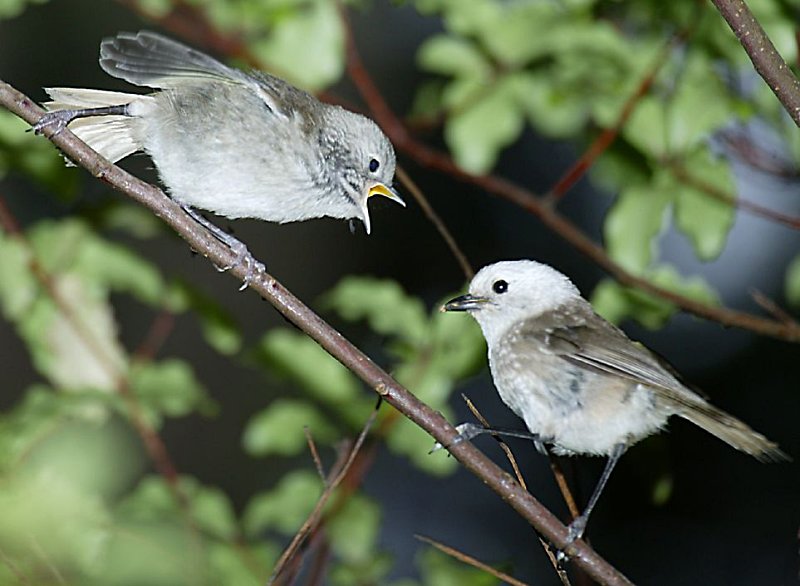
cuteness just goes on and on! Here is a juvenile whitehead
imploring a parent for food. The whitehead isn't a well known
species to most New Zealanders, but it's fairly common in the North Island,
south of Auckland, as well as on some islands offshore from the North Island,
such as Little Barrier, Kapiti and Tiritiri Matangi, where I photographed
these two. Unusually, a nest with two or three youngsters is
usually attended to by four adult birds, all of which feed the chicks and
rush in to distract predators. The chicks venture outside the
nest early, and it's common to find three chicks sitting closely together
on a branch. As you can see in this photo, the chicks rapidly
flutter their wings as a greeting to the adults, and the adults also greet
each other in this way. |
 |

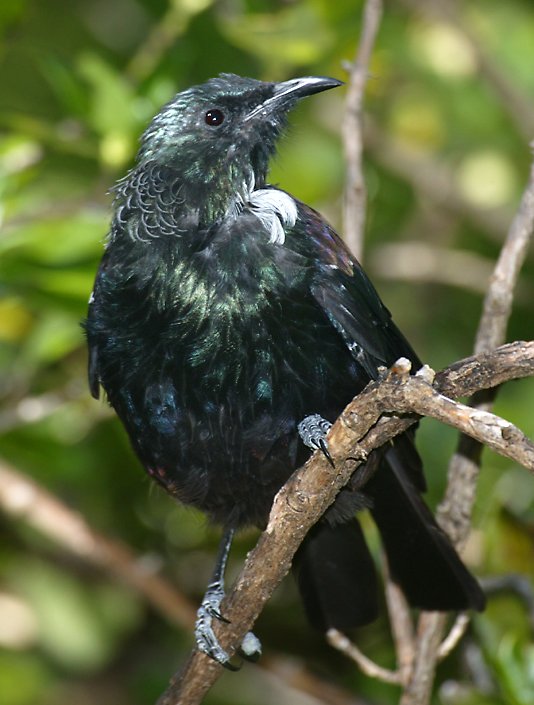
The tui is a much more well-known bird, and considerably more common than
the
whitehead, too. It's one of the few native birds comfortable
living in suburbia, lapping up nectar from flowers with its tongue.
It probably
helps a great deal that the tui is a very feisty bird which will chase
other birds from its territory. |
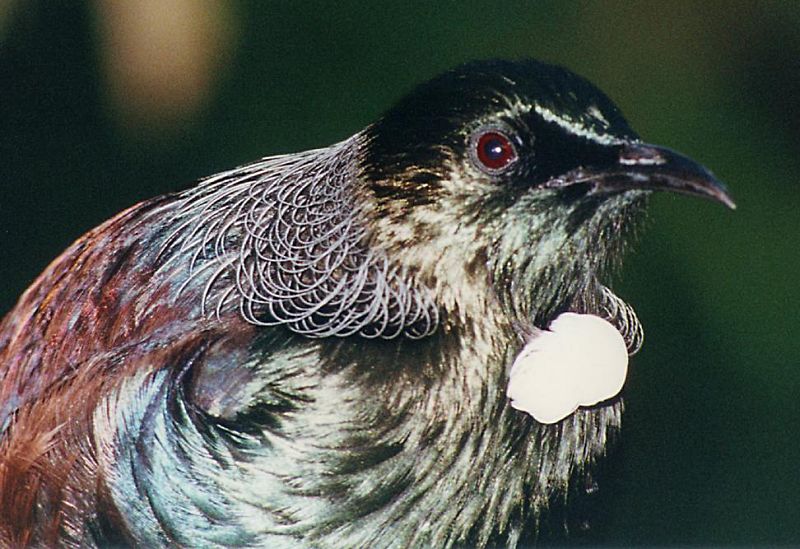
| The tui is sometimes
also called the parson bird, because of the white tufts under its chin
which reminded people of the white collars worn by English parsons.
The filaments around its neck also give it a very distinctive appearance.
From some angles the plumage looks almost black, but when the light strikes
it from certain angles you can see almost metallic greens and blues, as
well as rich copper colouring. |
 |
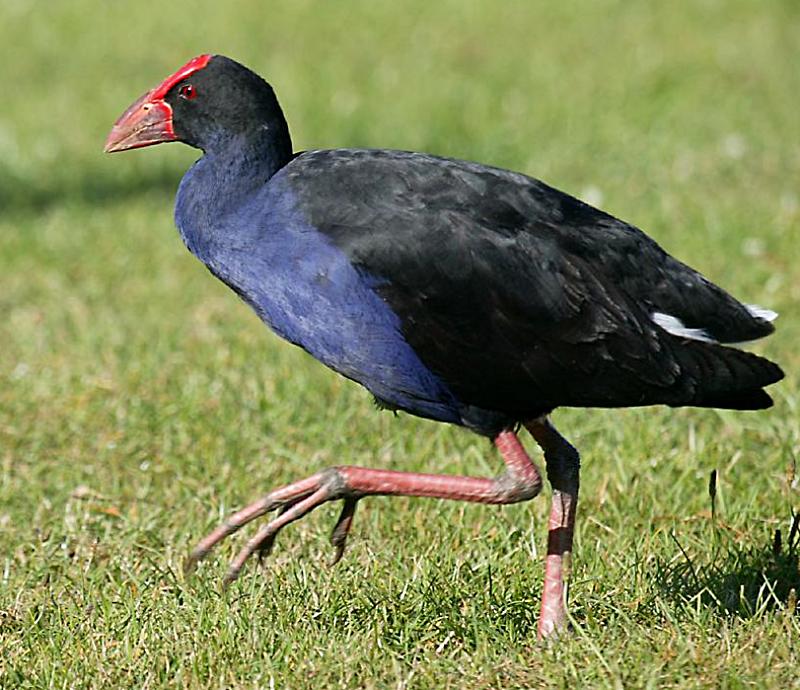
| The
pukeko is another very common and well known bird, but unlike most of the
birds on this page it is found in many other places around the world, including
the United States, Europe, Africa, Asia and Melanesia. Like
the name "tui", the word "pukeko" is of maori origin, but in other parts
of the world it's called a purple swamphen or purple gallinule.
For such a widespread bird it's a surprisingly bad flier, hardly able to
flap more than a few tens of meters with its legs dangling down, before
crash landing. Once on the ground it walks around looking for
insects, frogs and the like, periodically flashing the white plumage under
its tail, particularly if it feels threatened. |
 |
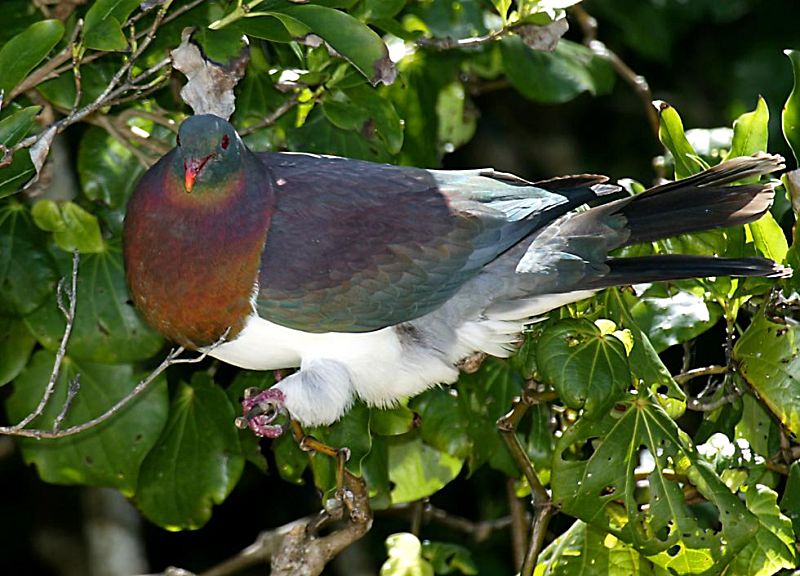
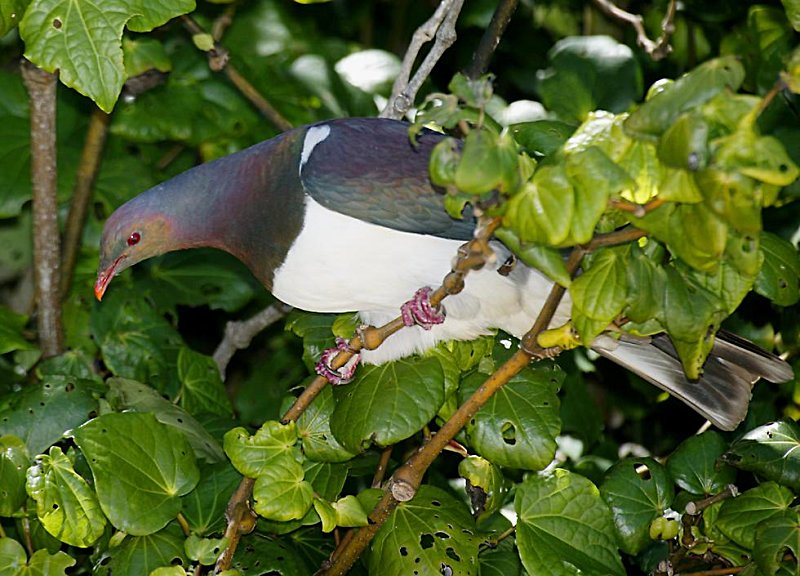
| The
New Zealand wood pigeon is another bird endemic to this country.
It's quite large and like the tui has really beautiful plumage, again with
metallic shades of green and copper. The white feathers on
its belly and legs nicely highlight the colours on the rest of the bird. |
 |
| Like the tui, the
wood pigeon is able to make a living in city parks and suburban gardens,
where it searches out berries, or leaves and shoots if there are no berries. |
 |
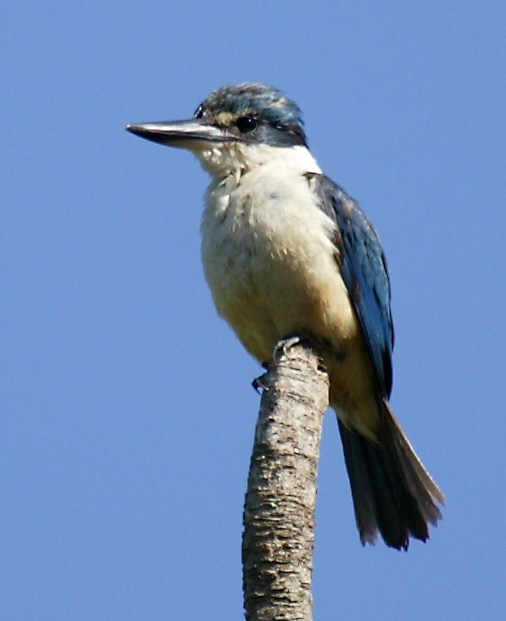
 There's
only one type of kingfisher found in New Zealand, a sub-species of the
sacred kingfisher found in Australia and parts of Melanesia.
They're very aggressive,
attacking other birds and even predatory mammals, and often eat mice in
addition to their regular diet of small fish, lizards, worms and insects.
Nevertheless, like most kingfishers around the world it's very difficult
to get close enough for a decent photograph. This shot was
taken on Tiritiri
Matangi island, as were the earlier photographs of the whitehead, tui,
wood pigeon and pukeko, as well as the next photograph. |
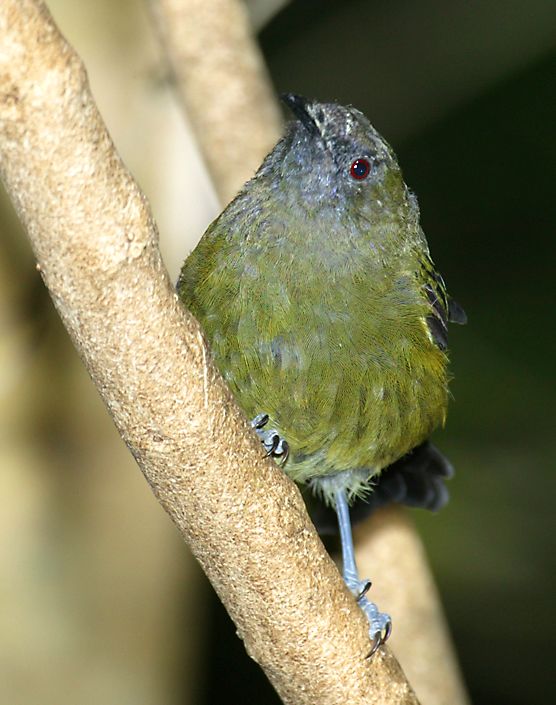
The bellbird is well known, but not often seen by most people, though it's
said to be relatively more common in the South Island.
The red eye on this individual indicates that it is male.
As the name suggests, their song sounds rather like the ringing of small
bells, and it was a major contributor to the dawn chorus of bird song which
filled the country each morning when Europeans first arrived.
Many species of birds became extinct in the following years, and it seemed
as if the bellbird might head in the same direction, but thankfully it's
been able to pull itself back from the brink. |

As you might have noticed, one characteristic of all of the birds on this
page is their feistiness, which has allowed them to survive despite the
arrival of humans and their accompanying horde of mammalian predators like
rats, cats, stoats and ferrets, as well as competitive species like deer
which have totally stripped away the forest undergrowth. Each
of these birds is impressive, but this one is definitely the King of the
Feisty.
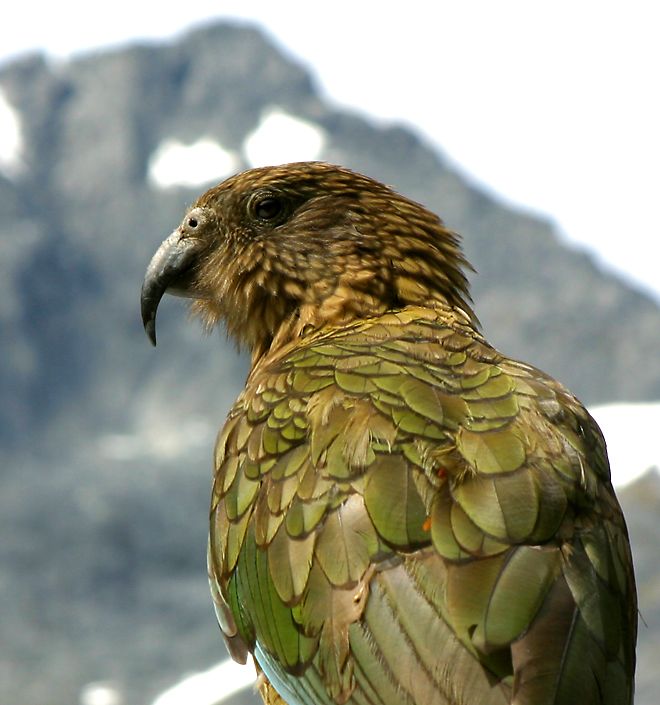
The kea is one of several parrots found only in New Zealand.
Some of these, like the red-crowned and yellow-crowned parakeets, are fairly
ordinary as parrots go, others are far from ordinary, like the kakapo,
which is not only the world's largest parrot, weighing up to 3.5 kilograms,
but is also flightless and nocturnal, and has a very strange and unbirdlike
"booming" call. Sadly, it has nearly no concept that there
are now enemies in its world and how it should defend itself from them,
and this has made the kakapo extremely rare, with fewer than a hundred
left in the world.
The
kea is another extraordinary parrot, but thankfully it's able to take care
of itself. The kea isn't nocturnal, nor is it flightless, but
it is unusual in being the world's only alpine parrot. High mountains
in the South Island are the best place to look for them, both of these
photos were taken at the top end of the Homer tunnel which leads across
to Milford
Sound.
Keas are extremely intelligent, scoring better on intelligence tests than
most primates, and research has shown that they're one of the very few
animals in the world which are self-aware. They've even learned
how to take advantage of the animals introduced by humans.
For many years farmers complained that keas were killing sheep at night,
only to be ridiculed for this idea by environmentalists. However,
eventually night camera footage was obtained of keas flying onto the backs
of sheep and using their sharp hooked bills to dig into the backs of the
sheep in order to feed on the fat around their kidneys. Of
course it's very unfortunate for the sheep, and some people refer to the
kea as "the feathered wolf". |
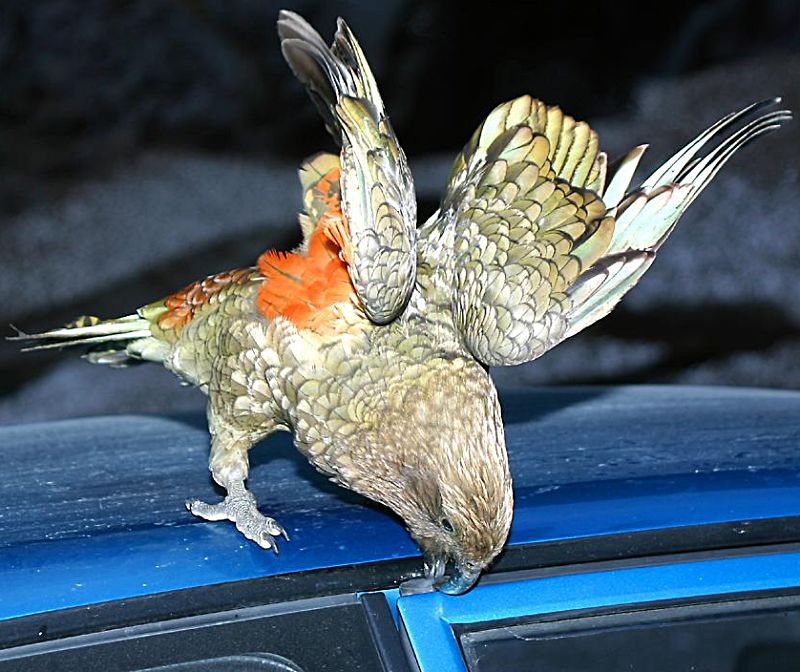
| Keas
gleefully take out their vengeance not only on the destructive animals
introduced by humans, but on humans themselves! Many a skier
has returned from an exhilirating day on the slopes only to find that his
car has been torn to pieces, with every plastic or rubber part around the
doors and windows ripped to shreds! Somehow it seems like very
appropriate payback for the thoughtless havoc that we've done, and continue
to do, to the original bird inhabitants of the country which were less
able to defend themselves. |
 |
Take
a look at some rare
New Zealand birds living on Tiritiri Matangi island.
 |