
Reptiles of California's Coachella Valley
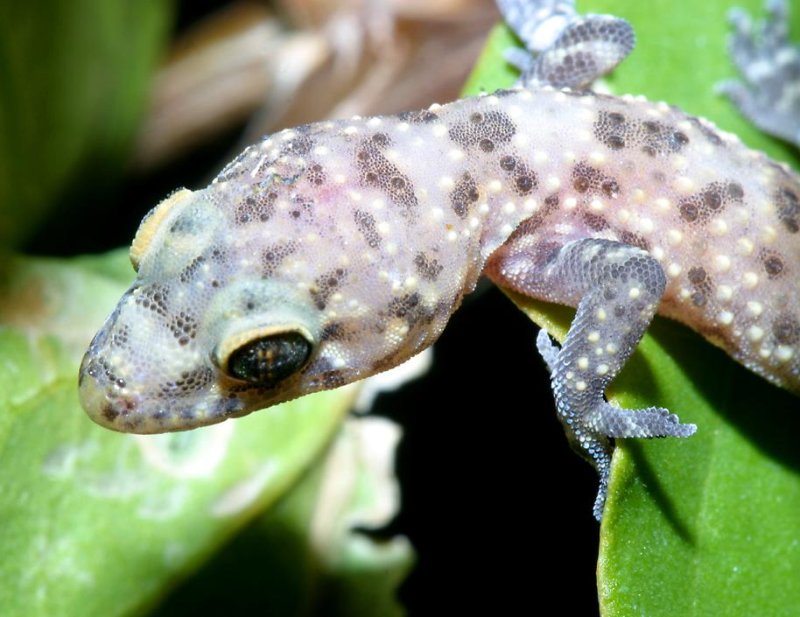
The Coachella Valley is about an hour's drive east of Los Angeles, where the true desert begins just past the San Bernardino mountains. I spent 18 months living here in the city of Palm Springs, after moving down from Chicago. When I moved down I was pretty fired up by the prospect of seeing some desert animals, and this page is a record of the reptiles I found during my forays. Let's start by clearing the decks of an animal which isn't at all representative of the Coachella Valley. This cute little critter strikes out on two counts - firstly because I found it in the backyard of my home in Palm Springs rather than in the Great Outdoors, and secondly because it isn't a native of Coachella Valley at all. In fact it isn't even a native of America, instead it's a Mediterranean gecko, a species which was probably transported here in a shipment of tiles from Italy, or some other Mediterranean country. |

Another gecko, but this time it's a true local! This is the San Diego sub-species of the Western banded gecko, which I encountered during one otherwise unmemorable night of wandering around with a flashlight in the Coachella Valley Preserve. Check out its outsized eyelashes, a necessary adaptation for keeping blowing desert sand and grit out of your eyes. |
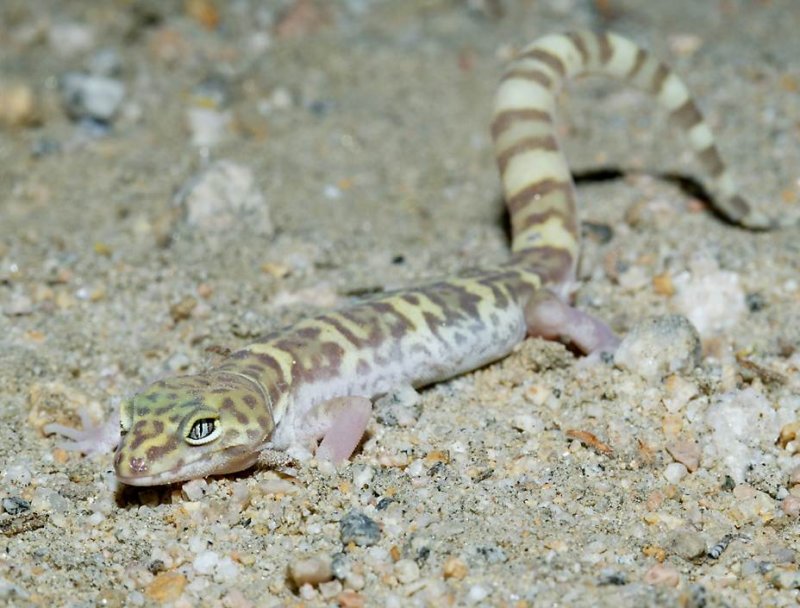
And check out those incredible eyes! Like the Mediterranean gecko, they're very cat like, but in this case they're a piercing blue. Take a look also at the curious display which this little critter is doing with its tail. I'd been hanging around this gecko for a while, and it must have decided that it was in danger of being eaten, so it started wagging its tail around, almost like a cat flicks its tail backwards and forwards. However, in the case of this gecko the waving is an attempt to make me grab its tail, at which time the gecko will discard it and run away to safety, with the tail still twitching around because of nerve impulses. |
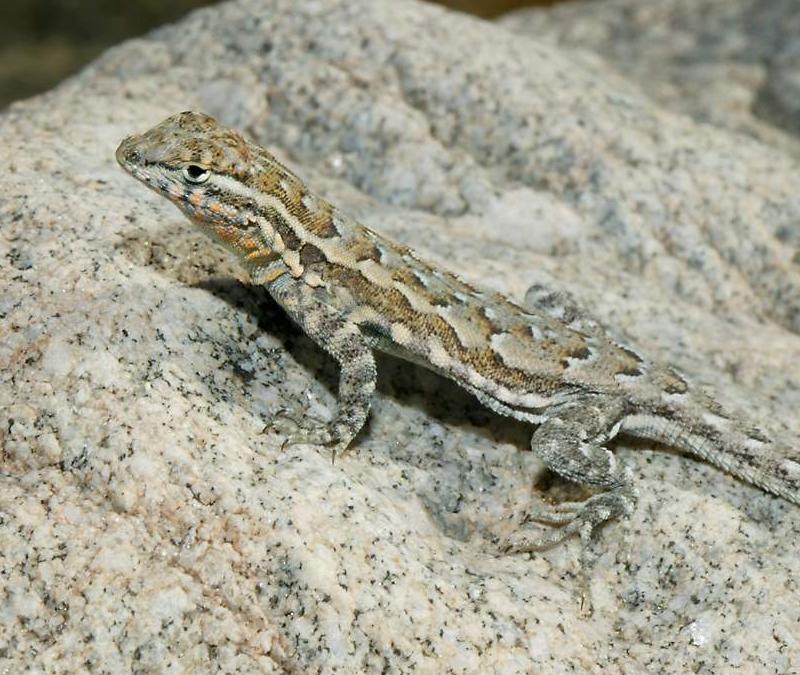
Geckos aren't very common around here, in fact those two individuals were the only ones I saw during the 18 months I lived in the valley. However, this species is almost everywhere, it's a side-blotched lizard, which is very variable in color and sometimes like this one is missing the dark blotch behind its front legs which is its main distinguishing feature. |
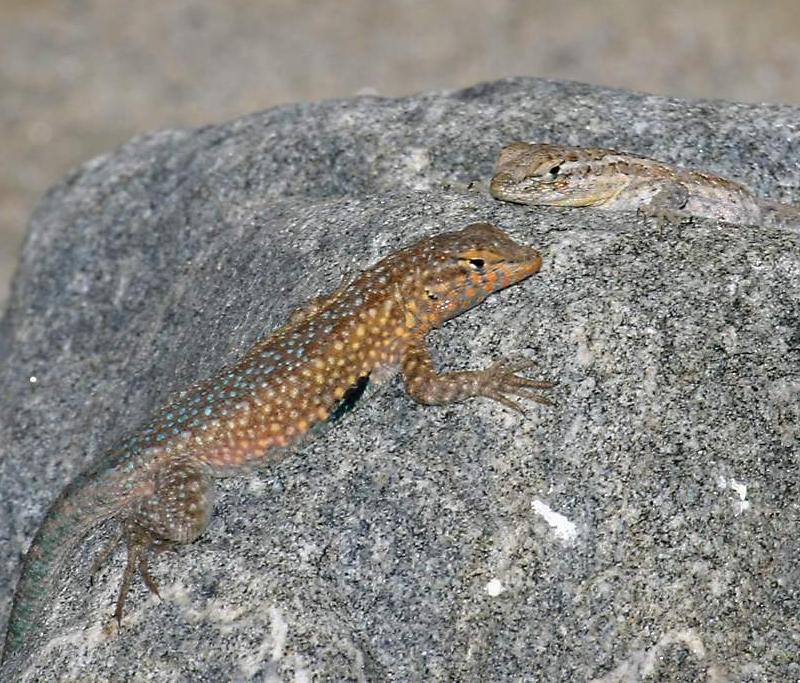
Here's a male and a female with more "typical" markings. The male on the left has a very pronounced blotch on its side as well as blue dots on its back, but the female looks fairly drab. Although they're very common, they're also quite small and wary so it's difficult to get close enough to get good photographs. |
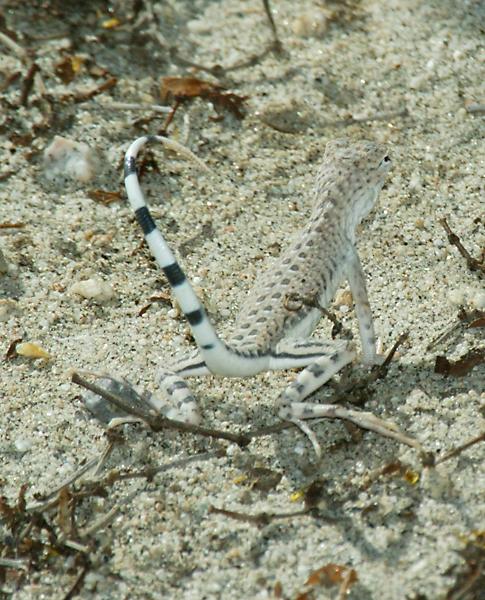
How wude! This is a juvenile zebra tailed lizard which I came across in the Coachella Valley Nature Preserve, it has the very obvious zebra striped tail of the adults, but it lacks the distinctive belly colors of either the mature male or female. Again the tail is used as a way of distracting dangerous predators like myself from the main course - the lizard's head, body and legs. They run across the sand at high speed and flash their tail as they go, perhaps as a distraction to hawks and other birds. |
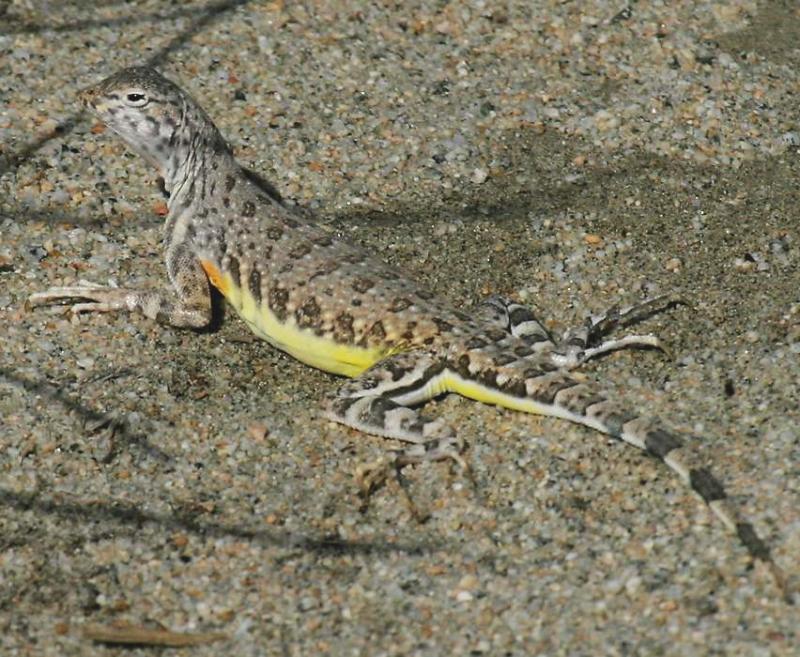
I didn't see too many of this species, but I did come across this nicely marked female in the same general area, but on a different day. |
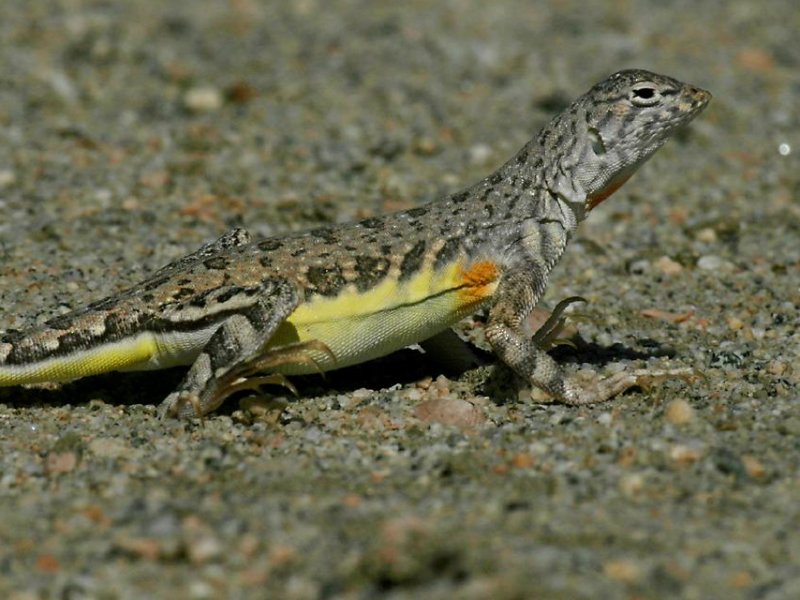
Here's another photo of that female. Adult males also look quite striking, with the same zebra tail, a blue underbelly and even a colored pouch under the throat. Interestingly, in this shot you can see this lizard raising its feet off the ground and resting on its heels, a piece of behavior which helps the lizard keep a minimum of its body on the hot sand, and therefore helps it to keep its cool in temperatures which regularly exceed 125 degrees Fahrenheit (52 degrees celcius) during Summer. |
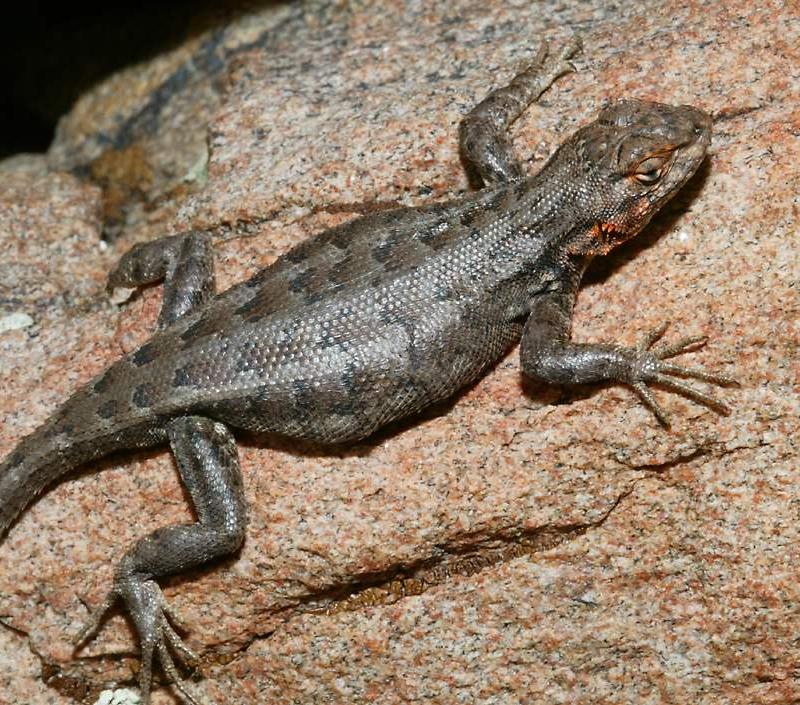
This female sagebrush lizard lives only about 10 miles from those zebra tailed lizards, but it's in very little danger of becoming overheated. In fact it has the opposite problem, because it's living at the top of Mount San Jacinto, the second highest mountain in southern California, which forms the south-western boundary of the valley. This individual is at an altitude of about 8,000 feet and for much of the year there's snow on the ground. It can be 40 or 50 degrees Fahrenheit (20 or 25 degrees celcius) cooler up here than on the valley floor, so these lizards need to spend quite a bit of time basking on the rocks. That doesn't mean that they're very approachable - they usually run for shelter before you can get within 15 or 20 feet of them, and it took me about 15 or 20 minutes of careful stalking to move in close enough to get this shot with a 100mm macro lens. |
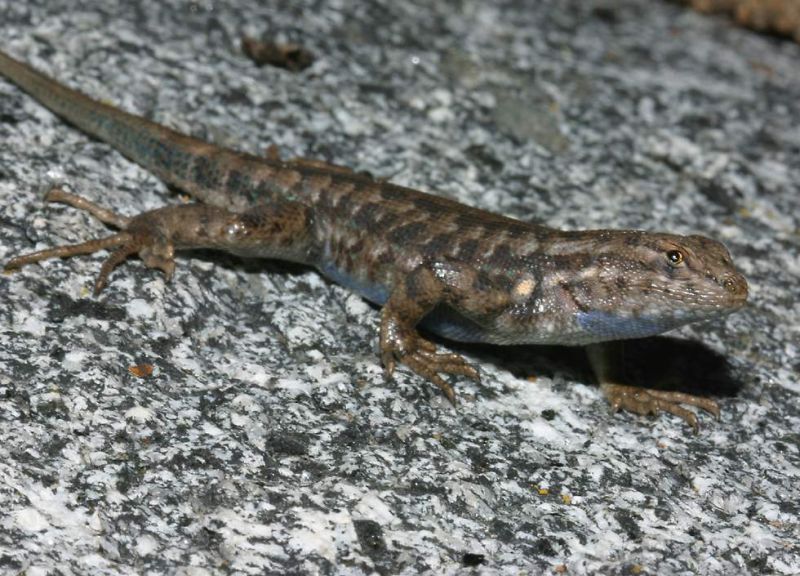
Of course it's sometimes easier to photograph the males of the species than the females, since the males often come out and do a little display of aggression, which usually involves doing rapid up-and-down pushups. This might be a juvenile male, its blue markings are certainly a lot less pronounced than some of the others I saw. Both sexes live mostly on insects and other arthropods including scorpions, which seems like a risky thing for such a small and delicate looking lizard to tackle! |
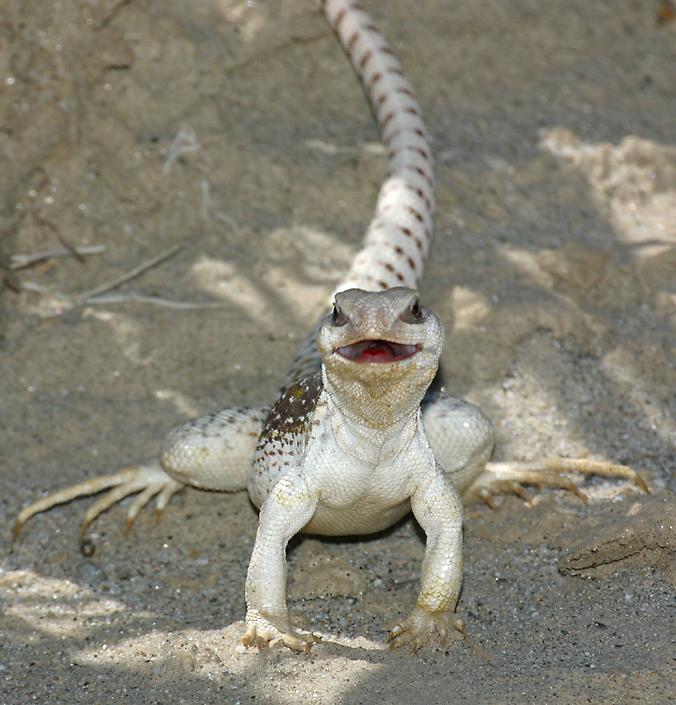
Enough of dinky little lizards! One of my favorite lizards when I moved to the desert was this desert iguana. Not only are they a nice size, they also have nice patterns and coloration on their back and tail. They're mostly herbivores but they will eat the occasional insect, and since one of their favorite foods is creosote bush, they're usually found only where those bushes grow. They'll climb up into the bushes to eat the leaves and flowers. Desert iguanas are the exact opposites of the sagebrush lizards, they're the most heat tolerant of any lizard in the United States, and you'll see them in the middle of the day when all the other reptiles have sought shelter from the sun. |
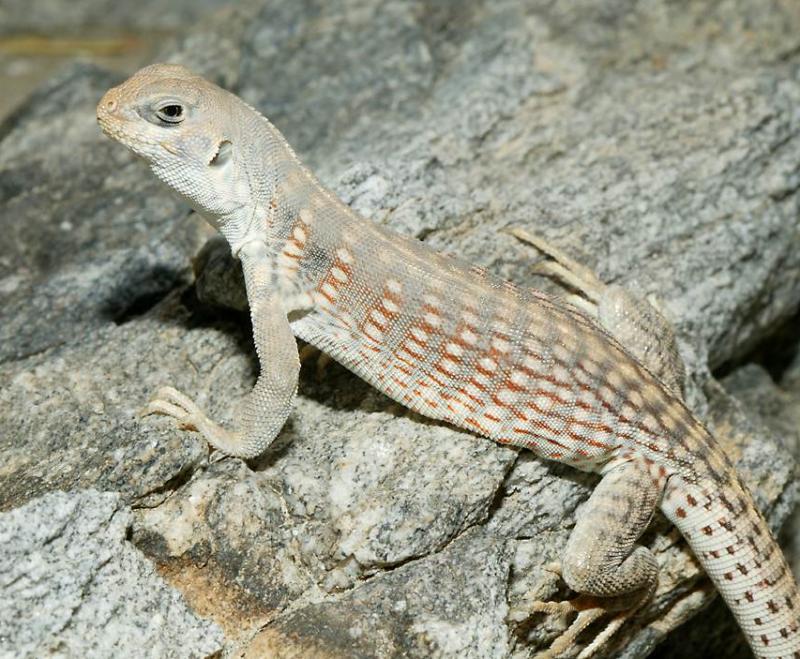
Here's an adolescent desert iguana, starting to develop the rich colors and patterns of an adult. Although they're fairly easy to recognize, the main distinguishing feature is actually the slightly raised row of scales down its back, which is visible even on lizards too young to have developed much coloration, such as the juvenile desert iguana I photographed in Nevada's Valley of Fire. |
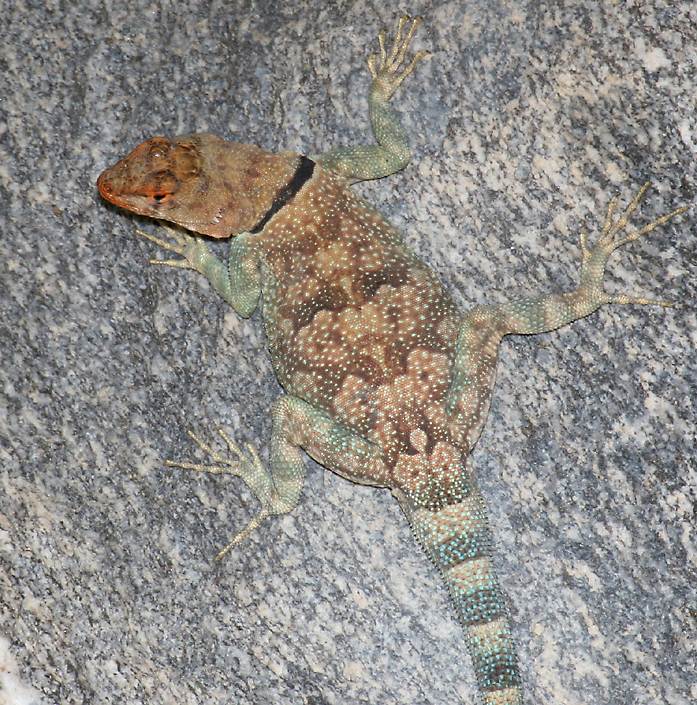
Another cool looking lizard, this time living in the boulder strewn Tahquitz valley, just five minutes out of downtown Palm Springs. This type of rocky habitat is the only place you'll find such lizards, and these environmental preferences together with the dark line around its neck led to its common name, the banded rock lizard. Banded rock lizards have fairly flat bodies so they can squeeze between rocks and into crevices, and their long claws allow them not only to walk with ease up vertical walls, but even to walk on the undersides of overhangs. The orange coloration on the throat and above the eyes of this individual marks it as a gravid female, meaning a female which is carrying eggs. In America's south-west, orange coloration often seems to be more associated with female lizards than males, which have a stronger tendency to have bright blue coloration. |
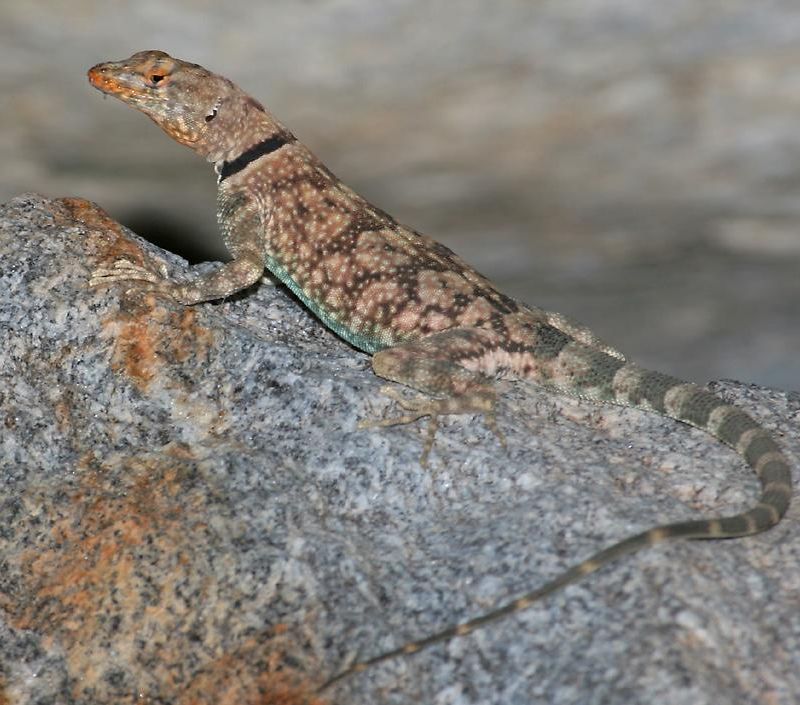
Here's the same individual from a different angle. These lizards are somewhat shy, but by moving in very slowly I was able to take a lot of photographs, and get to within a couple of feet of it. This is all the more surprising since it was in shadow, forcing me to use flash every time I took a photograph. It probably felt a bit more confident because it had several escape routes close to hand. |
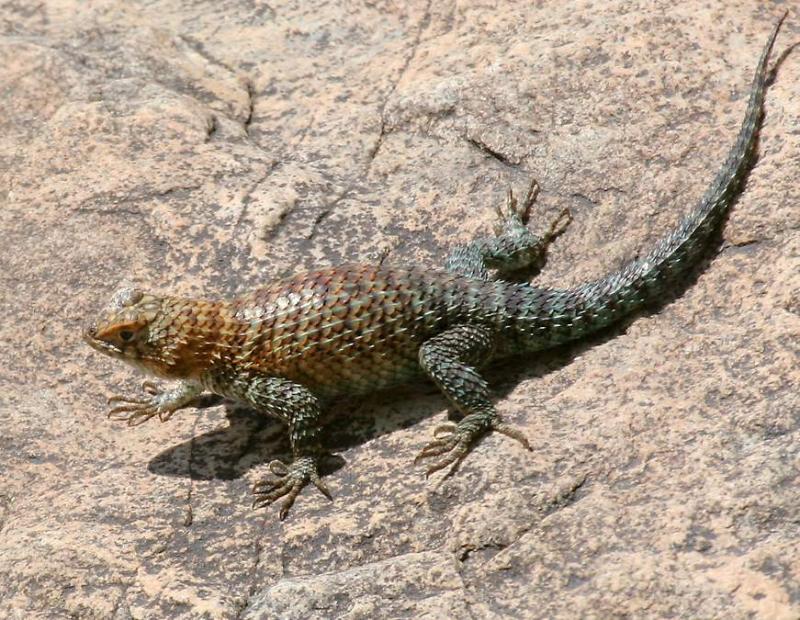
Another lizard living in Tahquitz valley, this time a granite spiny lizard, a very appropriate name considering the very pointed scales covering its body, legs and tail. There's a whole family of spiny lizards in America, all of which have scales like this. |
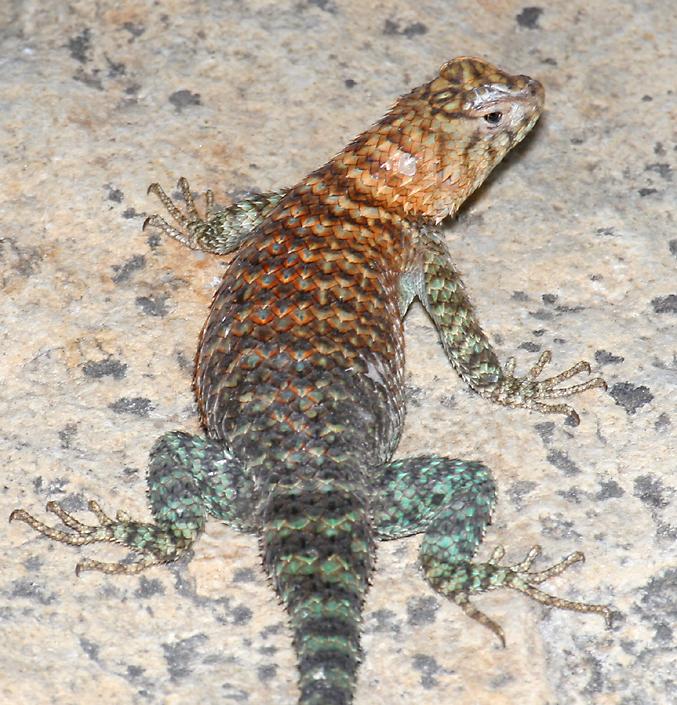
This is a different granite spiny lizard. They're said to have a temperament to match their well armored appearance, apparently they're quite inclined to bite if you pick them up! I love the green colored scales, to me it somehow doesn't seem that lizards like this should have green scales, so it makes them all the more fascinating. |
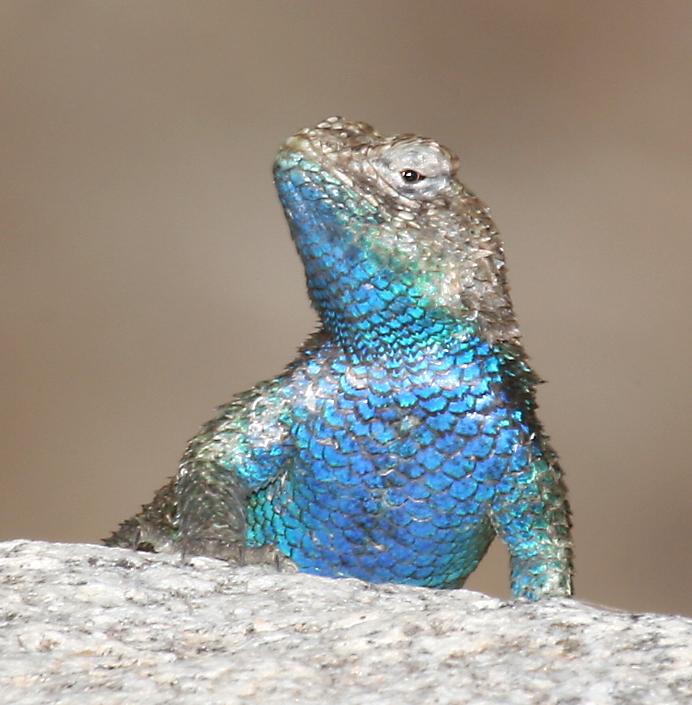
And if the green scales are a sight to behold, then how about these brilliant deep blue scales on the underside of this adult male! Despite repeated bouts of supposedly aggressive push up calisthenics, this guy wouldn't let me get within 30 feet, so I was forced to take this shot using a very long lens. |
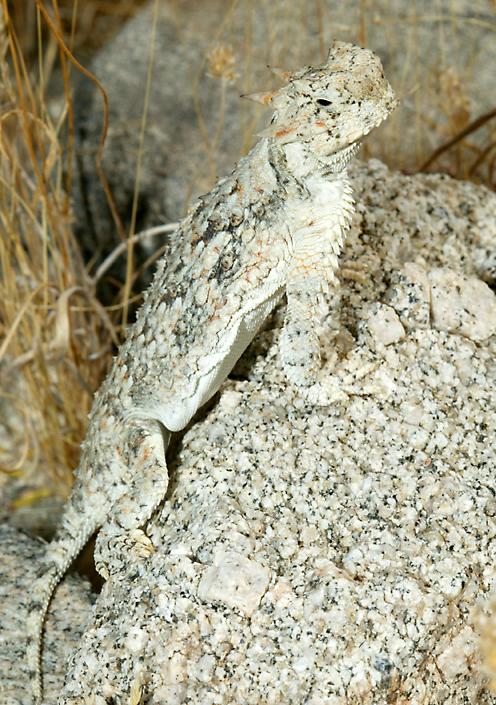
Spiny is one thing, but how about horny? This is a desert horned lizard, one of the most interesting lizards you can encounter in the valley. I didn't see very many of them while I was there, but I did come across a couple of them in the Coachella Valley Preserve beyond the springs. It's quite possible that I walked right past some during my excursions into the desert, because as you can see their coloration makes them very difficult to observe against the background, and their tendency to lie completely still until you're almost stepping on them makes it even less likely that you'll see them. |
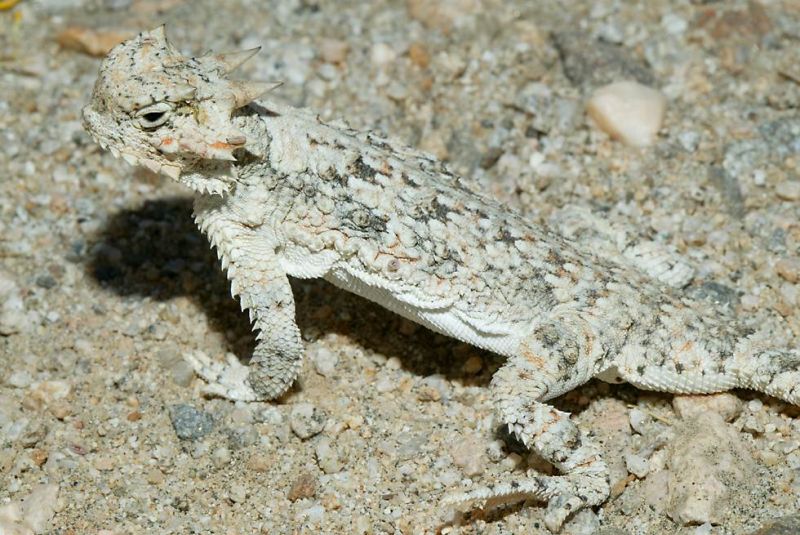
With its horns and spines it's a really great looking critter. It's interesting to contrast the pale salt-and-pepper coloration of this lizard with the reddish coloration of members of the same species living in the red rock and sand environment of the Valley of Fire. I doubt that individuals can change their color during their lifetime, so I assume that individuals have survived better if they happen to have coloration matching the environment they live in. |
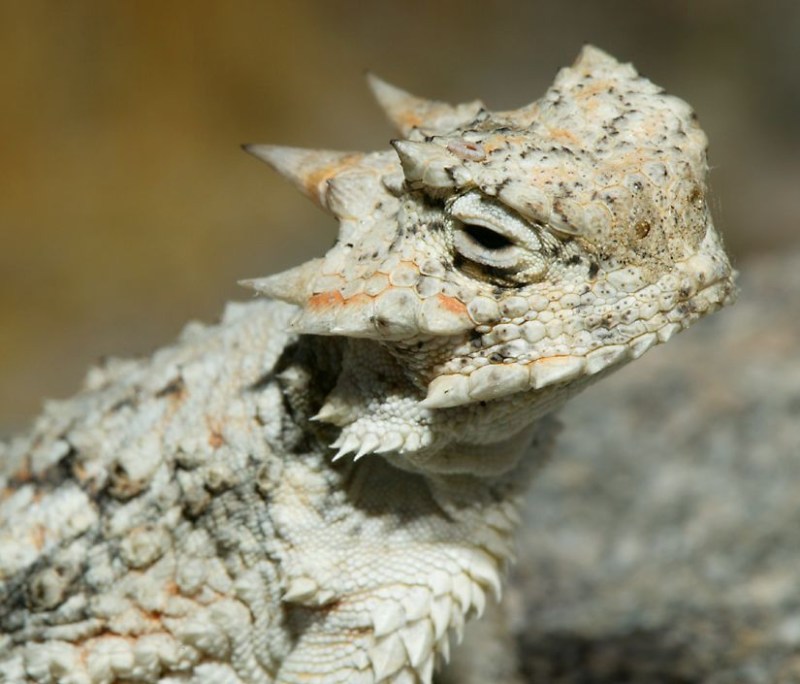
A face only a mother can love! The horns, the flat front and the mouth almost hidden at the bottom of the head all give it an ungainly appearance. However there is one admirer in this photo - if you look up from the back end of its eye you'll see a small, slightly pinkish lump next to one of the horns. This is a tick which is sucking blood from the lizard; you can see another one in the previous photo, actually sitting on one of the horns on the other side of its head. |
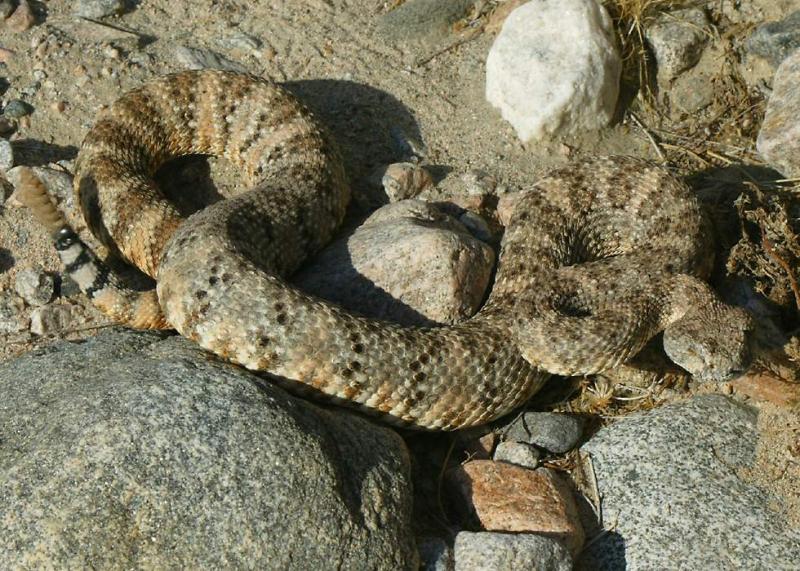
When I moved down from Chicago to Palm Springs I was especially eager to find some snakes out in the desert. As it turns out, though, I saw as many snakes up in Illinois as I saw in the Coachella valley, even though the California climate is much more suited to their kind. However, here's one beauty I did find, a speckled rattlesnake which was making its way down a sandy wash one morning in the Coachella Valley Preserve. As you can see, it's shaking the rattle at the end of its tail and its head and body are ready to strike. Despite their fearsome reputation, most rattlesnakes aren't aggressive, and this one soon made its exit into the nearest thicket of bushes. Western diamondback rattlesnakes grow up to 7.5 feet (2.3 meters), but this variety only reaches about 4 feet (1.3 meters), but even so you shouldn't toy with them! |
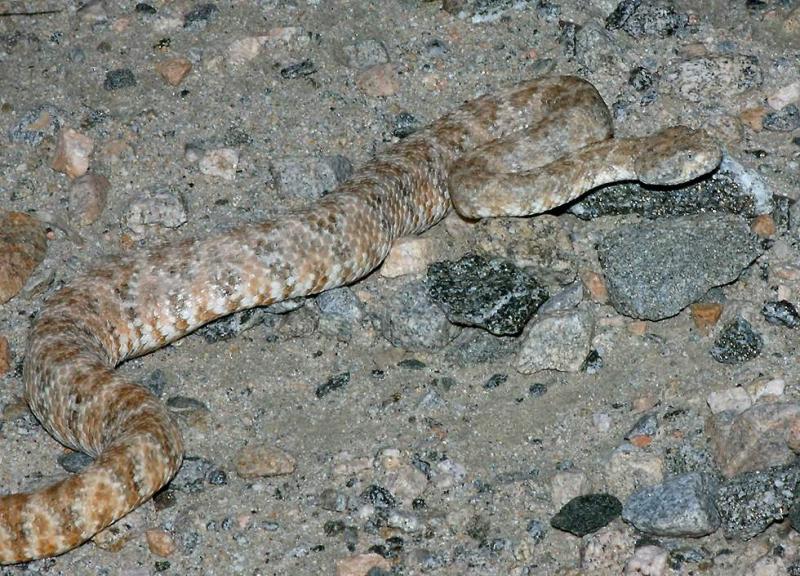
They might not be aggressive, but I don't take my chances, and even in the heat of summer I wear high rubber boots because they offer complete psychological protection against snakebite! It's not that I expect a snake to start chasing me across the desert, it's just that it's very easy to step within striking distance of a snake without knowing it. One evening I was walking up a ridge not far from where I saw the other rattlesnake and suddenly this individual started rattling at me, which is a good thing since I was only 3 or 4 feet away and it was right in the middle of the path I was walking up. Once again the snake beat a hasty retreat into a bush, so this is the only photo I got of it. |
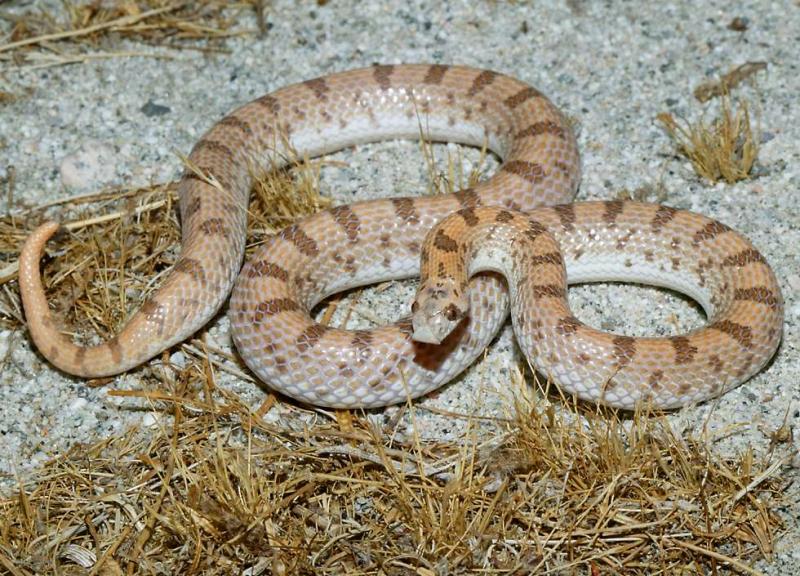
The rattlesnakes are great, but in a way this critter is even better. This species only gets to around 20 inches (50 centimeters) long, but it has a name which is almost the same size as the animal itself, the Western sub-species of the spotted leaf-nosed snake. The Western banded gecko and this snake were the only reptiles I ever encountered during my nocturnal wanderings, and in fact these geckos and their eggs are one of the favorite prey items for this snake. I was very fortunate to see it, because it's a species which is rarely encountered. |
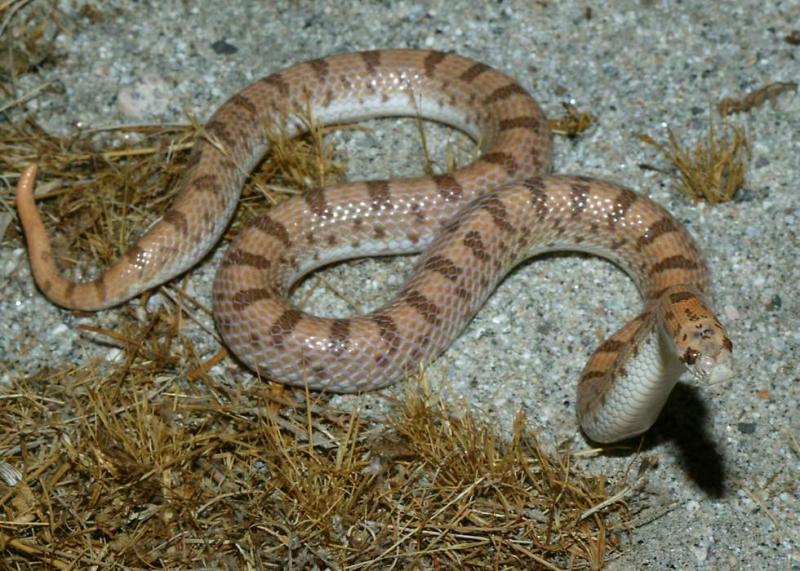
I wasn't taking any chances because of my almost complete ignorance of the snake species in the area, and the defensive posture the snake adopted also made me keep my distance. It seemed to be doing a fair imitation of a rattlesnake by lifting its tail in the same way, and it also did a good threat display by lifting up its head and the front part of its body, much as a cobra might do. |
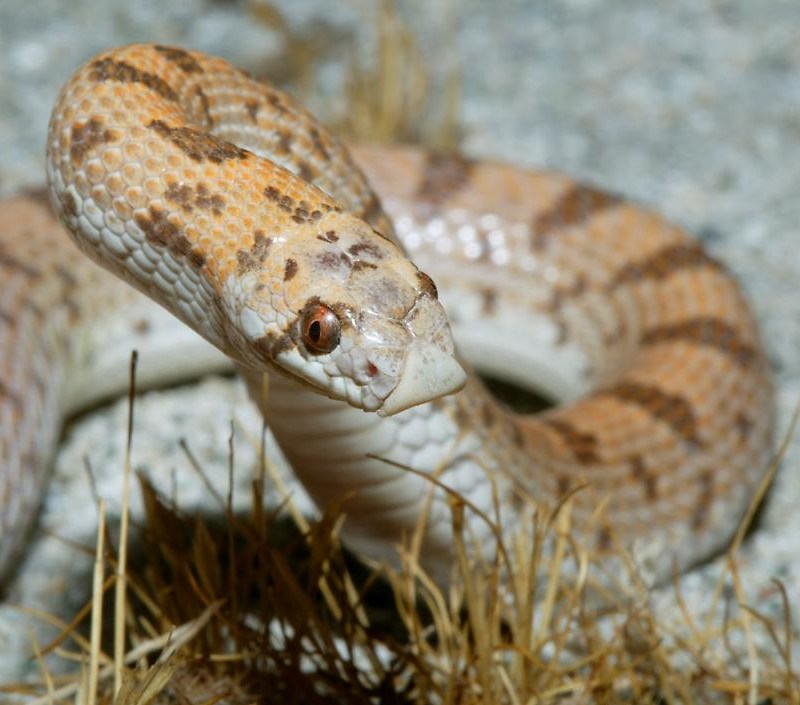
Of course there aren't any cobras in the United States, but it still put on a convincing show and it might have been only my imagination, but it even looked like it was flattening the front part of its body in order to appear larger. The place where I found this snake was within walking distance of my home, but it was about to be developed for a new housing development. I'd seen nothing but ants all night so I was very glad to stumble across it, and so I took several dozen photos. This shot shows its cat-like eyes and the enlarged scale above its mouth which allows it to push down into the sand in search of its prey and also provides it with its name. |