
Highlights of Wellington, New Zealand
|
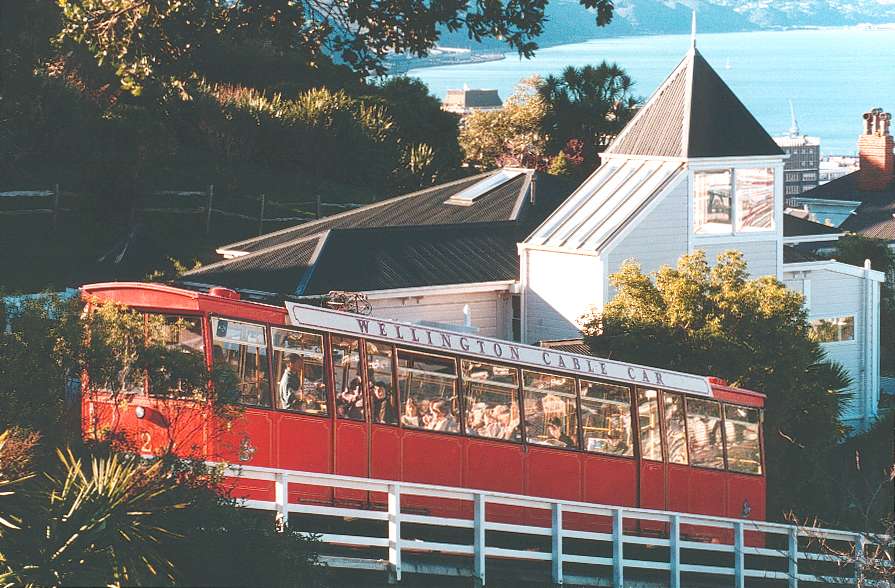
Wellington's not one of the world's great tourist attractions but it is pleasant, at least if the weather holds out. With its hilly geography and beautiful harbour there are some first class views. One way to see them is to take the cablecar, which has its lowest station in Lambton Quay, the main shopping street, and terminates up at the Botanic Gardens, which has 26 hectares of native bush and formal gardens including the Lady Norwood Rose Garden, which has over a 100 rose varieties. The cable car isn't just a tourist attraction, it's a practical means of transport for local residents and for students going to Victoria College, the university at the top of the hill. It leaves every 10 minutes from 7AM to 10PM on weekdays, 9AM to 10PM on weekends. |
 |
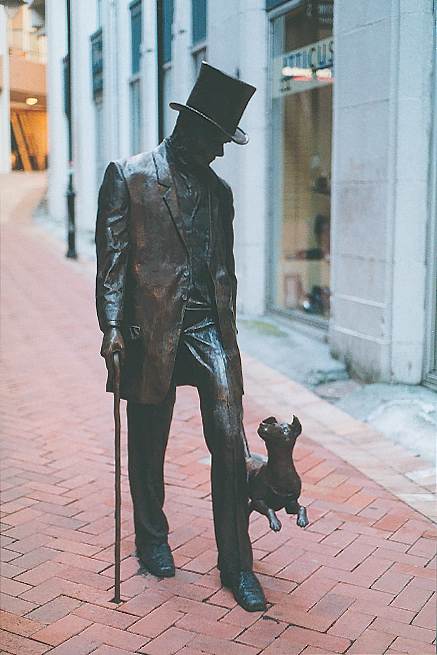 |
This charming statue is close to the cable car terminal in Lambton Quay. I don't know if it's meant to represent anyone in particular, but it's certainly delightful. |
|
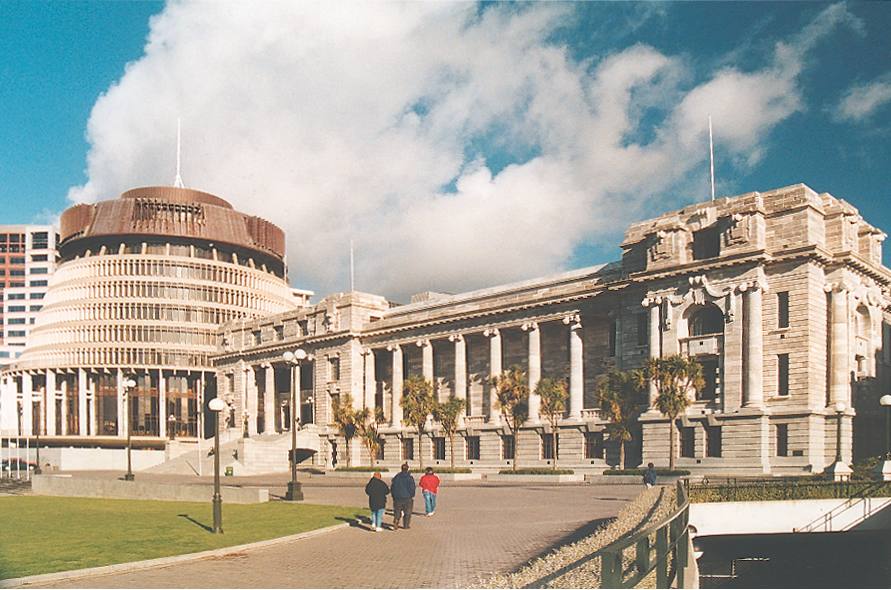
These are New Zealand's parliament buildings. The circular building is called The Beehive because of its shape, and it's probably the most well known building in the entire country. The trees you can see in front of the old parliament buildings are native to New Zealand, they're commonly called cabbage trees because they were used as cabbage substitutes by early settlers. Unfortunately, there's a disease wiping them out all around the country, just like elms were wiped out by Dutch Elm disease, so see them while they last! The old government buildings are in the near proximity, the second largest wooden building in the world after the Daibutsu-den in Japan. I don't have a photograph of it, because like most New Zealanders I wasn't aware of this claim to fame. |
 |
|
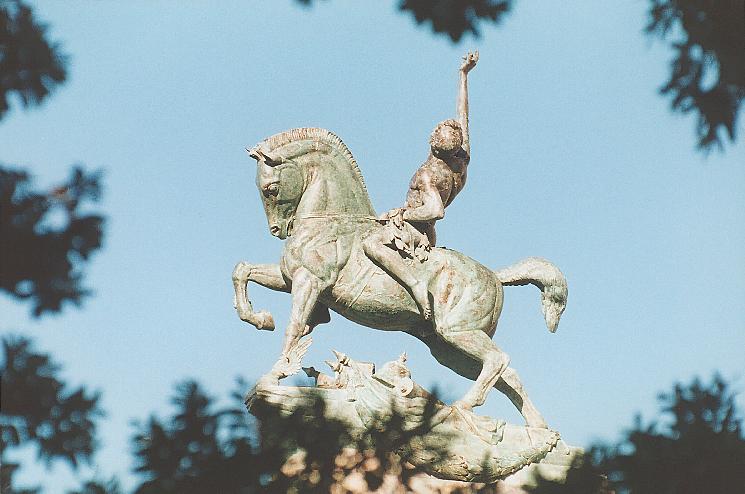
This statue is on the parliament grounds, but its significance is a total mystery to me. I didn't even notice that the horse has wings on its front legs until I scanned this photo! |
 |
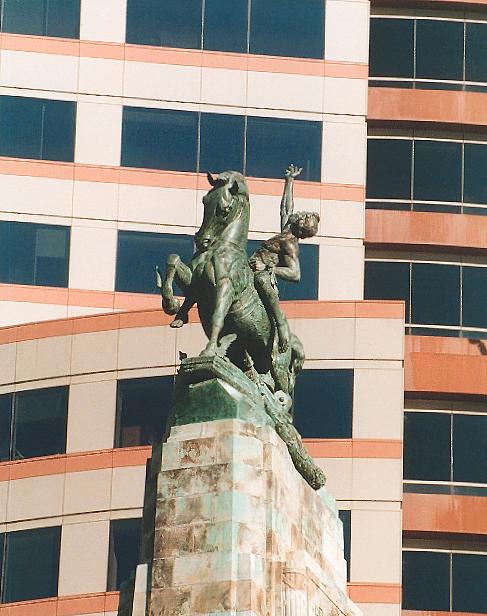 |
Ah - everything becomes much clearer when looked at from a different angle. The horseman is obviously pointing to the office where he used to work before he took to riding his horse naked up and down the corridors and elevators. This can only mean that the statue is a warning to others who might think of doing the same thing. |
|
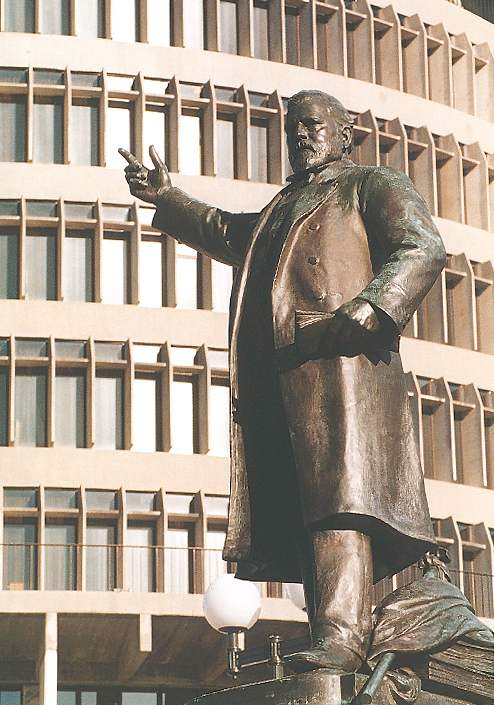
Talking about people pointing to offices where they used to work, here's a statue of Richard "King Dick" Seddon, the colourful and powerful prime minister at the start of the 20th century. Like most New Zealanders, I'm almost entirely ignorant of the country's history, so I don't know too much more about him. I guess politicians encourage this sort of ignorance, it makes the masses so much easier to hoodwink. Thankfully, this is one of the very few statues of politicians in the country, directly outside the Beehive. |
 |
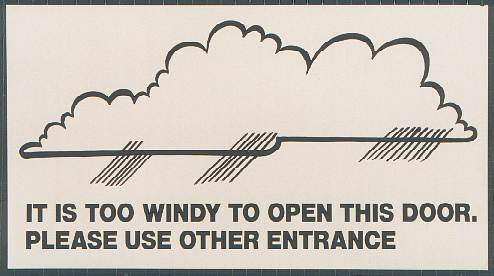 |
This sign just about sums up the climate of Wellington. It was a permanent fixture on a shop door while I was living nearby. |
|
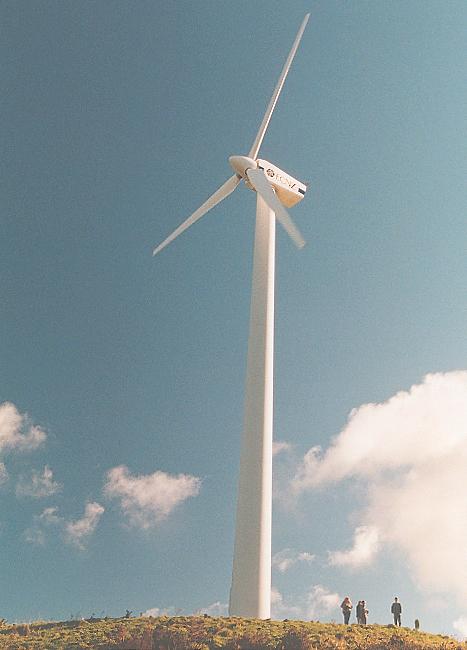
If you've got wind then you might as well turn it to your advantage (no jokes, please!). This wind turbine is on Brooklyn Hill and is visible from many parts of the city. It's operated by the Electricity Corporation of New Zealand (ECNZ) as something of a lip service towards non-polluting and non-destructive renewable energy. It stands up here all on its own, making enough electricity to boil a few cups of tea, and not much of a rival to wind farms like the one at Palm Springs in California, which has seven thousand turbines operating at once. |
 |
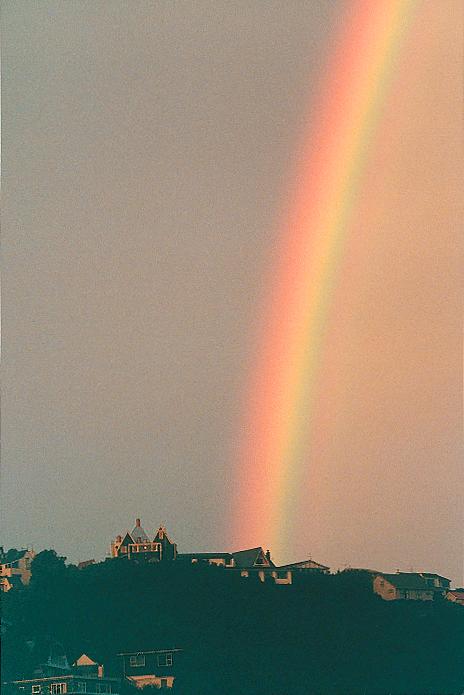 |
Which just goes to show that every cloud has a silver lining, there's a bun in every oven and all's well that ends well! |