| Underwater
Highlights of the Sinai Peninsula |
| The
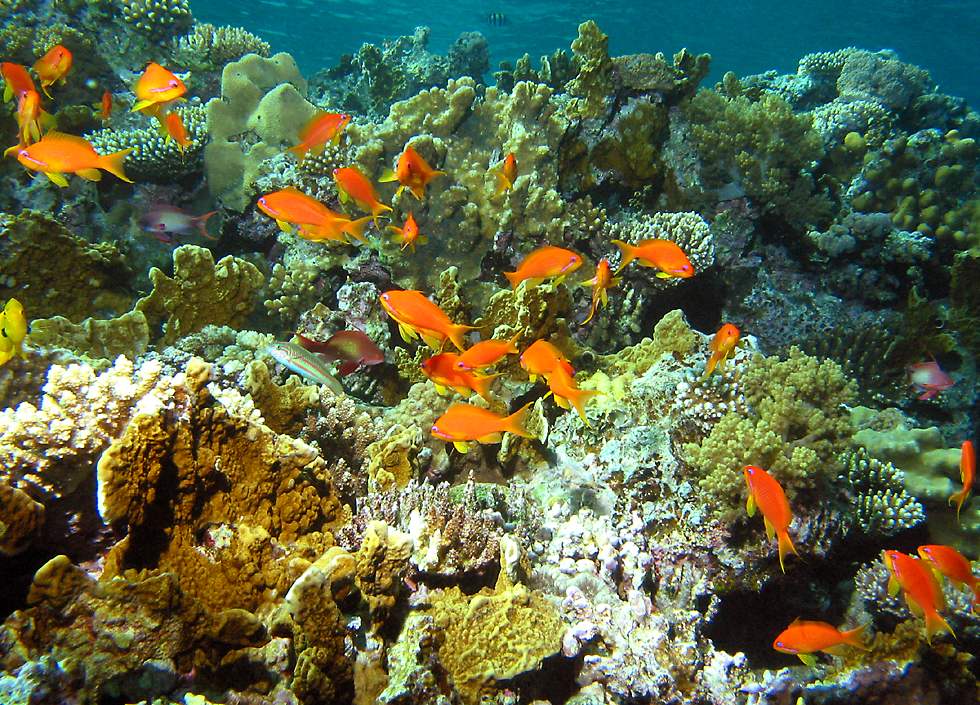
waters off the eastern shore of Egypt's Sinai Peninsula are a wonderful
place for people who like exploring the underwater world. The
low rainfall in this area helps to ensure that the water is crystal clear
most of the time, and the almost landlocked shape of the Red Sea means
that there are many species here which are found nowhere else in the world. |
 |
| There
are two main areas for diving, one in the south centered around the huge
international jet-setting resorts at Sharm el-Sheikh, and another more
laid-back area, but still with plenty of facilities, around the town of
Dahab, which is where I stayed for about a week in January of 2004.
I made one trip down to Ras Mohammed National Park at the extreme south
end of the Sinai Peninsula, but spent the rest of my time around Dahab's
various dive areas. |
 |
| Wherever
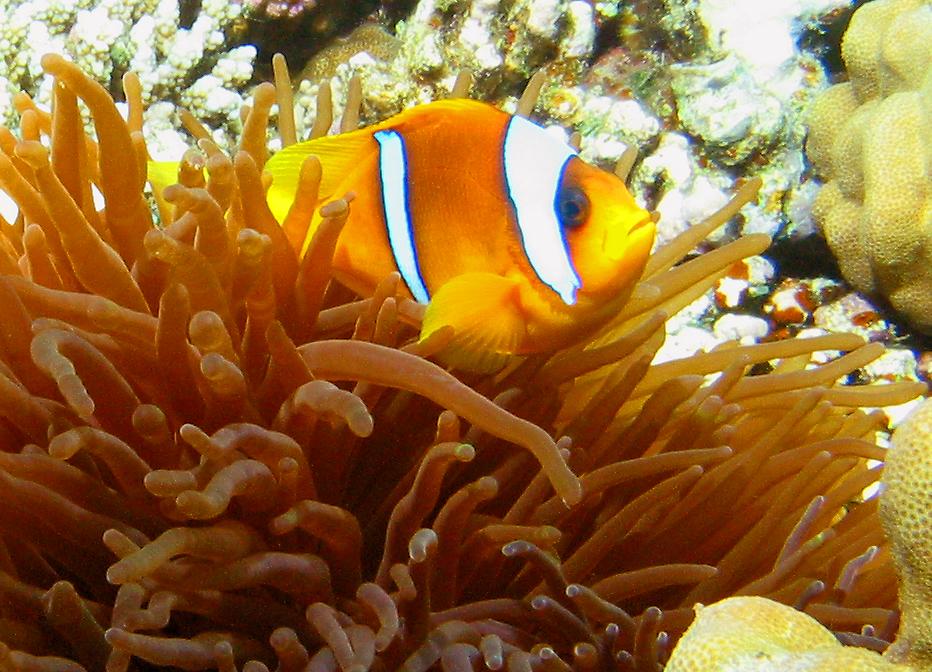
you find anemones in the Pacific and Indian Oceans, there you'll probably
also find anemonefish, which are immune to the stinging cells of their
hosts and use them as a protective shield from their enemies.
This particular anemonefish is a local speciality called, appropriately
enough, the Red Sea anemonefish or two band anemonefish. As
with most of these species, they're rather shy and it takes some doing
to get a good photograph of them. |
 |
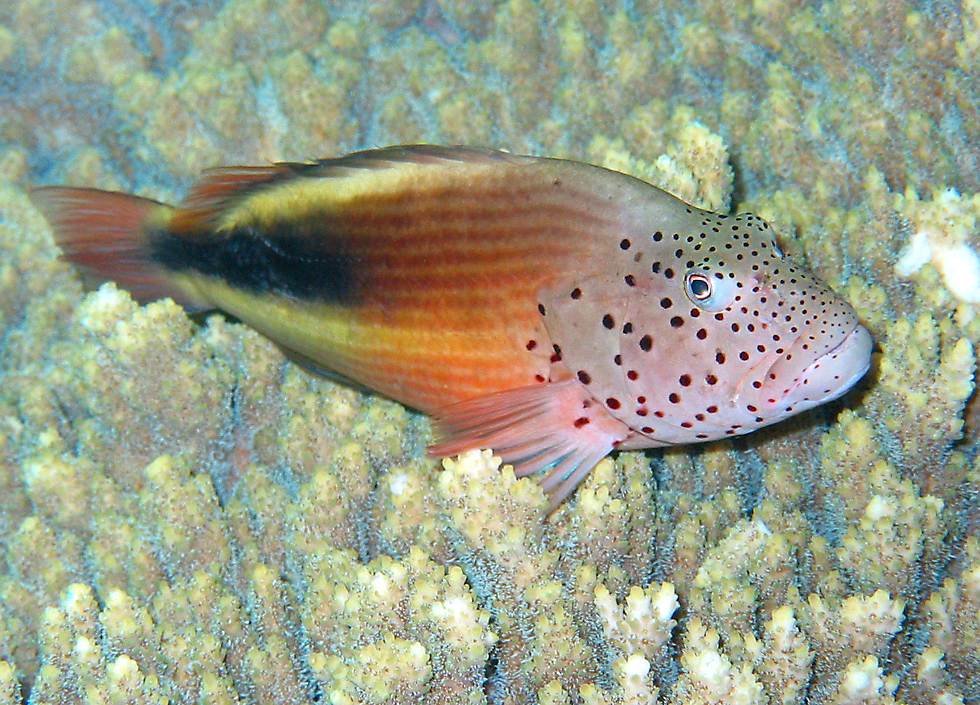
| Forster's
hawkfish likes nothing better than to sit motionless on a rock or piece
of coral, gliding down to deeper water when approached too closely.
The individual you see here is the less common maroon and orange color
phase, which was once thought to be a different species (Paracirrhites
typee) than the more common "blackside hawkfish", which has a broad
black stripe along its side. Although found all the way from
east Africa to Japan in the north and Tahiti in the east, for some reason
it seems to be absent from the nearby Persian Gulf. |
 |
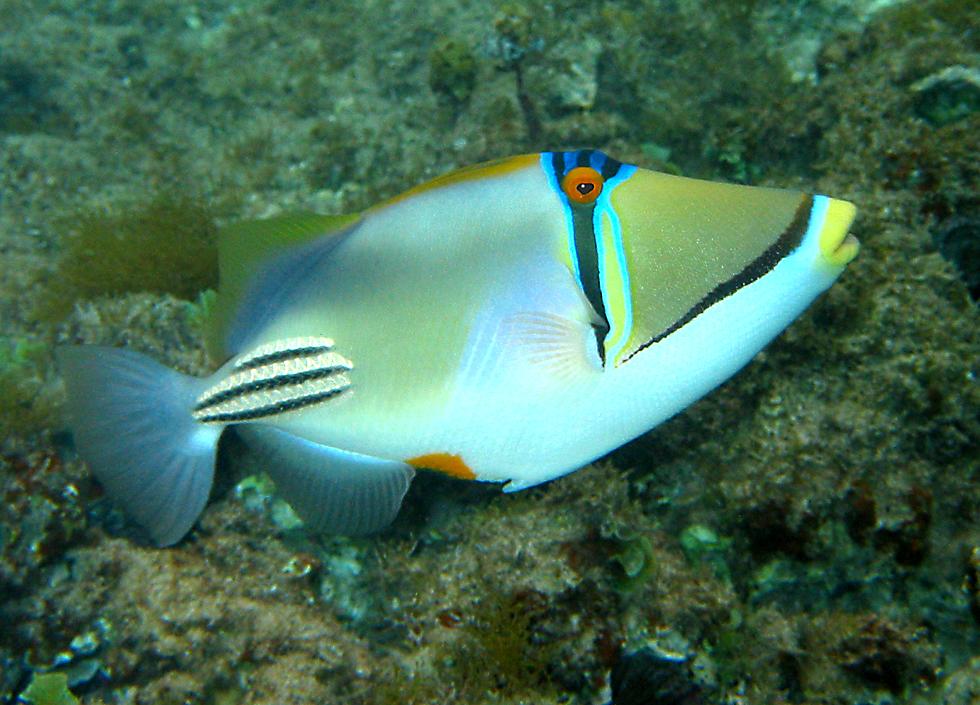
| One
of the most spectacular fish you might bump into is this Picasso triggerfish,
with colors, shapes and patterns befitting the artist it was named after.
This individual was in only two meters of water near the Blue Hole dive
site. Under its belly you can see the spine that allows it
to wedge itself into crevices in the reef to avoid enemies, and which gives
it the name "triggerfish". Like other triggerfish, they can
rotate their eyes independently. |
 |
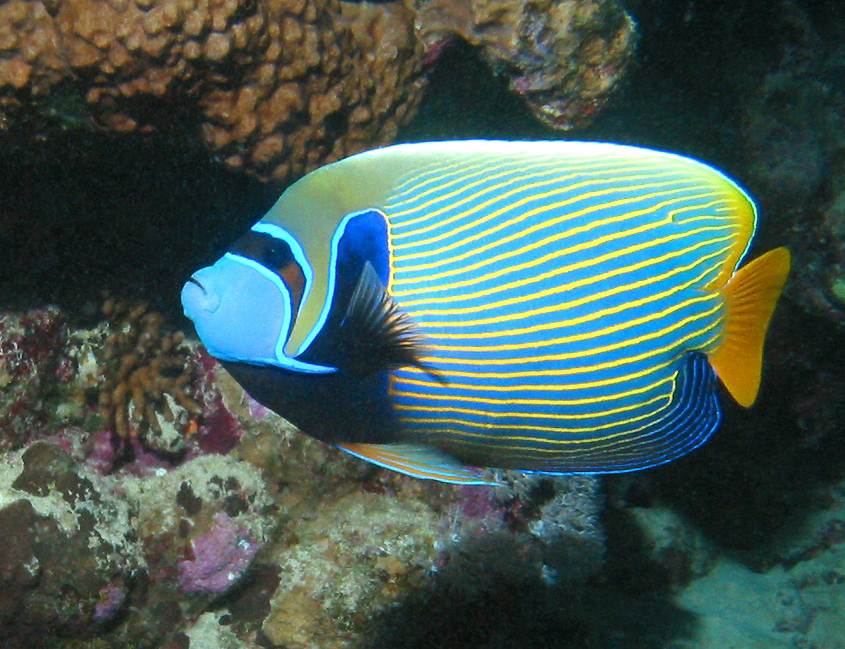
| The
Picasso triggerfish is by no means the only fish with spectacular colors
and patterns - here's an emperor angelfish. They feed mainly
on sponges, but will also clean parasites from larger fish. |
 |
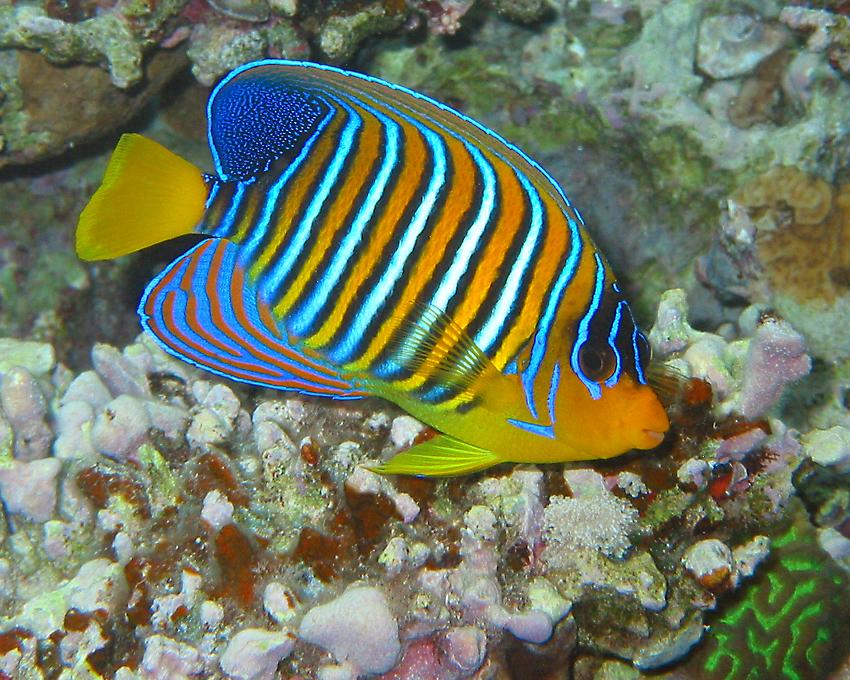
| Another
angelfish with a noble name, the royal angelfish, which is as widely distributed
as the emperor angelfish. The royal angelfish is often sold
for aquariums, but with a difficult to provide diet of sponges it usually
doesn't survive long. |
 |
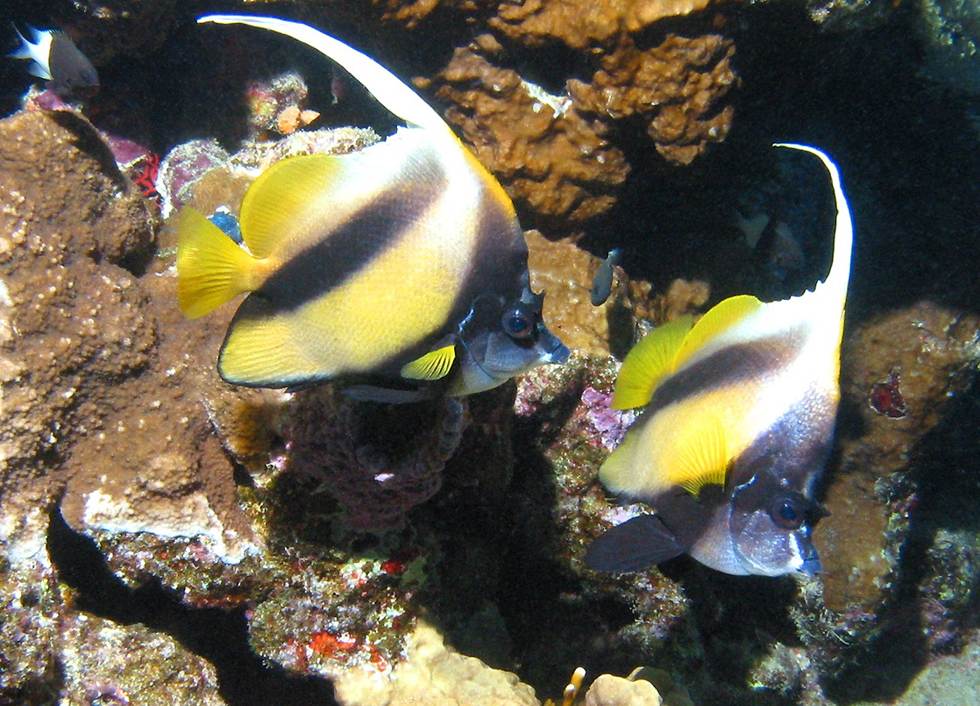
| These
Red Sea bannerfish look similar in shape and coloration to the Moorish
idol, but belong to a different family of fishes. |
 |
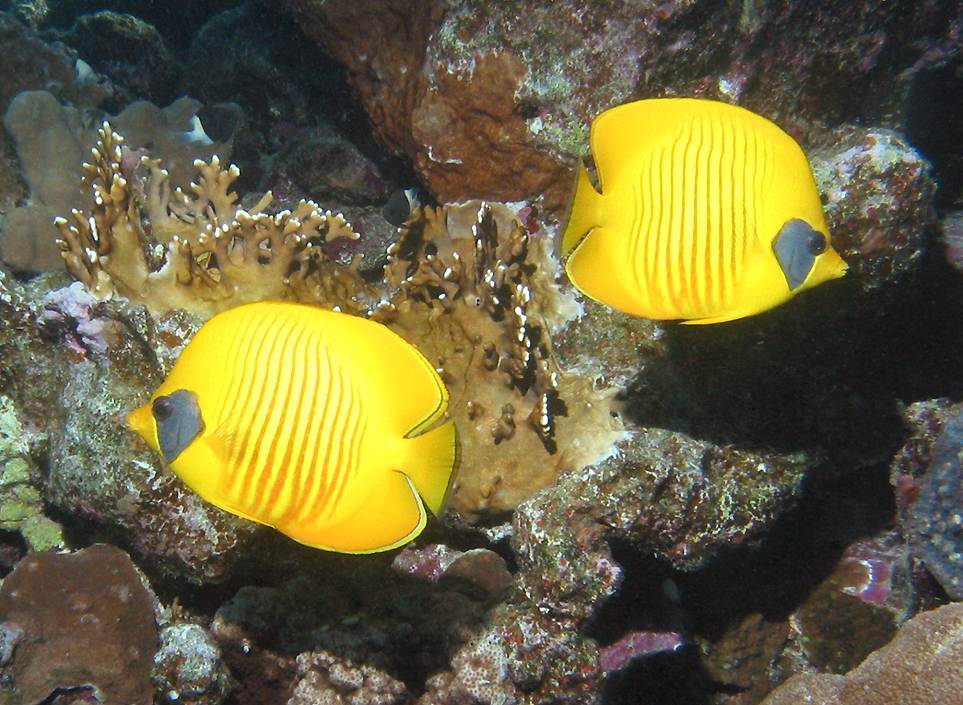
| Bannerfish
actually belong to the butterflyfish family, even though their shape is
much more like the Moorish idol. The Red Sea has a marvellous
selection of butterflyfish, many of which are unique to this body of water,
like these masked butterflyfish, which also go by the name of blue cheek
butterflyfish. |
 |
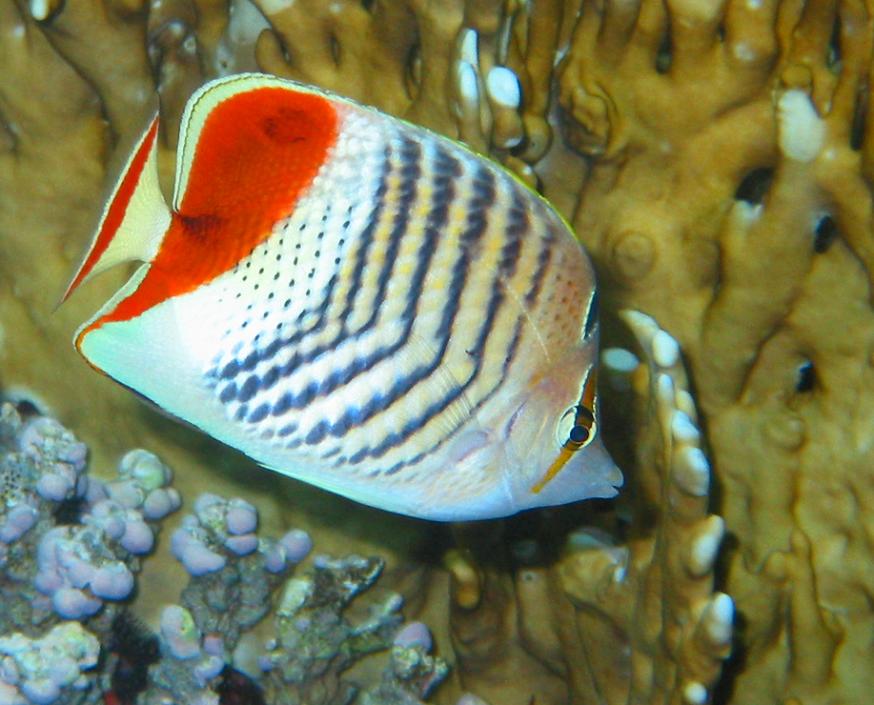
| Here's
another butterflyfish found only here and in the Gulf of Aden; it goes
by various names, including the red back butterflyfish, Eritrean butterflyfish,
Red Sea chevron butterflyfish and crown butterflyfish. |
 |
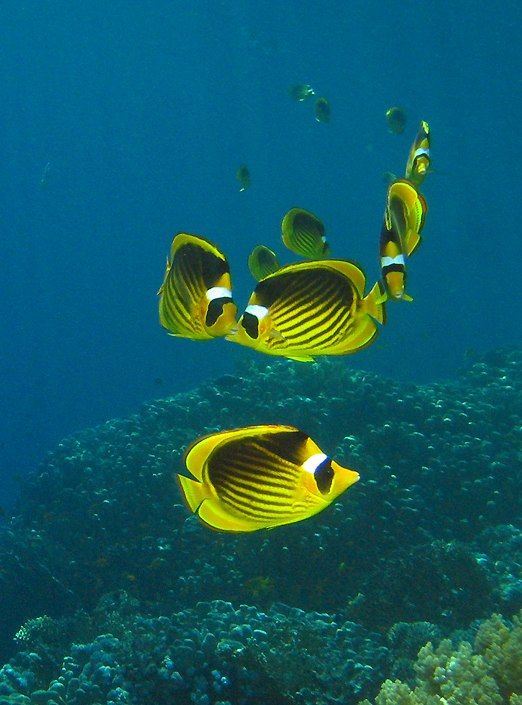
 Butterflyfish
are usually found in pairs, but here's a collection of 14 or 15 Red Sea
raccoon butterflyfish all in the same spot, and arranged very nicely for
a photograph. Like most of the photographs on this page, you
can click it to bring up a new window with the photograph in computer wallpaper
format, to brighten up your day!
There are so many
different types of butterflyfish in this area that I've created a separate
Butterflyfish
of the Red Sea page so you can see them all. |
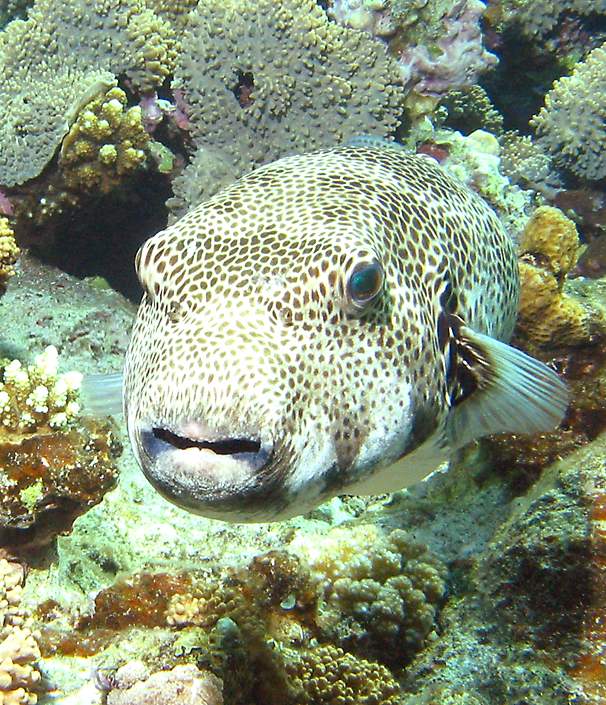
 It's
a sad fact of life that some fish are not so much beautiful as.... interesting!
With a face like this, the giant pufferfish definitely falls into this
category, and perhaps it's also the reason it's sometimes given the unflattering
name "starry toadfish".
It might be ugly,
but the giant puffer certainly earns the "giant" part of its name, since
it can grow to a meter in length, though this one was more like half that
size. No matter what its size, its fins always seem too small
for its body, so even when it's trying to make its escape it can only waddle
away rather slowly, its dorsal and anal fins flapping desperately side
to side with little effect.
This one decided
that it just couldn't be bothered, and its size perhaps made it feel that
it would be too big a mouthful for me to eat, anyway. In fact
most of the photos of this species show it sitting rather sluggishly on
or near the bottom. |
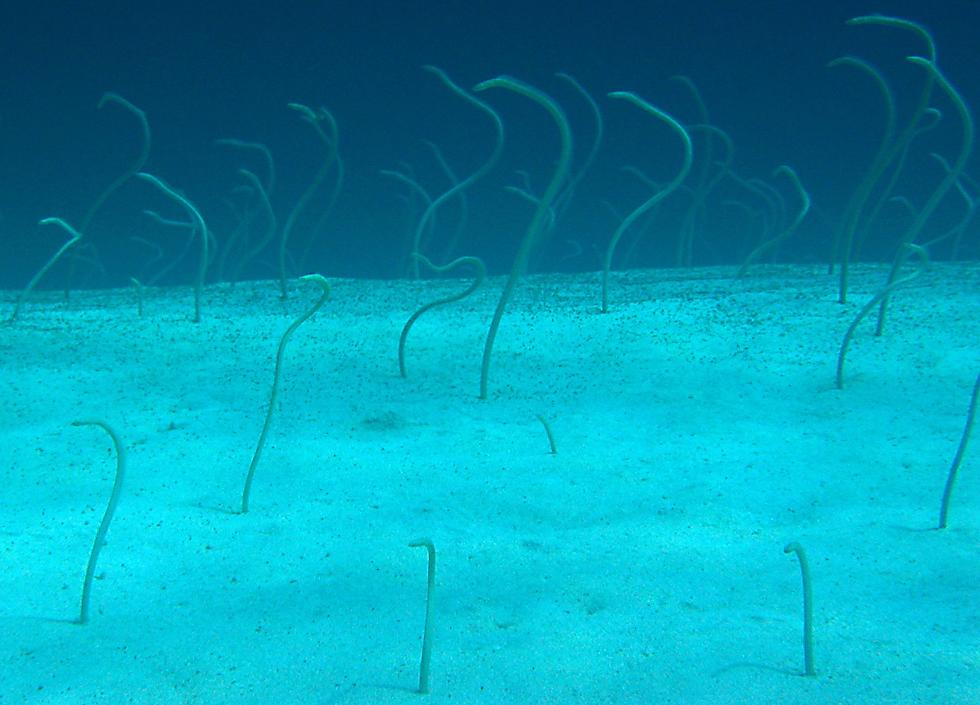
| More
fish in the interesting file, this time Red Sea garden eels at the appropriately
named Eel Garden at the north end of Dahab. Since I free dive
rather than scuba diving it seemed like I wouldn't be able to photograph
these critters, since this site is usually swept by a fast current.
However I was fortunate enough to encounter 4 or 5 days of uncommonly calm
weather with very little wind, and I also found that they were only in
7 or 8 meters of water, rather than deeper as I'd been told.
Like little question marks these eels hang out in the current snatching
small food items as they drift past. It might not be apparent,
but the colony is made up of pairs of eels located adjacent to each other;
but if you approach too closely then the whole colony will vanish in a
flash into their burrows. |
 |
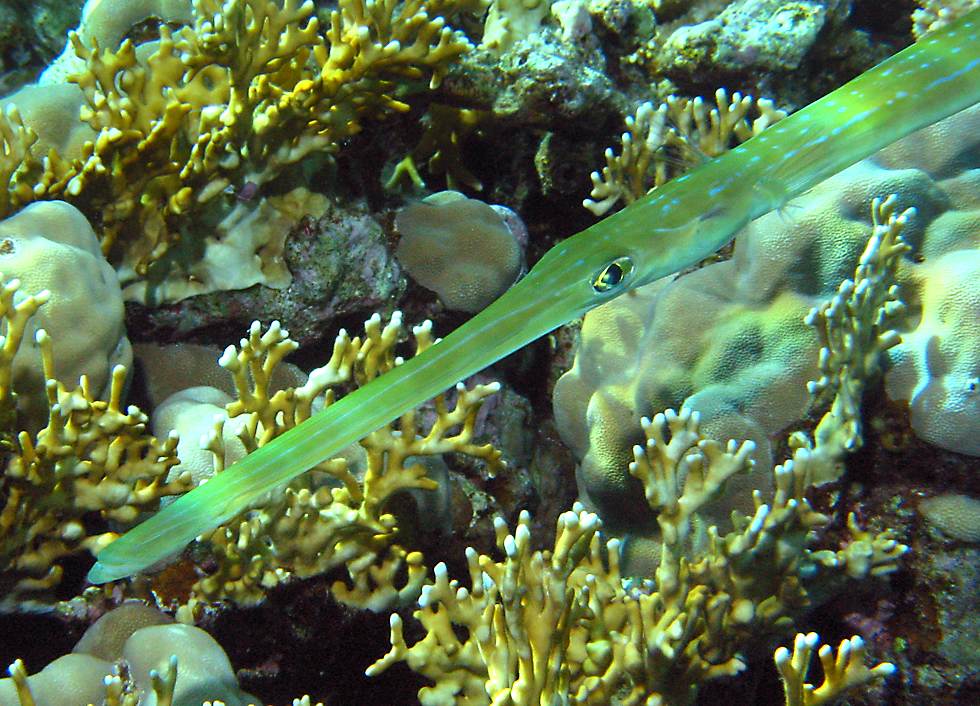
| The
blue spotted cornetfish is a much larger and more active predator than
the garden eels. Usually hanging vertically near the reef like
some sort of plant life, the cornetfish extends its mouth wide and swallows
any small fish or crustacean that unwittingly blunders too close. |
 |
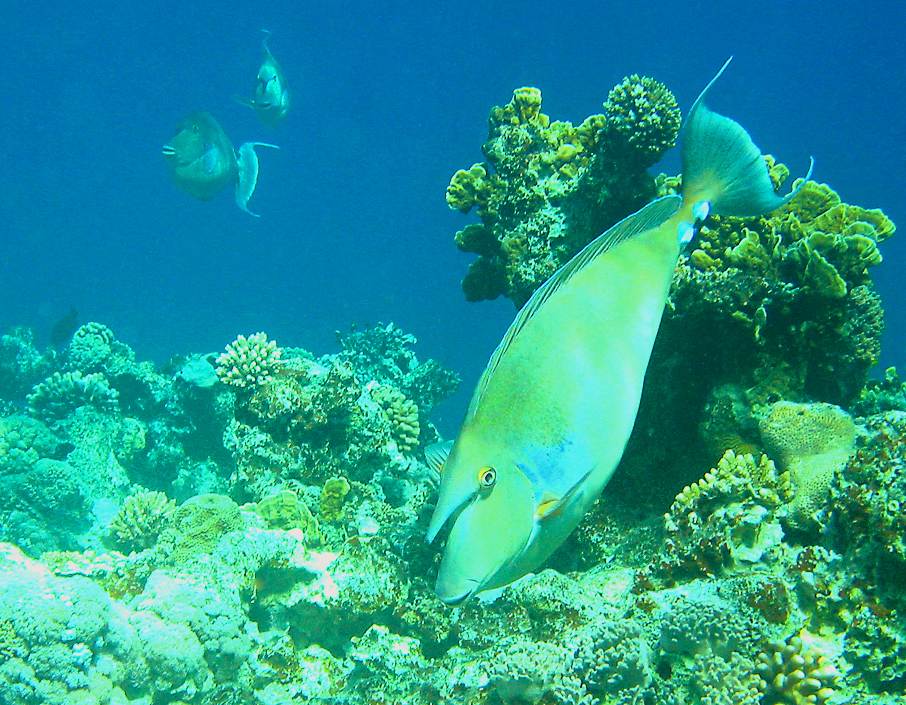
| A
small group of blue spine unicornfish scour the reef for the brown algae
which is their preferred food source. Apart from the obvious
"horn" which gives them their name, the other obvious feature of these
unicornfish is the blue spines directly in front of their tail.
These sharp spurs are also seen amongst surgeonfishes and tangs, which
belong to the same family as unicornfish. |
 |
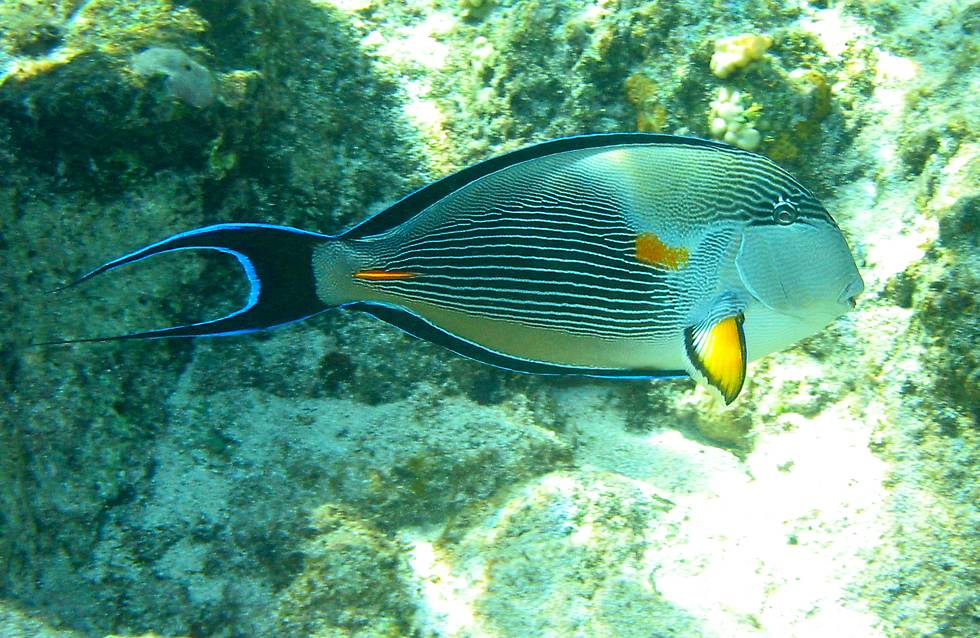
| An
Arabian surgeonfish with its orange colored "scalpel". Though
vegetarian, they're aggressive and territorial, and it's thought that the
razor sharp spines are used in combat and as a defense against predators.
Like many of the fish on this page, Arabian surgeonfish go by a variety
of names, including Red Sea surgeonfish, Red Sea clown surgeonfish and
Sohal surgeonfish. |
 |
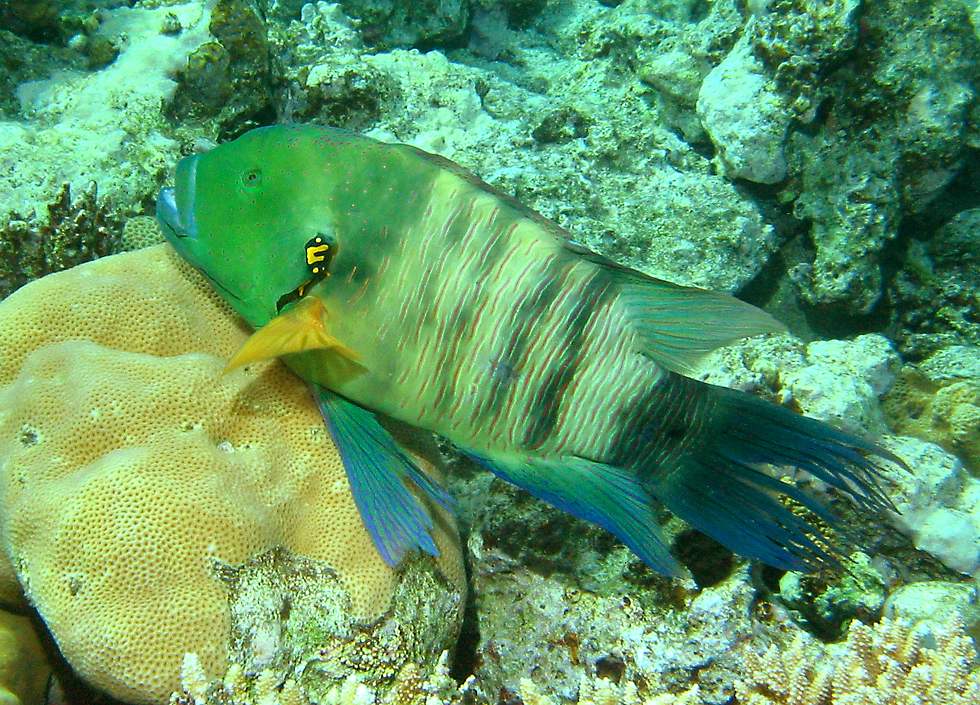
| Wrasses
are a large family of fish found throughout the world, varying in size
from very small to huge. This broomtail wrasse might not be
as large as the Napoleon wrasse, but it's still a large fish, and quite
interesting, too. They mostly eat molluscs, which maybe explains
why they're a bit slow moving, and also perhaps why their eyes are so small. |
 |
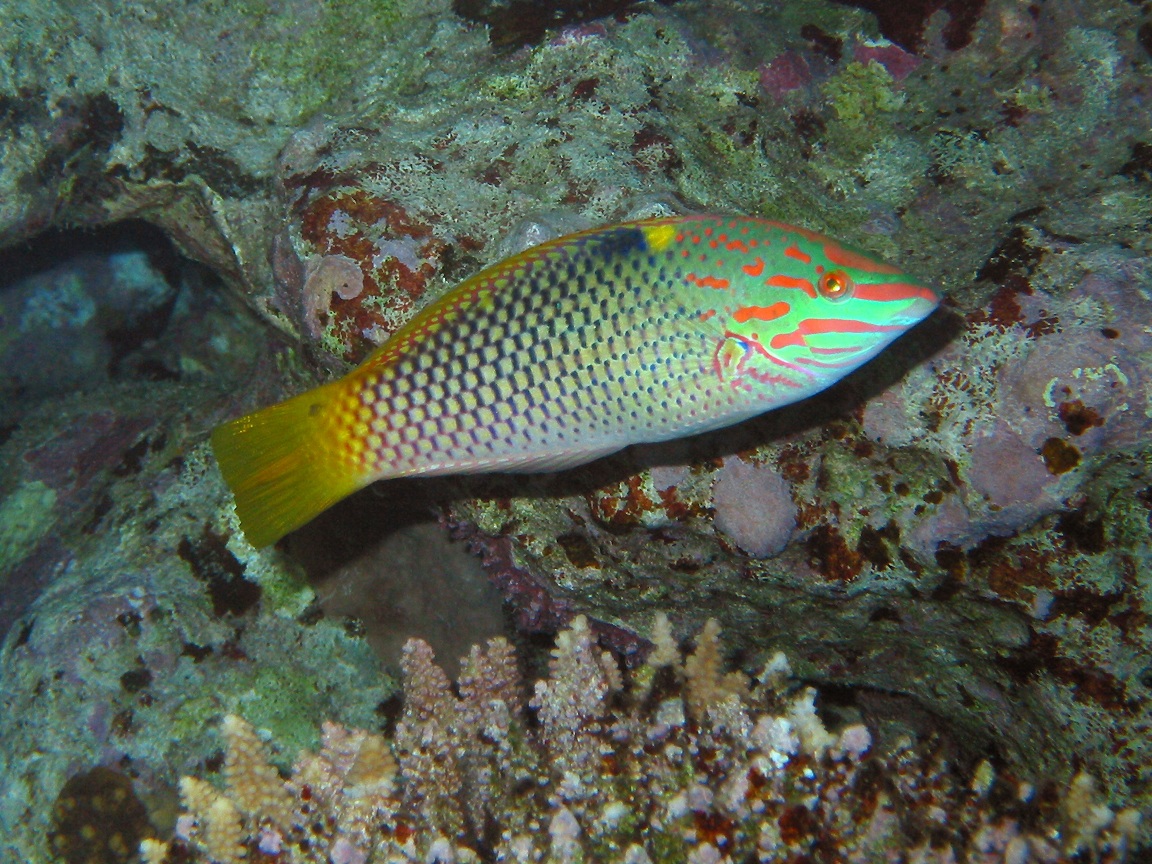
| A
much more typical looking member of the family, the checkerboard wrasse,
sometimes also called a four-spot wrasse because of the yellow dots on
either side of its back - in some areas only one spot is really visible
on either side, as you see here. This is the typical wrasse
shape and size which makes them fairly easy to tell apart from other fish. |
 |
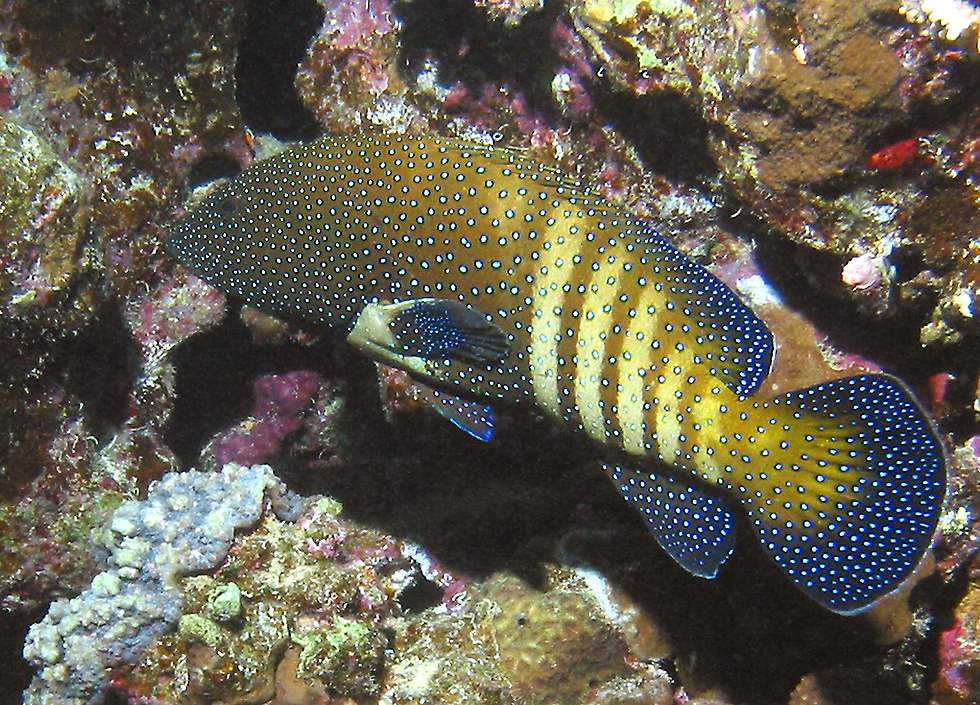
| Groupers
tend to be much larger than wrasses, which makes them highly prized for
the dinner table! This is a peacock grouper, found all the
way from South Africa to Japan, down to Australia and across to French
Polynesia. This individual has unusually prominent stripes,
otherwise its coloring is typical. |
 |
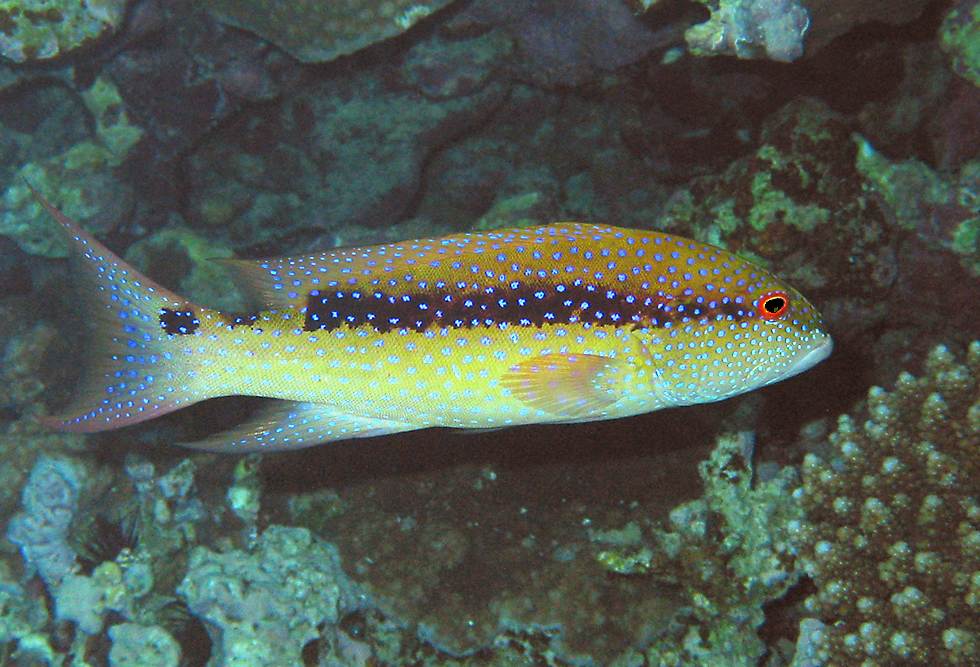
| Blue
spots are not particularly typical of groupers, but this juvenile lyretail
grouper has just as many as the peacock grouper. It's said
to taste very good and is sold in fish markets around the world. |
 |
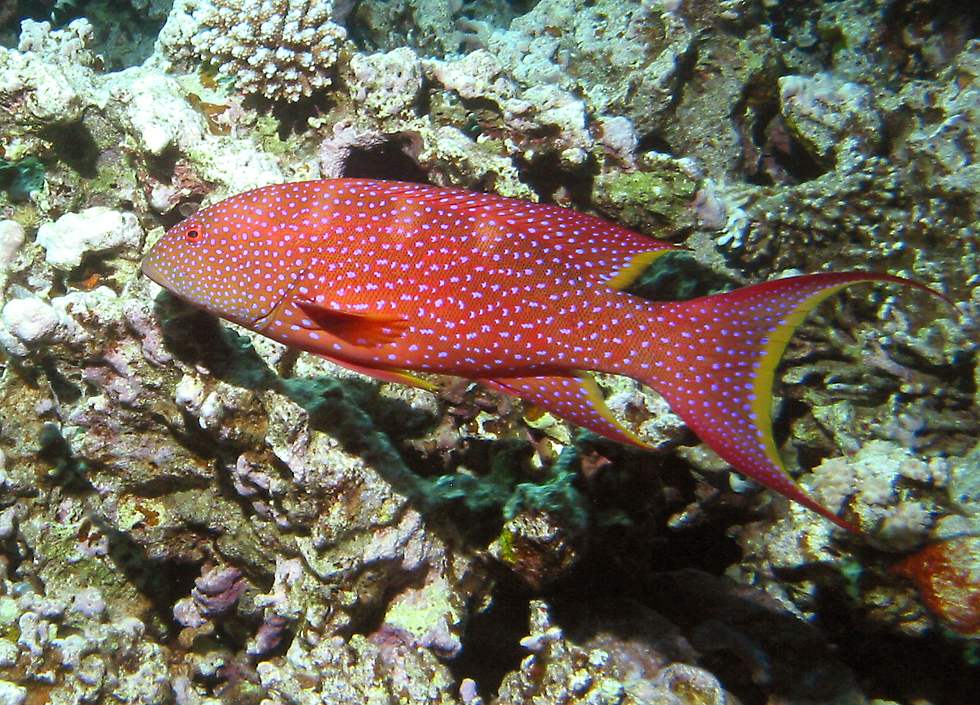
| An
adult lyretail grouper, demonstrating how this species got its name.
There are actually two species which look very similar, this one with yellow
edges on the tail and fins, and another one with white edges.
It might be easy to distinguish the adults, but it's difficult to imagine
that the juvenile fish eventually changes color enough to look like this! |
 |
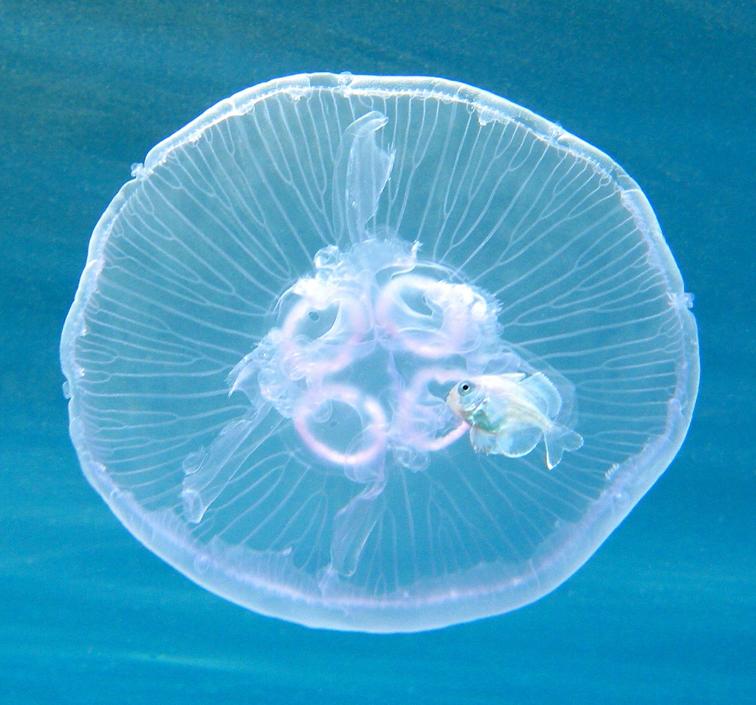
| There
are always fish and other critters around that you might not want to meet,
and jellyfish like this one would come pretty high up most people's lists.
However it doesn't have any trailing tentacles and on closer inspection
you can see that it even has a house guest - a small fish that uses the
jellyfish as shelter and perhaps a source of food, also. It's
remarkable to see how the fish has turned the same color and transparency
as its host. |
 |
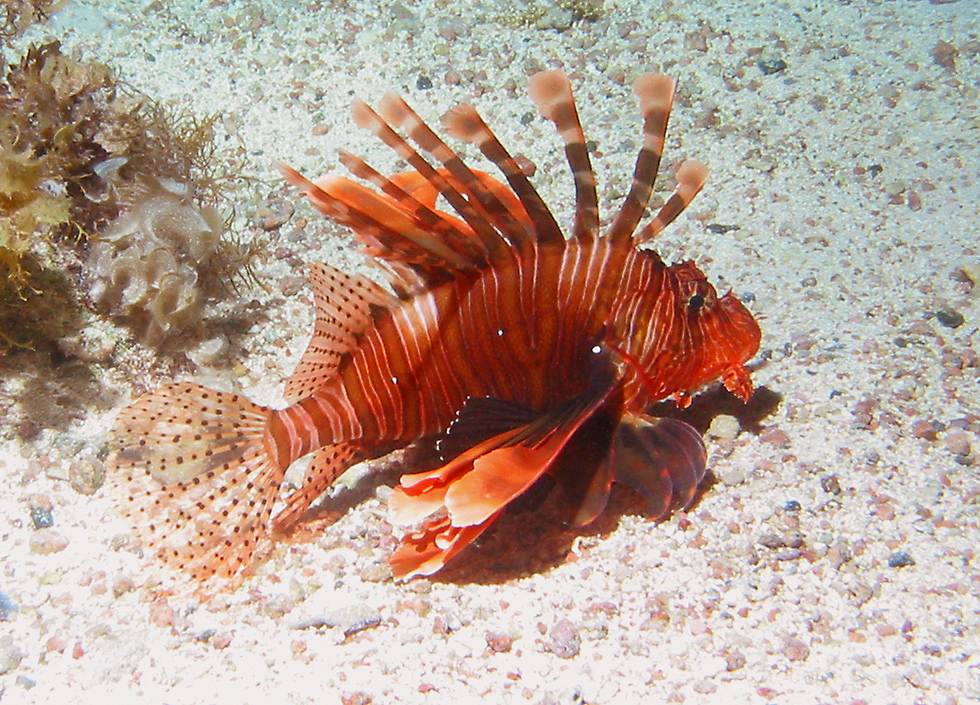
| This
juvenile common lionfish is definitely a critter you should avoid - its
thirteen spines are highly venomous and quite capable of killing a person.
I'd never seen a lionfish before, but there were many at Dahab.
I photographed this one at night on the reef flats near the Eel Garden
just a few minutes before my strobe battery compartment flooded, putting
the strobe out of operation and bringing my night-time expedition to an
abrupt end. However, I saw several together during the daytime
in one rocky area right beside the main public beach in Dahab, where large
numbers of tourists were swimming around in blissful ignorance. |
 |
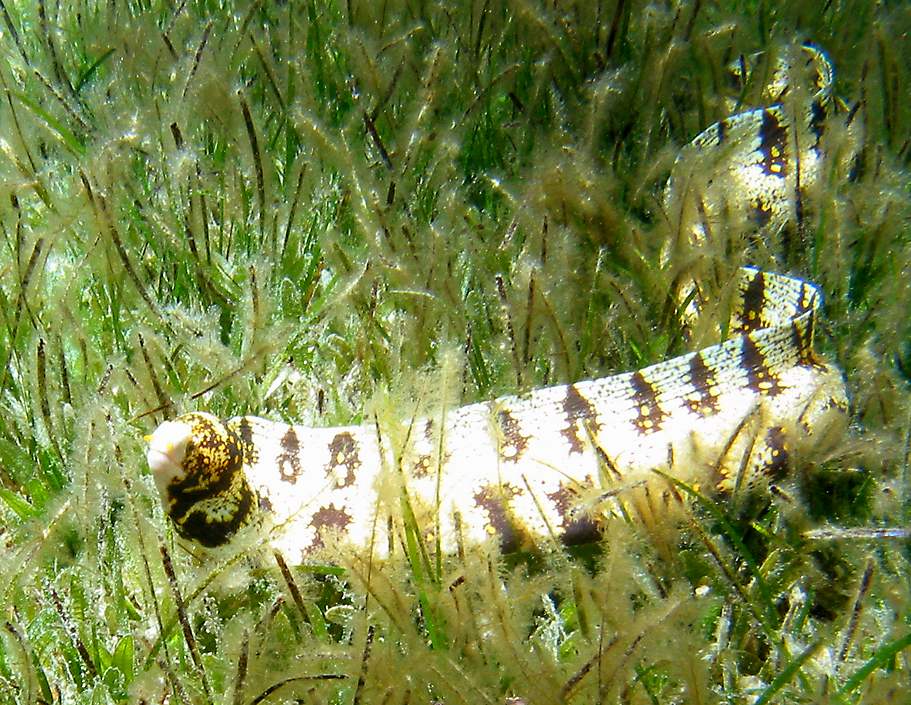
| Another
creature guaranteed to freak out the fearful - a juvenile snowflake moray
eel, discovered appropriately enough amongst the eel grass near the Eel
Garden! Like many eels they're usually nocturnal, but this
one was poking around during the daytime. Although moray eels
are greatly feared, this species is actually rather shy and lives mostly
on a diet of crabs. |
 |
  |