
Highlights of the 2004 Kern County Airshow
|
The Kern County airshow was supposed to start at 1 o'clock, so I took my own sweet time to get my equipment ready when I arrived in the parking lot at 11:30. I had just started to walk toward the entrance when a very unusual looking jet zoomed past. With a delta wing and canards just behind the engine intakes I thought it might be a Swedish Saab, perhaps a Viggen or a Gripen. I moved closer as quickly as I could and managed to get this shot on its third pass. This is an Israeli Kfir "lion cub", a significantly modified version of the French Mirage 5, a plane which was built in Israel even though the French had an arms embargo against Israel and therefore wouldn't give them a manufacturing license. This required a certain amount of behind the scenes effort by the Israelis in order to obtain blueprints and other technical information. The US Navy and the US Marines leased 25 Kfirs for three or four years and operated them as F-21s to simulate enemy aircraft during "Red Flag" combat training. This particular aircraft is operated by the American civilian company ATAC (Airborne Tactical Advantage Company), and is used for training of American military personnel. Kfirs have also been sold to Colombia and Ecuador. It's capable of Mach 2.3, largely because of the more powerful American engine which replaced the original French design. The new engine required modifications to the air intakes and fuselage, and you can also see the air scoops just in front of the tail which were added to provide cooling for the afterburner. |

|
|
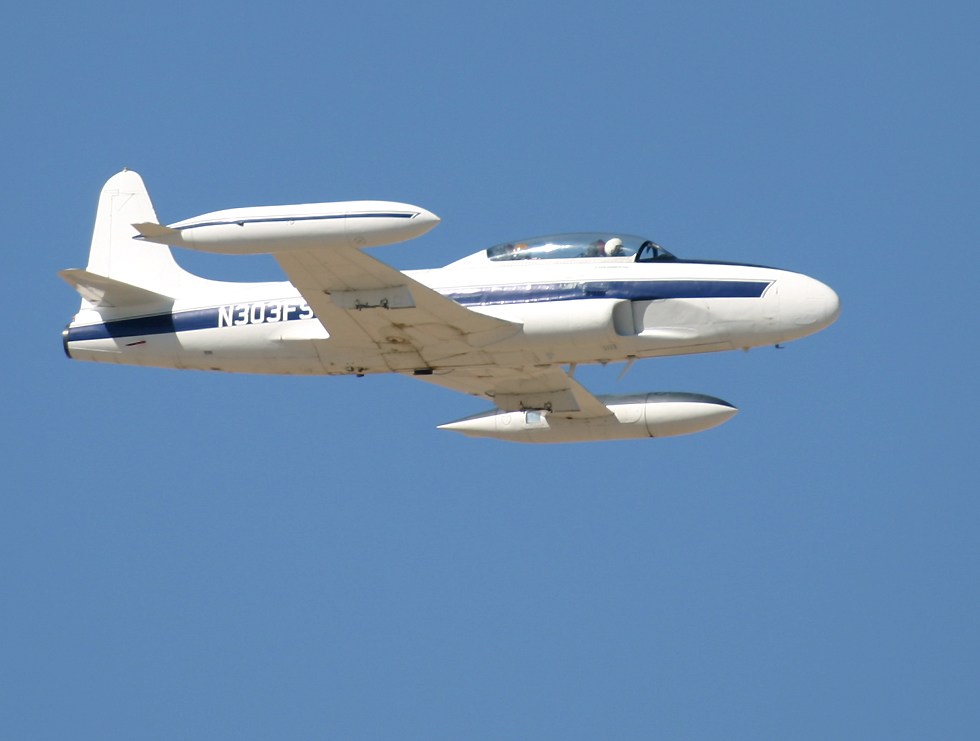
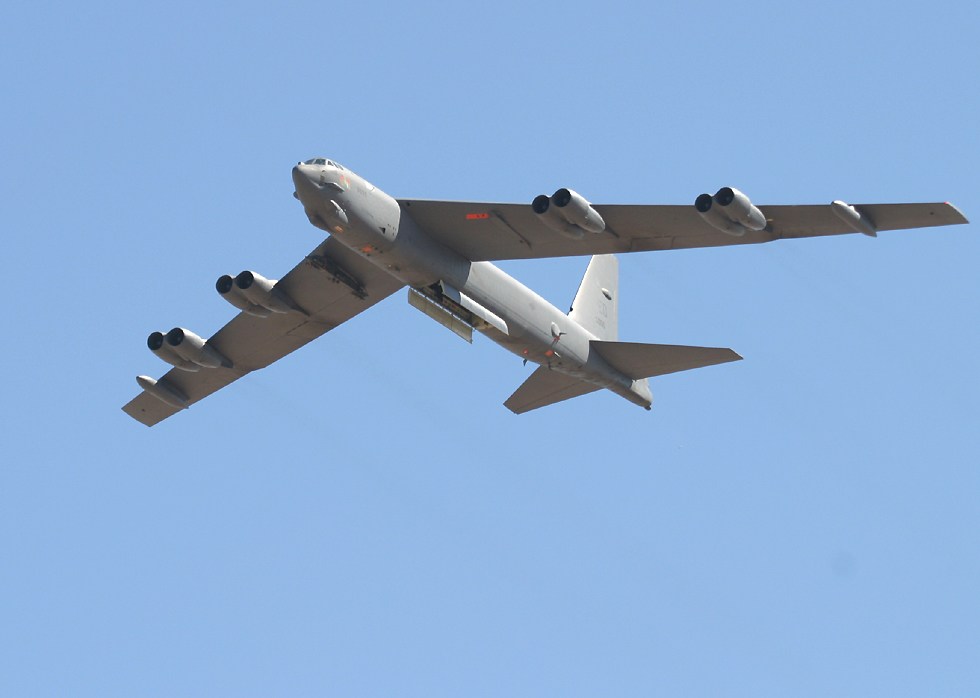
The Kern County airshow is not in the major leagues, so the only reason that I made the 380 mile (610 kilometer) round trip was to see an aircraft which is very rarely displayed, an EA-6B Prowler, the electronic warfare version of the now retired A-6 Intruder attack plane. I was destined to be disappointed, just as I had been four days earlier at the Prescott Air Show, but just as at Prescott, other aircraft made up for the absence of the plane I'd come to see. The Kfir was an extraordinary bonus, as was the T-33, and here's another - a B-52 Stratofortress, which first flew in 1952 and is currently scheduled to remain in service until 2040, even though the last one was built in 1962! The Stratofortress is quite a common sight on static display at American airshows, but after attending well over 20 airshows in the United States, this is the first time I've ever seen it flying here (though I did see one do a display in England at the Royal International Air Tattoo in 2002, with the added bonus that it took off in front of the crowd, did its display and then landed, complete with parachute-assisted braking. Of course, since this was England, all of this was done under an unattractive thick grey overcast). |
 |
|
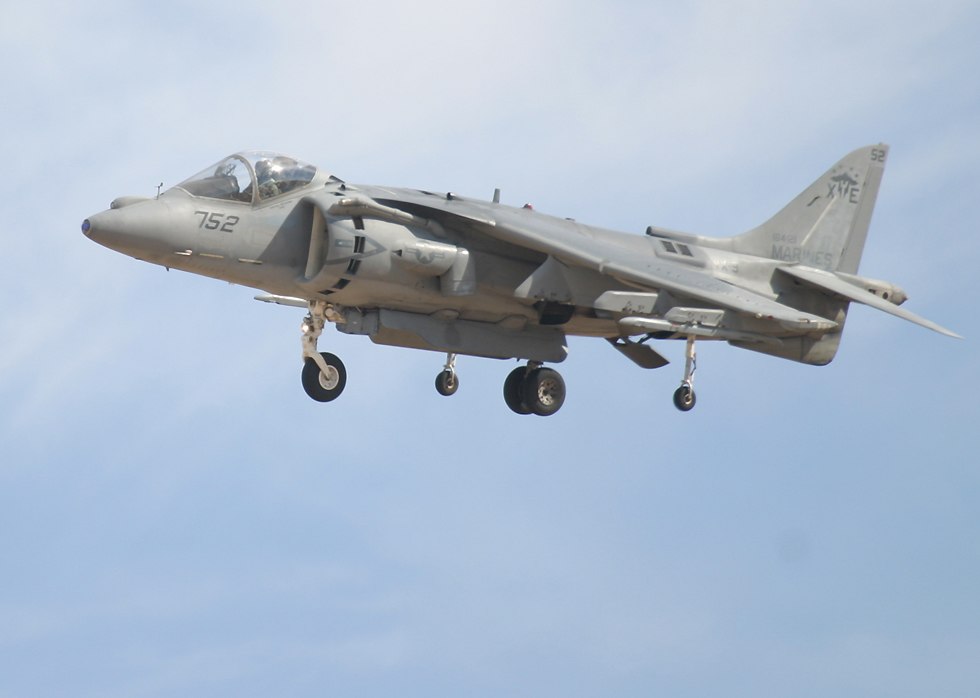
This AV-8B Harrier vertical takeoff and landing attack plane is a much more intriguing and innovative piece of technology than the Stratofortress, but I've seen it hover and roar at so many shows that I've almost entirely lost interest in it! If you're still fascinated by it then you might want to check out these photos of it at Oshkosh in 2002 and Prescott in 2004 (both these pages will open in a new window). |
 |
|
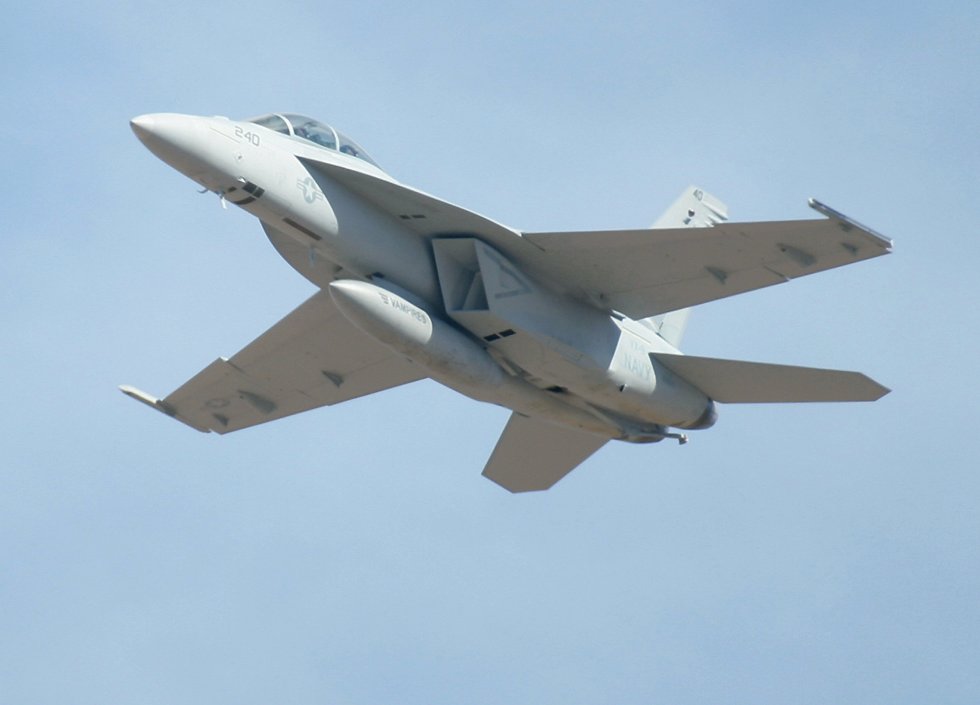
This F/A-18F Super Hornet did the feeblest display I've ever seen by this type of aircraft, a single high-speed pass, before vanishing off into the distance. OK, I know, I'm a spoiled brat and I should be grateful just for a glimpse of this incredible aircraft, since this brief view would be the dream of aviation enthusiasts from most countries around the world. But perhaps you'll understand my feelings if you take a look at this Super Hornet display at Dayton in 2003, or this cool Super Hornet pass with a vapor cone which happened at the Point Mugu airshow a few weeks earlier. |
 |
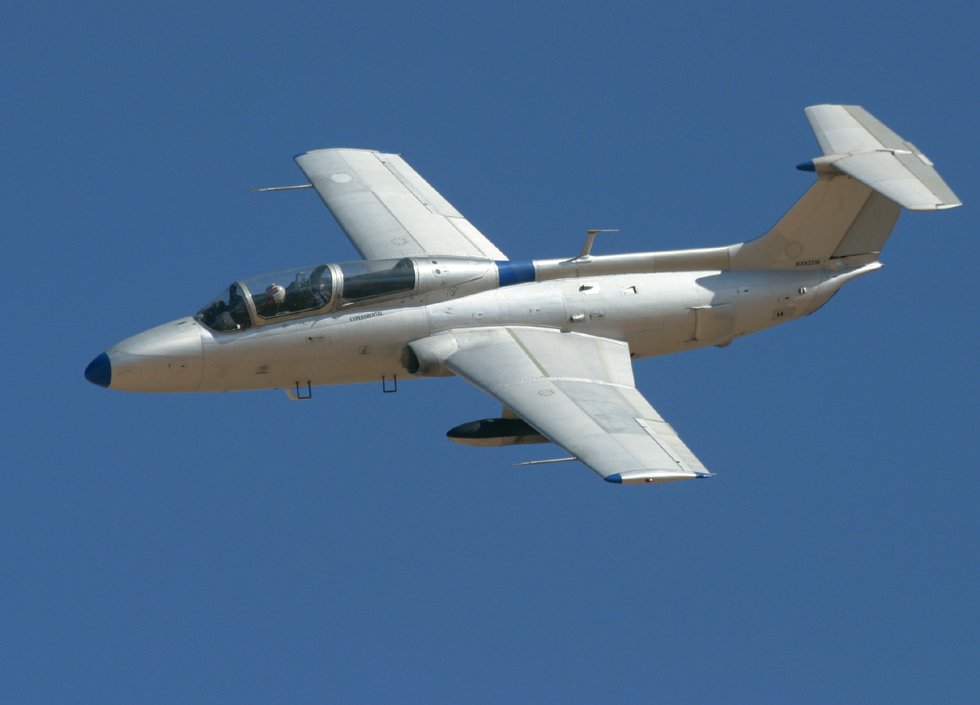
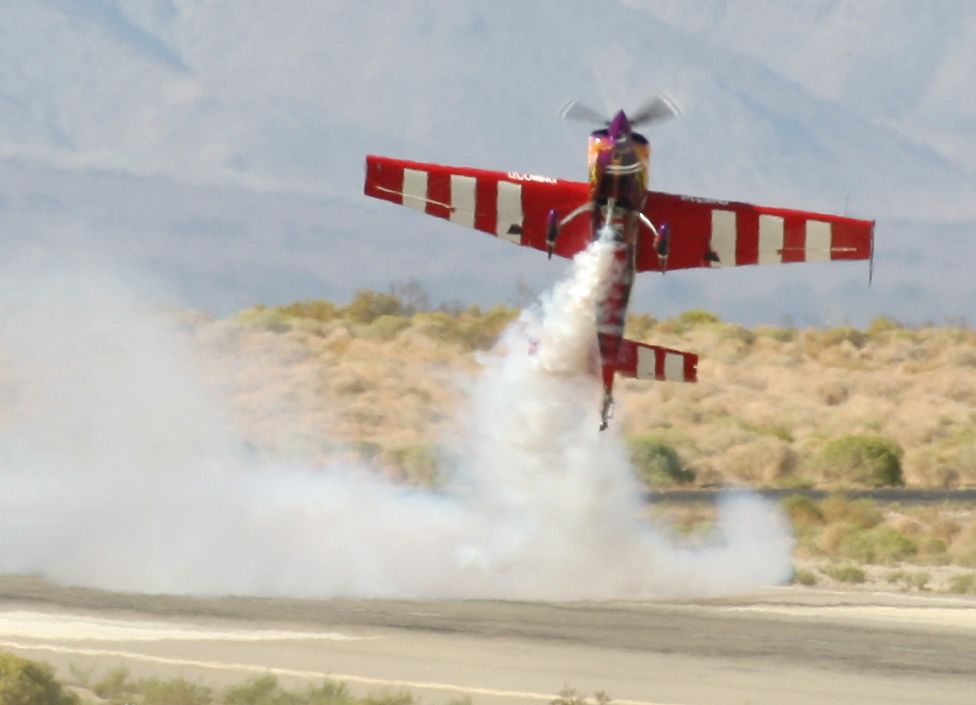
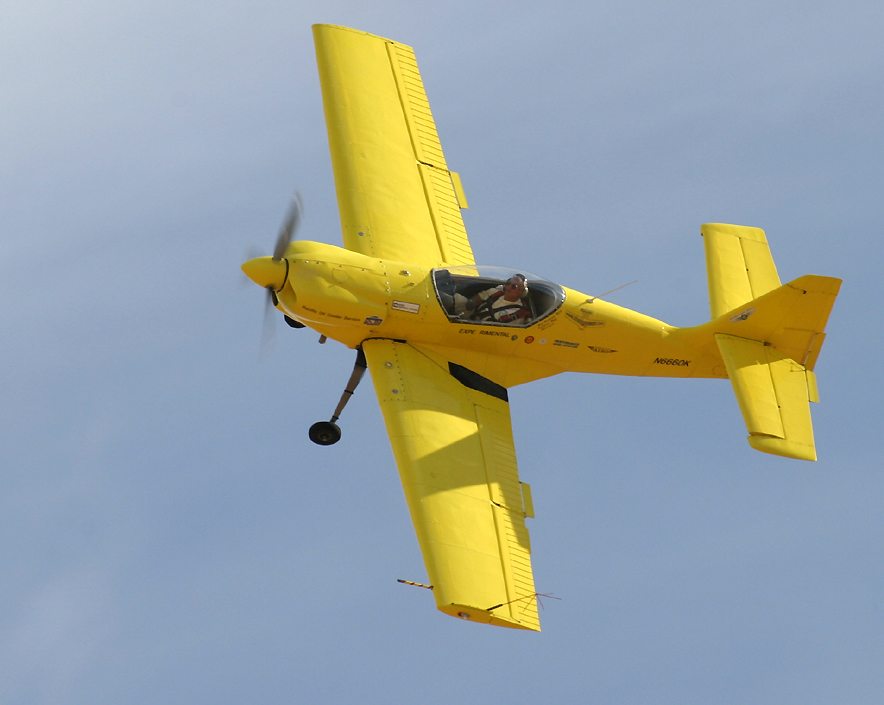
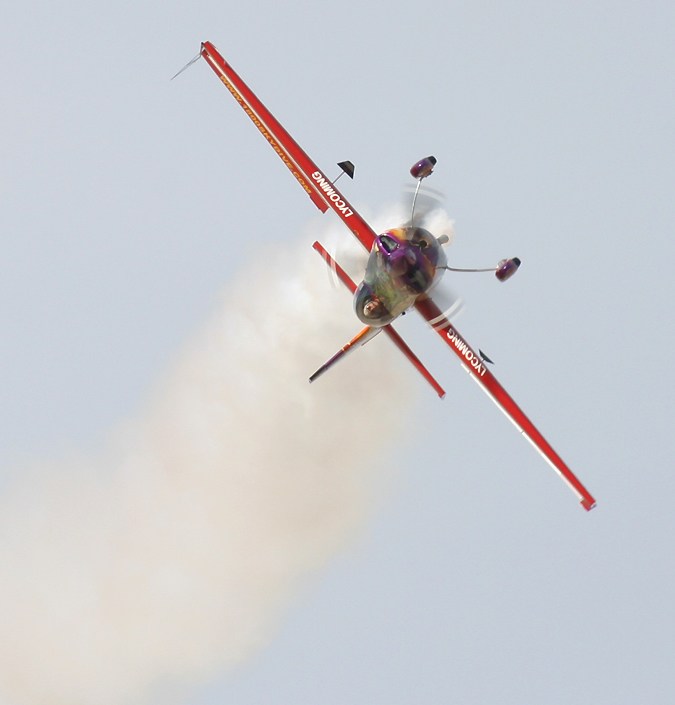
I'm not usually a big fan of civilian aerobatic displays, it's the technology and history of military aircraft which really interests me. I'm also too ignorant of flying to know what maneuvers are more or less difficult than others, so I can't really appreciate what the pilots are doing. However, even I can see that some of the things these planes are doing are pretty amazing, and I've finally decided that I'll have to make a page about the aerobatic displays at this show. American airshows have very strict safety rules about what can and can't be done at these events, but since I was outside the regulated display "box" at this show, there are quite a few photos from angles that you won't normally see, like this one. |
|
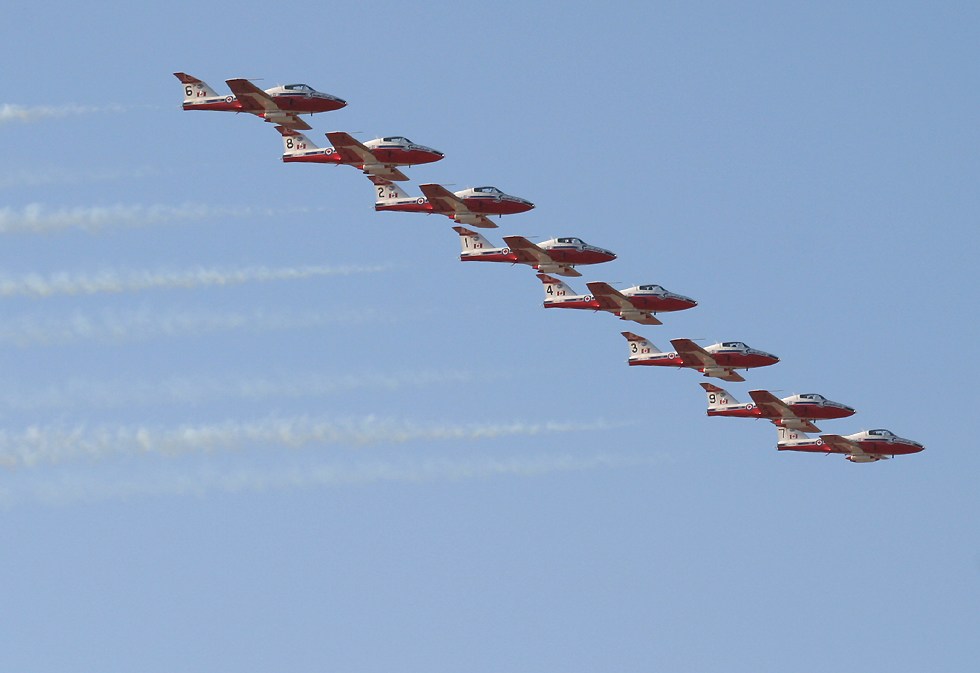
The Kern County airshow is very unusual in a number of ways. For one thing, it was held on a Wednesday instead of the weekend, so I had to take a day off work to get to it. Also, it bills itself as an "Airshow and Aerospace Science Expo", which means that this isn't supposed to be an airshow just for the sake of entertainment, it's also meant to be educational and to promote the aerospace industry in this area. The airshow was held at Inyokern airport, which is very near the navy China Lake weapons testing area; together with other military installations like Edwards Air Force Base, these are an important part of the local economy. Kern county is also home to the Mojave Spaceport, where civilian entrepeneurs like Bert Rutan developed SpaceShipOne and took it for its first flight into space. One benefit of having an airshow in the middle of the week is that it's possible to book acts which normally wouldn't be available, such as the Canadian Air Force jet display team called the Snowbirds. I've seen them perform once before, at the Dayton airshow in 2003, and the crowd there really appreciated them, even though the much flashier US Air Force Thunderbirds and US Navy Blue Angels flew at the same show. |
 |
|
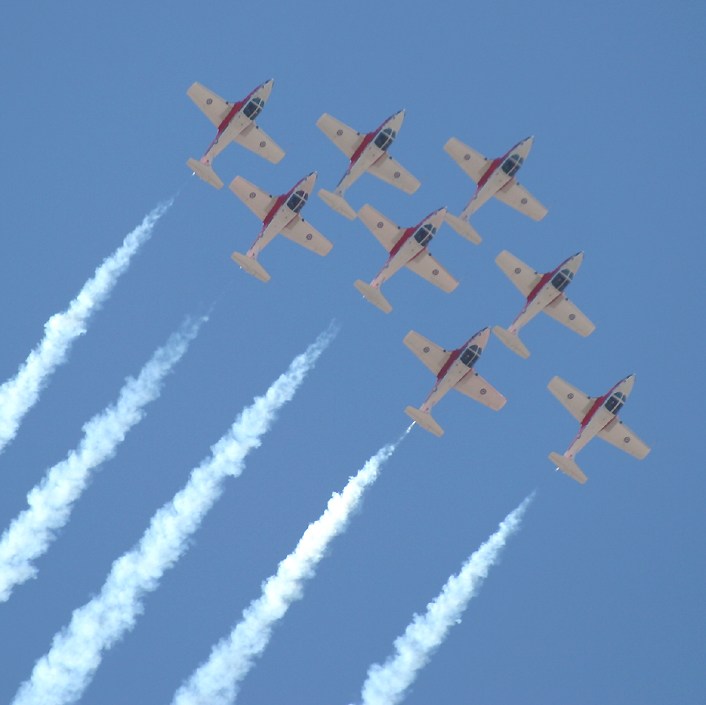
The Snowbirds manage to do a lot with somewhat limited resources - the Thunderbirds fly F-16 fighters and the Blue Angels fly F-18 fighters, but the Snowbirds have to make do with CT-114 Tutor jet trainers. Of course, the Snowbirds do have the numbers - eight aircraft instead of the six aircraft flown by the Thunderbirds and the Blue Angels. A fast pass by a Tutor isn't as impressive as one done by an F-16 or an F-18, but the Canadians make up for the lack of muscle by putting together some imaginative formation maneuvers, one of their most popular ones being this barrel roll with all eight planes, and another being the "Canada Burst" where all the aircraft climb together with their smoke on and then do a "star burst" where each of the aircraft heads off in a different direction. It's a great sight in a clear blue sky like this one. |
|
|
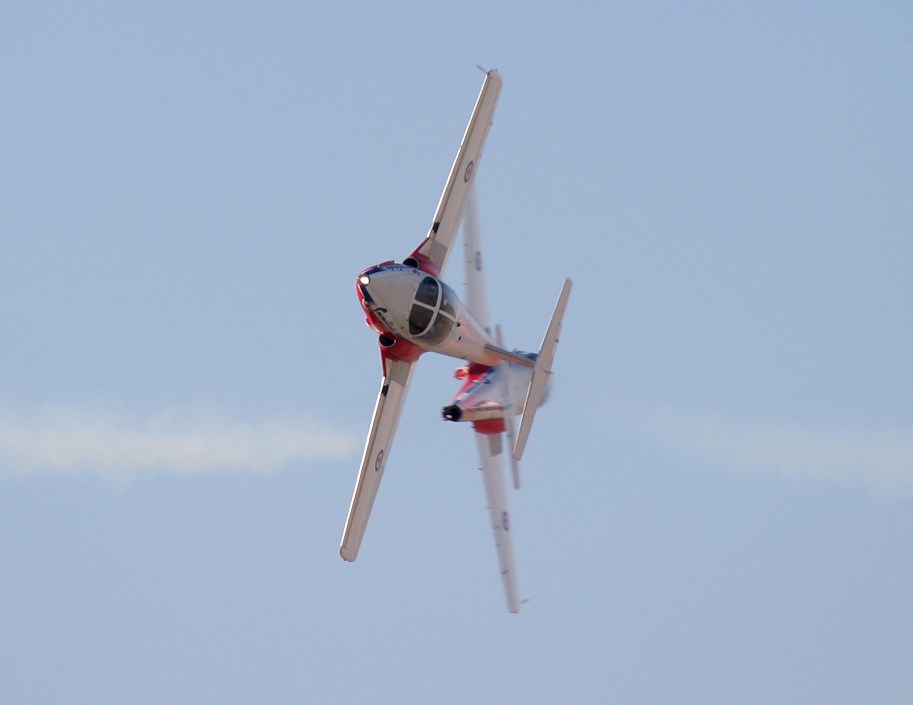
I was too far away to hear the crowd reaction at Inyokern, but during the Dayton airshow the audience reserved their strongest reaction for the Snowbirds' head-on passes. The crowd gasped every time the planes flew past one another seemingly with only inches to spare. It's a reaction that the Snowbirds milked for as much as it was worth, performing the pass 4 or 5 times during the show! |
 |
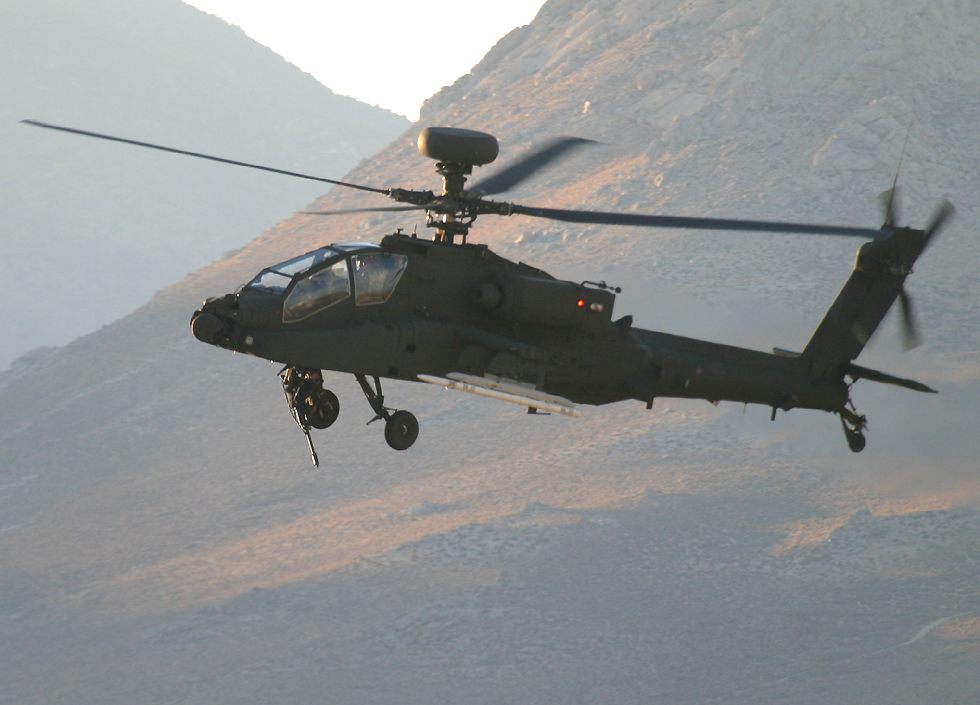
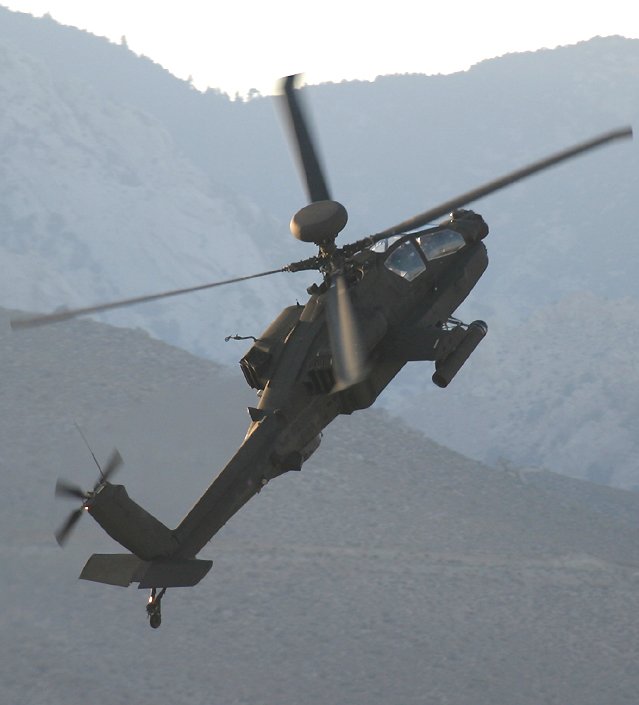
It was half an hour after the show had finished and almost all of the spectators had already left, but it seems that the Apache pilot had his own thoughts on the lack of helicopter performances at American airshows. In fact, whether he was invited to perform or not, and probably whether he had permission to perform or not, he was going to put his bird through its paces. To my surprise and delight, then, he banked around and made a pass of the now empty airfield. He threw the machine steeply up and back down, went around once or twice more and finally made his exit. I guess that's the sort of bravado that naturally happens when your Commanding Officer is 6000 miles away! |