
Nellis AFB "Aviation Nation" Airshow 2009
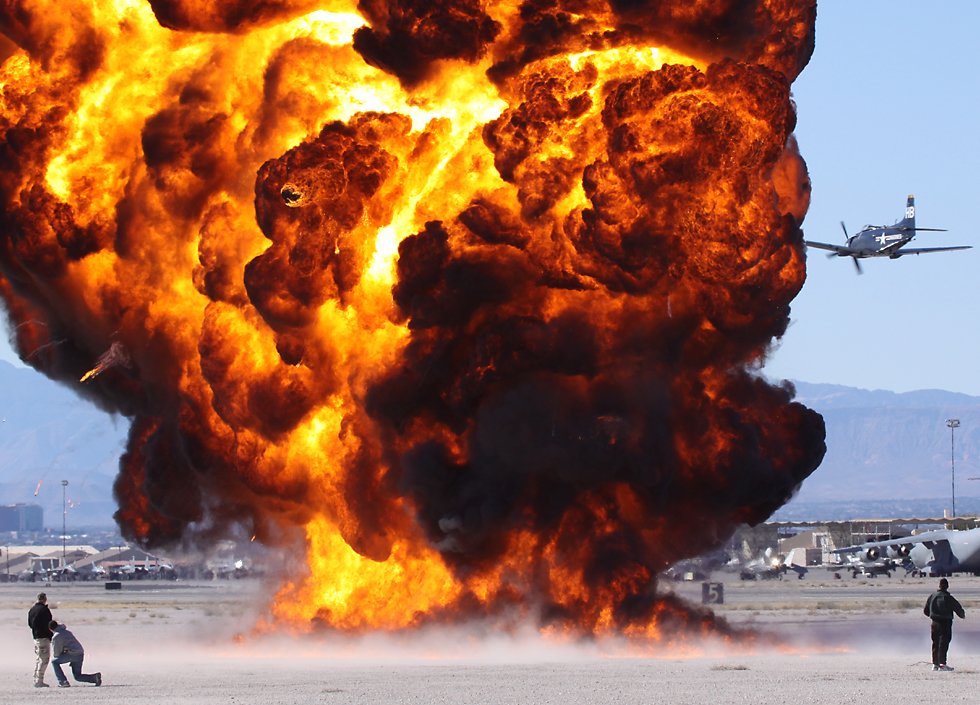
In 2009 the "Aviation Nation" airshow at Nellis air force base near Las Vegas came back with a bang, after financial and organisational issues which affected the 2008 show. In 2009 Chris Rainey and his team from PyroTechs produced much of that bang, with a little help from gasoline and high explosives! On the right of this photo Frank Wilson detonates one of many set pieces during the Vietnam demonstration, while Chris and his son Colton watch on. Unfortunately on Saturday the air force gasoline tanker driver got lost on his own air base and turned up almost an hour late, then instead of pumping 450 gallons of gasoline as expected, he ran out after just 250 gallons, both events forcing the PyroTechs to curtail their display considerably. |
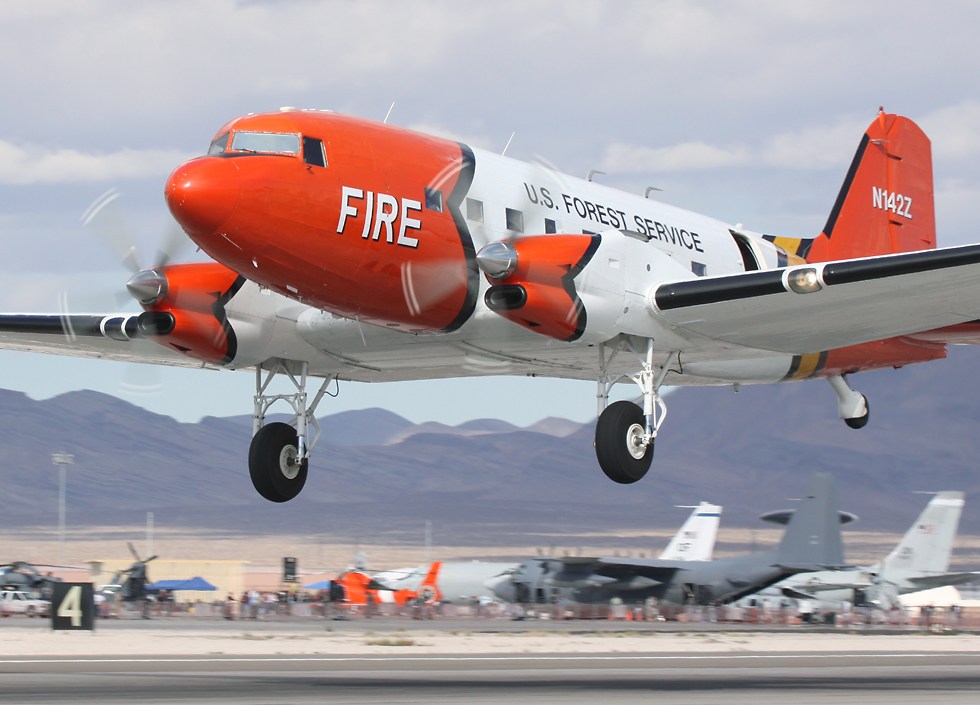
The United States Air Force Academy "Wings of Blue" parachute team did their drops this year from this forest service Super DC-3, a turboprop powered version of the classic 1930s DC-3 airliner, which operated during World War Two as the army C-47 Dakota and the navy R4D. The Super DC-3 was developed by the same Douglas Aircraft Company which produced the DC-3, but there were too many cheap ex-military C-47s available, and the Super DC-3 wasn't commercially successful. This photo is from Friday's practice, when the skies were cloudy and the temperatures warm, but on the public days the temperatures plunged and the winds picked up so much that the Wings of Blue couldn't do their display on Sunday. |
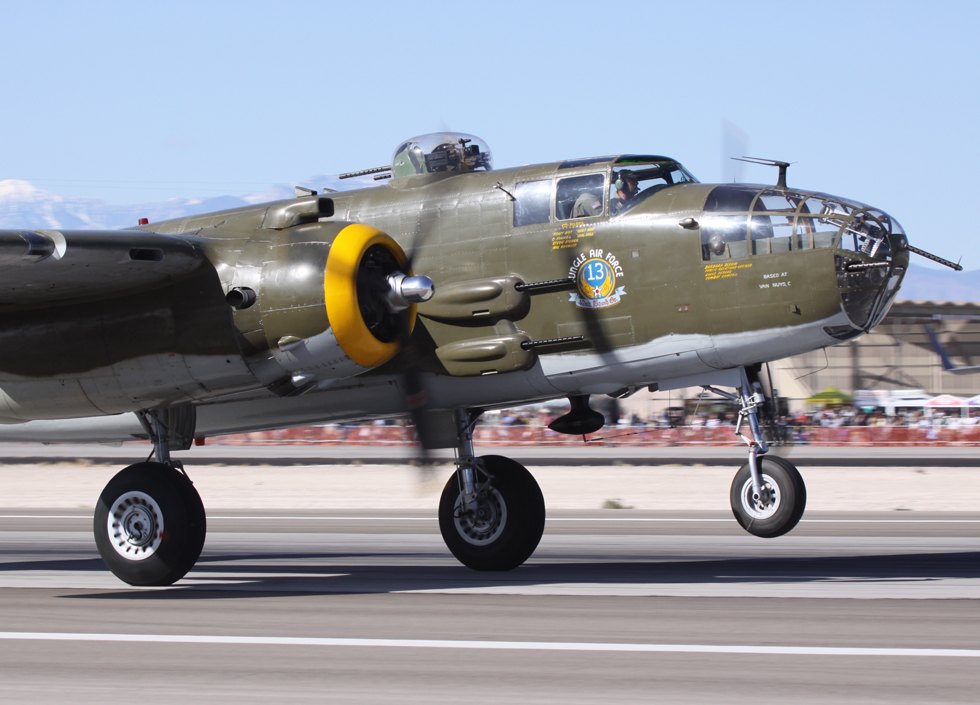
The 2009 show had a very different feel to previous years, because of a change in direction with the show organization. To qualify as an air force "open house" rather than an "airshow", the flying displays consisted entirely of military aircraft rather than a mixture of military and civilian acts. So there were no aerobatic acts like Sean Tucker in the Oracle Challenger biplane, or the Red Bull helicopter, instead there were military types broadly grouped into different eras, like this B-25 Mitchell bomber which was part of the World War Two sequence. It was one of two Mitchells which flew together, and of course since they're bombers most of the pyrotechnics for this part of the show were co-ordinated with their passes. |
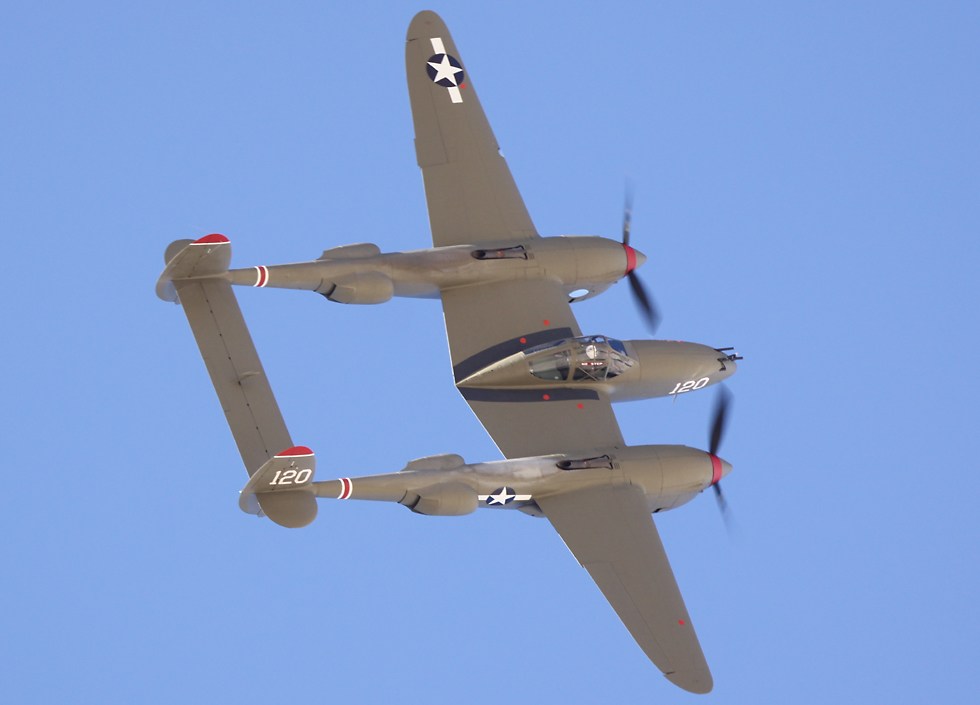
This P-38L Lightning fighter is a very welcome addition to the airshow scene. Previously based at the Lone Star Flight Museum in the markings of a wartime aircraft called "Putt Putt Maru", it's now painted in a new color scheme with nose art titled "Thoughts of Midnite". There are very few P-38s left, but now no fewer than three of them are based, at least temporarily, at the Chino Air Museum in the greater Los Angeles area. |

The Horsemen are a three-man team who fly aerobatics in P-51D Mustangs, though they have been known to do their act in F8F Bearcats, too! One of the team members was tied up with his day job flying airliners, but the two other pilots flew their craft "February" and "Double Trouble two". |
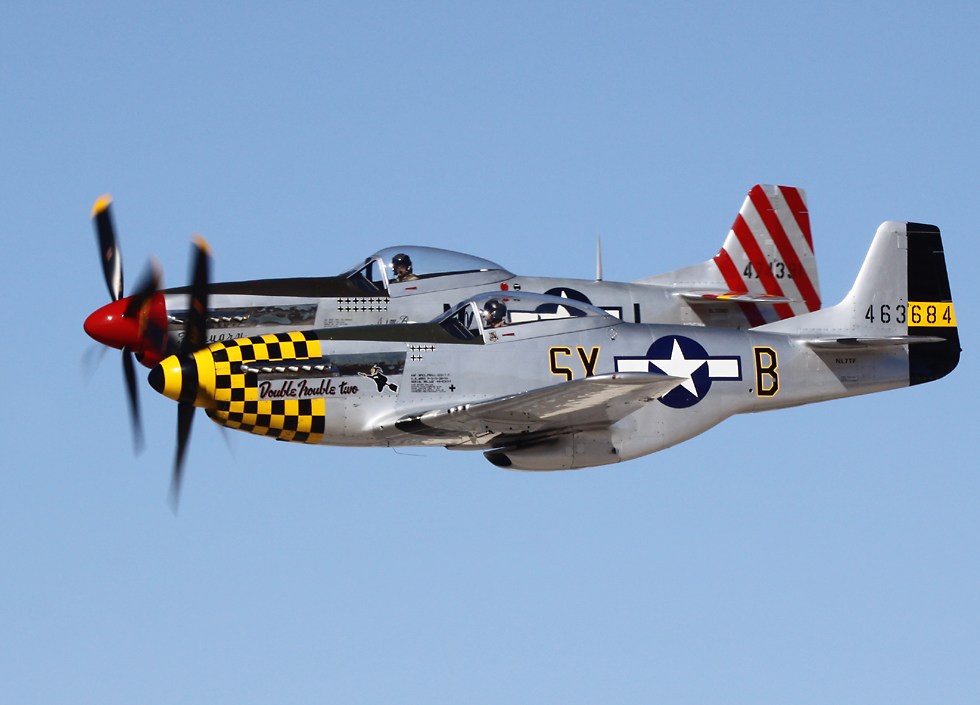
These guys fly some seriously tight formations, all the more impressive because they do it not just while going straight and level, but also while doing barrel rolls and other maneuvers. To make it even more amazing, they managed to do all of this even as gusty winds over the weekend were forcing the other pilots to fly much looser formations than usual. The wind even made photography more difficult, forcing me to crank the shutter speed up a notch or two to compensate. |

Ed Shipley was flying "Double Trouble two", he's a tremendously experienced warbird pilot with lots of tight formation flying experience in many different aircraft types, including a rare F-86 Sabre jet formation with Dale Snodgrass at the Oceana airshow in Virginia. On Saturday he decided to drop in to say "hi" to the pyrotechnics team, flying at only 20 feet above the ground and straight over the top of their heads as they were setting up one of their displays. The Federal Aviation Administration's safety personnel at the show weren't convinced that mixing aircraft, explosives, detonation cord and bagged gasoline was such a good idea, so he got a mild rap on the knuckles and flew somewhat higher on Sunday! |
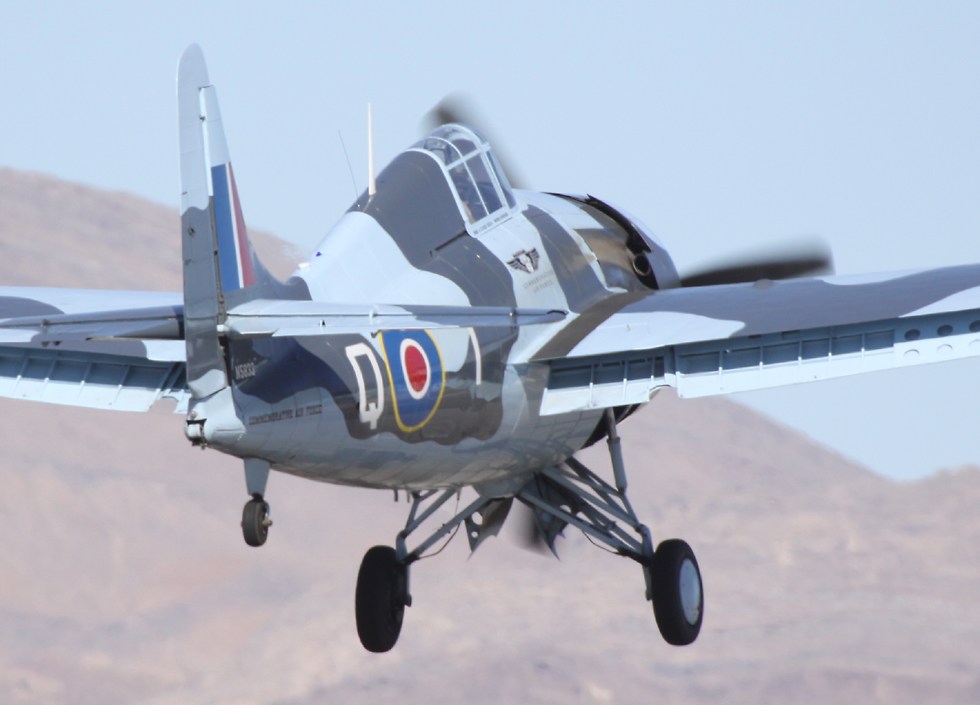
The navy was represented, too, with this F4F Wildcat. The Wildcat was the main US naval fighter at the start of the war in the Pacific, and many people are surprised to learn that it was also the first American-designed aircraft to shoot down a German plane during World War Two. That action happened when a British F4F shot down a Junkers Ju 88 bomber over the British naval base at Scapa Flow, in Scotland. Technically, the aircraft in this photo isn't an F4F Wildcat at all - it's painted up in a North Atlantic paint scheme as one of those British aircraft. The British didn't originally refer to this aircraft as "Wildcats", instead they assigned the name "Martlet" to them. If you're not sure what a Marlet is, don't be too embarassed - it's a British name for a bird called the house martin, which is a type of swallow. Goodness knows why they called a pudgy naval fighter after a highly maneuverable land bird! The other reason why this particular aircraft isn't an F4F Wildcat is that it wasn't built by the Grumman Corporation which designed the plane, but by General Motors - which makes it an FM2 instead of an F4F! Since it's a naval type, this FM2 Marlet didn't fly with the rest of the World War Two aircraft, instead it did a naval Tailhook Legacy Flight with the F-18F Super Hornet which went aloft at the same time. |
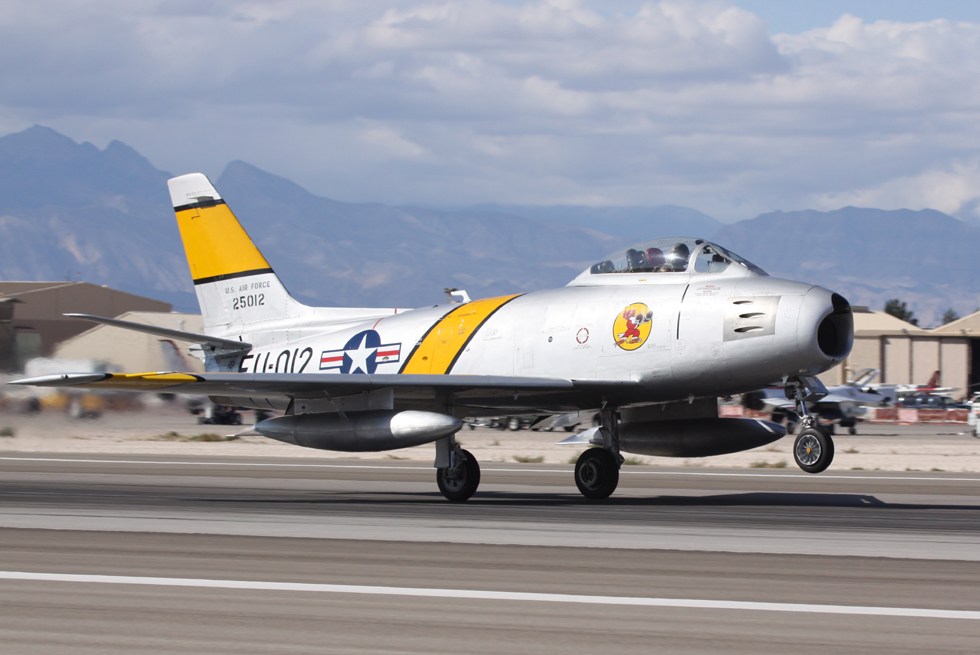
The Chino Air Museum regularly brings its F-86 Sabre fighter jet to the Nellis show. It's one of the stars of the Korean War segment of the display, this year appearing along with a T-6 Texan trainer which was masquerading as an LT-6 Mosquito forward air controller. There were two scares during this year's show, the Sabre providing one of them when one of its external fuel drop tanks detached and fell to the ground. Thanks to the rigorous safety standards enforced at all American airshows, it landed far from the crowd, but I lost sight of the plane and couldn't see it anywhere. However it turned out that Chino's head honcho, Steve Hinton, had taken it higher and called in one of the other aircraft to survey what had happened and whether there was any damage to the aircraft. There wasn't, and he was able to land it uneventfully, and even take it up again later that same day, this time with both external tanks removed. |
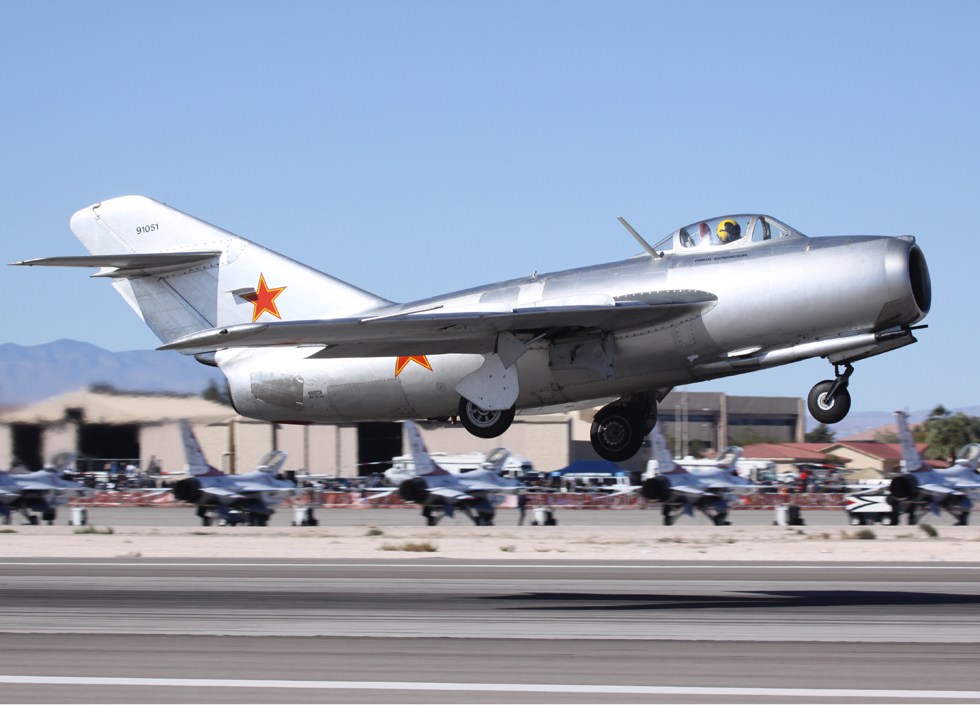
The Chino Air Museum also owns this immaculate MiG-15 "Fagot" fighter, which was the Sabre's main combat foe during the Korean War. The MiG is a lot stubbier than the Sabre, so it requires a proportionally larger tail to maintain stability. There's little doubt that the Sabre would win any beauty contest between the two aircraft, but technologically the two were very evenly matched. |
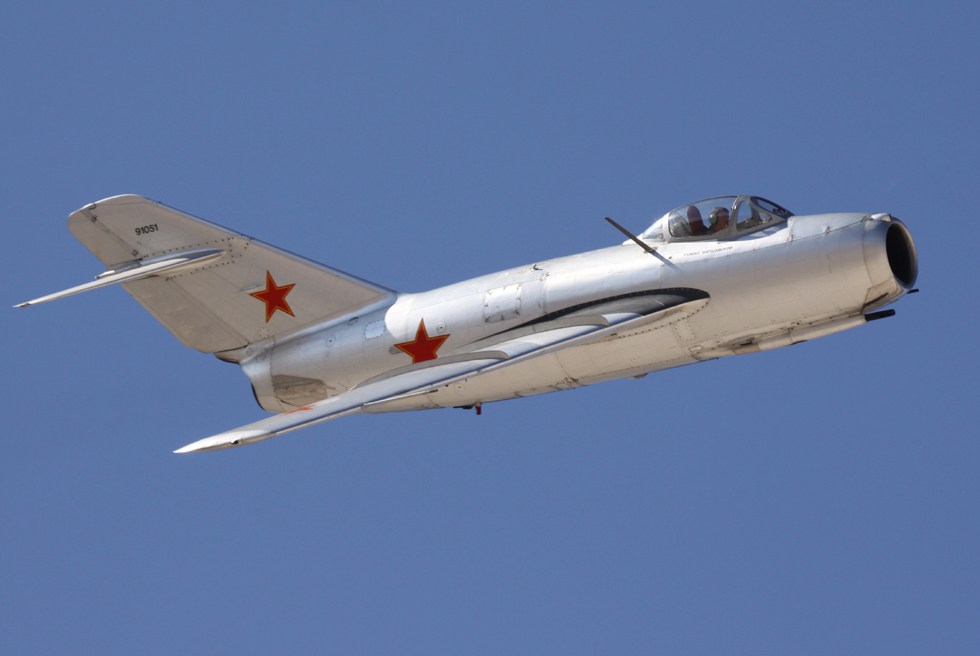
In terms of firepower the MiG definitely outclassed the Sabre, with two or three large caliber cannons mounted under the nose, rather than the six 50 caliber machine guns that the F-86 possessed. Even during World War Two it became clear that cannons had far greater effectiveness against other aircraft, so it was rather anachronistic that the Sabre only possessed machine guns. |
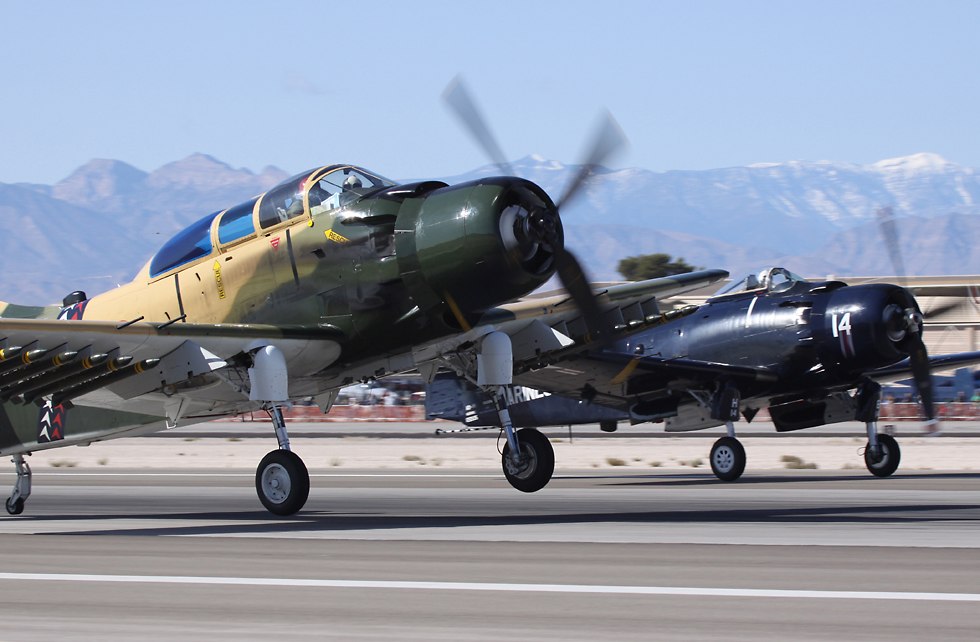
As you saw from the pyrotechnics display at the top of this page, this pair of A-1 Skyraiders provided most of the punch during the Vietnam War segment of the show. On the left of this shot is a four seat air force A-1E, while the blue marine corps Skyraider in the background is a single seat model which carries the designation AD-4N, which was assigned before the joint services designation scheme came into effect in 1962. |
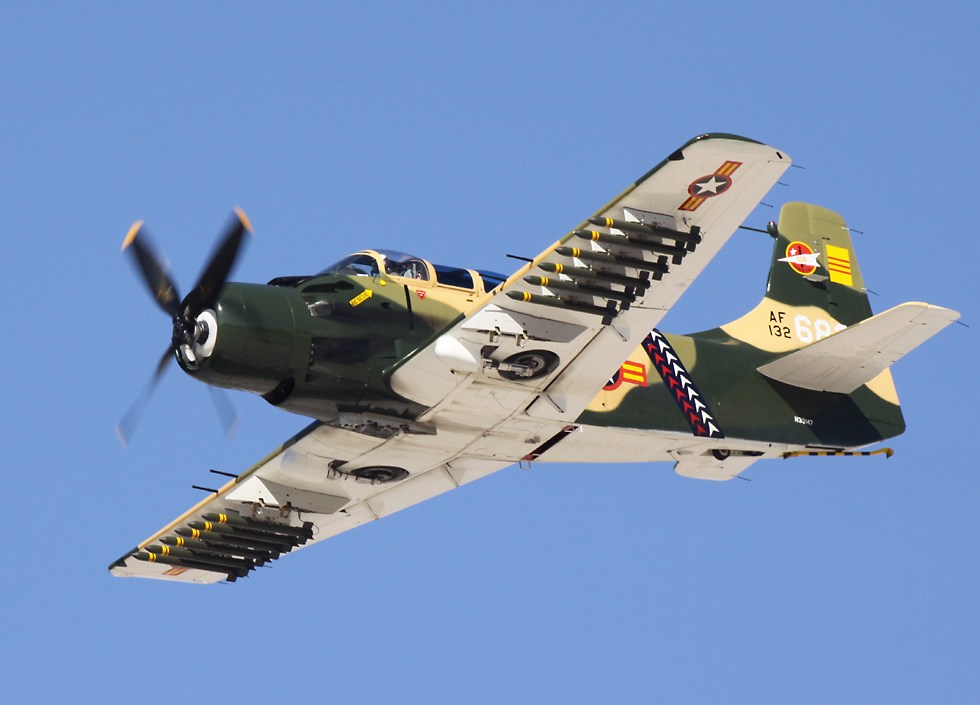
The four seat models are particularly rare nowadays, and this one is especially impressive with its camouflage paint scheme and the racks of rockets mounted under its wings. Although it entered service immediately after World War Two and flew much slower than the jets developed in the post-war years, the Skyraider remained an extremely effective weapons delivery platform right into the Vietnam era. Its relatively slow speed made it able to deliver ordnance very accurately, and its piston engine provided much better fuel economy than jets, allowing it to loiter in the target area for many hours. |
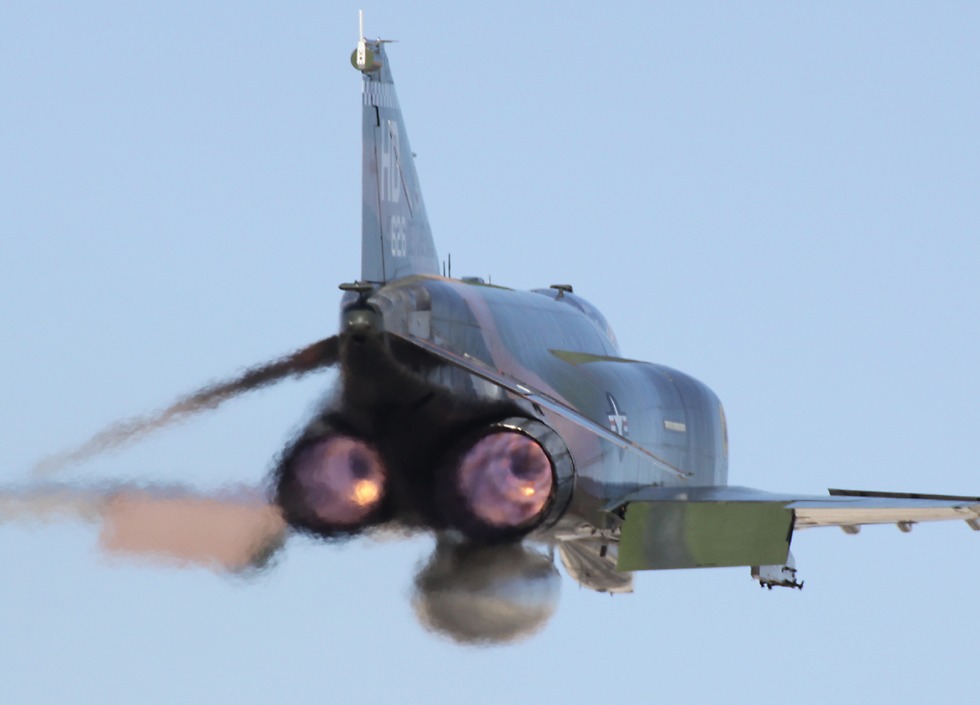
However the jets were well represented at Nellis, too! This F-4 Phantom II is the definitive jet of the Vietnam conflict, operating in large numbers both with the air force and with America's naval forces. The strangely angled tail surfaces and outer wing surfaces earned it the nickname "Double Ugly", but it was actually a very effective aircraft both in the air-to-air combat role and in ground attack. Although still operated by several foreign air forces, United States Air Force Phantoms like this one now operate purely as QF-4 target drones, with only a few painted up in past combat schemes for display on the airshow circuit. |
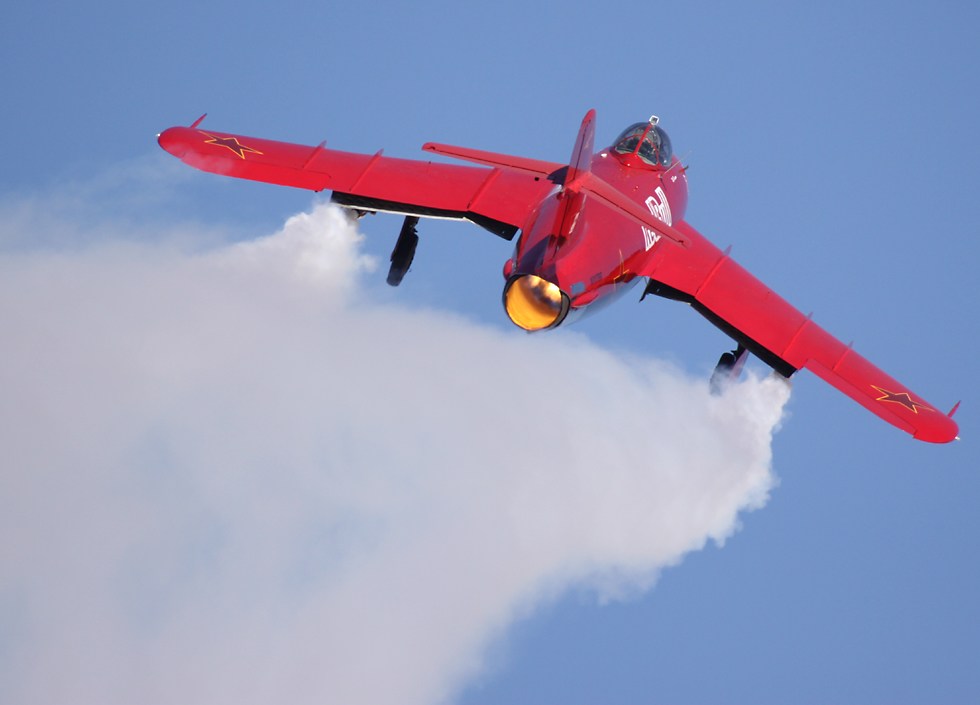
The Red Bull helicopter might not have been at this year's show, but the Red Bull MiG-17 flown by Bill Reesman was still here, able to fly at the open house because of its military connection. The MiG-17 "Fresco" was a development of the MiG-15, with more highly swept wings and an afterburner-equipped engine which you can see in operation here. Although it was sub-sonic, it proved surprisingly dangerous when fighting against supersonic American fighters during the Vietnam War, shooting down 32 F-4 Phantoms, which on paper were vastly superior. This experience lead the US navy to develop the TOPGUN training program with sub-sonic American A-4 Skyhawks playing the role of the MiGs. |
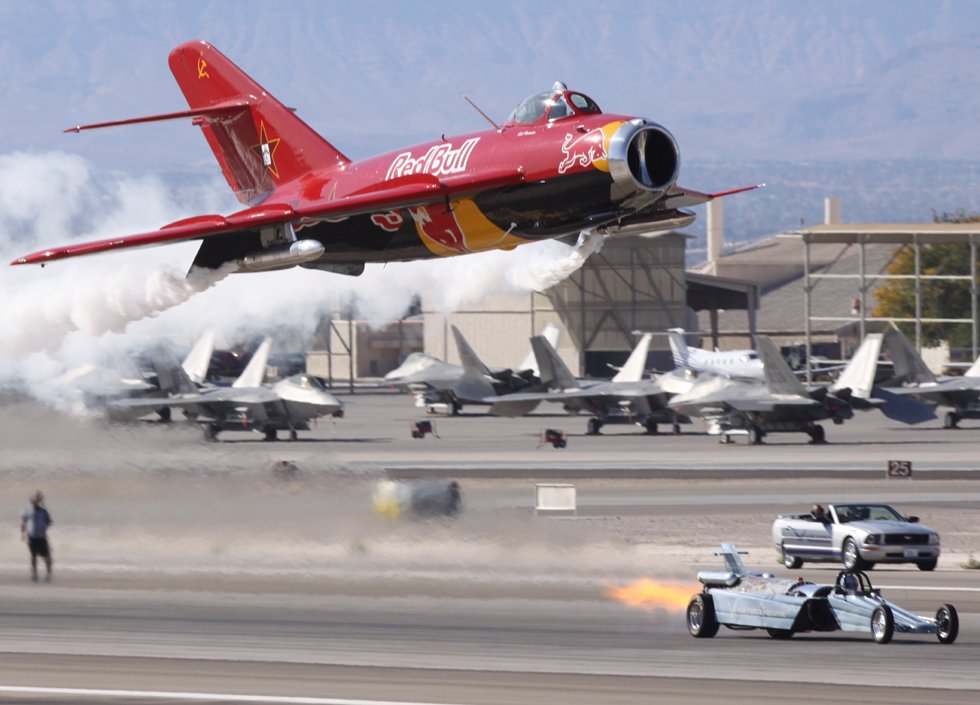
Apart from his use of smoke, one of Bill's main party tricks is racing against jet-powered land vehicles, either one of Les Shockley's Shockwave trucks or, as here, the Air Force Reserve's "Smoke-N-Thunder" jet car powered by a 10,000 horsepower afterburning jet engine. No matter who he's racing, somehow Bill manages to lose every time! |
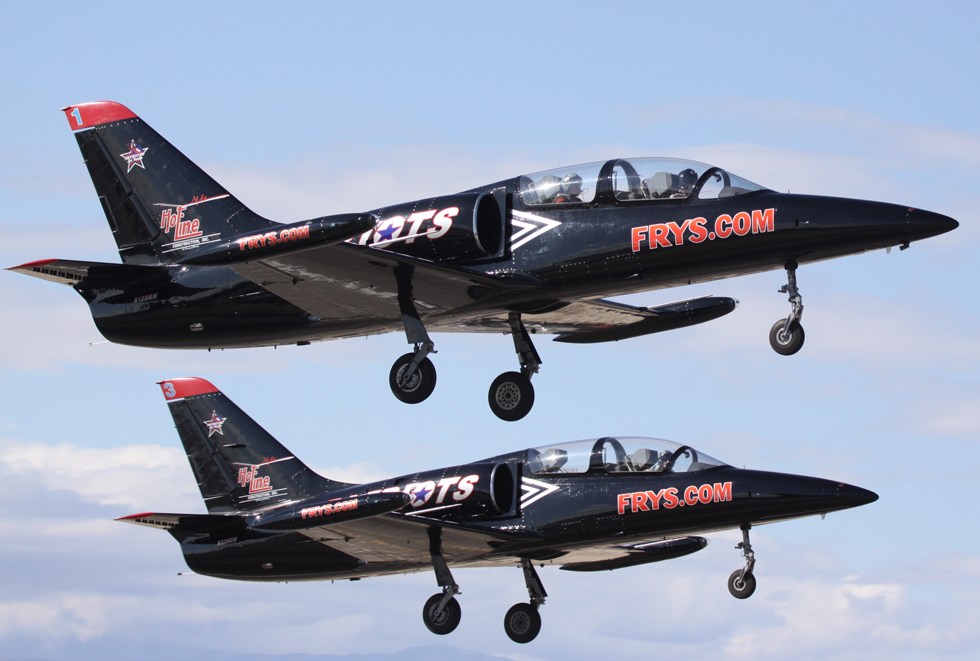
Like the Red Bull MiG, the Patriots jet team managed to squeeze its way onto the schedule because of their military connection. For a team called the Patriots, it's rather ironic that they actually fly ex-Soviet jet trainers in the form of the L-39 Albatros, which was designed in Czechoslovakia. It's a good-looking aircraft, and the Patriots have put together an excellent routine which is every bit as good as the military jet teams, and includes some maneuvers that they don't do. One of these is the tail slide, where the pilot points his aircraft straight up, lets it slow down to a stop and then falls backwards before recovering and heading back for the next maneuver. None of the western military jet display teams do tail slides, but the Russian air force team does, complete with flares! |
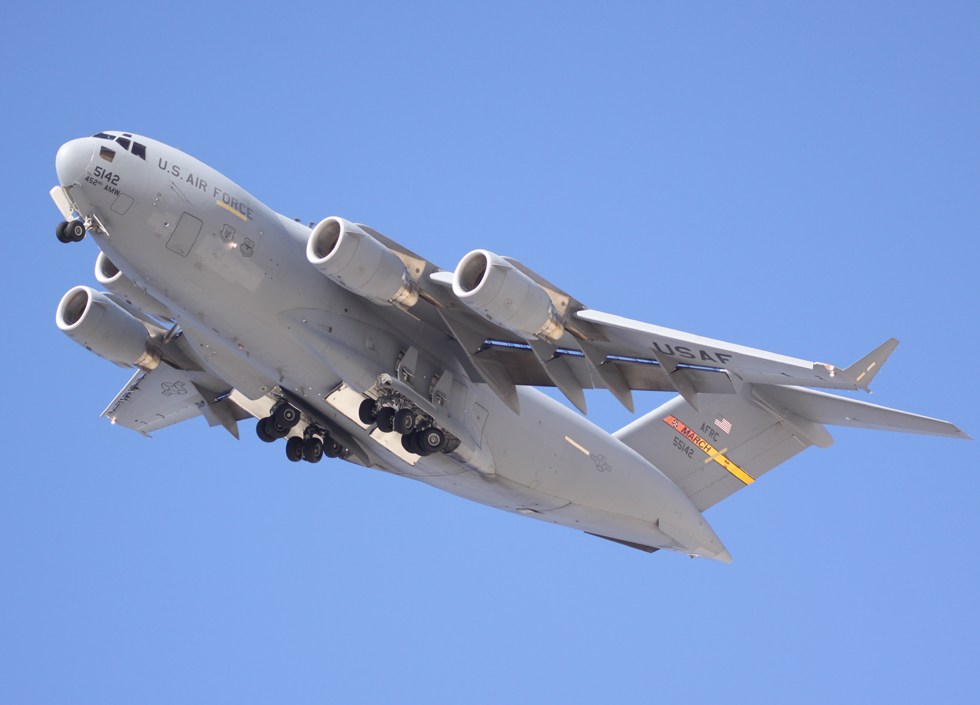
The C-17 Globemaster III performance has become a surprise favorite at American airshows. The C-17 doesn't have any weapons or afterburners, it's not fast or even loud, but its virtuoso display of maneuverability impresses even ordinary airshow attendees who wouldn't know a sponson from a blown flap. After a very short takeoff roll the Globemaster lifts off and immediately begins a steep climb, which can be a spectacular maneuver if there's a lot of loose dirt around, as you can see from the takeoff at the 2007 Riverside airshow. After lifting off, the C-17 banks hard over and begins a tight circuit right in front of the crowd. In fact the entire sequence is done at a relatively short distance from the crowdline, unlike the fighter demonstrations which rely more on fast passes which lead to an extended wait as the plane vanishes in the distance and then repositions itself for the next part of the routine. After a few passes with gear up and gear down, the routine ends with a very short landing courtesy of the thrust reversers, and then the plane backs up for several hundred yards with crew members keeping watch out the side doors and then the plane then returns to the ramp. |
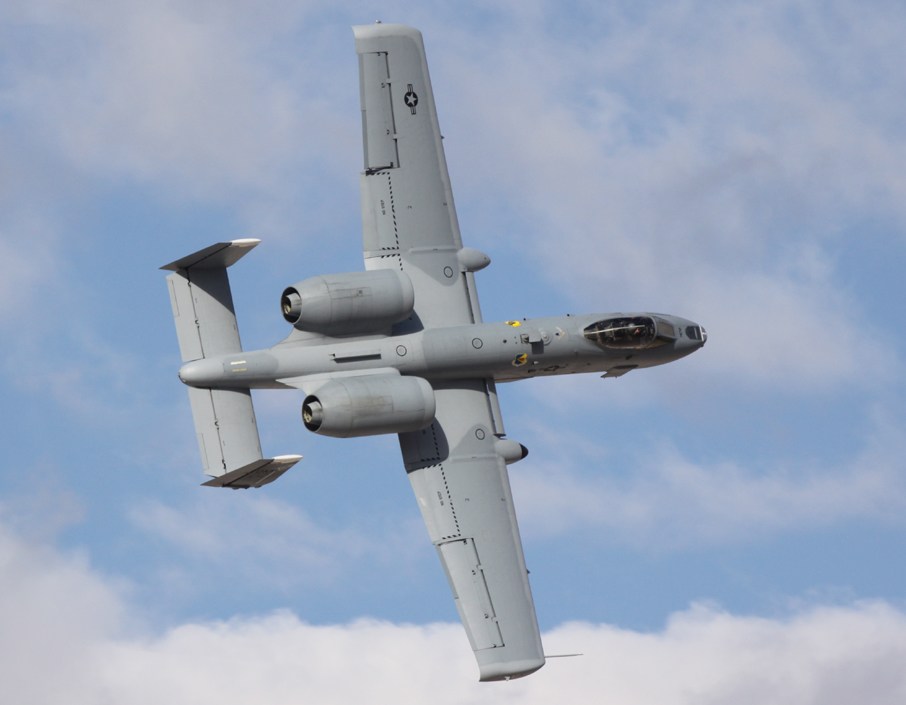
The A-10 Thunderbolt II is another crowd favorite which manages to stay in front of the crowd for most of its display. Of course the other reason the A-10 wows the crowd is that it's a natural candidate for some more pyrotechnics, with strafing runs and large explosions! |
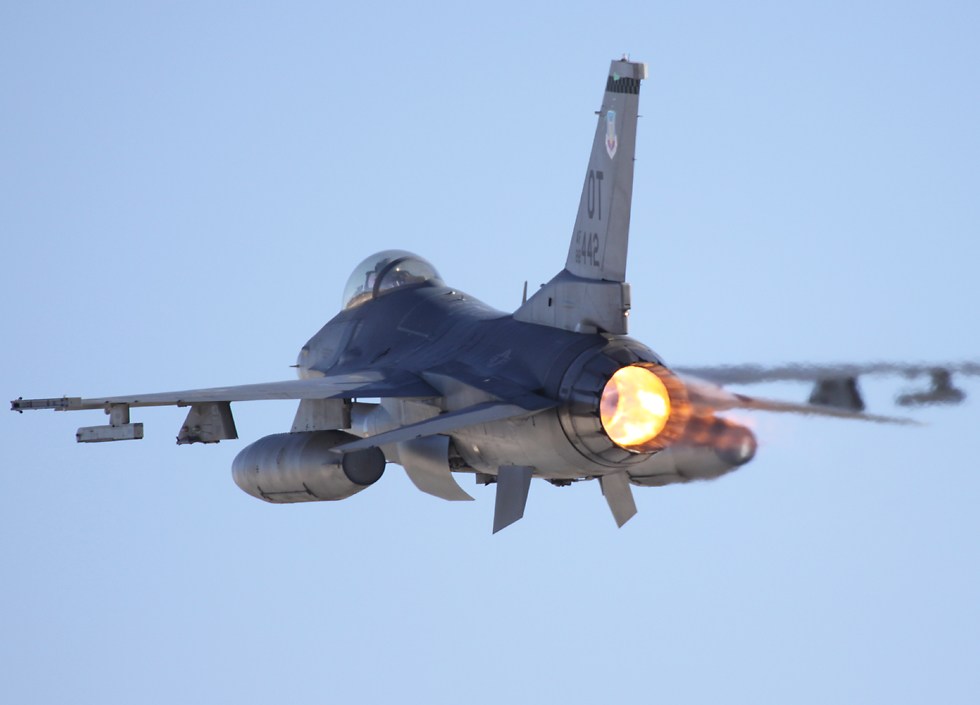
If the 2007 Point Mugu airshow turned into a Vaporfest, then the increased military emphasis at the 2009 Nellis open house definitely qualified it as an Afterburnerfest! In this case, the afterburner belongs to a USAF F-16 Fighting Falcon taking off for its part in a four-ship formation which took place early in the day's show, the F-16 flying alongside the A-10 Thunderbolt II, an F-15 Eagle and an F-22 Raptor. |
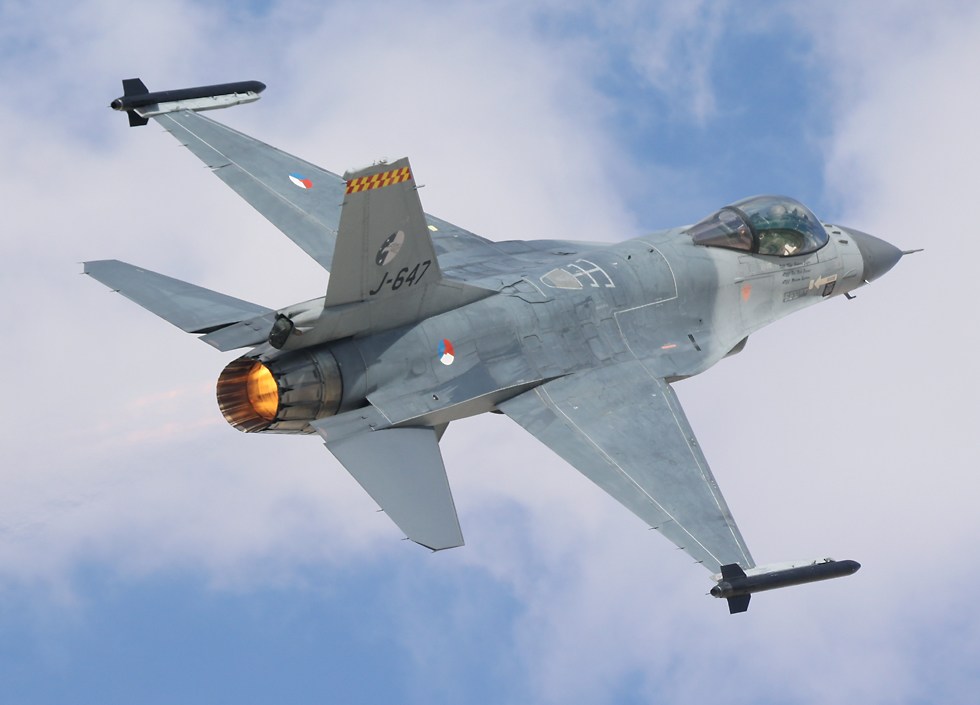
However, that wasn't the only F-16 at the show! This Royal Netherlands Air Force Fighting Falcon is one of the few foreign military acts you'll ever see in America. The Dutch have a very distinctively painted F-16 which they use for the display when they're in Europe, but this one was flown in their aircraft based in the US. This display was the last one flown by a demonstration pilot whose call sign is "Sheik". The Friday routine must have been his shortest ever, and he didn't even get to turn his wingtip "smokewinders" on, because mechanical problems caused him to abort the display and land the plane. After parking in a remote area of the base, firetrucks rushed over (some in the wrong direction!), but there was no further incident. However this F-16 didn't fly again over the weekend, and the Dutch went to a great deal of effort to bring in a replacement which was used on Saturday and Sunday. |
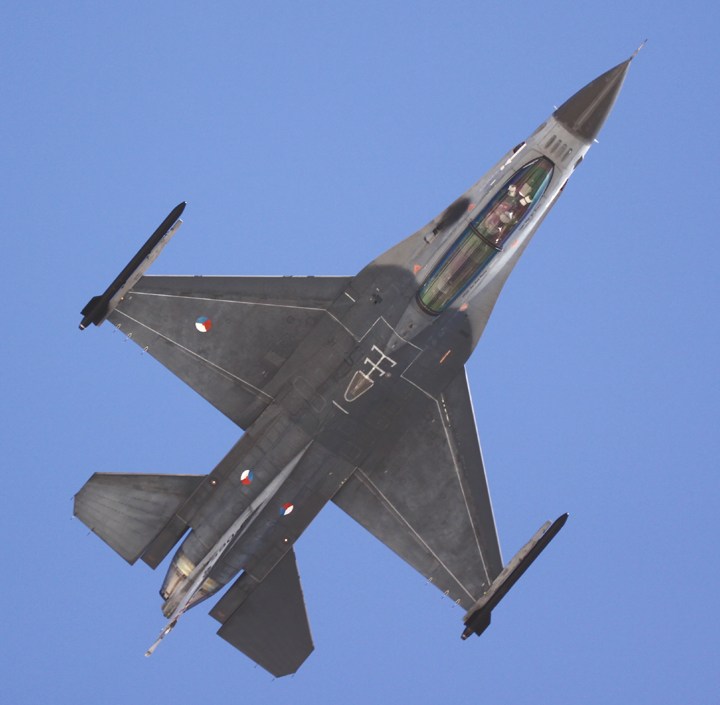
Here's that replacement - a two seat training model which proved that it's every bit as good a performer as the single seat combat aircraft. |
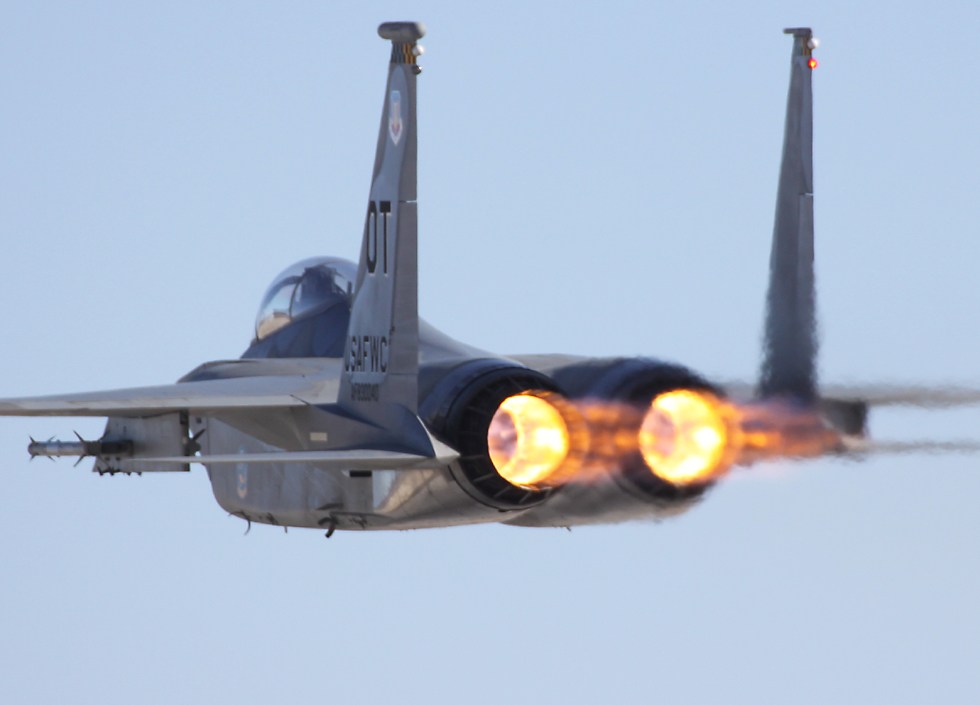
Here's the F-15 Eagle which was in the same formation flight as the American F-16. This one belongs to the United States Air Force Warfare Center at Nellis, it's fitted with dummy air-to-air missiles on the racks under its wings, which isn't a very common sight at American airshows. |
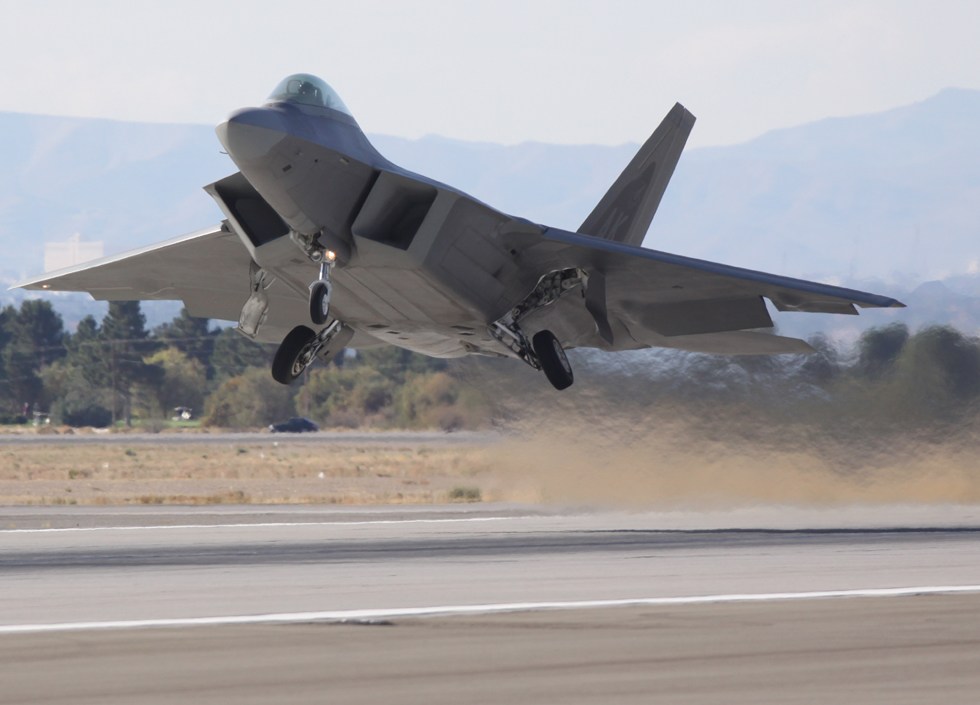
The F-22 Raptor is America's newest operational fighter and is now a frequent sight at Nellis. This one is from a rather colder place - its "AK" tail code indicates that it's based at Elmendorf air force base in Alaska. The Raptors at Elmendorf frequently scramble to intercept Russian Tu-95 "Bear" bombers which our vodka-drinking friends send over periodically to probe our defenses, just as we send aircraft and ships near the Chinese coastline. |
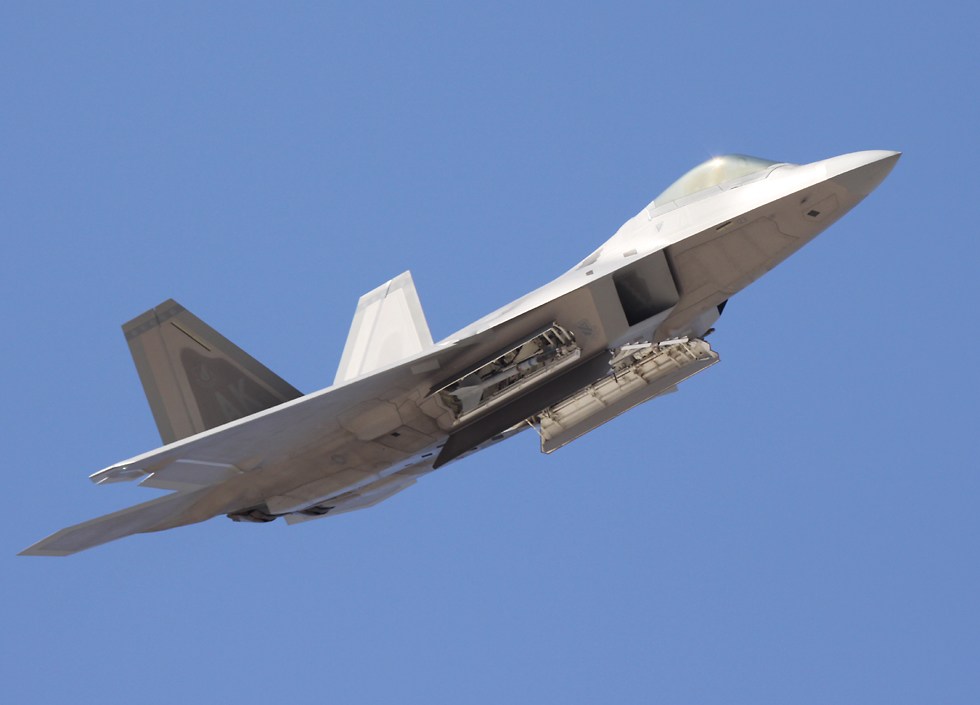
The official F-22 demonstration was due to be performed at Nellis, but the Air Force decided quite late to send the team to Dubai instead, because there's been some talk of the United Arab Emirate states buying the F-35 Lightning II, a cheaper but equally stealthy fighter which is currently undergoing flight testing in the United States. The cancellation of the Raptor demonstration was a major disappointment for the many aviation enthusiasts who came to this airshow from overseas, but the show organizers went to considerable effort to make up for the loss by arranging a lightweight display put on by one of the Raptors at Nellis. The pilot did many of the same maneuvers as the full demonstration, including showing off the weapons bays, but this is the first time I've seen a dummy air-to-air missiles in one of the side bays! |
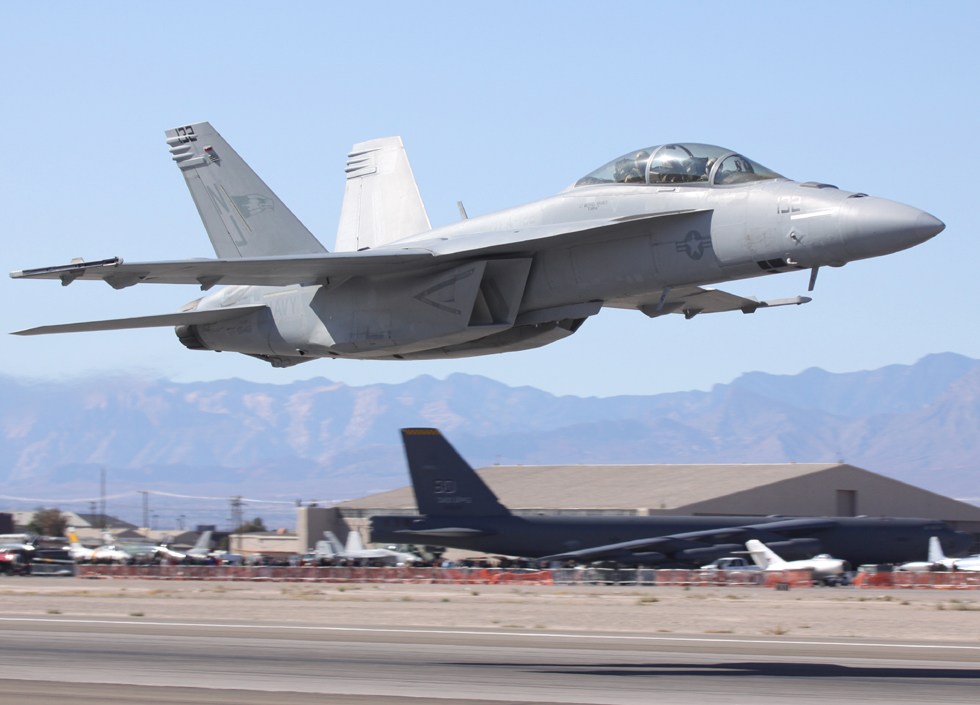
Although this is an Air Force base, the Navy wasn't forgotten, either! Here's a Navy F-18 Super Hornet starting its routine with a ground-shaking fast afterburner pass straight after takeoff. |
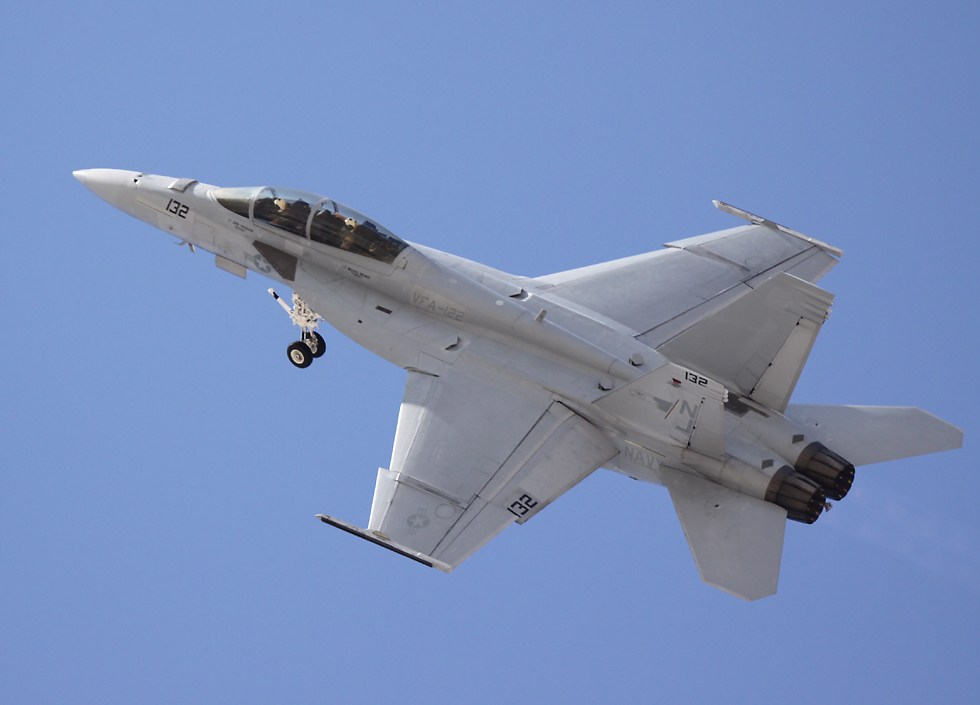
The Super Hornet is very maneuverable, and the navy demo teams have added several interesting tricks to their act in the last few years, some of which look like an attempt to do the same sort of thrust-vectoring stunts as the much fancier Raptor. Here, though, you can see the Super Hornet doing a "dirty roll", with undercarriage extended and afterburners blazing. This plane seems to be taking the US military's "low visibility" markings scheme very close to its ultimate conclusion - you can scarcely see the national insignia on the wings, the squadron number VFA-122 behind the cockpit or the "NAVY" lettering behind the wing! As with many naval aircraft, only the aircraft number is clearly visible. In case you're wondering, the "NJ" tail code doesn't mean that this aircraft is based in New Jersey, instead it means that it's based at Naval Air Station Lemoore in California. Naval squadrons based on aircraft carriers operating in the Atlantic have tail codes starting with "A", but aircraft on carriers in the Pacific have codes starting with "N". |
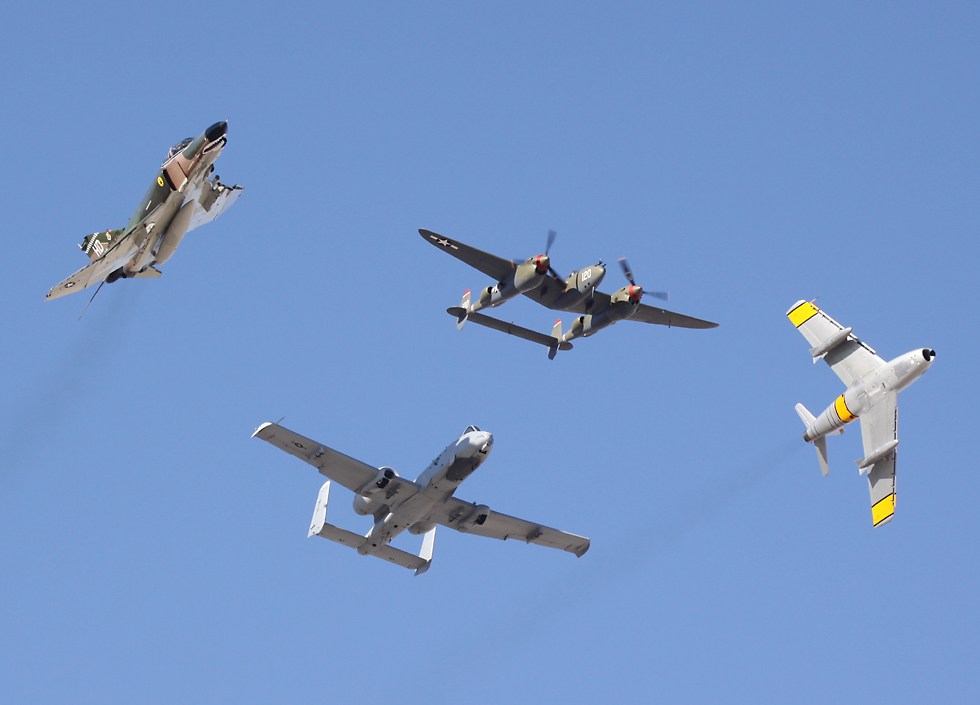
As well as the modern military formation, there was also a Tailhook Legacy formation with the Super Hornet and the Wildcat, and this Heritage Flight formation. Here you see the "break" at the end of the Heritage Flight formation. |
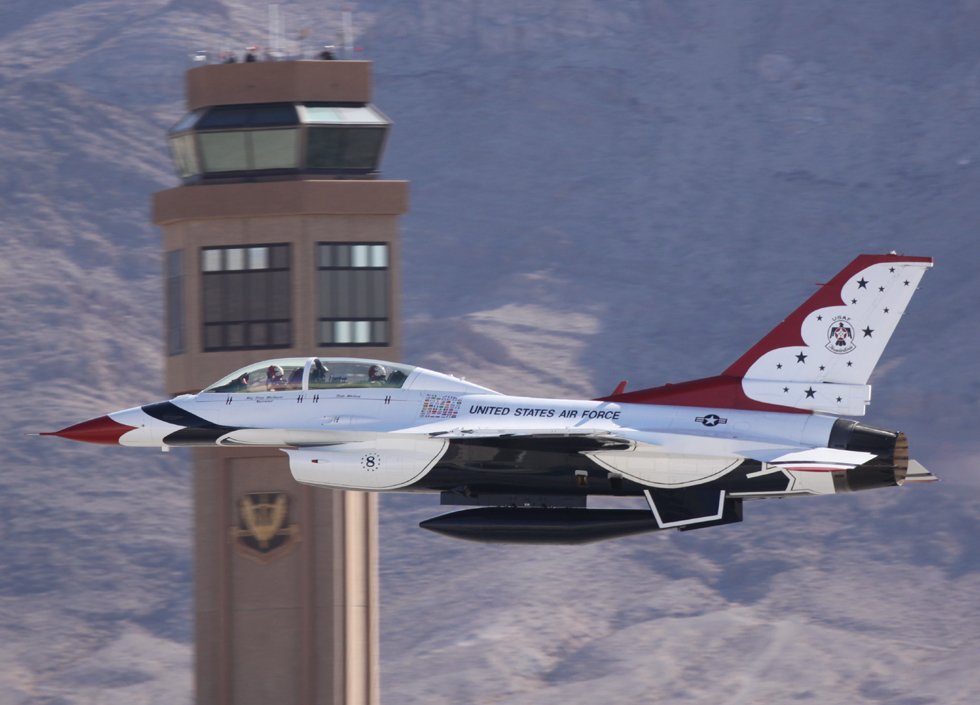
The Aviation Nation airshow is always the last performance of the year for the USAF Thunderbirds jet display team. Here you see one of the Thunderbirds aircraft taking off early in the day and passing by the Nellis control tower. This one is a two seater, perhaps going out to give one of the pilots a refresher or a preview - the backseater is often one of the pilots for next year's team. |
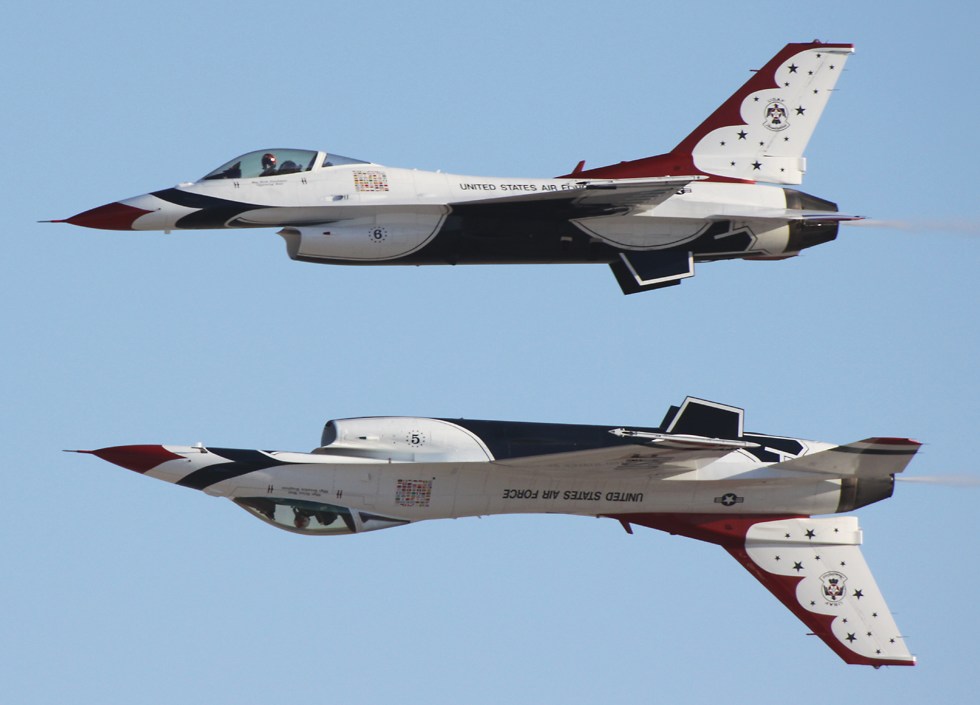
For most people, the Thunderbirds are the highlight of the show, performing many apparently death-defying routines. As the final act, they also start a mass exodus as people head for their cars in a vain attempt to get home quickly. Considering that well over 100,000 people attend the show, the Air Force does a great job of bussing people to and from the parking lots, and getting everyone through security. |