| Highlights
of the 2007 Nellis AFB "Aviation Nation" Airshow |
| This
year was the 60th anniversary of the United States Air Force as an independent
branch of the military, and the Air Force's premier airshow, at Nellis
Air Force Base outside Las Vegas, put on an excellent display which drew
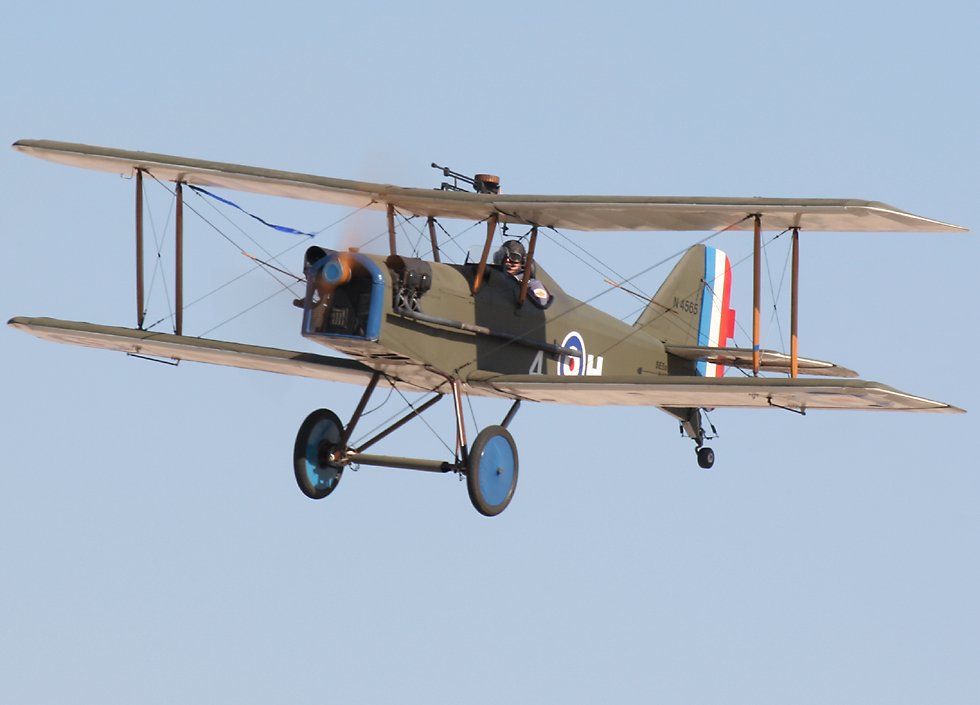
the largest crowd for many years. They started with a pair
of replica world war one fighters, this S.E.5a fighter and a DH.4 light
bomber in a post-war US Mail color scheme. Both of these British
designed aircraft were used during the war by American forces, because
of the lack of suitable American types. The S.E.5, together
with the Sopwith Camel, regained control of the skies from the Germans
in the summer of 1917, and maintained air superiority until the end of
the war. |
 |
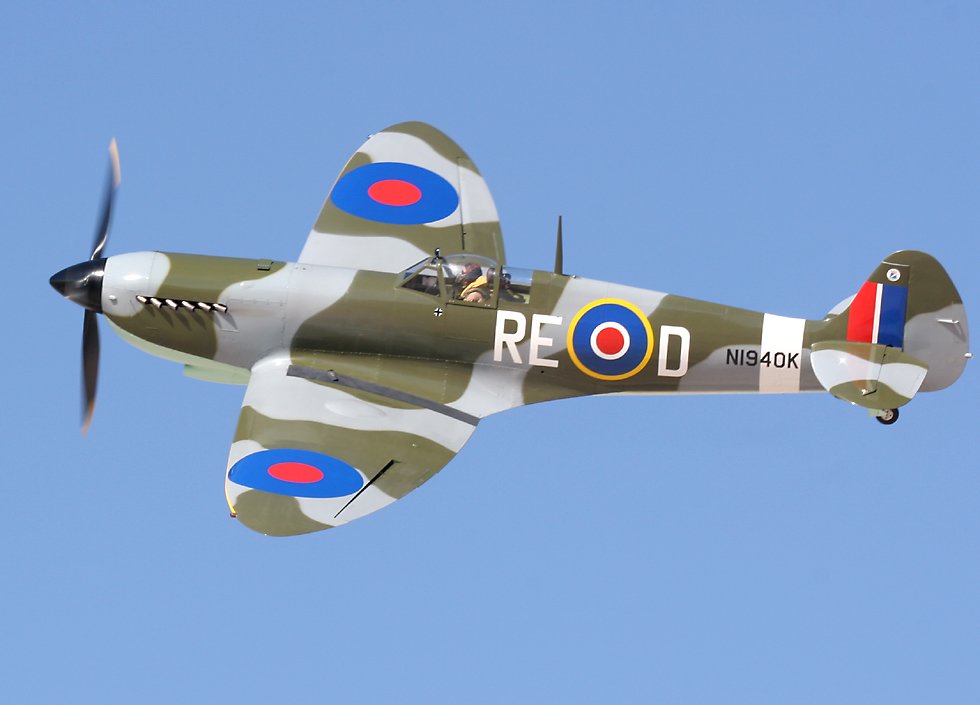
| The
Supermarine Spitfire was the fighter which enabled the British to survive
the nazi onslaught at the start of world war two, before pushing the fight
back to the German homeland. This beautiful example is Bob
DeFord's replica Mk IX, fitted with an American Allison engine. |
 |

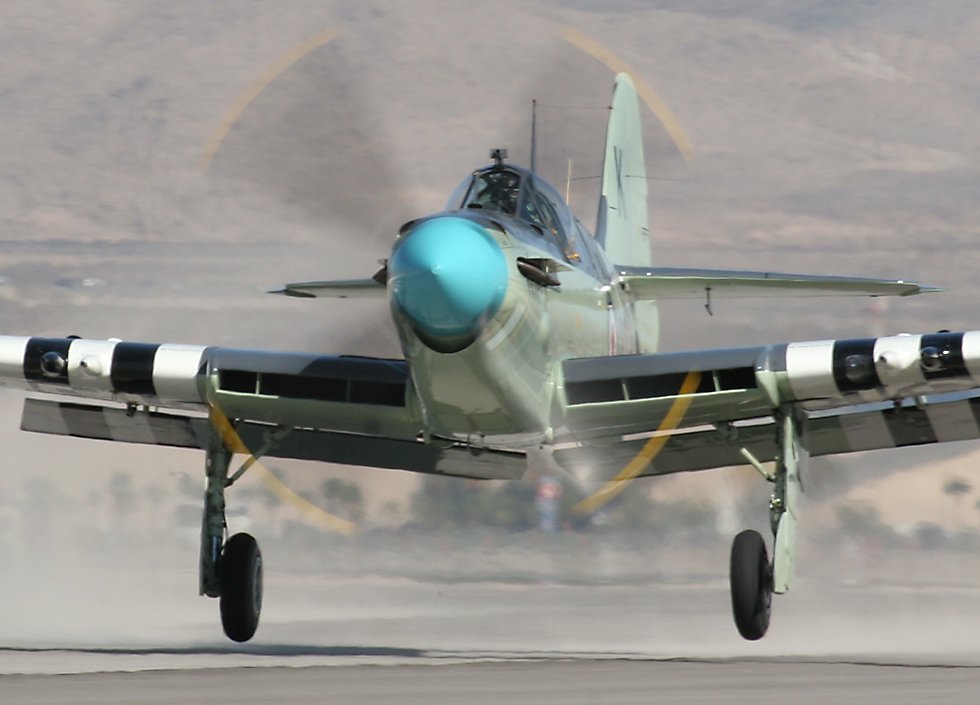
| And
now to the genuine article, a little-known British naval fighter called
the Fairey Firefly. This is the only flying example in the
world, owned by former US navy pilot Eddie Kurdziel. You might
think that its 2250 horsepower Griffon engine would make this a top performer,
however its maximum speed was only 316mph (509 km/h), in part because of
the extra load created by having a radio operator/navigator seated in the
rear cockpit. Nevertheless, the Firefly became the first British
aircraft to fly over Tokyo, and the type flew for many years in the military
services of different countries. |
 |

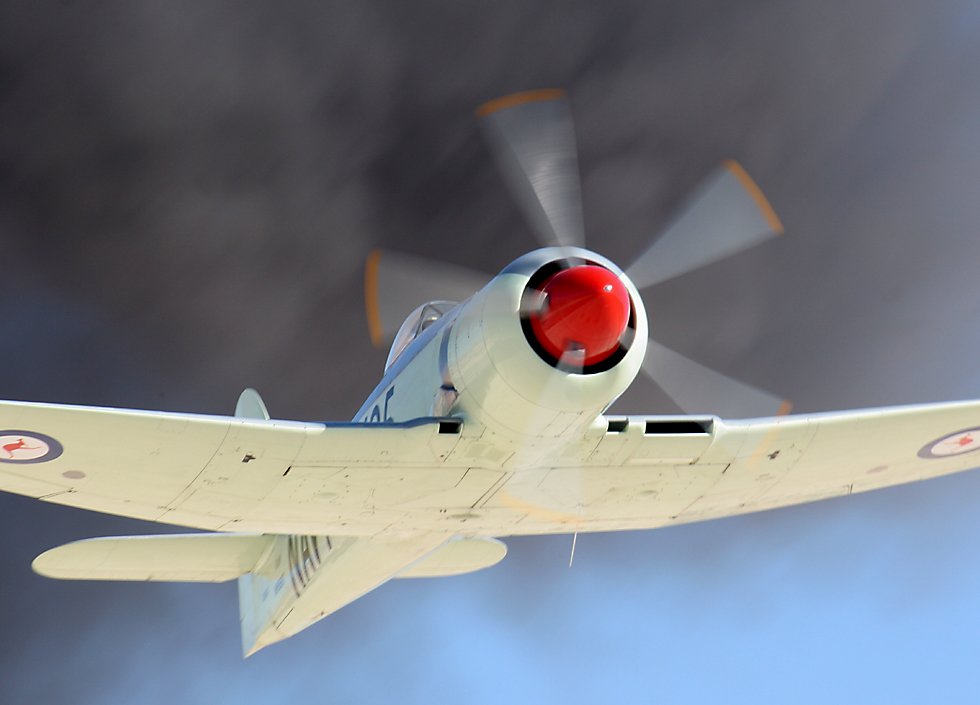
| Ellsworth
Getchell flies another British naval fighter of world war two, the Sea
Fury, powered by a Bristol Centaurus radial engine delivering 2480 horsepower.
This engine, coupled with clean aerodynamic lines and a five-bladed propeller,
allowed the Sea Fury to achieve up to 460 mph (740 km/h). Armed
with four 20mm cannons, a Royal Navy Sea Fury even managed to shoot down
a MiG-15 jet fighter during the Korean war. |
 |

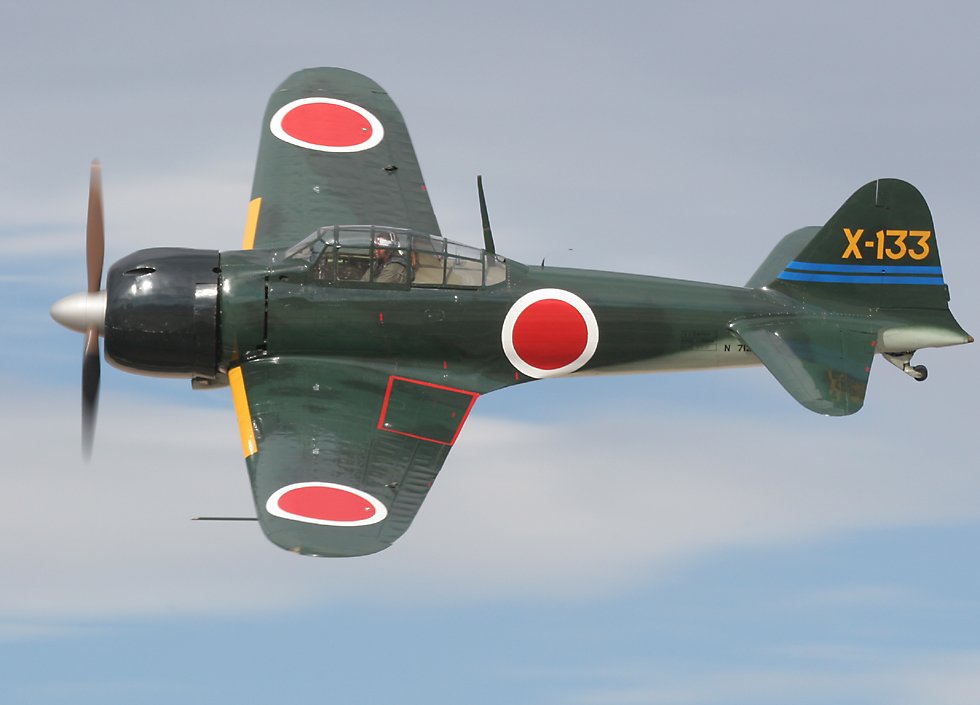
| The
Camarillo wing of the Commemorative Air Force displayed yet another naval
fighter, the Mitsubishi A6M3 Zero, scourge of the Pacific until more capable
aircraft like the F6F Hellcat and F4U Corsair were introduced.
This particular aircraft is modelled after a Zero which was salvaged from
Babo airfield in what is now Indonesia, however the only parts still in
use from this original plane are the landing gear legs and the tail post. |
 |

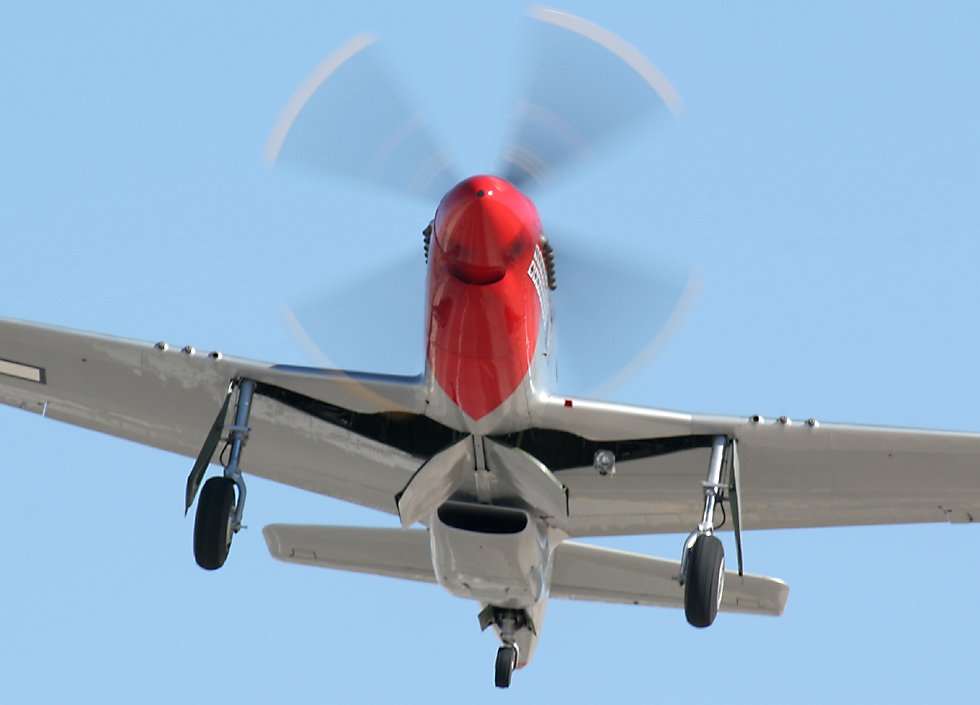
| With
all of these foreign world war two aircraft on display, it's a real surprise
that there were so few American fighters present. The P-38
Lightning "23 Skidoo" flew in on Friday for static display, leaving this
P-51D Mustang called "Ridgerunner" as the only representative of the excellent
American fighter tradition of the war. |
 |


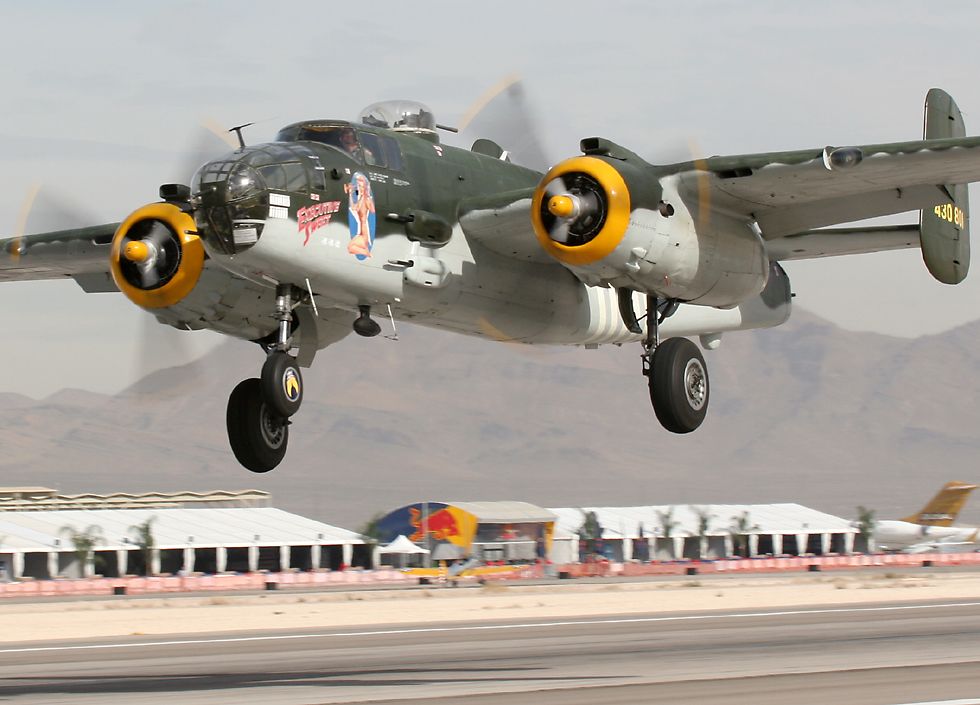
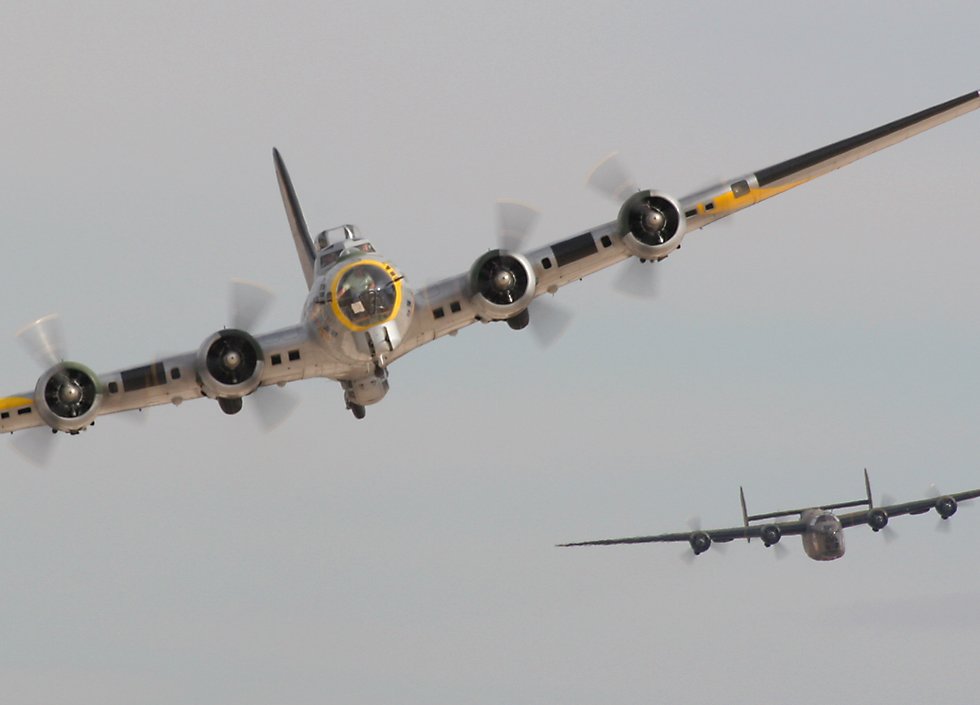
| As
well as the Mitchells, the show also included this late-model B-17G Flying
Fortress called "Liberty Belle" and an early model B-24A Liberator called
"Ol' 927", which is more familiar on the American airshow circuit in its
old role as "Diamond Lil", a transport variant of the Liberator.
This particular aircraft did indeed start its life as a bomber but was
converted
to a transport after a landing accident, so it's only appropriate that
it should be converted back to B-24A status. |
 |

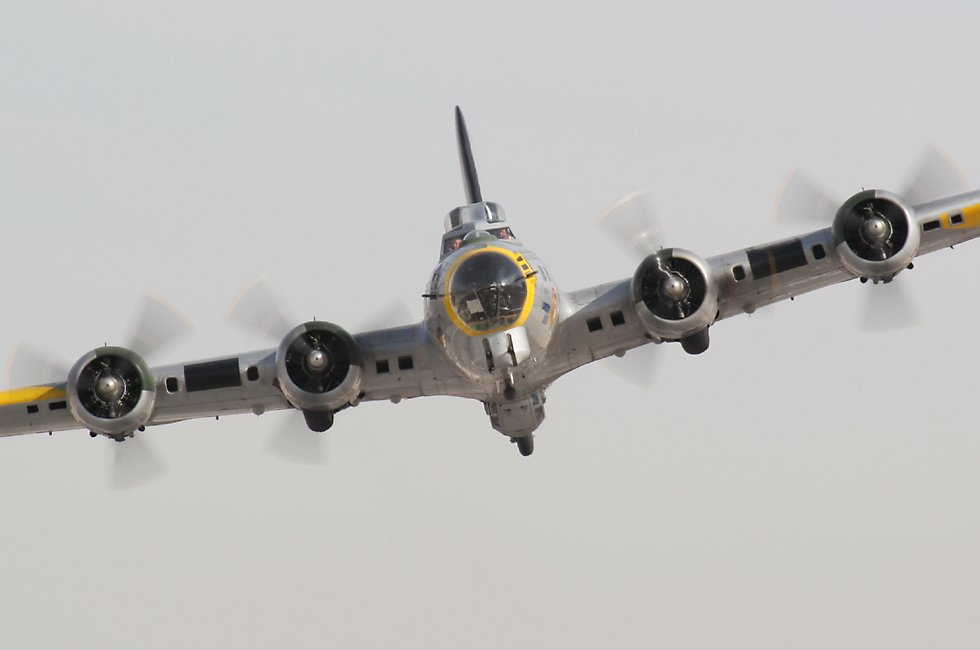
| Earlier
models of the Flying Fortress were found to be very vulnerable to frontal
attack, so a "chin" turret with two 50 caliber machine guns was added under
the nose of the B-17G, in addition to the two nose guns which can be seen
protruding in this photo. This brought the total number of
heavy machine guns up to thirteen, enabling these aircraft to fight their
way through heavy opposition during daylight attacks against Germany. |
 |

| About
18,500 Liberators were built compared to 12,700 Flying Fortresses; the
B-24 was more modern, faster, had significantly greater range and carried
a heavier bombload. However the Flying Fortress captured the
public imagination far more and crewmen also preferred the Flying Fortress,
since it could survive more battle damage and was far easier to escape
from if it did go down. |
 |

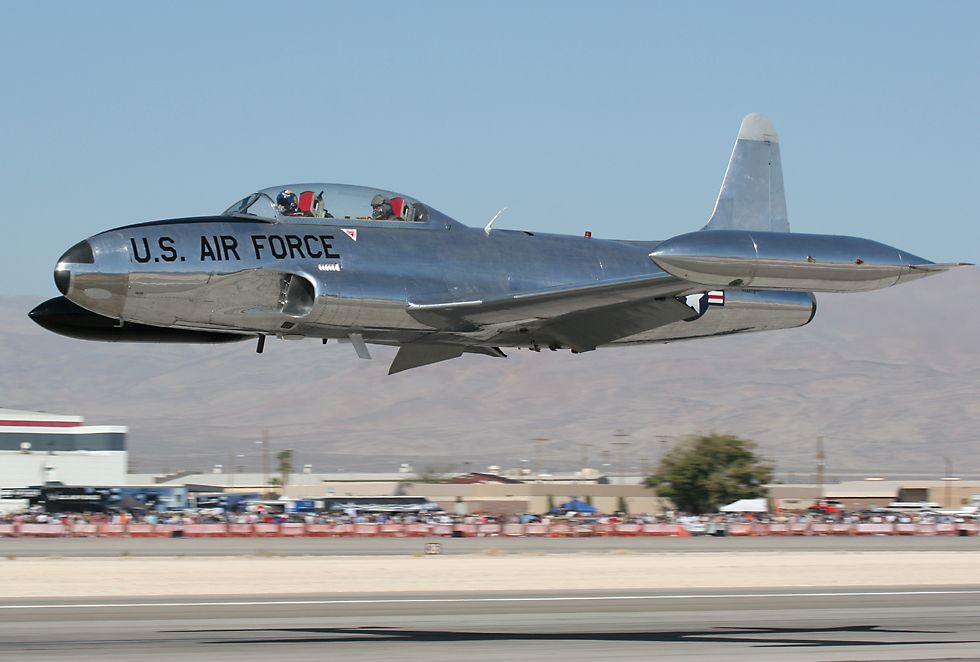
| Each
year the airshow organizers arrange the show thematically and chronologically
according to the era of combat the aircraft served in. This
year there was a section of trainer aircraft as well as a Korean war segment,
and this T-33 trainer would have fit well in either, since it is the trainer
version of America's first jet fighter used in combat, the F-80 Shooting
Star. |
 |

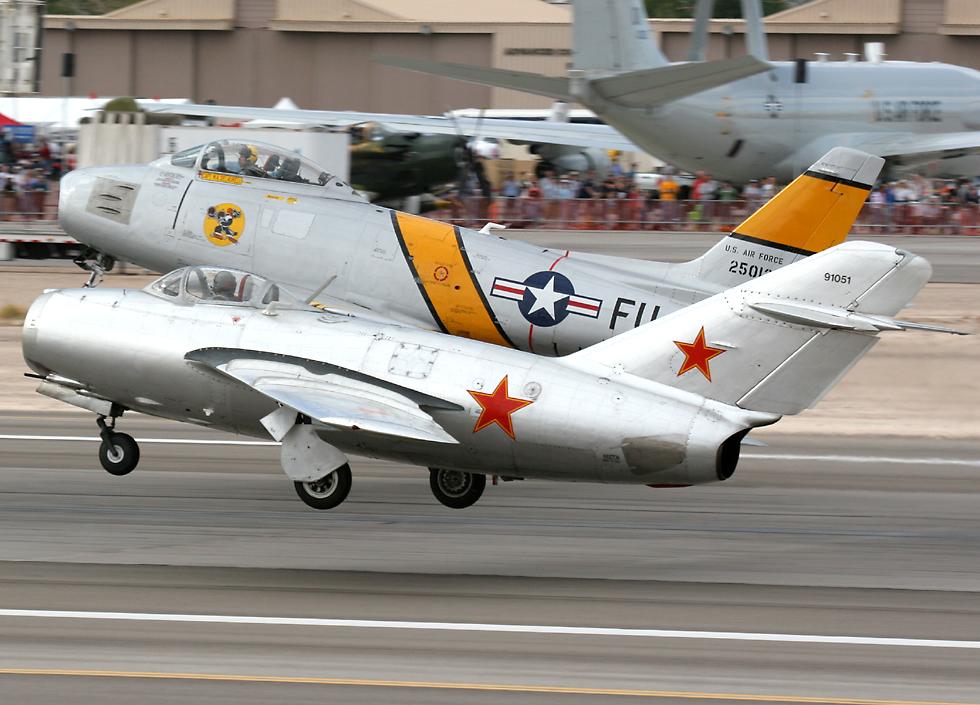
| In
November of 1950 an F-80 became the victor of the first jet-on-jet combat,
shooting down a MiG-15 in Korea. However the straight-wing
Shooting Star was at a severe disadvantage against the swept-wing MiGs,
and they were soon retired in favor of the F-86 Sabre shown here taking
off alongside a MiG-15. |
 |

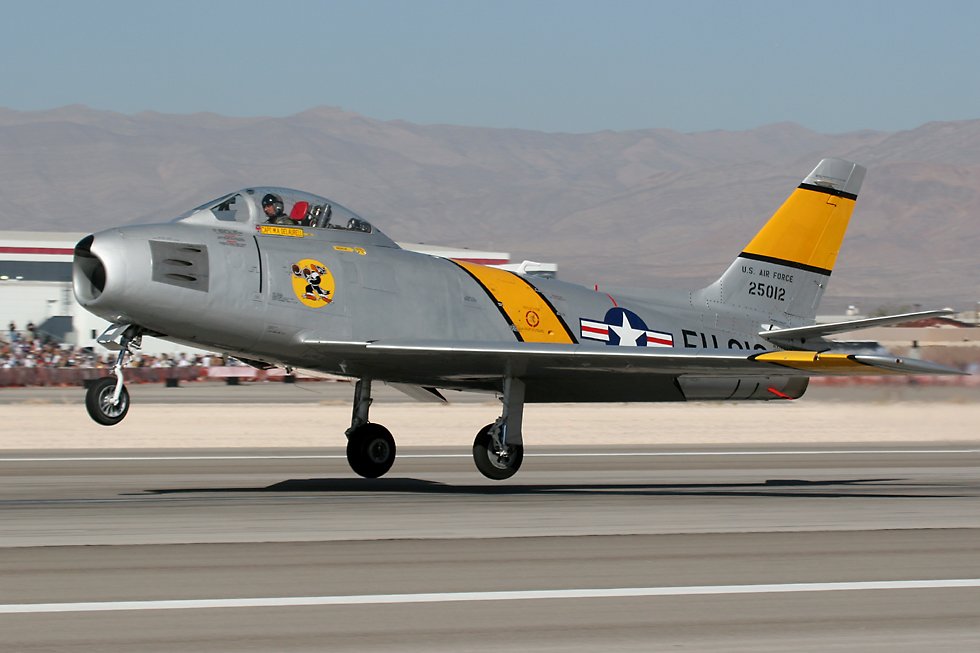
| This
Sabre is owned by the Planes of Fame museum at Chino, and is piloted by
Steve Hinton. The Sabre was very evenly matched with the MiG-15,
and the 10-to-1 kill ratio in favor of America is usually attributed to
superior training of the pilots, a theme which would recur during the Vietnam
war. |
 |

| Apart
from various aerodynamic advantages, the MiG-15 was also much more heavily
armed than the Sabre which, like the Shooting Star, was equipped with six
50 caliber machine guns. In contrast, both the British and
the Soviets had learned during the previous war that cannon fire was much
more effective than machine guns, so MiG-15s were fitted with two 23mm
cannon and a single 37mm cannon, which could literally blow apart a tank. |
 |

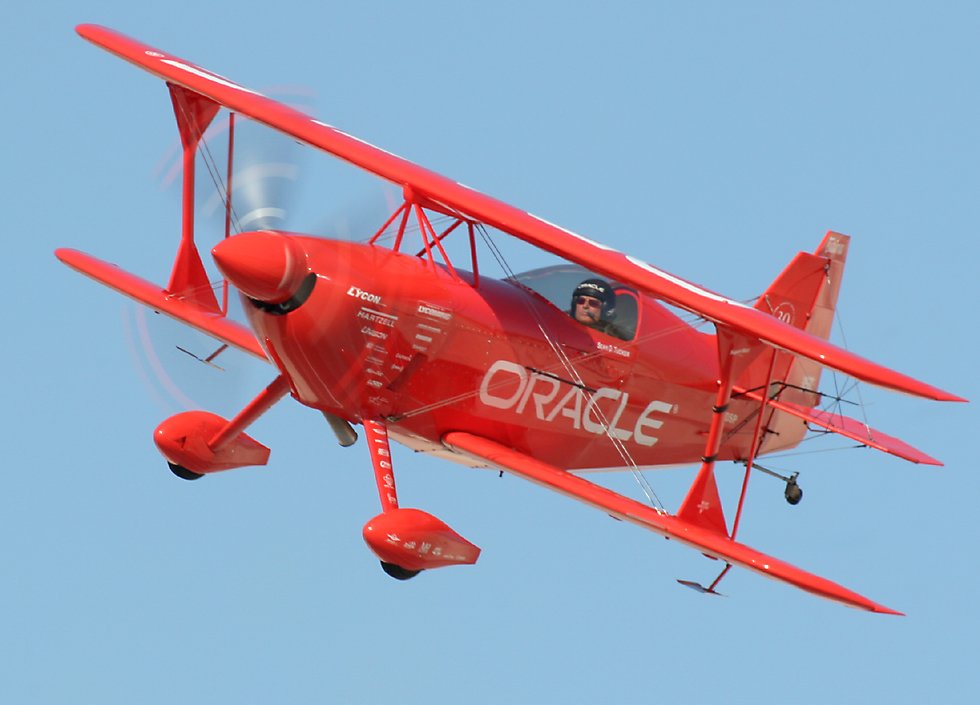
| The
show isn't all warbirds and military aircraft. Sean Tucker
was one of three top-rate aerobatic acts at the show, together with Ed
Hamill and Red Bull pilot Kirby Chambliss. Sean performed his
signature act of cutting through three ribbons in a row, each 25 feet off
the ground. Flying at 220mph, he cuts the first one while in
right knife-edge flight, the second in left knife-edge flight and the third
while upside-down. |
 |

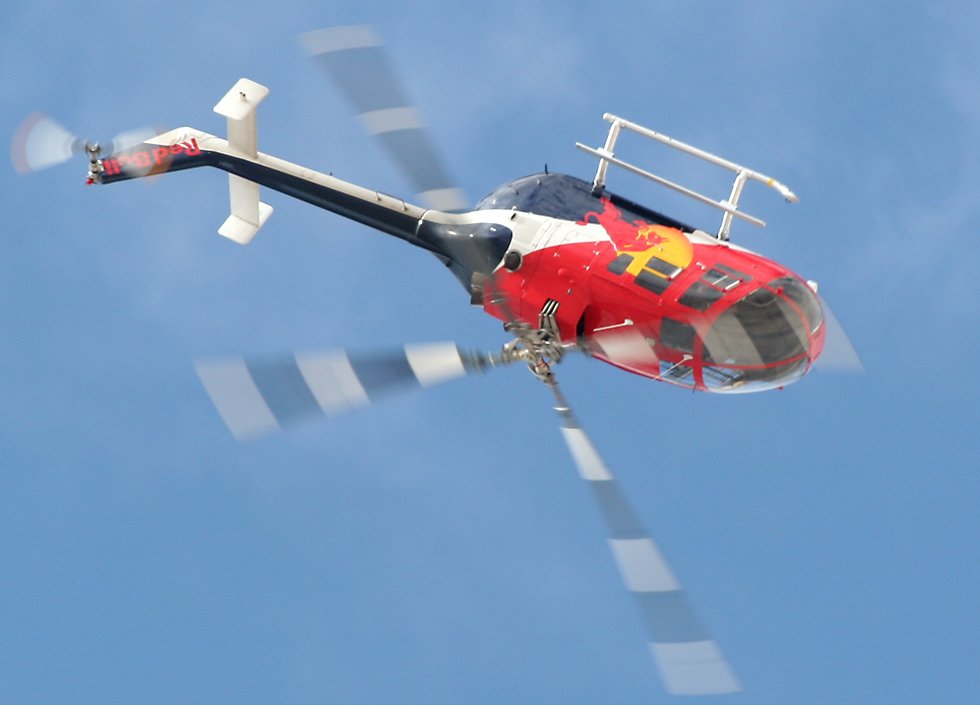
| Red
Bull has been a major sponsor of airshow aircraft over the last ten years,
both in Europe and the USA, sponsoring aerobatics, warbirds and even a
high publicised pylon racing competition series in a variety of high-profile
locations around the world. One of Red Bull's most recent innovations
is an aerobatic display by this German designed Bo-105 helicopter, which
amazes crowds by doing climbs, rolls and loops which seem impossible. |
 |

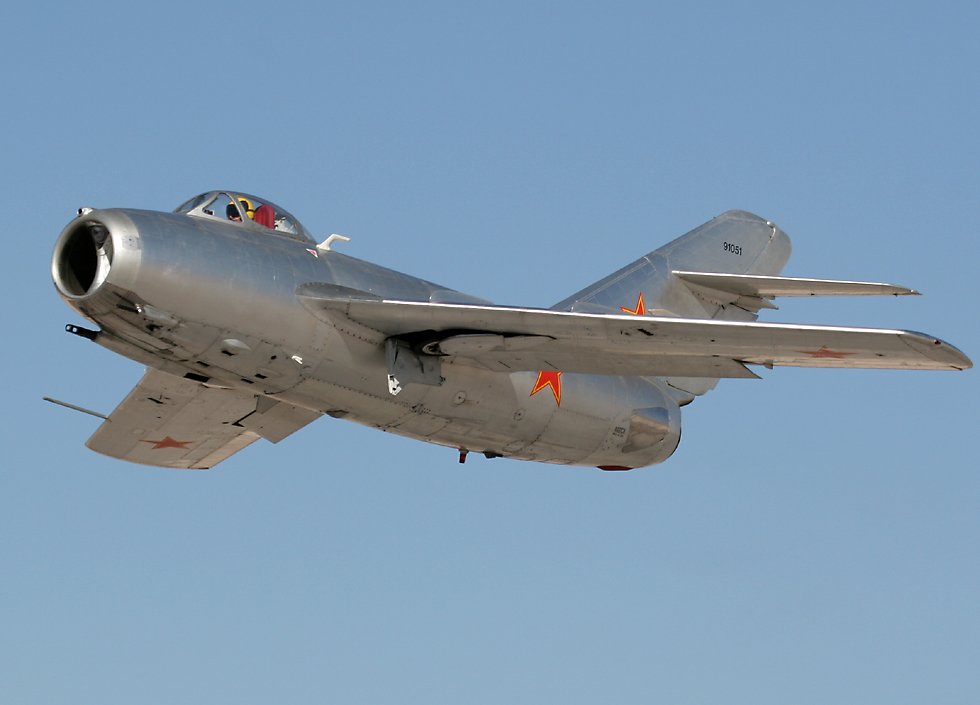
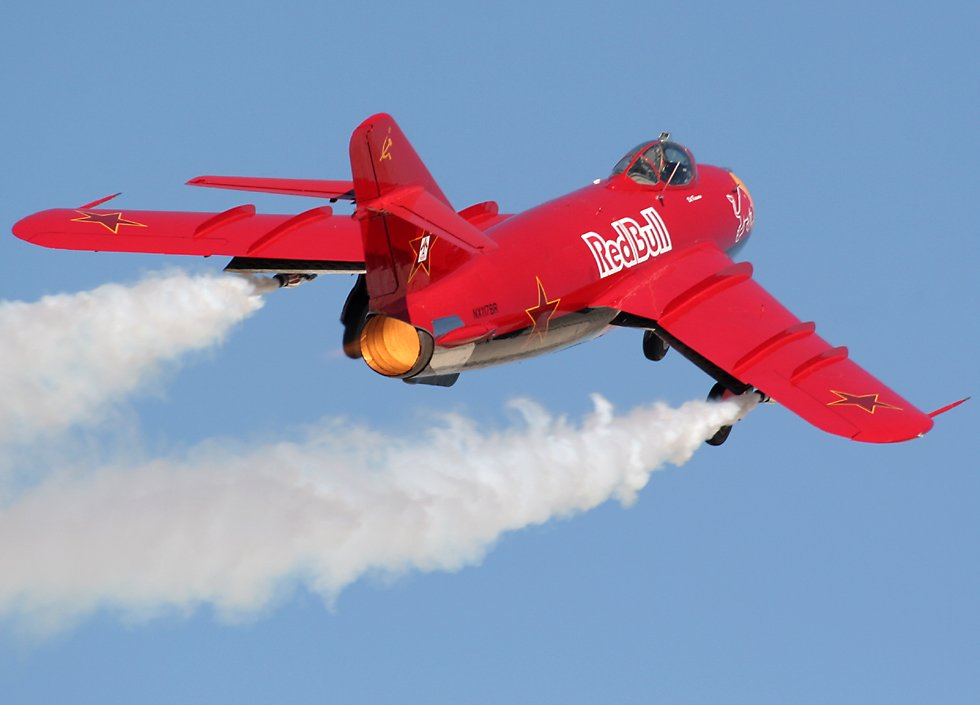
| Red
Bull also sponsors Bill Reeseman and his MiG-17 fighter, which he puts
through a full aerobatic routine. The MiG-17 "Fresco" is the
Soviet's successor to the MiG-15, equipped with the afterburner which Bill
puts to good use during his display. The Fresco flew even before
the MiG-15 was introduced into Korea, but American pilots first encountered
the MiG-17 in Vietnam. They were shocked to see sophisticated
mach 2 aircraft like the F-105 Thunderchief being shot down by this elderly
sub-sonic fighter of a previous generation. |
 |

| This
airshow is one of the very few in America where you can see foreign military
aircraft flying. Last year it was the turn of the Belgian air force
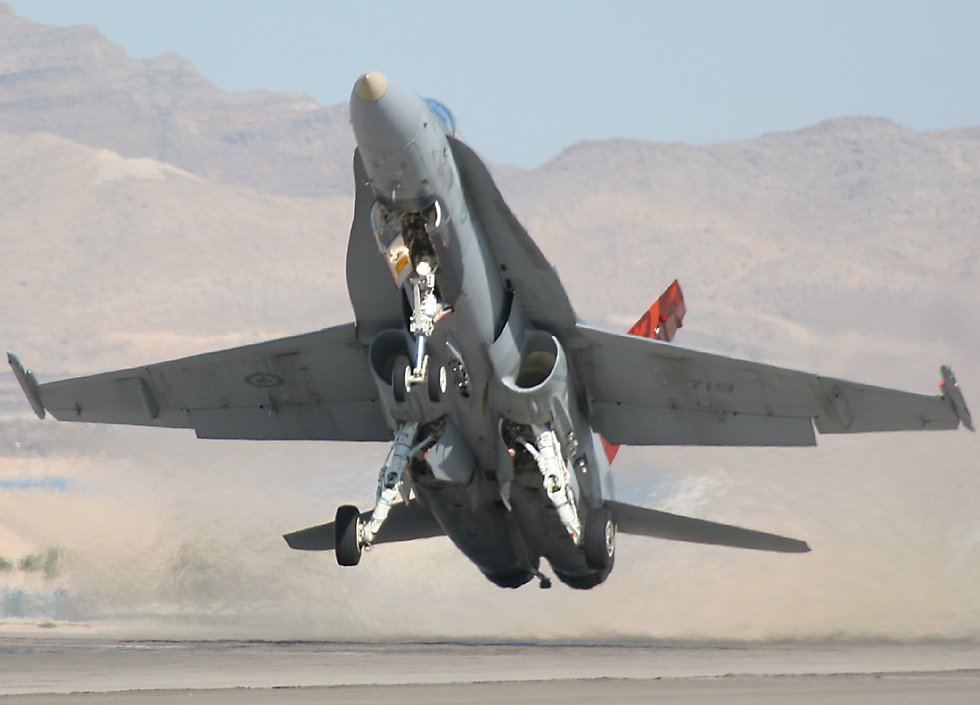
F-16 Fighting Falcon, and this year there was a display by a Royal Canadian
Air Force F-18 Hornet, celebrating the 25th year of the Hornet's service
in Canada. |
 |

| Nellis
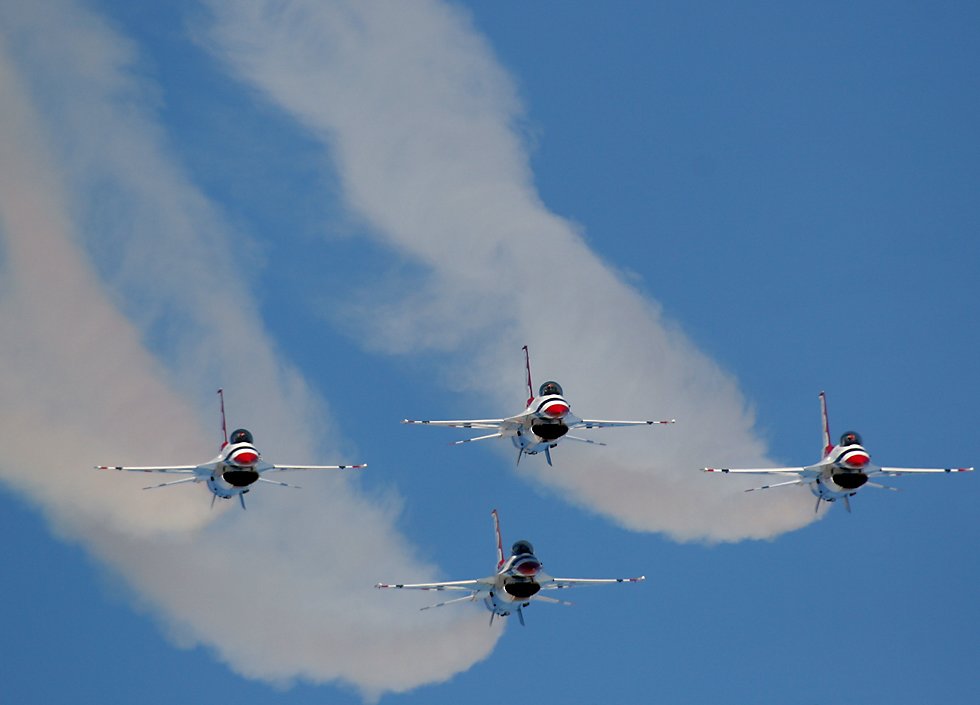
air force base is home for the official US air force jet display team,
the Thunderbirds, so it's guaranteed that they'll perform on each day of
the show. This year was very different, though, because they
flew part way through the day, rather than in their usual slot at the end
of the day, which probably confused quite a few spectators who are accustomed
to bolting for the exits at the end of the Thunderbirds routine. |
 |
 
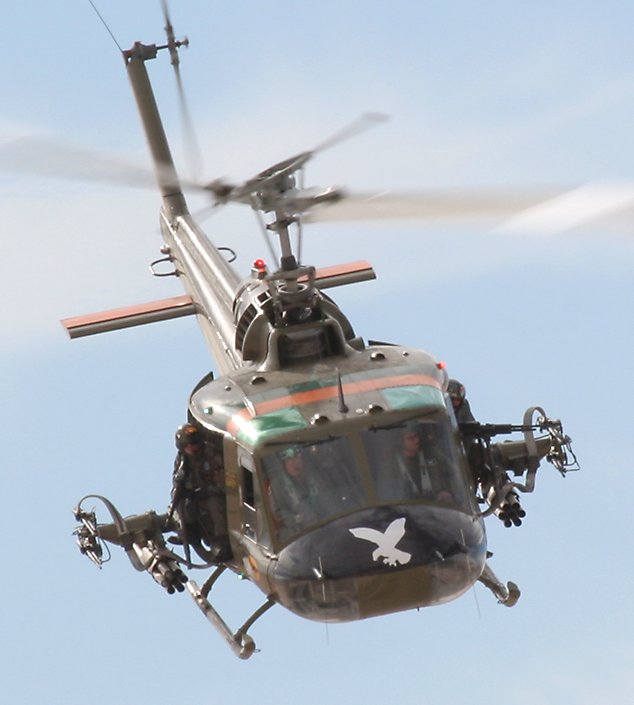
As almost everyone knows, the UH-1 Iroquois, better known as the "Huey",
was one of the workhorses of the Vietnam war.
Designed as a medical evacuation helicopter, it soon proved itself doing
cargo and troop transport, air assault, combat search and rescue, and electronic
warfare.
This aircraft has been beautifully restored as a "hog", equipped with rocket
pods, mini guns and door guns. Helicopters like this would
support the "slicks" used to insert troops into landing zones.
Early
UH-1s had a single engine, but an upgraded two-engine version started flying
in 1965, allowing greater carrying capacities and improved resilience to
battle damage. From 1967 the AH-1 Cobra entered service, a
specialized two-man gunship based on the Huey, but with a very narrow fuselage
to offer a smaller target, while providing greater lifting capacity for
ordnance. |
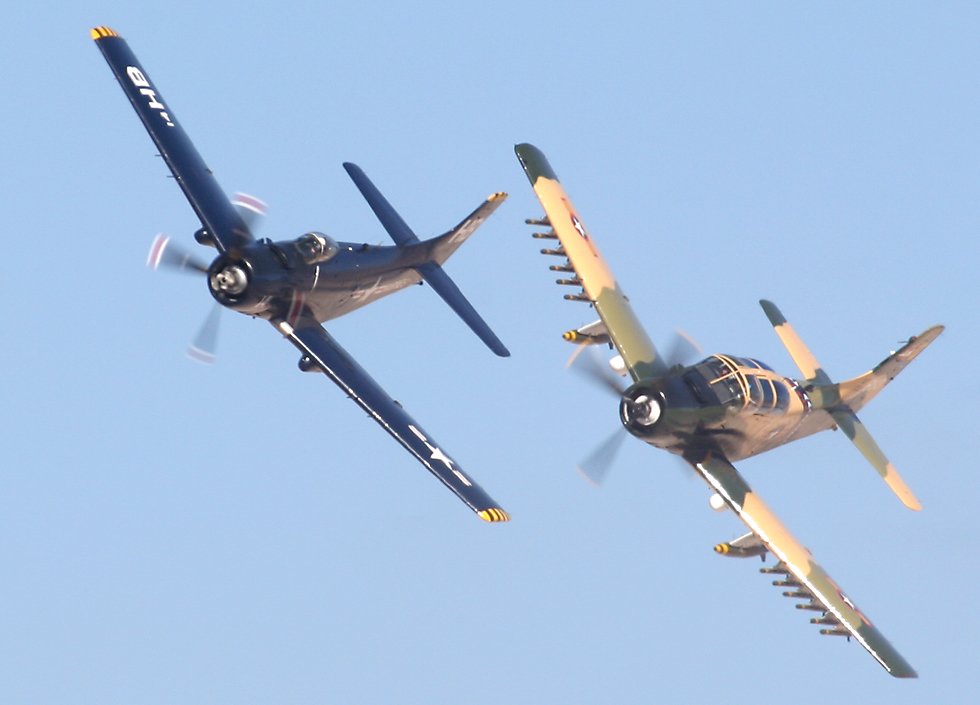
| These
A-1 Skyraiders were also invaluable during the Vietnam war.
Coming just too late for world war two, the single-engine one-man Skyraider's
phenomenal armament load of up to 8,000 pounds equalled that of the Flying
Fortress with four engines and a ten man crew. In addition,
the aircraft's excellent endurance allowed it to loiter while waiting to
be called up by ground troops or air controllers. It really
made its name in the "Sandy" role doing combat search and rescue in conjunction
with fast jets and "Jolly Green Giant" helicopters. Skyraiders
are even credited with shooting down two MiG-17 fighters over the course
of the conflict. |
 |

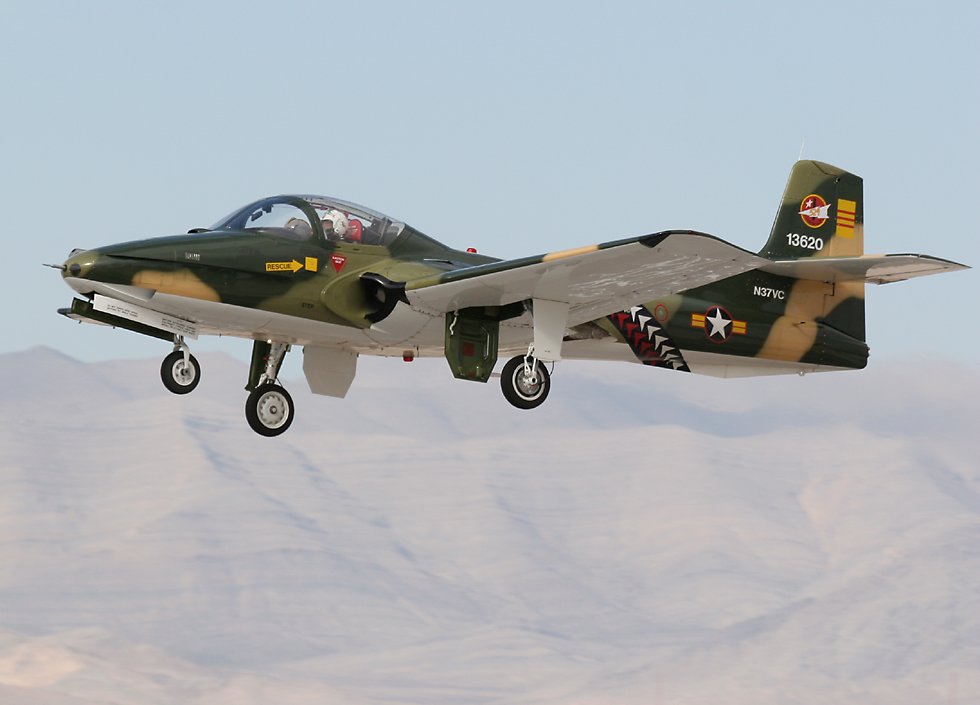
| The
United States has converted many different trainer aircraft into ground
attack types, including the
T-6 "Texan" in its LT-6 Mosquito incarnation, the
T-28 Trojan and this A-37 Dragonfly, which is based on the T-37 Tweet.
At the end of the war, 95 A-37s were captured and added to the communist
Vietnamese air force, where they served for many years, fighting in Cambodia
and against the Chinese. You can see one
of these captured A-37s at the Vietnamese air force museum in Hanoi,
together with other American aircraft. After retirement a few of
these captured aircraft were bought by western collectors in the United
States, Australia and New Zealand. |
 |
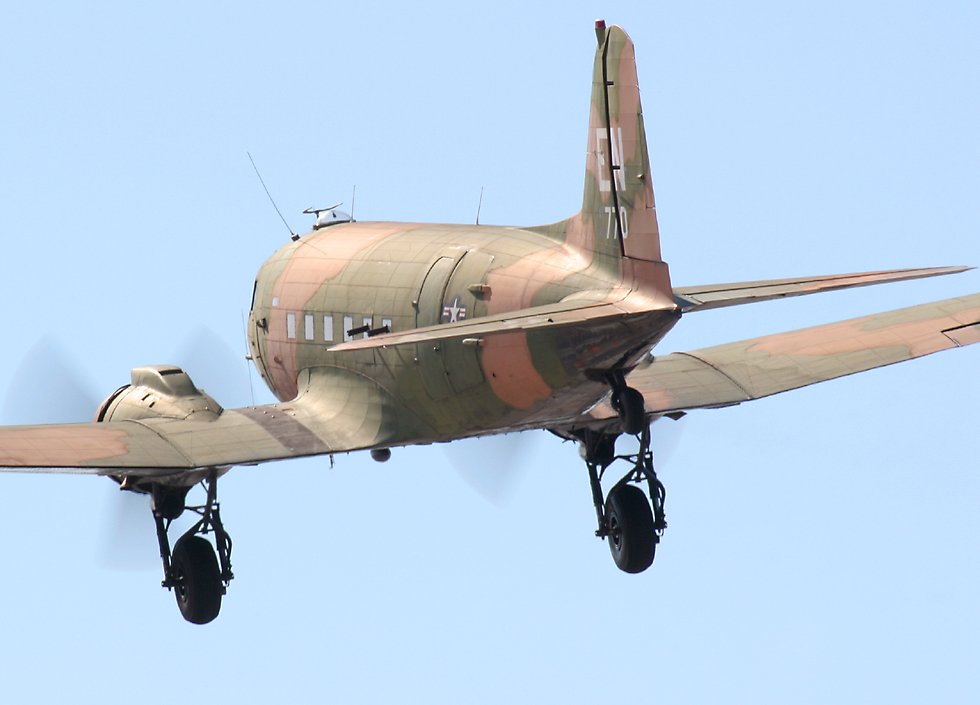
| The
AC-47 "Spooky" gunship was developed during the Vietnam war by mounting
two or three miniguns which fired through the left side of the plane.
Controlled by the pilot, each minigun could fired 4000 rounds a minute
as the plane orbited around onto a ground target. Although
very effective, nineteen of these aircraft were lost during the war. |
 |

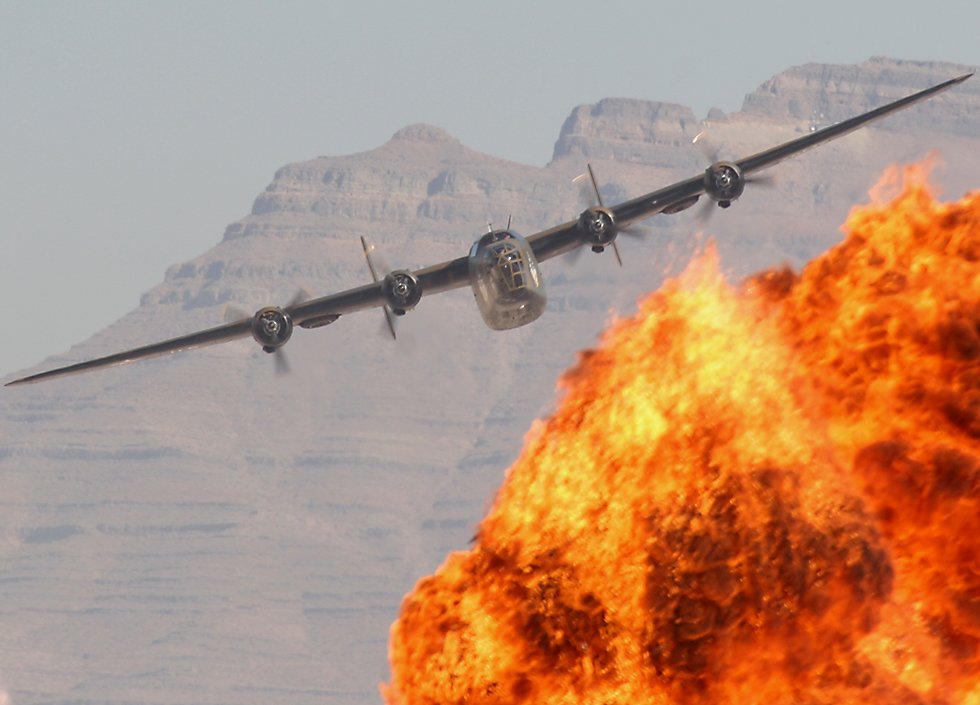
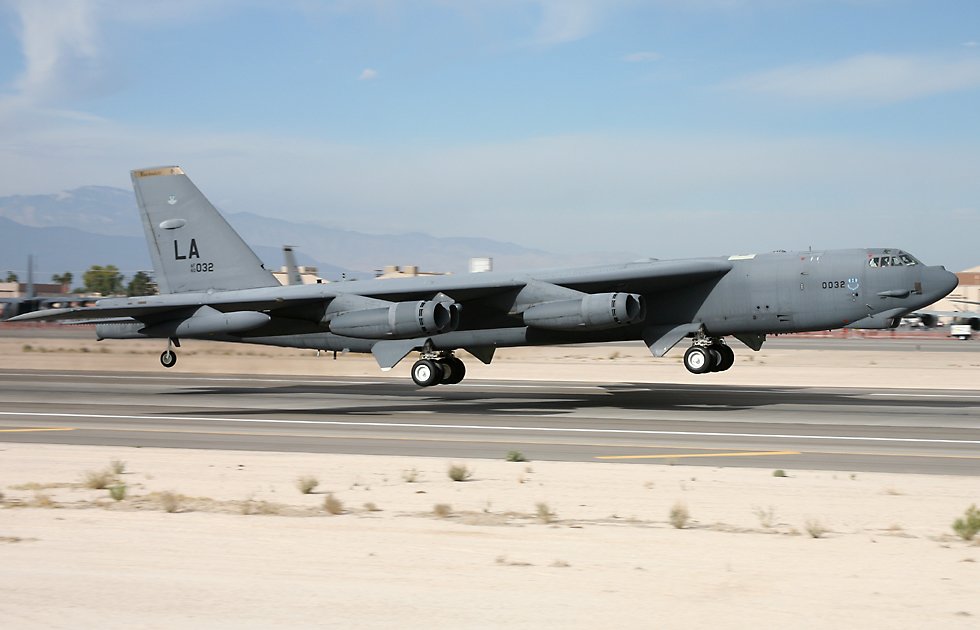
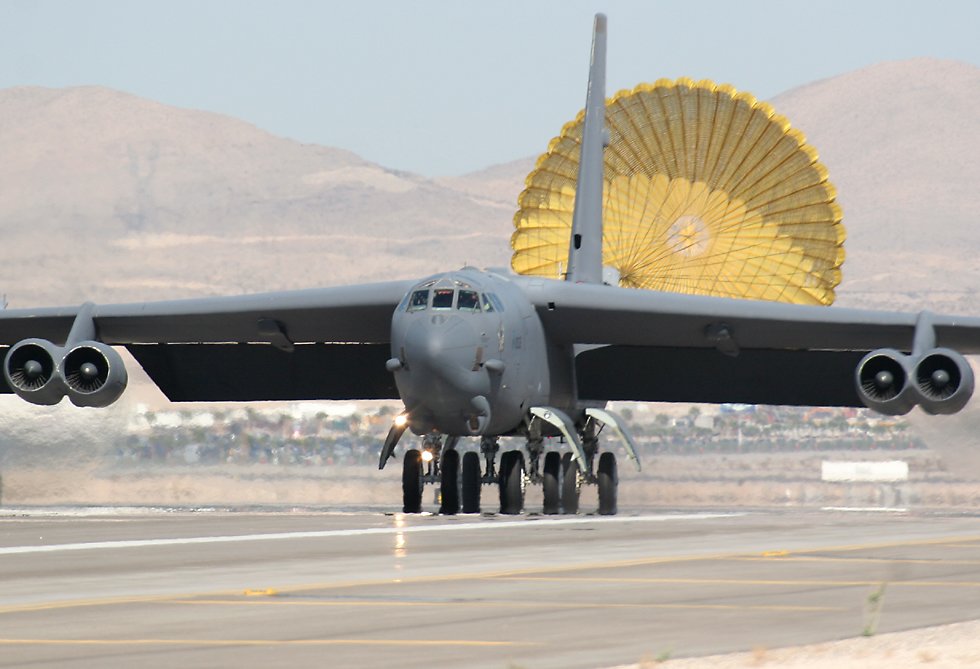
| The
highlight of this year's show for me was an exhibition by another icon
of the Vietnam war, the B-52 Stratofortress, here appropriately enough
seen taking off with the Stratosphere tower visible on the Las Vegas skyline.
The B-52 performance was such a treat because it's not common to see this
aircraft flying at airshows, particularly a full sequence of takeoff, display
and landing. |
 |

| If
judged by longevity, the Stratofortress is the most successful American
military aircraft ever, with the possible exception of the C-130 Hercules
transport. First flown in 1952, the air force currently expects
to keep the B-52 in service until 2040, an extraordinary feat for what
was originally seen as an interim bomber design. The project
was almost cancelled several times during early development, but the airframe's
size and flexibility has enabled the plane to be continually updated over
the years as new technologies became available. B-52s have
now been flown for so long that several generations of the same family
have crewed this same aircraft type. |
 |

| The
display at this year's show included simulated bomb runs with a "Wall of
Fire" pyrotechnics display ably supplied by Chris Rainey and his team.
There was a larger than usual pyrotechnic field this year, with several
smaller walls of fire and a mini atom bomb sequence during the B-29 commemoration,
which was a recorded event played over the two jumbotrons, since there's
currently no B-29 flying anywhere in the world. |
 |

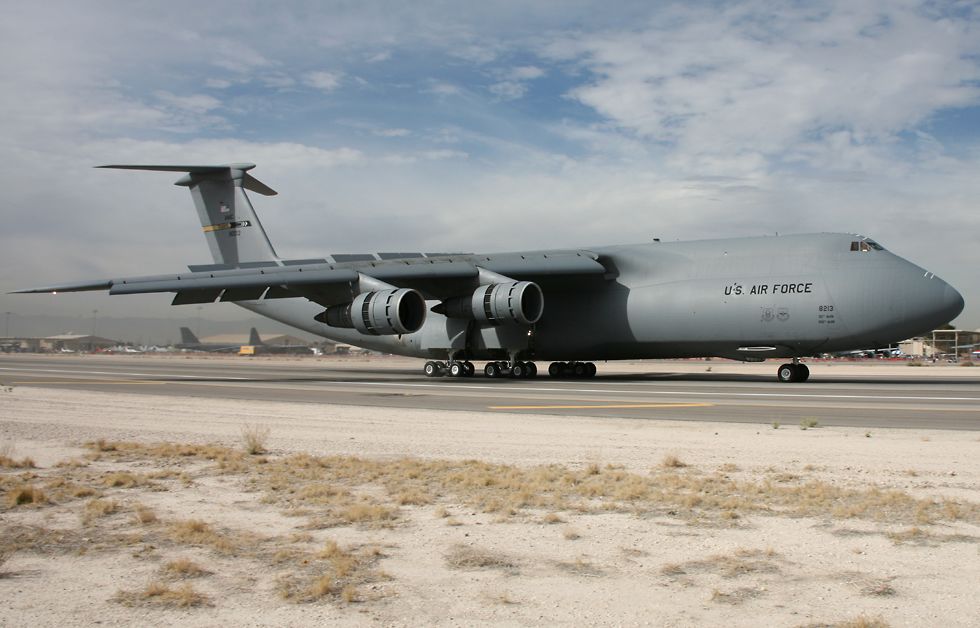
| The
B-52 was the largest aircraft to fly during the airshow, but it wasn't
the only piece of Heavy Metal at the show, nor even the largest.
This C-5 Galaxy, largest aircraft in the American military inventory, landed
on arrivals day and taxied over for static display during the show.
The Galaxy is much larger than the Stratofortress; the Galaxy is 247 feet
long, 65 feet high, with a 223 foot wingspan and 840,000 pound maximum
takeoff weight, compared to the Stratofortress at 159 feet long, 41 feet
high, with a 185 foot wingspan and 488,000 pound maximum takeoff weight. |
 |

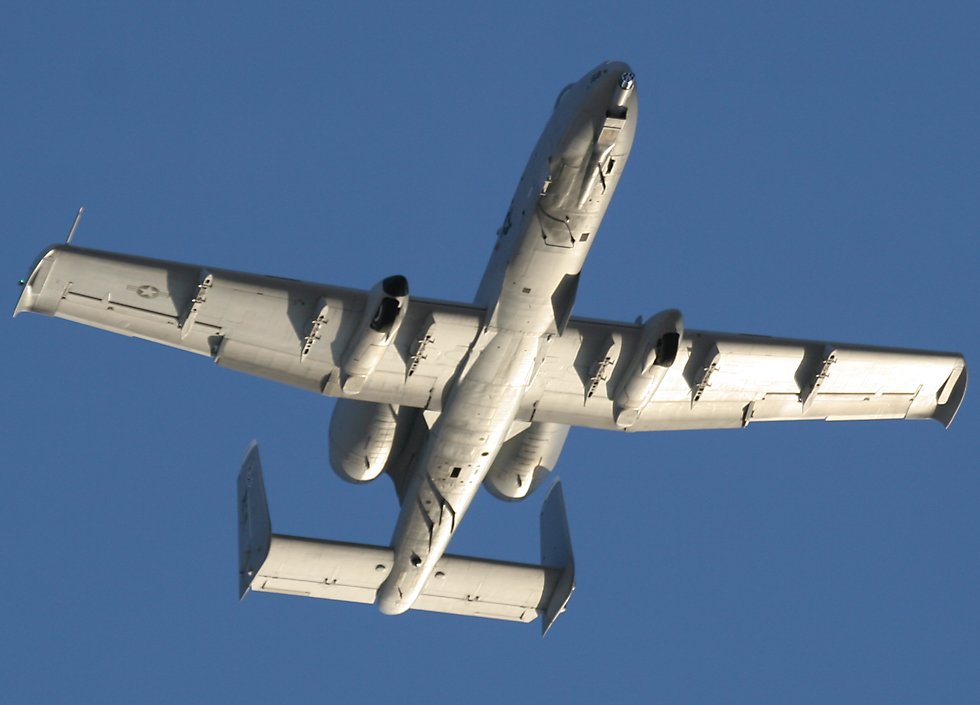
| Putting
the Thunderbirds early in the programme led to significant delays in the
display of modern era equipment, which was especially unfortunate since
this show had the last public display by the F-117 Nighthawk "stealth fighter",
which is due to be fully phased out in 2008. The Nighthawk
ended up flying so late that it was too dark for photographs, but at least
it was possible to photograph some of the other modern types, including
this unusual sunlit underside view of an A-10 Thunderbolt II, popularly
called the "warthog" because of its ungainly appearance. |
 |

| The
Heritage Flight was just about the last display which could be photographed
before the sun dipped behind the Spring Mountains west of Las Vegas. |
 |
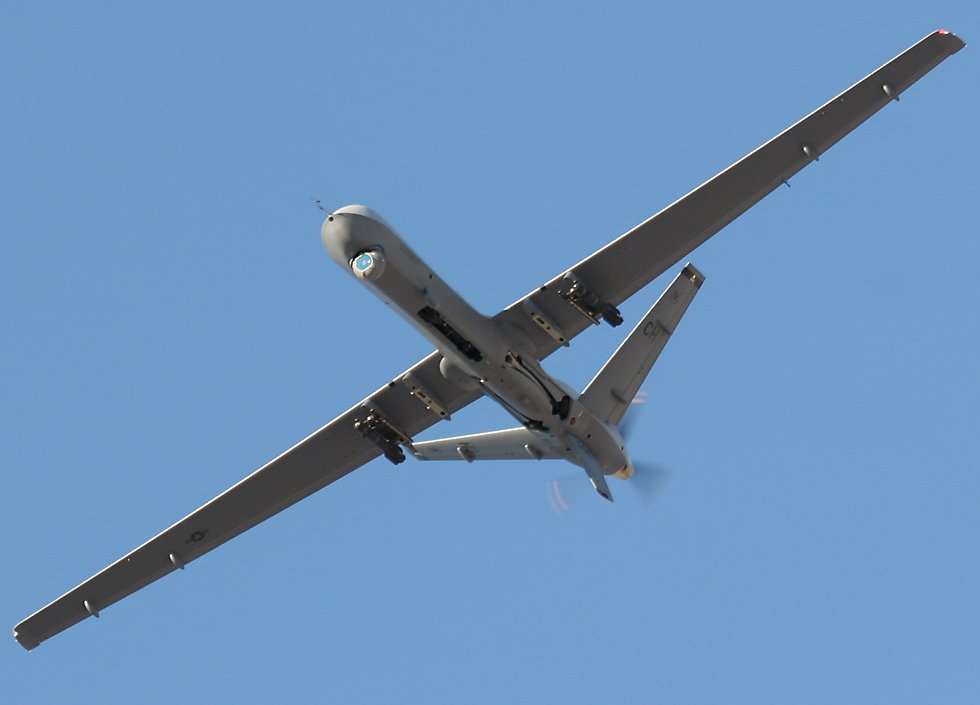
| The
"Aviation Nation" airshow is unique in several ways, including being the
only place where you can see a demonstration of some of America's military
drones, which are an increasingly important part of the air force inventory.
For the past two years the original MQ-1 Predator has displayed, but this
year its big brother also flew. Originally called the Predator-B,
it is now officially designated the MQ-9 Reaper. The general
appearance is very similar to the Predator, but it is much larger, has
an upturned tail instead of downturned and a three-bladed propeller instead
of its predecessor's two-bladed one. The Reaper has a 950 horsepower
turboprop engine rather than the Predator's 119 horsepower piston engine,
allowing it to fly at three times the speed and carry four Hellfire missiles
or laser-guided bombs, compared to the Predator's two Hellfire missiles. |
 |

See
the "Aviation Nation" airshow of 2004,
2005
or 2006.
 |