
Tutankhamun's Death Mask and Coffins
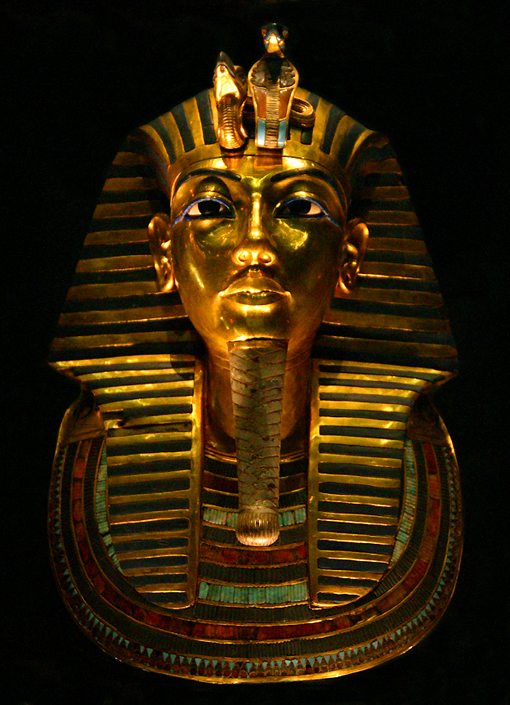
There's no question that for most people the single "must see" of the Egyptian museum in Cairo is room 3 on the upper floor, which contains the death mask and coffins of pharoah Tutankhamun, jewellery recovered from the wrappings of his mummy and other artifacts from his tomb. I made two visits to this room, one as soon as I got into the museum when there were only 10 or 15 people present, and also later in the day when the place was packed shoulder to shoulder and it was nearly impossible to move. |
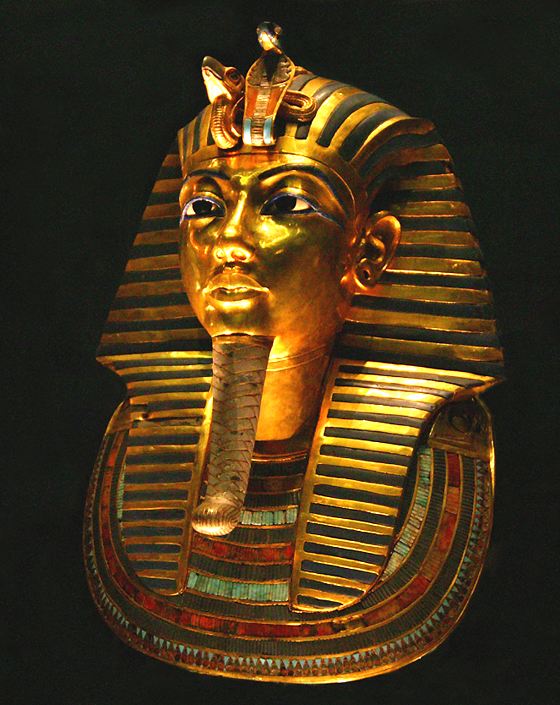
The death mask really is magnificent even to someone with no knowledge of the finer points of Egyptian antiquities. Made of solid gold and inlaid with semi-precious stones, it weighs 11 kilograms. At the top you can see representations of a vulture and a cobra. You'll often see the latter referred to as a "uraeus", which is the Latinised form of the Greek word for "cobra"! You can click on this photo or the previous one to go to a large "wallpaper" image that you can put as a backdrop on your computer. The wallpaper image will open in a new window. |
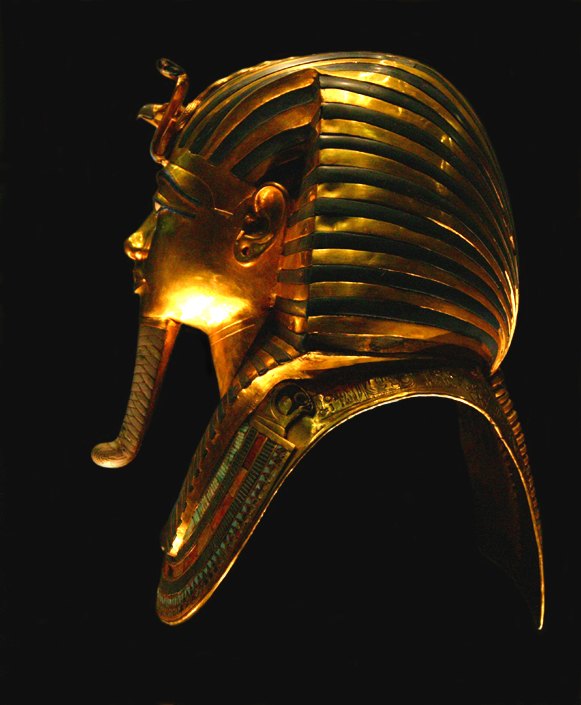
The death mask originally covered the head of Tutankhamun's mummy. Here you can see magic spells of protection inscribed on its shoulders, and similar spells appear on the back. The false beard is commonly associated with pharoahs, and even female rulers of Egypt such as Hapshetsut. |
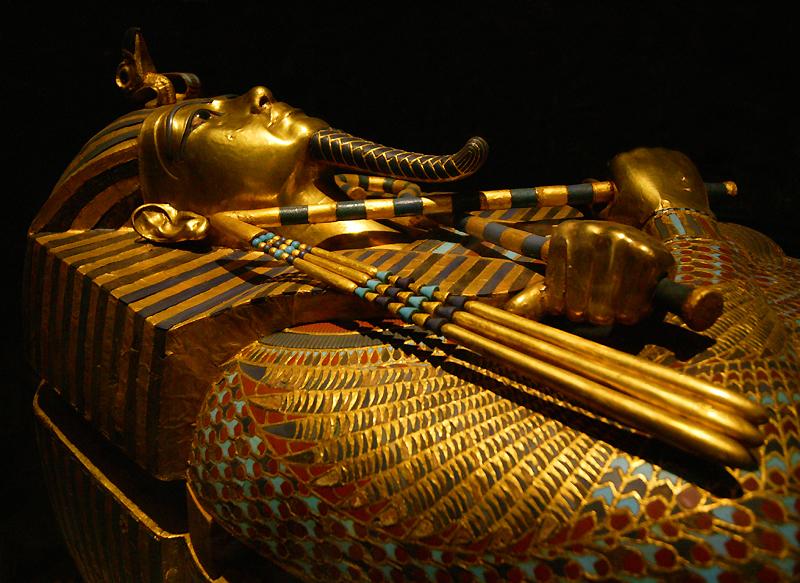
Tutankhamun's mummified body was found within three coffins or sarcophagi, each one within the next. The largest is still in the original tomb in the Valley of the Kings along with his mummy, but the other two are here. This is the middle coffin, made of wood covered with gold, semiprecious stones, glass and obsidian. |
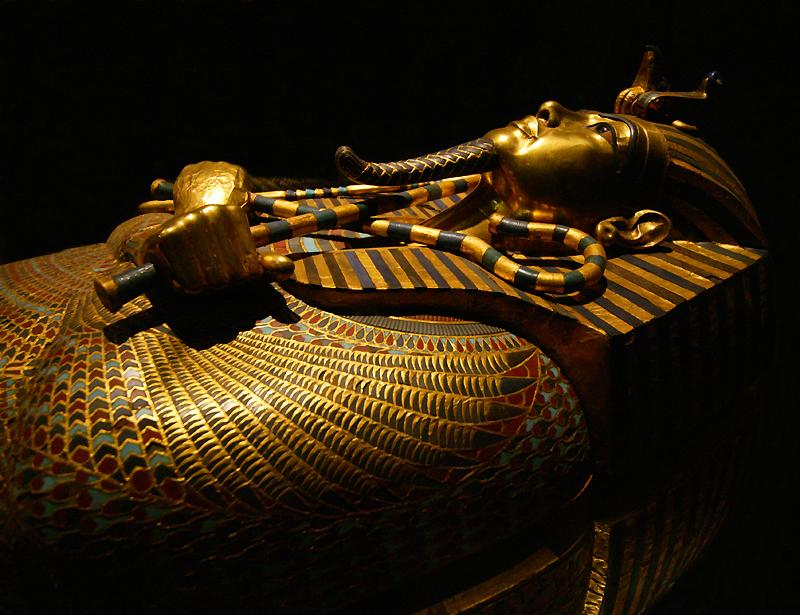
As with some of the statues in other rooms, here he's portrayed holding a flail in his right hand and a crook in his left hand. |
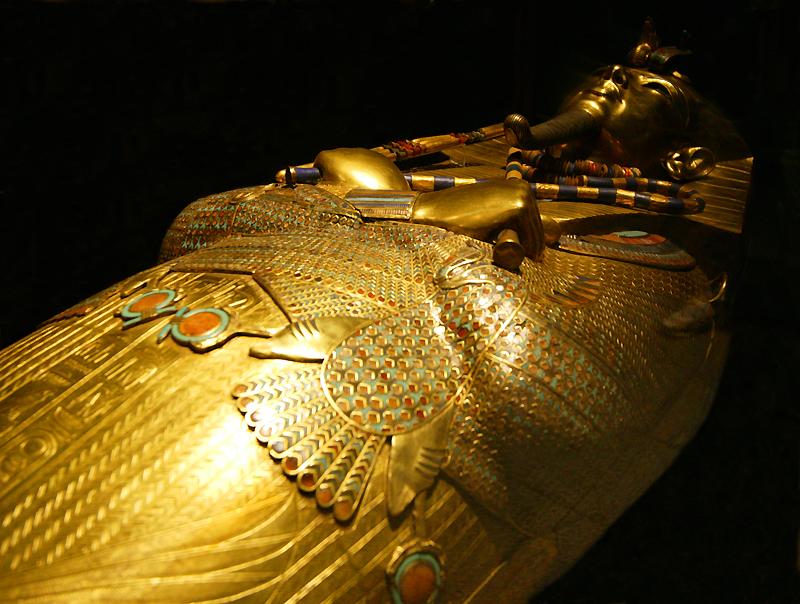
The inner coffin is made of solid gold and weighs 110 kilograms (which at 2004 prices makes the gold by itself worth over one and a half million US dollars). The room where all of these articles are kept are the fanciest in the museum, with modern cabinets, security systems and lighting. However, it's very dark, which is no doubt essential for the preservation of the displays, but makes photography very difficult, especially since flash isn't permitted. The glass of the cabinets also creates a lot of reflections, so I've blackened out the surroundings in these photos to remove distractions. For technically inclined readers, all of the photos on this page were taken with a Canon 1Ds digital camera and Sigma 15-30mm lens set to varying focal lengths, 1/45th second shutter speed, f4.5 and ISO 1250. |