
Statues of Tutankhamun
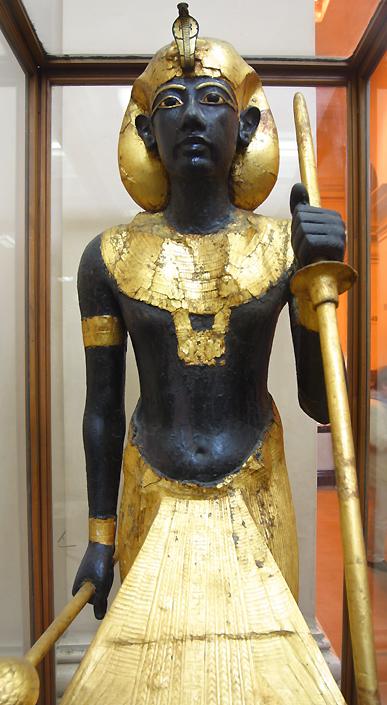 |
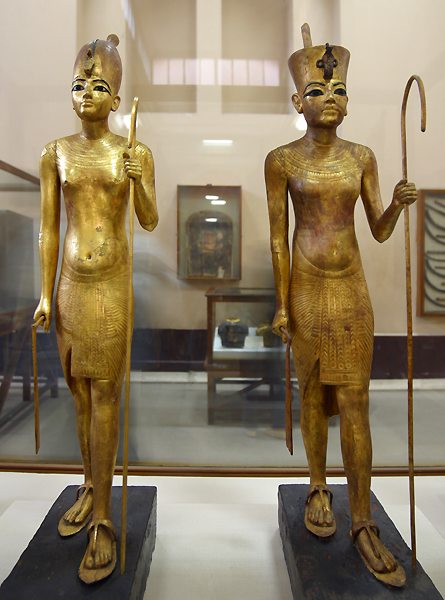
This pair of life-sized statues was found in a small entrance room of Tutankhamun's tomb in the Valley of the Kings, poised like sentries. They've been identified as "Ka" statues, or representations of his soul or spirit. Both figures are wearing a kilt with some very serious pleating, the one on the left wears a "khat" head dress, the one on the right a "nene" head dress. |
 |
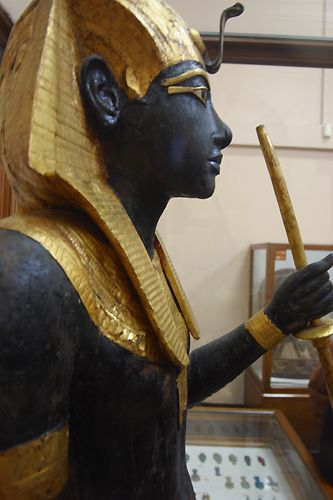 |
A side view of the statue which is on the right, above. It's thought that the black colouring is supposed to invoke the richness and fertility of the black silt which the Nile deposited each year when it overflowed, and which Egypt depended on for its existence. It was the normal convention in Egyptian art for males to be shown with dark skin and females with light skin, presumably to show that they spent their time indoors. |
|
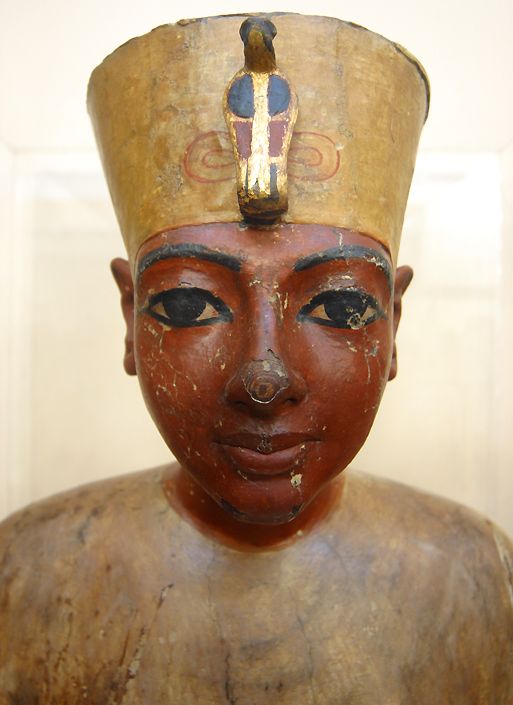
This is a very intriguing and surprising artifact. Apparently it's a mannikin of the young pharoah used by his clothesmakers, as you can see from the roughness of the painting, and the way the paint ends abruptly at his neckline. It seems strange that this would be buried with him. |
 |
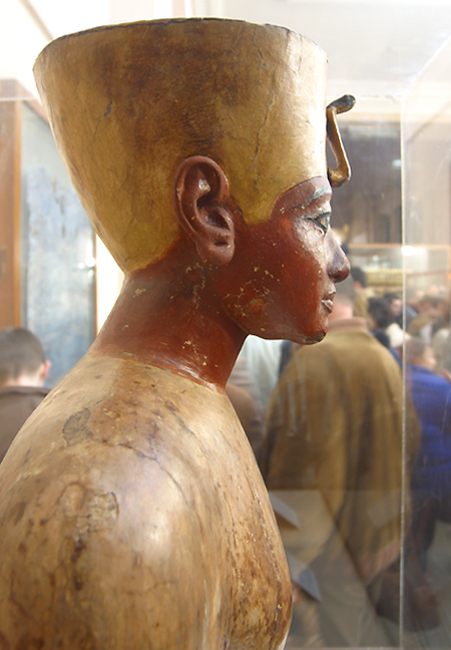 |
Now he gets to look at all the tourists going past, which must be one heck of a lot better than being stuck in that dark old tomb with nothing to do for millenia. |
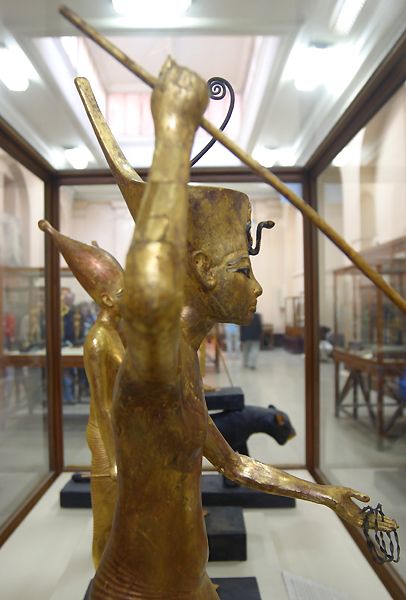 |
This is the only statue I remember seeing where he's actually doing anything except standing around with his best foot forward. It's very rare in classical Egyptian statuary for the pharoah to be shown doing anything - almost without exception the king is shown in a static pose. Here, he's standing on a small papyrus raft, re-enacting the role of the god Horus hunting the god Seth in the form of a hippopotamus. I have no idea what he has in his left hand. At the far end of the cabinet you can see a leopard, which carries another small statue, one of four in this display case. |
|
Two more statuettes from the same display case, all made of wood covered in gold. They are part of a set of 32 which were in the tomb, some of which depict Tutankhamun acting out various Egyptian myths. Both of these show him with a crook in his left hand and a flail in his right hand. Egypt was historically divided into Upper Egypt, roughly south of where Cairo is now, and Lower Egypt, where the Nile spreads across the delta in many separate branches. The image on the left shows Tutankhamun wearing the crown of Upper Egypt, and the image on the right shows him wearing the crown of Lower Egypt. These two crowns were often combined to represent power over the whole of Egypt. |
 |
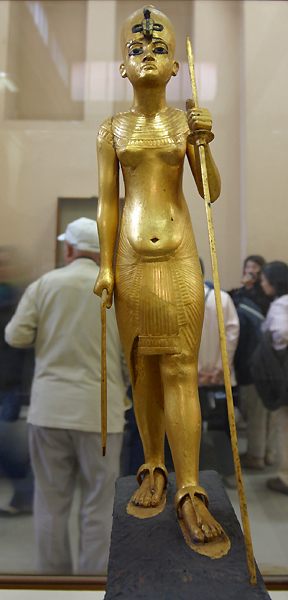 |
This is the statue which is mounted on a leopard. Here he's back in the crown of Upper Egypt, and looking like a very arrogant little dictator, quite different from the sweet kid portrayed on the face of the mannikin. The bulging stomach and prominent breasts are reminiscent of the unusual and somewhat androgynist artistic style of Tutankhamun's heretic father or grandfather Akhenaten. |
|
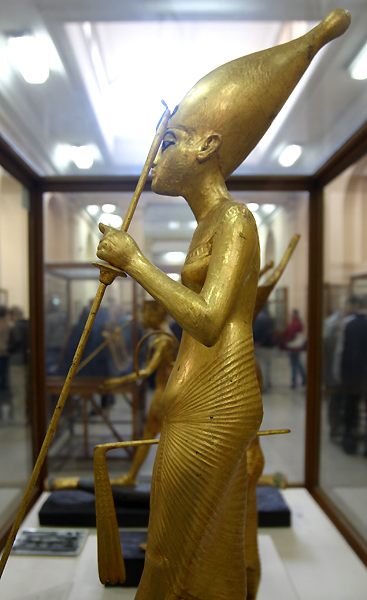
This side view of the same statue shows that he definitely needs to work on his butt, too. Off at the far end of the cabinet you can see the funny little stylized boat that the spear-wielding figure is standing on. |
 |