| Bangkok
is the center of Thailand, both geographically and in terms of what makes
the country tick. The metropolitan area has a population of
around eight million, far surpassing the next largest city Udon Thani,
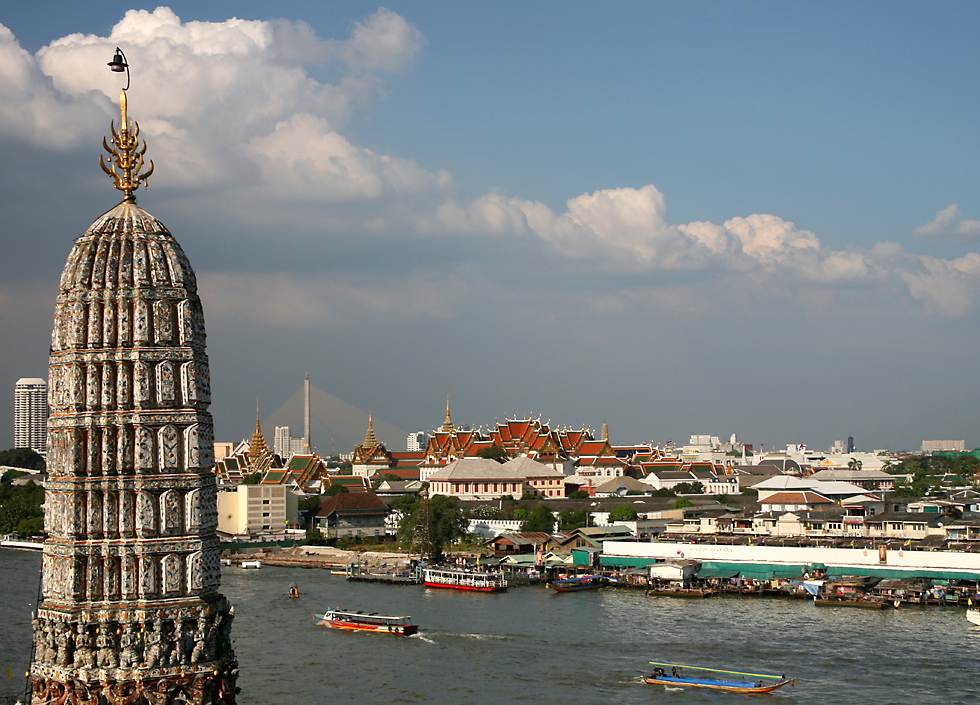
which has less than a quarter of a million. This photo towards
the royal district of Ko Ratanakosin was taken from Wat Arun, one of the
first temples built in the city - and yes, that tower really is leaning
over slightly! |
 |
| Wat
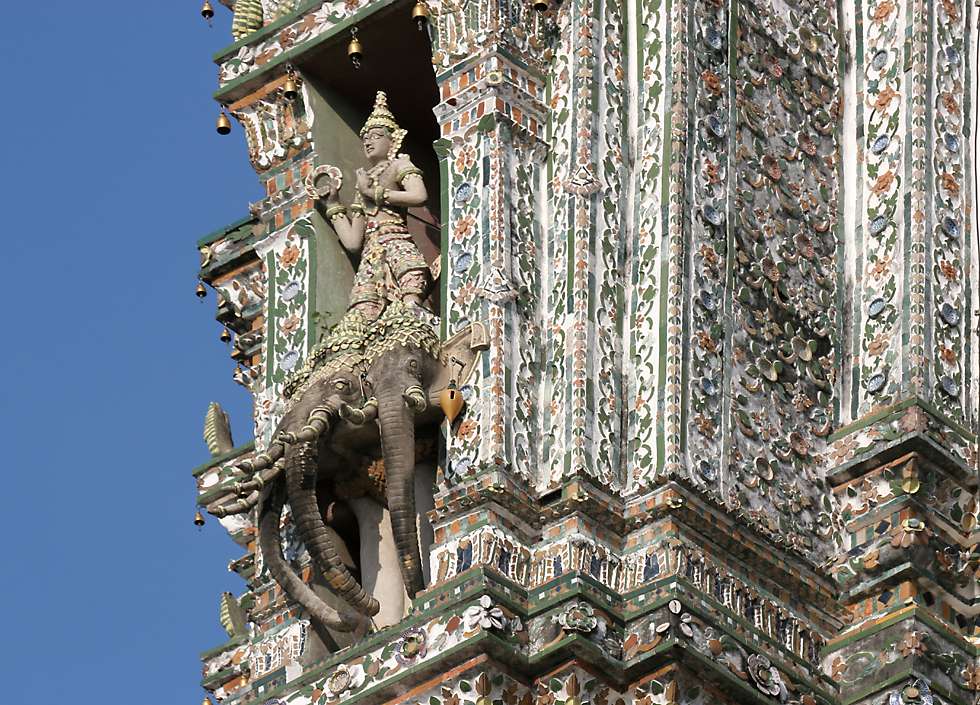
Arun is a good introduction to Thai temple architecture, which is rich
in Hindu and Buddhist themes such as this statue of Erawan, the Thai three-headed
elephant which corresponds to the Hindu elephant Airavata, the steed of
Indra the Lord of War. The decoration on the side of the temple
is made from broken crockery brought as ballast in trading ships from China. |
 |
| By
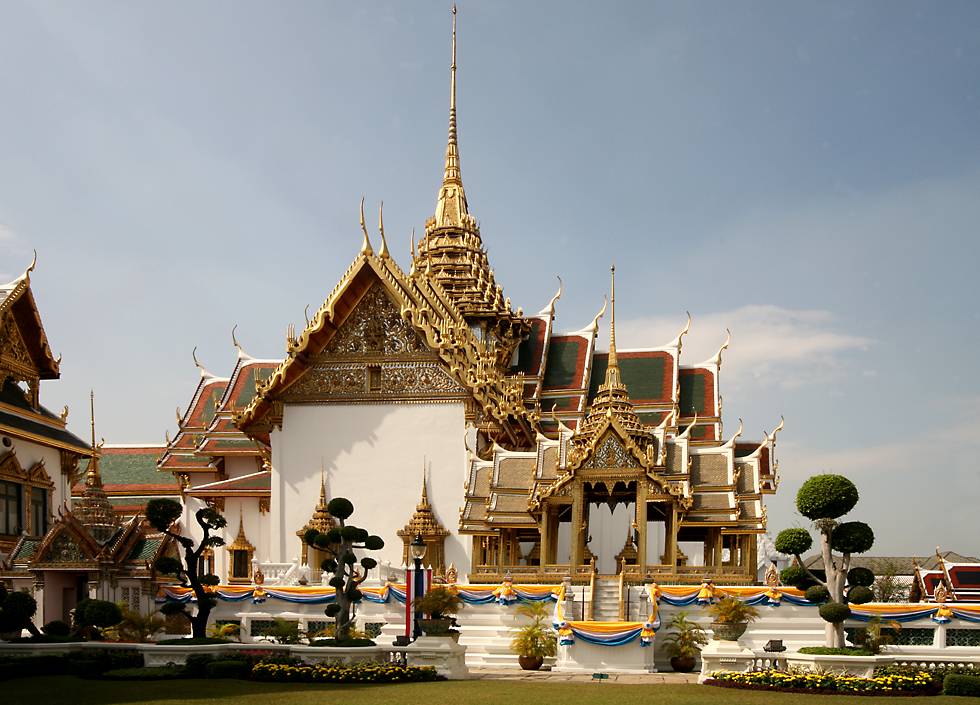
far the most spectacular sight in Bangkok is the Grand Palace complex and
its associated temples. The building here is Dusit Hall, which
King Rama I had built as a place for his body to lie in state when he died.
The smaller structure in front of the hall includes a platform to allow
the King to mount one of his white elephants. |
 |

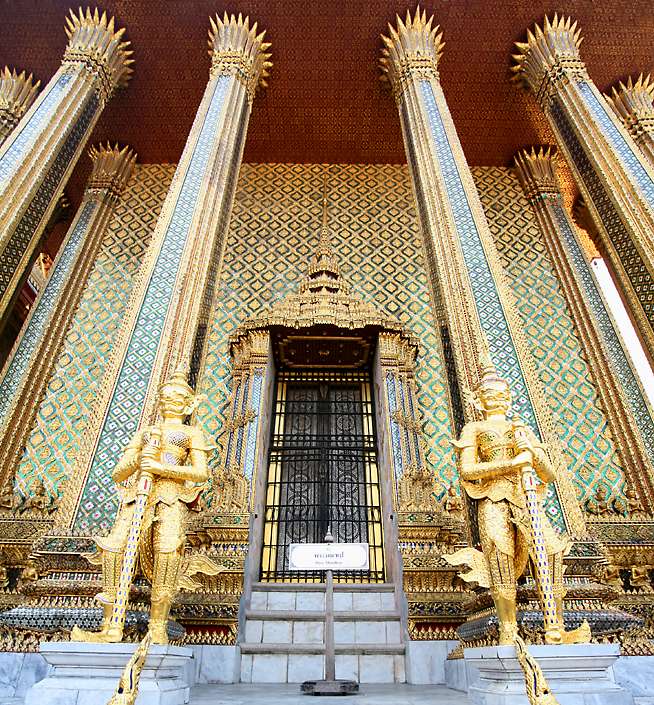
In case you hadn't already noticed, Thai palace and temple architecture
tends very much towards the ornate. This is a side entrance
to Prasat Phra Dhepbidorn, usually translated into English as The Royal
Pantheon.
It's only open to the public on one day of the year, which wasn't the day
I was there, but I'm told that it contains statues of kings of the current
Chakri dynasty. |
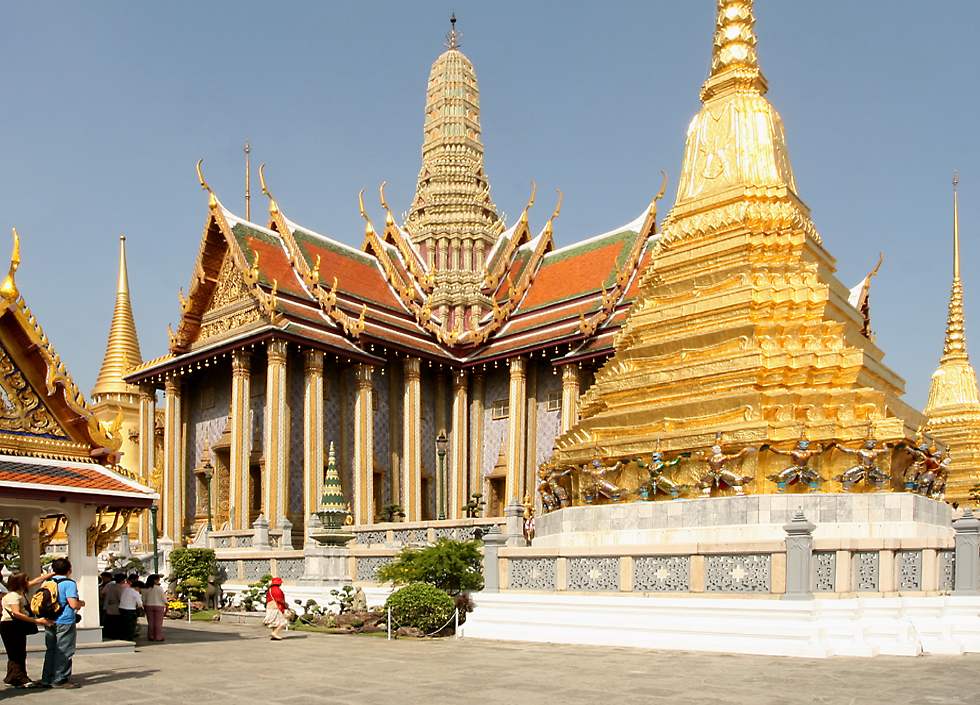
| Here's
Prasat Phra Dhepbidorn from another angle, with two large golden stupas
on the right and hidden away on the left Phra Siratana Chedi, a stupa said
to contain relics of Buddha. |
 |
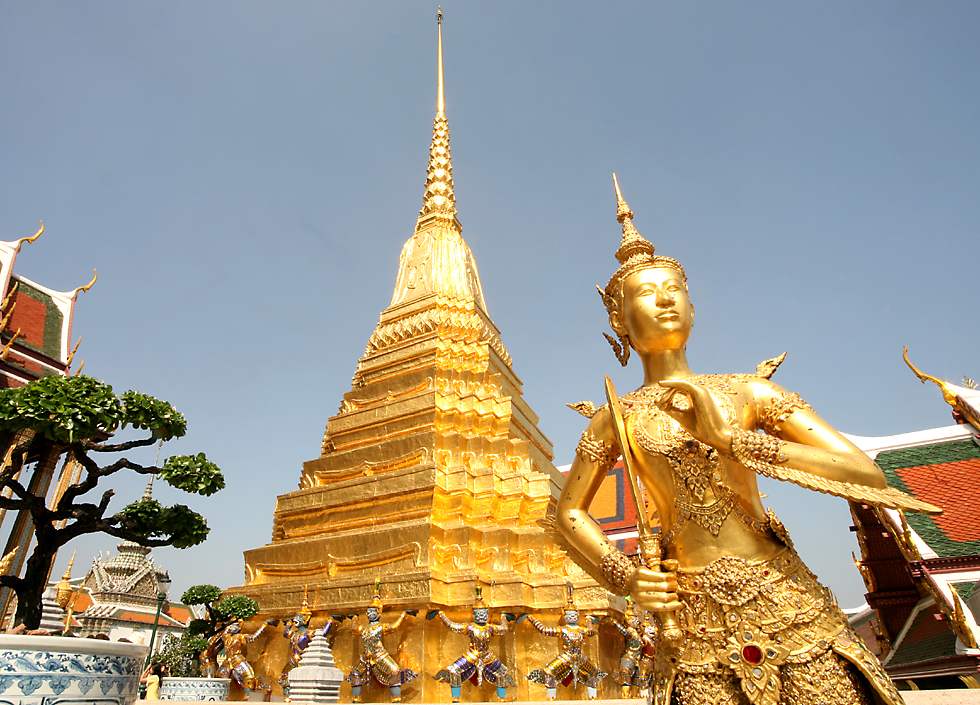
| It's
gold, gold, gold everywhere, guarded by deity statues like this one, whose
top half is a woman and bottom half is a chicken. Laugh if
you want to, but she'll run her sword right through you if you do something
naughty! |
 |
| There
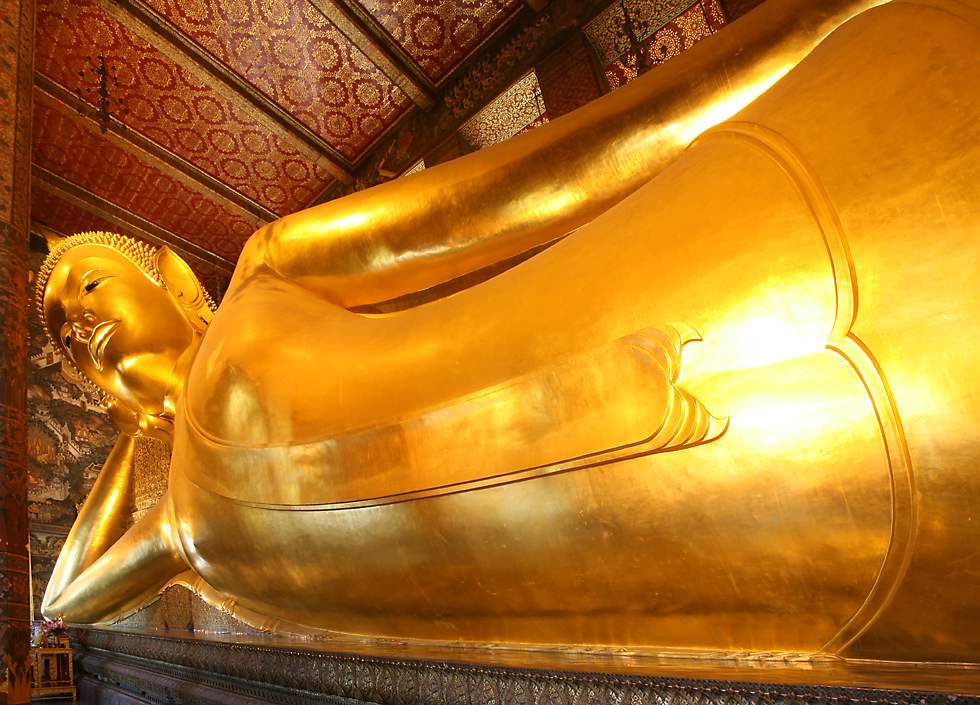
are plenty of other interesting temples in Bangkok including Wat Pho, which
is only a short walk away from the Grand Palace complex. Wat
Pho is famous for housing the largest reclining Buddha statue in the country,
measuring 46 meters from head to toe, and 15 meters from bottom to top. |
 |
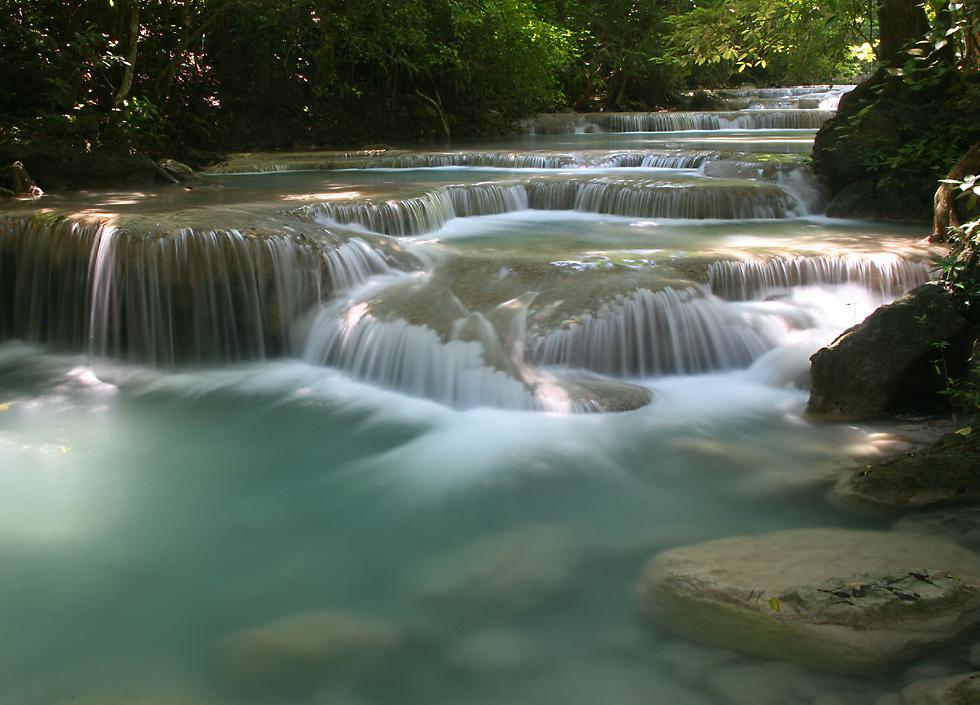
| Heading
out of Bangkok, the first place I visited was Erawan national park, named
after the same elephant seen on Wat Arun. As well as being
a great place for seeing birds, insects and other wildlife, it's also well
known for having seven tiers of waterfalls, this photo showing the lowest
tier. |
 |
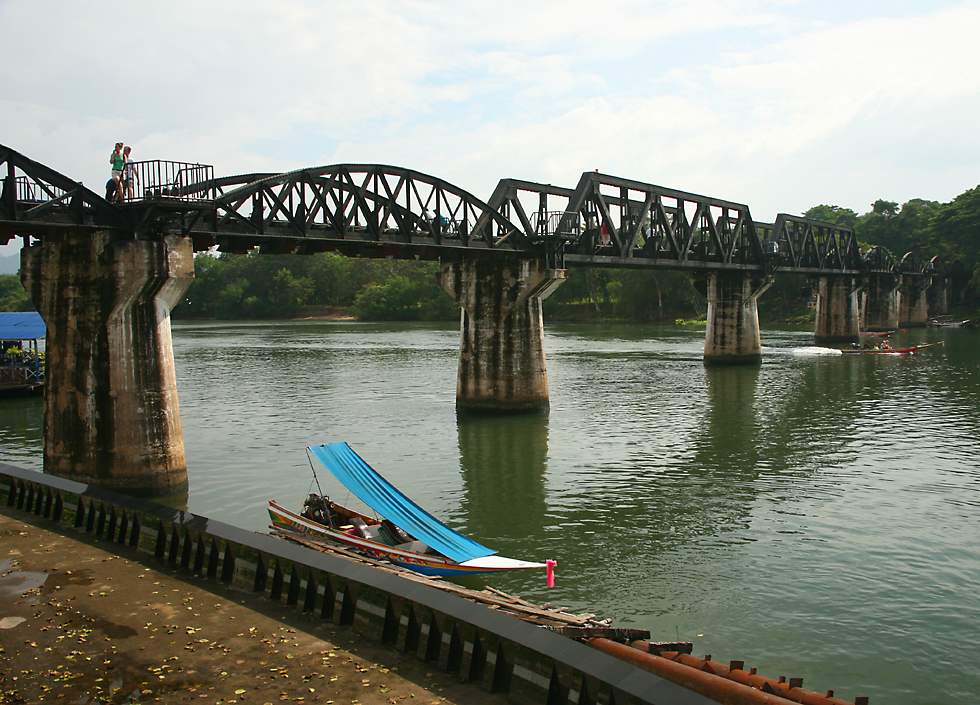
| One
of the main reasons why foreign tourists come to this part of the country
is to visit the "death railway bridge" on which the fictional book and
movie "Bridge on the River Kwai" were based. The historical
bridge was heavily damaged by allied bombing in 1945, but was repaired
after the war; the round trusses are part of the original Japanese design,
while the box trusses on the two center spans are the repaired sections. |
 |
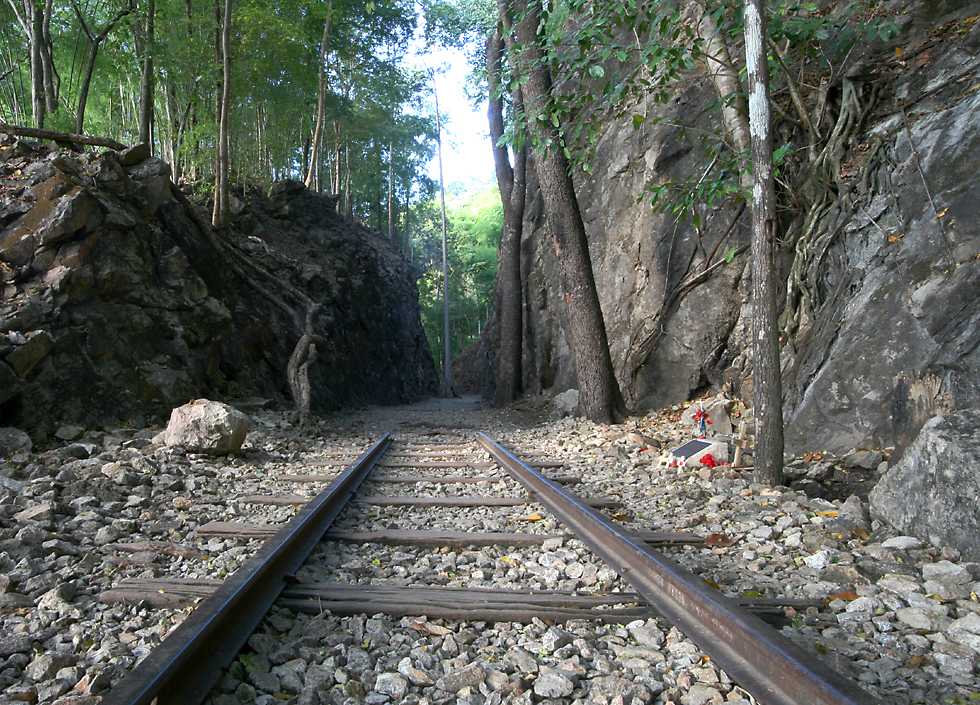
| The
Japanese army used Asian slave labor and prisoners of war to build the
bridge, which was part of the Thai-Burma railroad built to take war supplies
to the advancing imperial forces. During construction over
100,000 conscripted locals and 12,000 prisoners of war died building the
railroad with inadequate tools, food and medical care through difficult
terrain such as this at the aptly named Hellfire Pass, the most difficult
cutting in the entire enterprise. |
 |
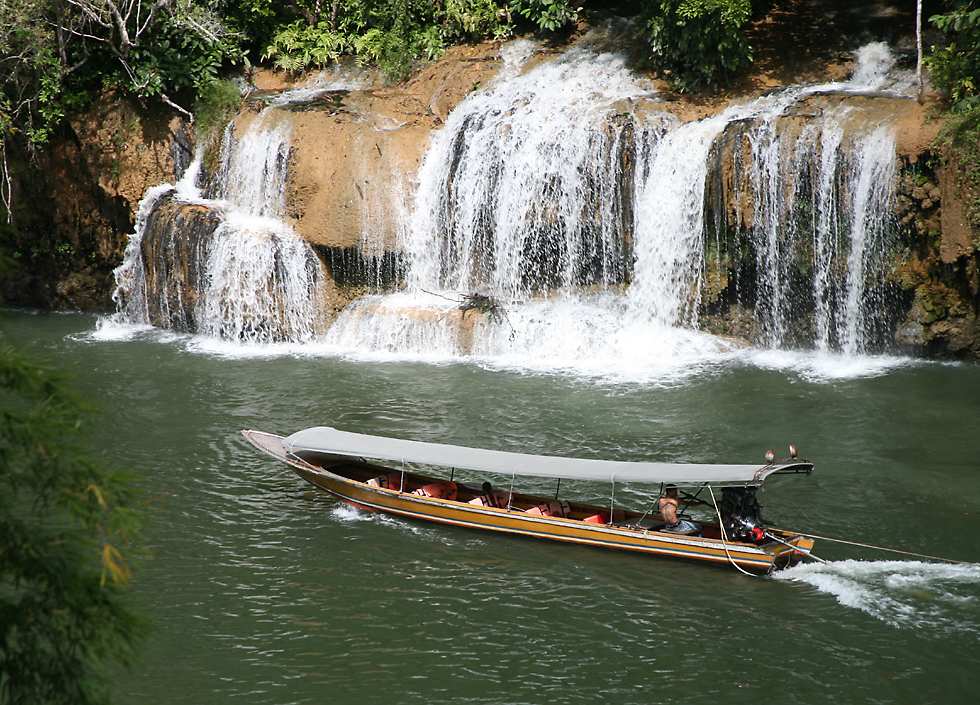
| Sai
Yok national park is only a few kilometers west of Hellfire Pass.
It's a pleasant enough place with several hiking trails and a couple of
waterfalls, Sai Yok Yai (Big Sai Yok, shown here) and Sai Yok Noi (Little
Sai Yok). There's also a bat cave you can visit in the early
evening, though you shouldn't expect to encounter either Batman or the
swarms of bats you've seen on wildlife documentaries! There
are a few remains from the Thai-Burma railway here and the park also has
a movie connection as the place where the Russian roulette scenes from
The Deer Hunter were filmed. |
 |
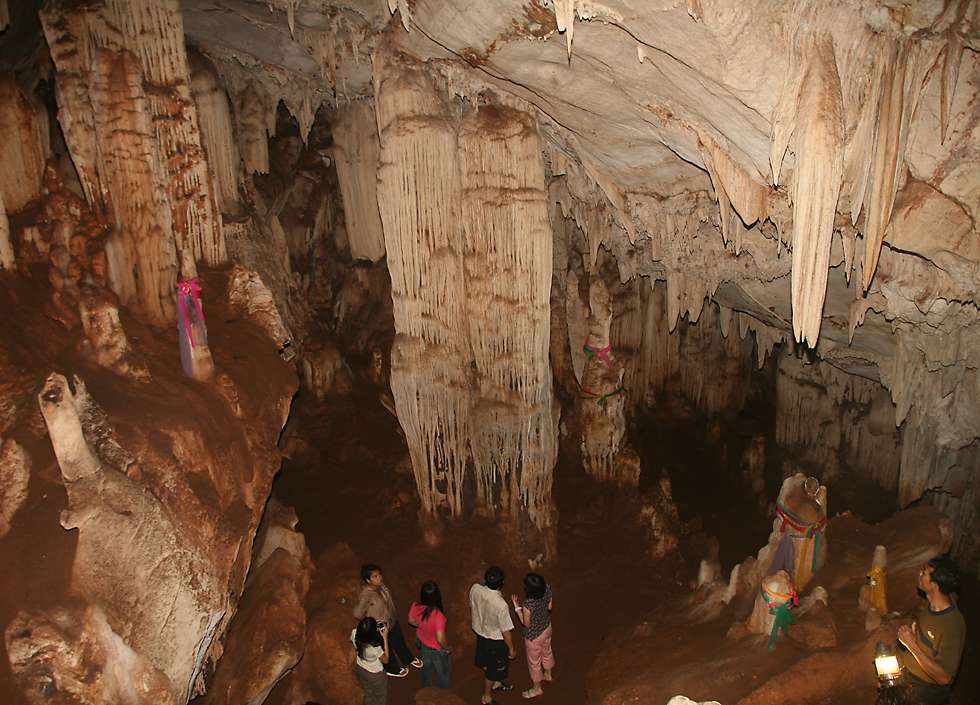
| Another
very short hop and step and you're at Tham Daowadung, the Cave of Heaven.
It's not sign-posted in English, so it took me about an hour to find, but
you can join a tour of the cave without needing a booking, and it's worth
the price to see the different rooms, formations and wildlife - mostly
in the form of bats, which are somehow able to tolerate all of the disturbances
and even hang on the roof at eye level. |
 |
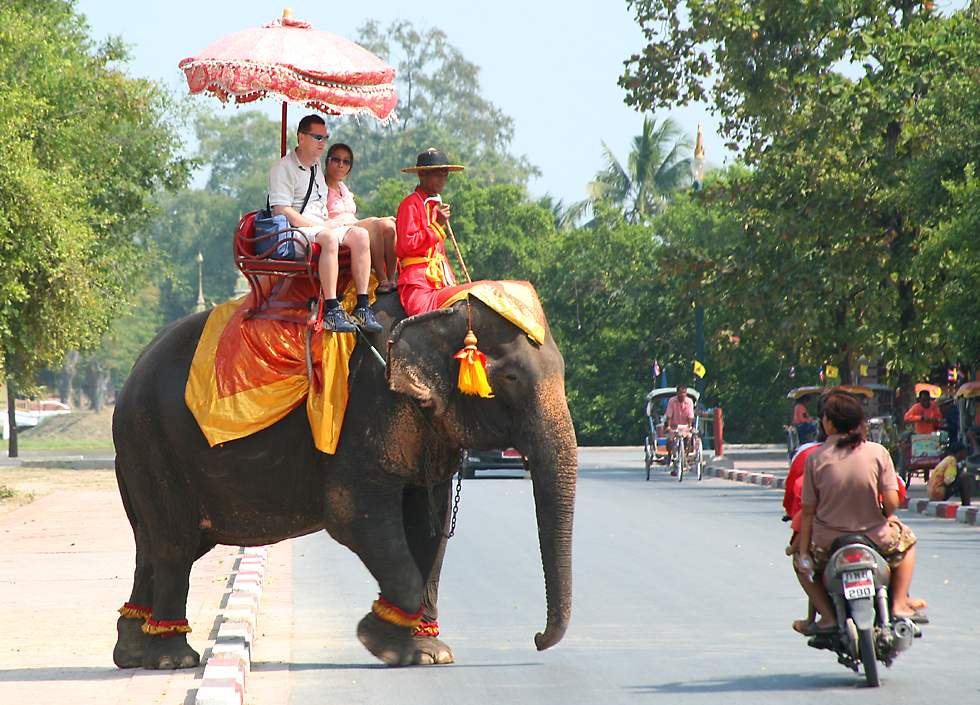
| Heading
back towards Bangkok, Ayuthaya is only an hour or two north of the current
capital. You wouldn't think so to look at it, but Bangkok is
actually a very new city, founded as recently as 1782. Prior
to that, Ayuthaya was the center of political and religious power in Thailand.
However today elephant transportation is mainly the preserve of tourists
as they make their way around the ruins of the city, which was almost entirely
destroyed by the Burmese army in 1767. |
 |
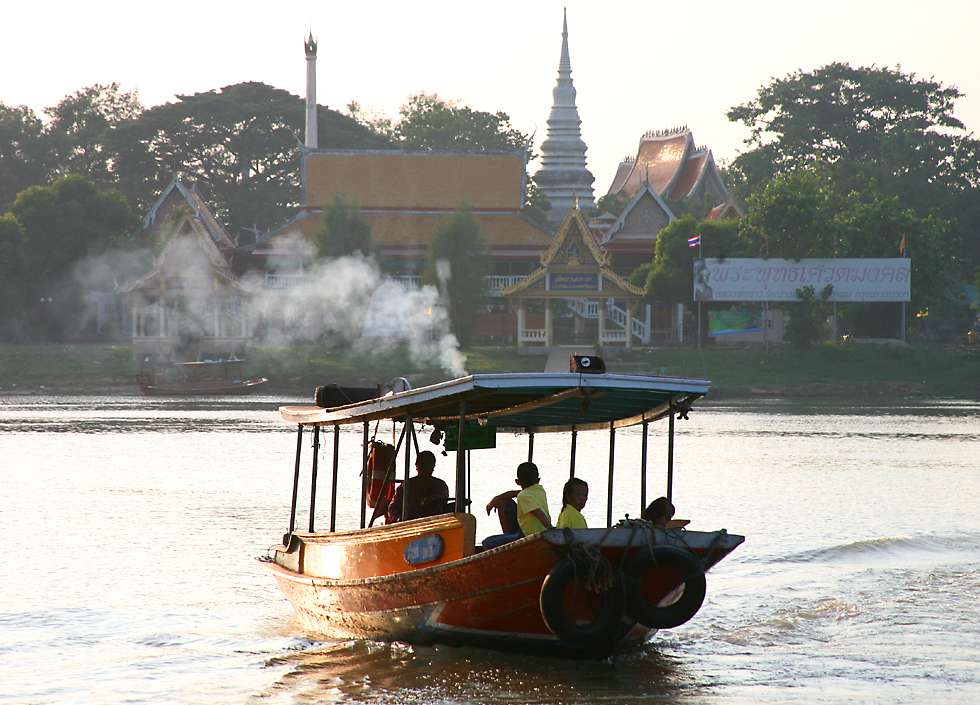
| The
Burmese managed this feat even though the city was effectively an island,
surrounded by a vast moat created by diverting the flow of the four rivers
which converged in this spot from the north. Even now parts
of the city are considered "on the island" or "off the island", and a slow-chugging
ferry is the best way to get from one riverbank to the other. |
 |
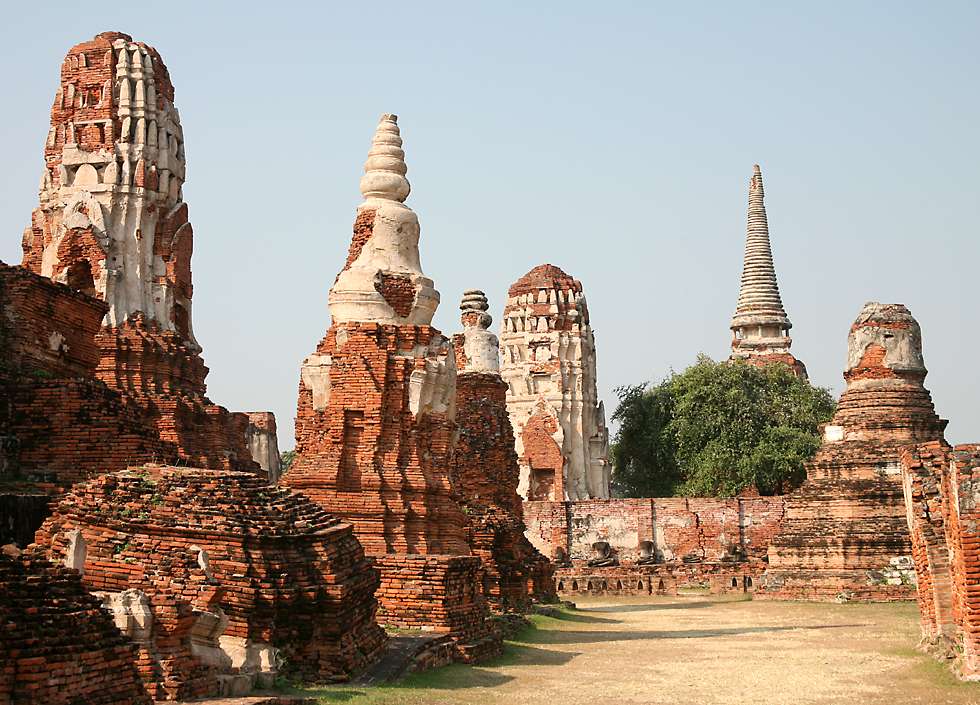
| As
you might expect, most of the historical area is "on the island", including
the largest temple complex, Wat Phra Mahathat. From the time
it was built in the 14th century this was the spiritual center of the city,
with quite a few prang or towers, some of which borrowed their architectural
style from the Khmer kingdoms to the east of Thailand in what is now Cambodia. |
 |
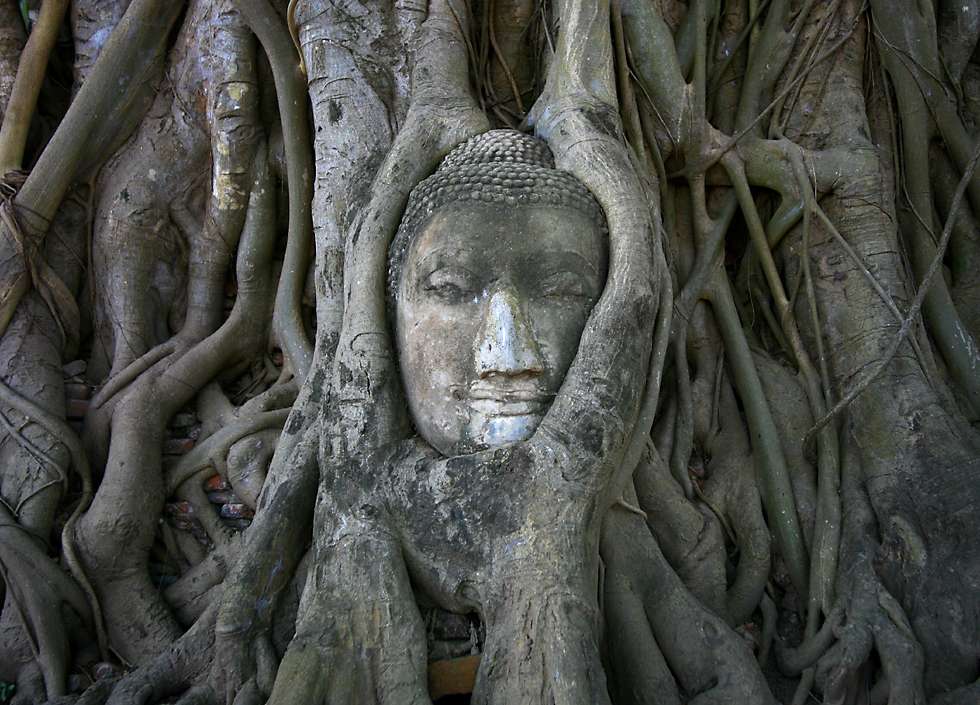
| Buddhist
merit-makers still come to this temple, to decorate the remaining images
and to visit this very auspicious relic, a Buddha head entwined within
the roots of a bodhi tree, a type of fig tree which Buddha was said to
be meditating under when he achieved enlightenment. |
 |
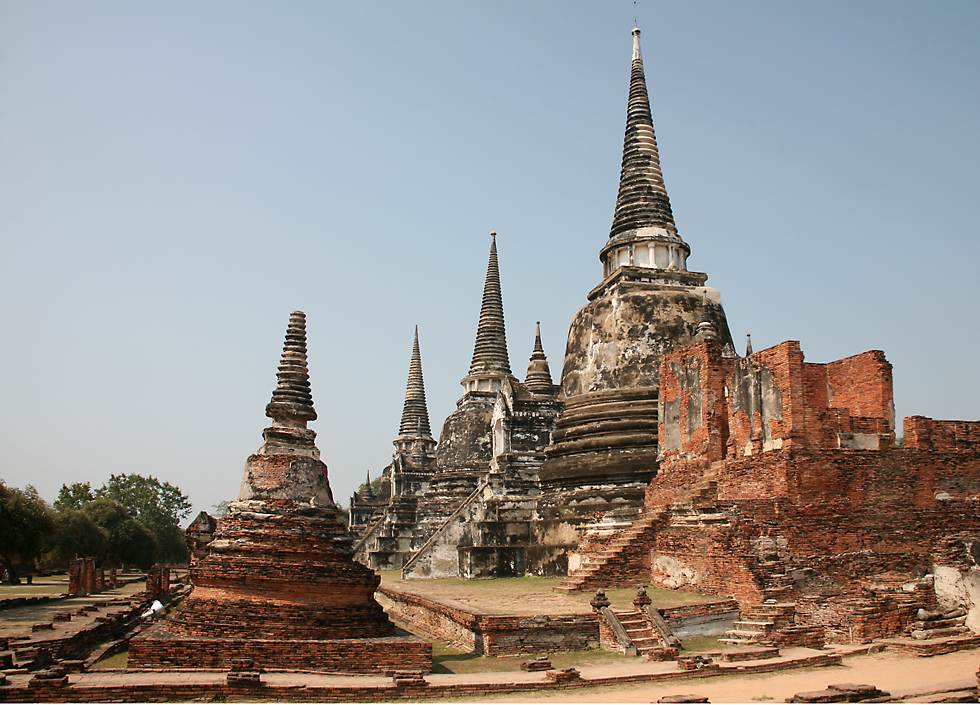
| Wat
Phra Si Sanphet is one of many other temple complexes within Ayuthaya.
It's well known for its three large chedi lined up on the central platform,
as well as other chedi, wihaan (halls, sometimes spelt wiharn)
and arches. |
 |
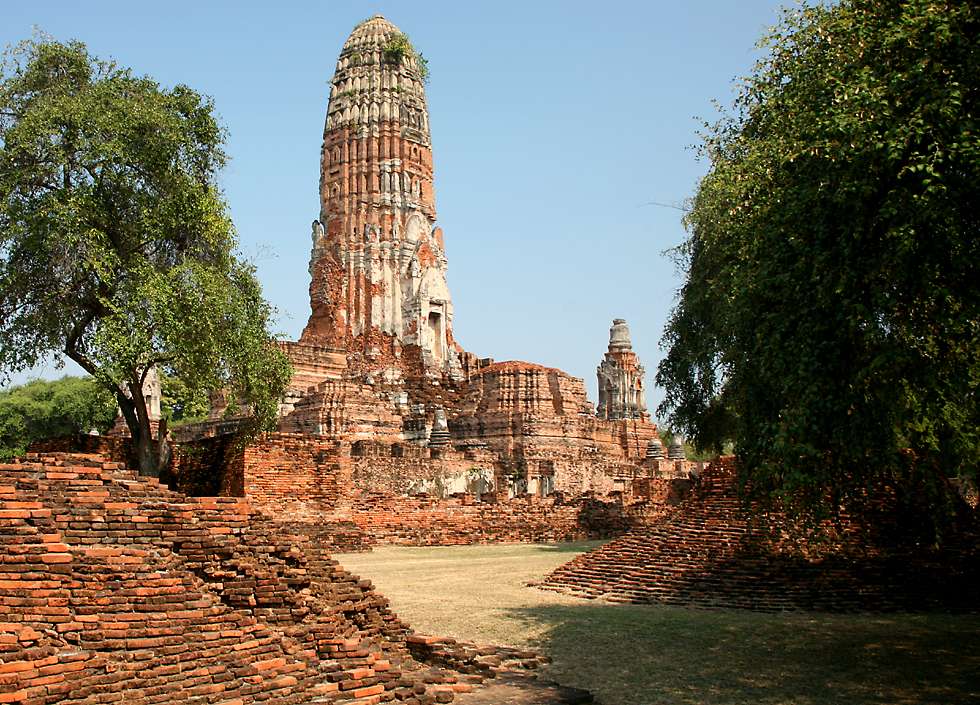
| Wat
Phra Ram contains a very large prang or tower, it's not certain
who built it, but some historians think that it was the cremation site
of King U Thong the founder of Ayuthaya. |
 |
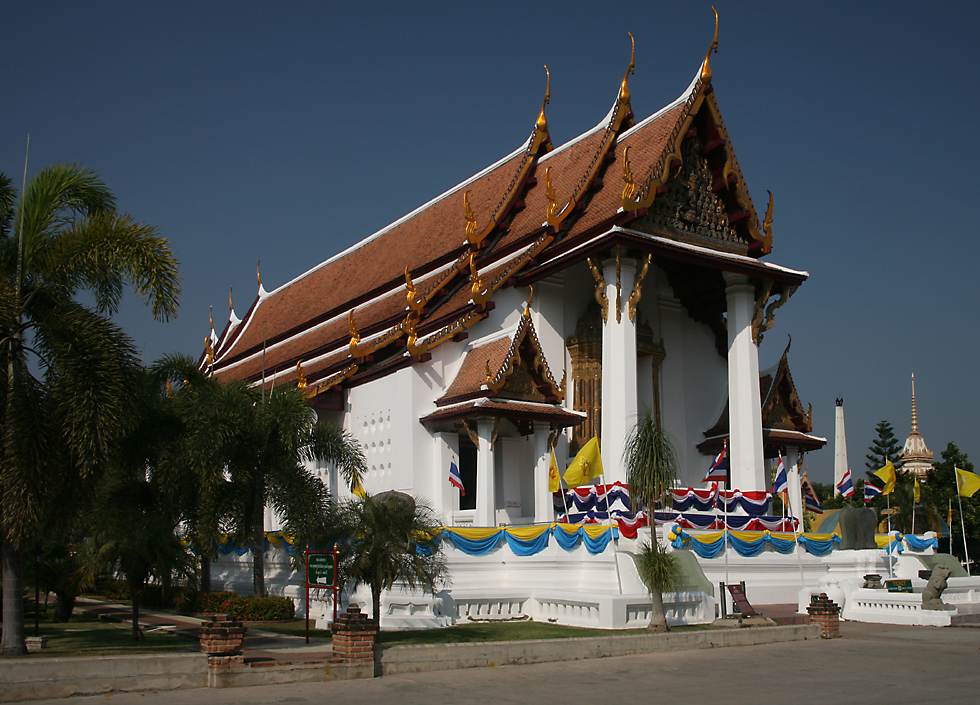
| Wat
Na Phra Meru is a real oddity, a temple built in 1546 which survived the
fall of the city. It's very interesting to compare this wihaan
to the ruins of the other wihaan around the city, which have all lost their
roofs but sometimes have remnants of the stucco-covered brick columns visible
here in their original state. This temple survived because
it's off the island, making it a suitable headquarters for the Burmese
army during their attack. The Burmese king was fatally injured
here when he fired a defective cannon which exploded, so I suppose he might
have wished that he hadn't gone to war. Perhaps it was "instant
kharma"! |
 |
| Ayuthaya
wasn't the first capital city of Thailand, that honor goes to the city
of Sukhothai about 450 kilometers north of Bangkok. The large
historical park here is spread over an area about the size of Ayuthaya,
though in the case of Sukhothai the city was surrounded by walls rather
than a moat. There are a great number of Buddha images here,
some standing and some sitting. |
 |
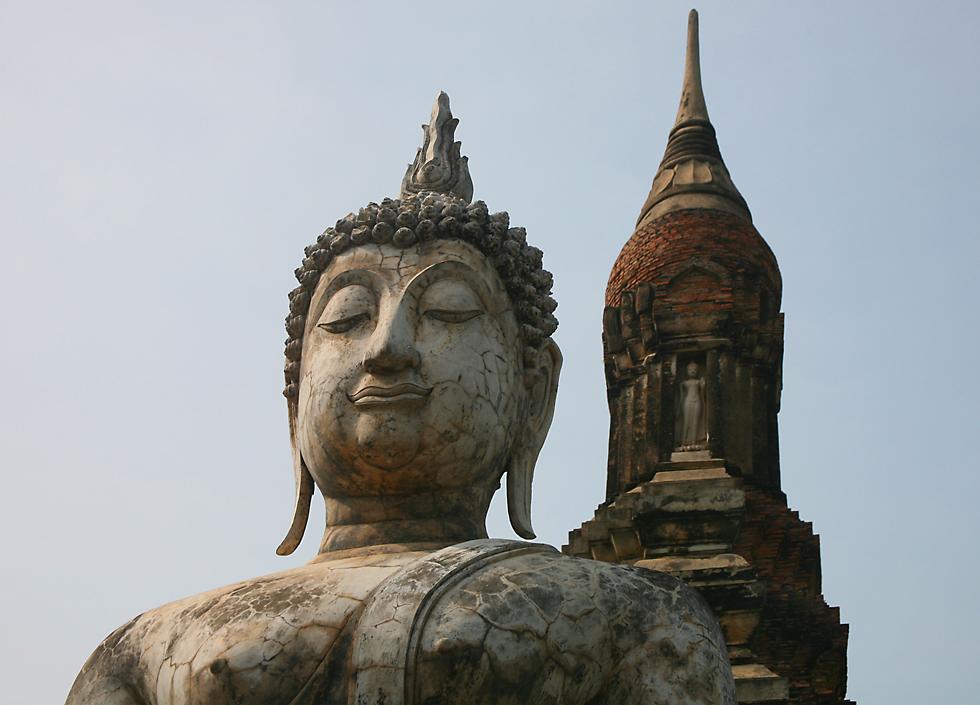
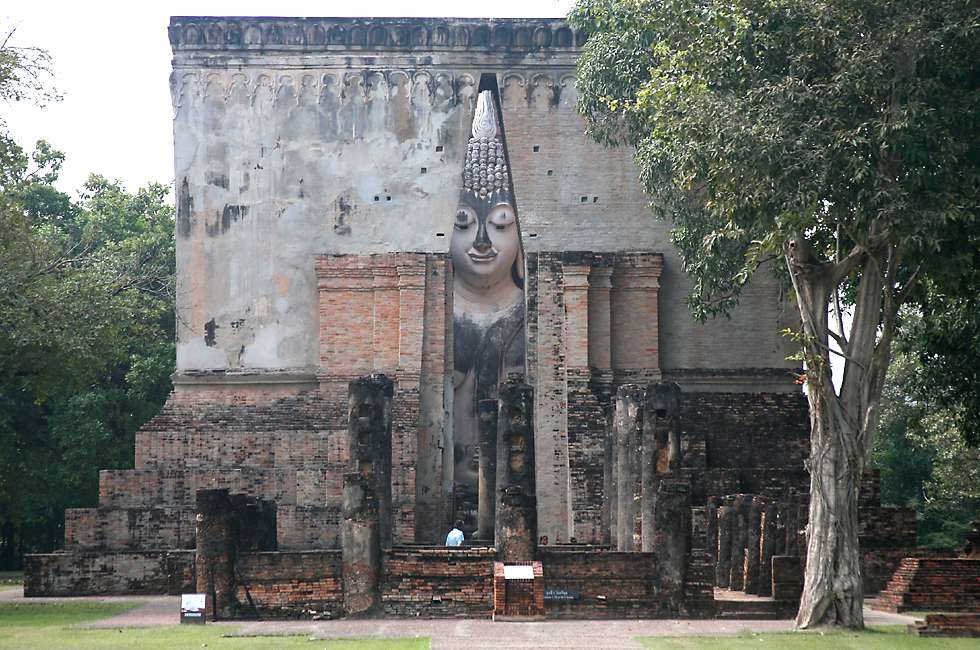
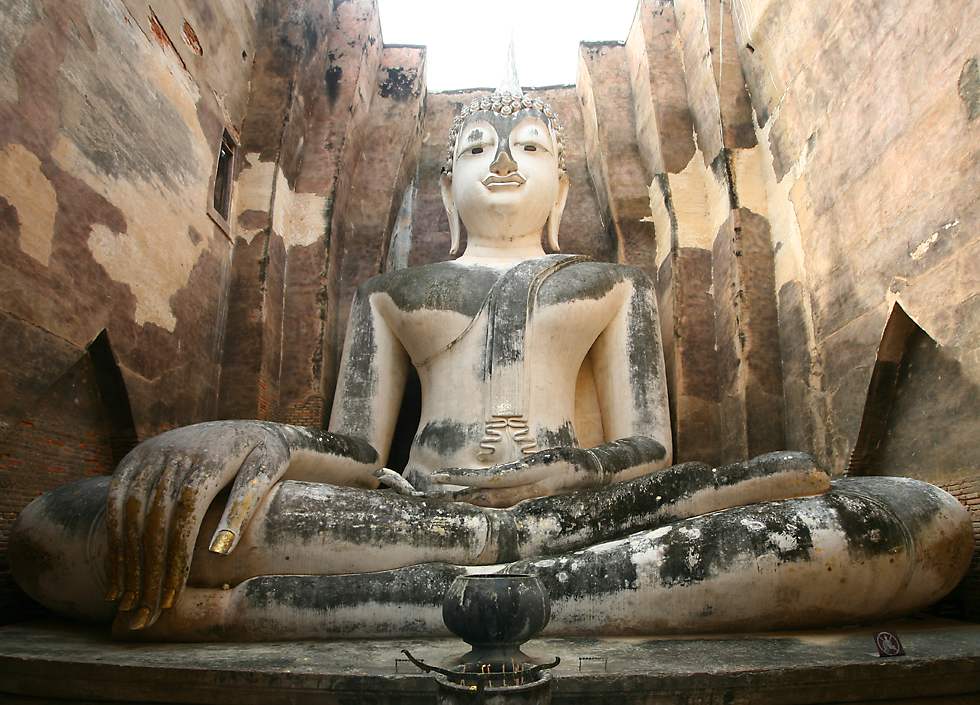
| By
far the most impressive sight in Sukhothai is Wat Si Chum a mondop
or square building which once had a large sloping wooden roof, but now
stands roofless in front of the ruins of its attached wihaan.
The architecture might be interesting, but it's the contents of the mondop
which are this temple's most impressive feature. |
 |
| Inside the mondop
is a 15 meter high brick Buddha sitting in one of the classic poses, and
covered in stucco. The body shape and long, curved fingers
are two features of the Sukhothai artistic style, which is considered the
most "classic" of all the Thai styles. |
 |
If you want to see unruined temple architecture, then the northern city
of Chiang Mai is the place to go.
Within the city walls and its surrounding moat there are about 120 temples,
about the same number as Bangkok, but most are older and are concentrated
within a much smaller area.
Although some of these temples are more famous than the others, you'll
find interesting things everywhere, just by walking along any footpath
within the city and walking into every temple you find.
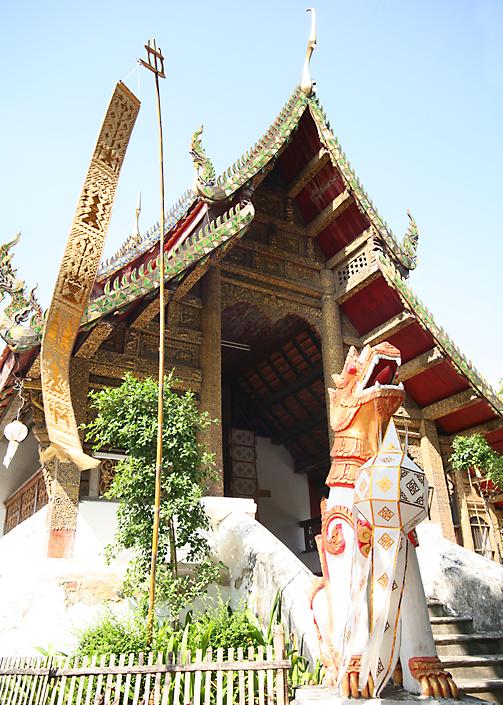
This photo shows one of the lesser temples, Wat Sum Pow, which has examples
of the same eye-catching and exuberant architectural and sculptural motifs
of the more heavily-trafficked sites. |
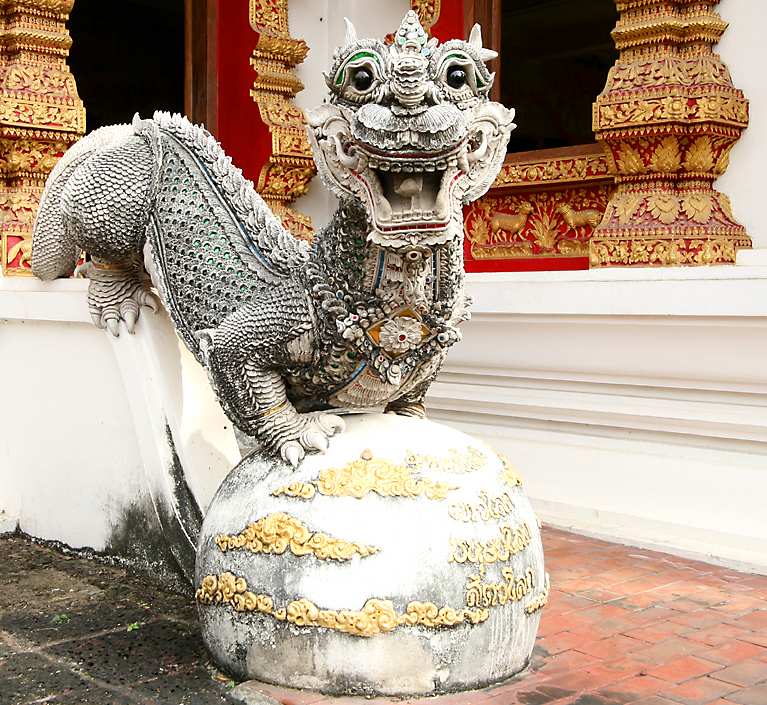
Wat Bupparam is one of the better known temples, and although it contains
three of the most significant Buddha images in the country, it's no staid
religious site.
Instead it's a very whimsical place surrounded by animal statues, including
suspiciously modern looking images of giraffes, zebras and Bactrian camels,
as well as this playful and very Chinese looking dragon, and even a five
foot tall Donald Duck lookalike, tucking into a tasty bowl of noodles,
all under the watchful gaze of a serene Buddha. |
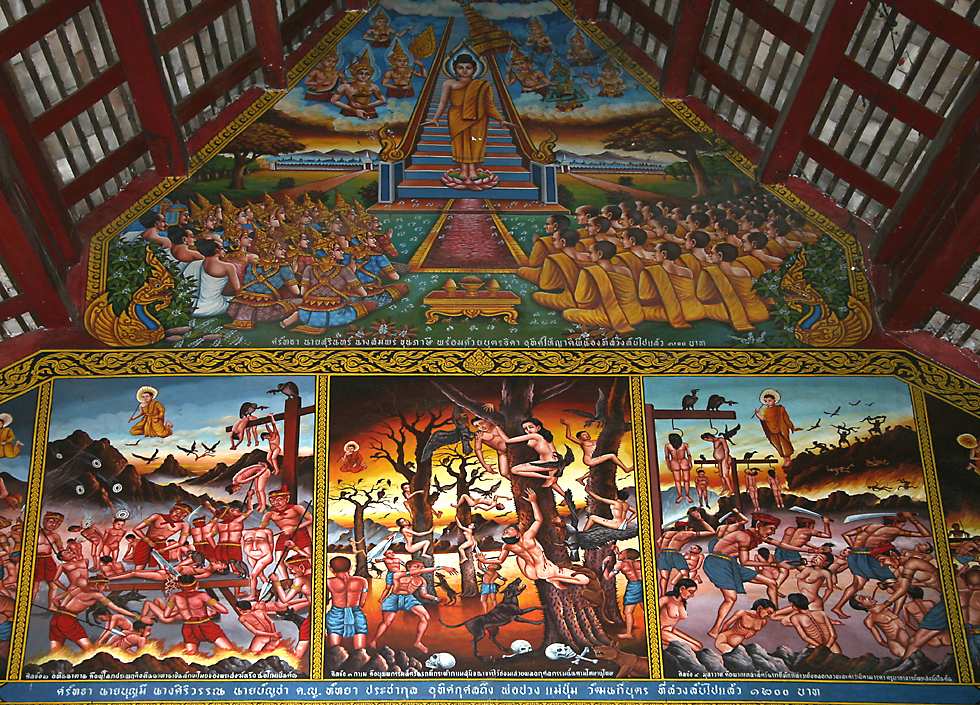
| Wat
Tung Yu is another minor temple in Chiang Mai, but I was captivated by
this vivid modern mural on the wall of the main wihaan showing the terrors
which naughty people will be subjected to in hell, and the delights of
the faithful in heaven. It's all rather similar to Christian
images of heaven and hell, right down to the devils prodding naked people
with sharp pointy things, and angelic beings on clouds - all that's missing
are the harps! |
 |
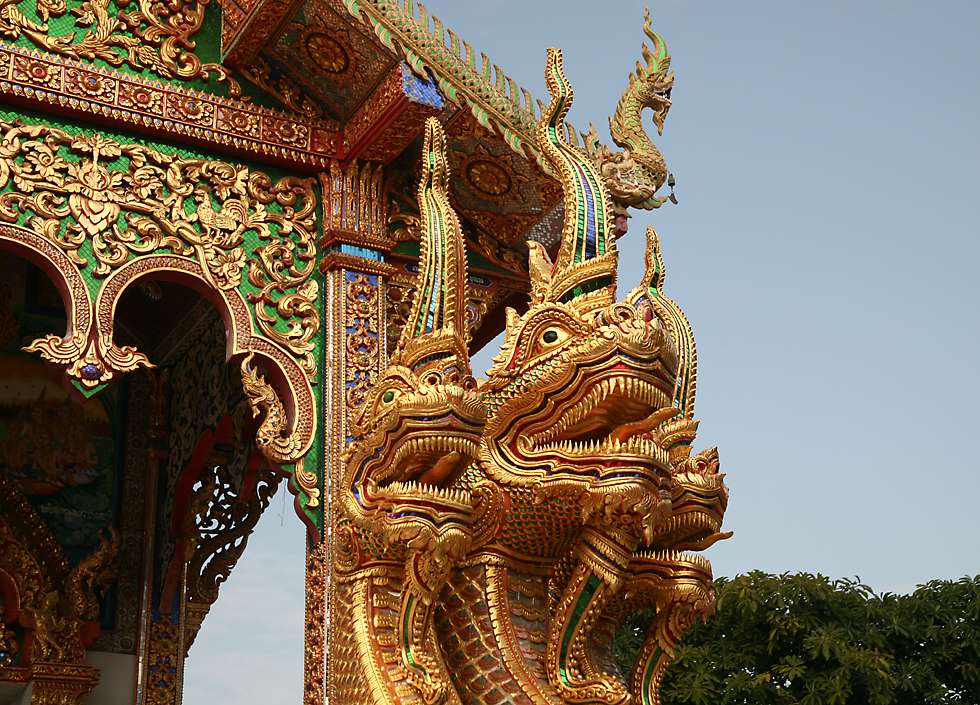
| Leaving
Chiang Mai, I wanted to stay in the nearby Doi Inthanon national park for
a few days, since it's famous for its birdlife. However after
trying to find the way for a few hours I gave up and went instead to Nam
Nao national park, which is 500 or 600 kilometers south-east of Chiang
Mai. On the way I stopped briefly in the town of Lamphun, which
has two famous temples, neither of which I could find. But
I did find Wat Mahawan, originally built in 657AD and housing a famous
Buddha image. I didn't see the image, but I did enjoy myself
immensely photographing the temple itself, which has some of the most appealing
Naga
(mythical serpent) statues in Thailand. |
 |
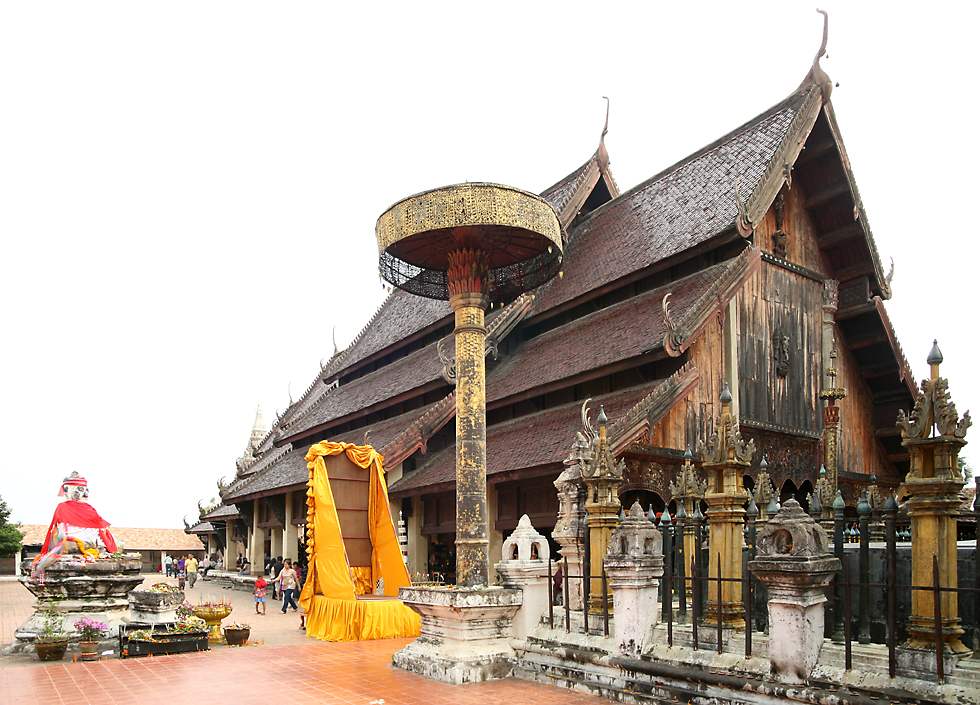
| I
arrived late in Nam Nao, partly because of my belated start, partly because
of the distance I had to drive, and also because of my stopover in Lamphun
and also a visit to Wat Phra That Lampang Luang, which has a very large
and original open-sided teak wihaan built in 1476 on the site of an eighth
century fortress. At the back of the wihaan there's a 45 meter
high chedi which is said to contain a Buddha relic, and it all attracts
a
steady stream of Thai merit-makers who form a clockwise procession around
the wihaan and chedi. |
 |
| Nam
Nao wasn't a great place for scenery, though it proved very good for birds,
butterflies and even an attractive red-necked keelback snake which I photograph
on the morning I left. After getting back to Bangkok I flew
straight down to the resort island of Phuket off the western coast of southern
Thailand. Almost every waking moment of the next five days
was spent scuba diving around various islands in the area, though the visibility
was disappointing due to high winds (this was in December). |
 |
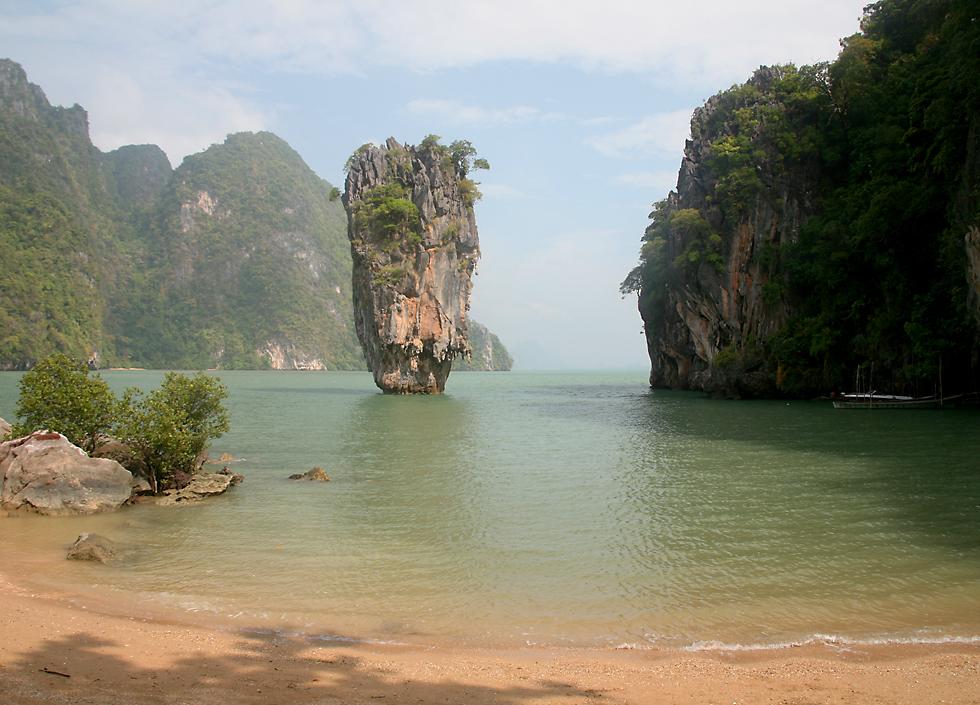
| Thailand's
south-west coast is famous for its limestone scenery, fashioned in Karst
type formations both on land and sea. I made a very rushed
but worthwhile half-day trip around Ao Phang Nga marine national park,
which has a number of interesting pieces of scenery, including "James Bond
Island", where the eponymous secret agent thwarted the evil plans of The
Man With The Golden Gun. The beach you see here is where the
duel between Bond and the villain Scaramanga takes place. |
 |
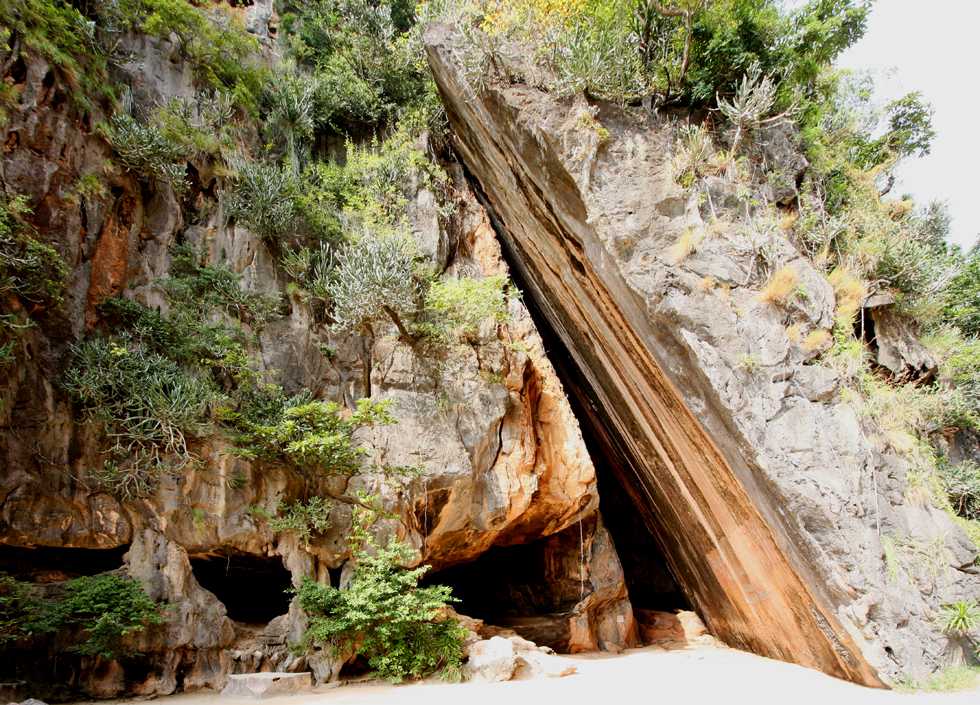
| Though
many tourists probably don't realize it, the island was actually here before
the movie! In Thai it's known as Ko Phing Kan or "leaning on
itself" island, because of this massive rock leaning against the rest of
the island. |
 |
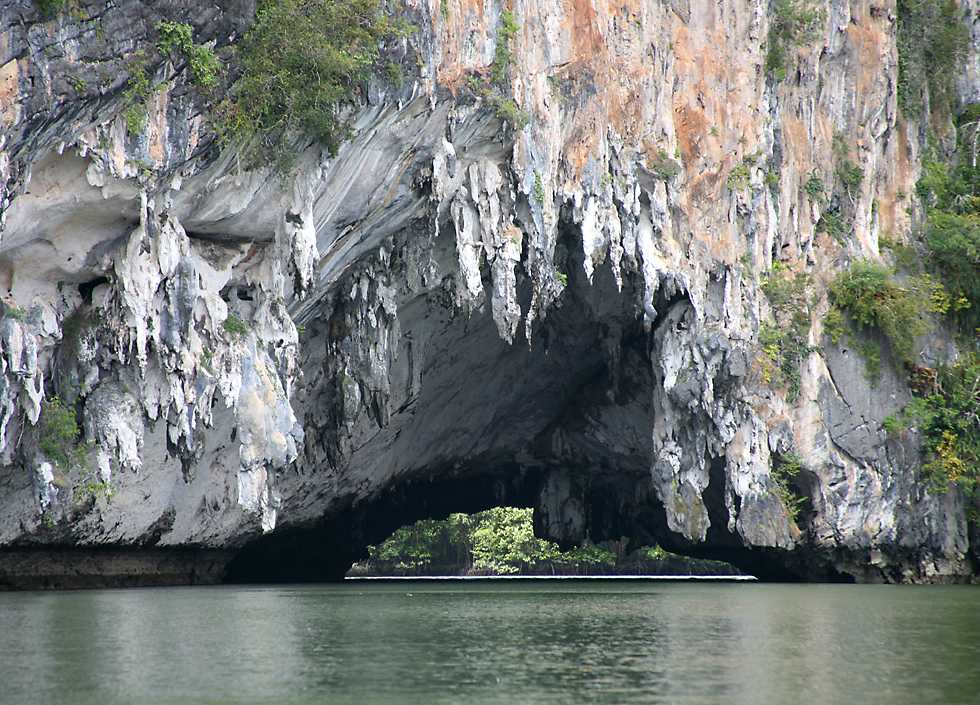
| The
national park has large stands of very tall mangrove trees, and several
caves cutting right through limestone islets, such as 50 meter long Tham
Lawt. "Tham" is the Thai word for cave and "Lawt" is the Thai
rendition of the Malay word "laut" meaning ocean, an appropriate mix since
southern Thailand is very near northern Malaysia, and many of the inhabitants
of this area are ethnic Malay muslims. |
 |
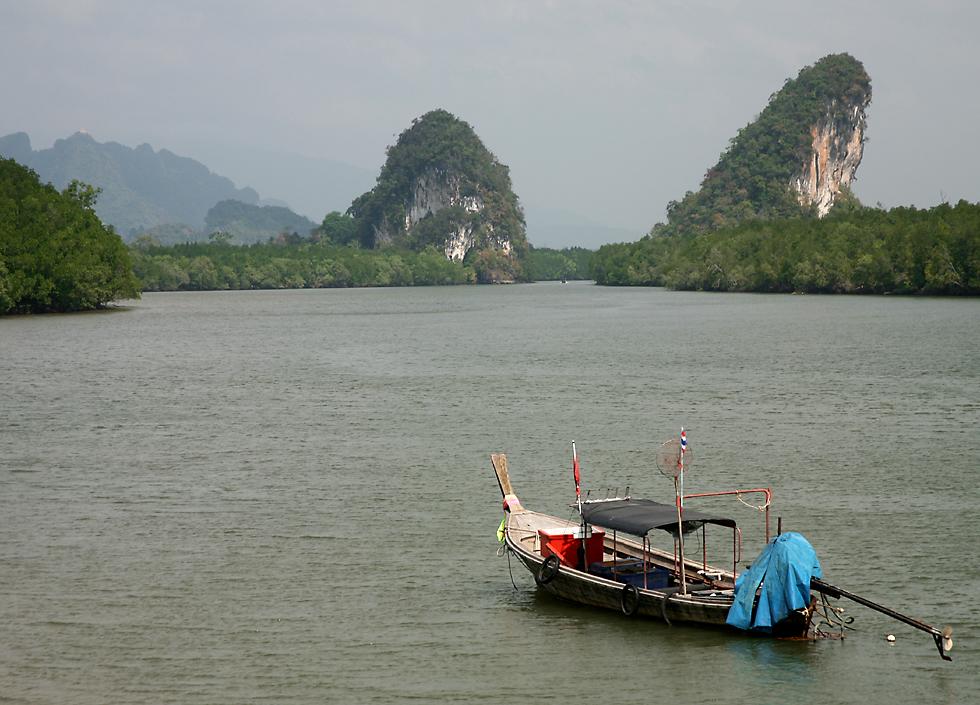
| I
headed even further south to Krabi, jumping off point for Phi Phi Don and
Phi Phi Leh, two of the most popular islands in an archipelago making up
Ko Phi Phi marine national park. Krabi town has a very scenic
setting beside the river of the same name, lined with tall mangroves and
with a pair of giant limestone pillars just up from the main pier, looking
for all the world like ancient monuments from The Lord of the Rings. |
 |
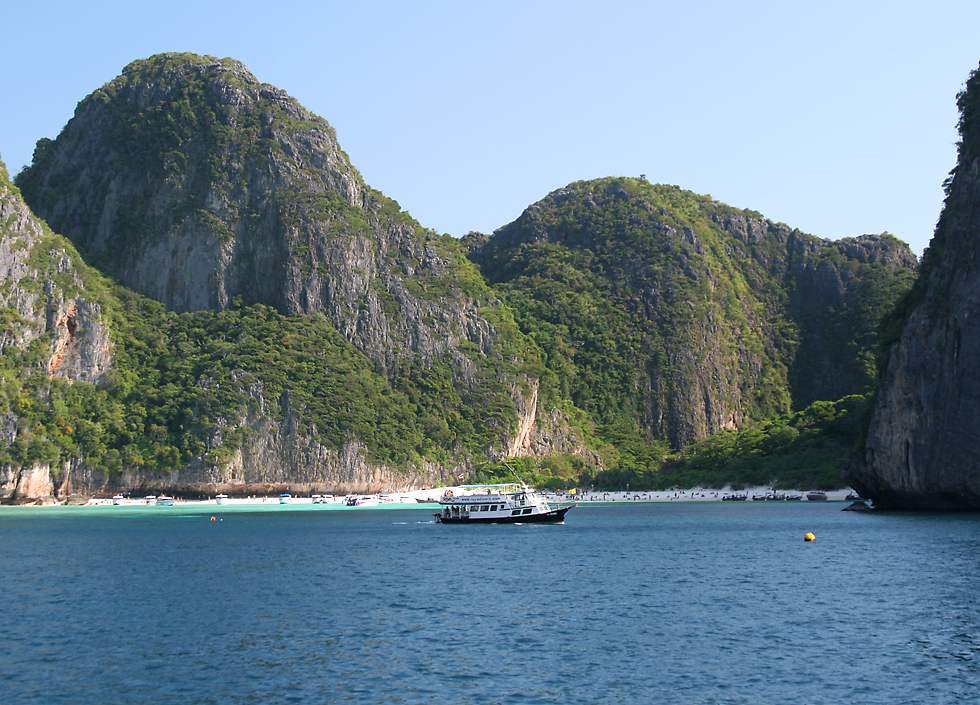
| Ko
Phi Phi Leh (pronounced "ko pee pee lay" and meaning "little Phi Phi island")
is where the Leonardo DiCaprio movie The Beach was filmed.
In the movie the island is an idyllic secret hideaway with a backpackers'
commune which changes twist by twist from paradise to hell.
It's certainly not my idea of paradise with all the tourists who now descend
on the place, but I came here twice, once with a dive boat for an underwater
visit and then later by long-tailed boat for a quick photo stop onshore. |
 |
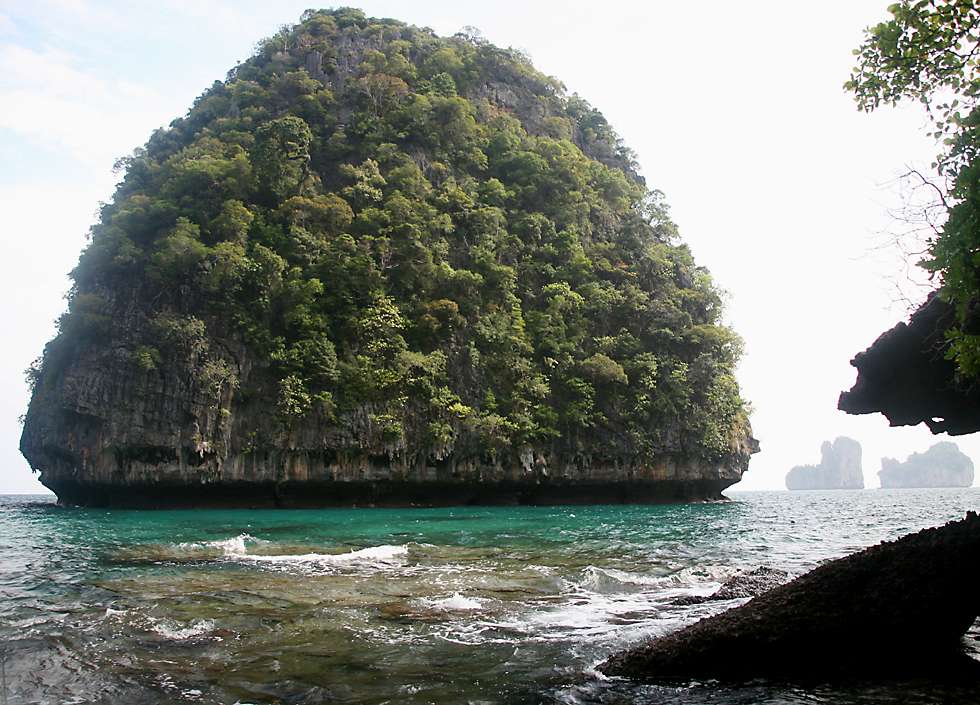
| The
beach is on the bay called Ao Maya, but there's another photogenic bay
a short walk to the other side at Pilah. There's no beach here
but it's a good spot for snorkelling and has good scenery, including a
distant view of two very small islands which I dived on the same day as
Phi Phi Leh. |
 |

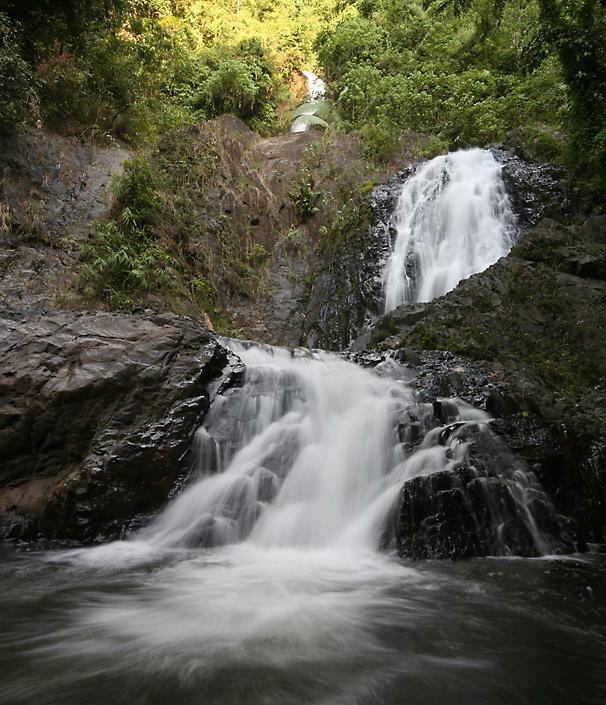
I visited a lot of temples during my three and a half weeks in Thailand,
but I also made sure to spent a lot of time in the national parks, visiting
eight on land in addition to the two marine parks.
I also stayed in the parks, either in bungalows or in tents which I rented
at the park together with bedding. Staying overnight allowed
me to go out on numerous long night-time expeditions along paths in the
jungle, which is when much of the most interesting wildlife can be seen,
including snakes, frogs and even sleeping birds and butterflies.
The waterfalls in this photo are in Khao Phanom Bencha national park, which
isn't visited much by foreign tourists because of the lack of transportation
- though the Lonely Planet guidebook's statement that "it doesn't offer
any lodging or eating options" is incorrect.
Along with Erawan and Nam Nao, this was one of the most productive places
for me in terms of wildlife, with lots of great insects and even a couple
of different lizards which got angry at me, one hissing and the other harmlessly
striking me with vegetarian teeth.
I'd normally put several wildlife photos on a country's "highlights" page,
but in this case I've already gone overboard with more than the usual number
of photos of temples and scenery, so you'll have to wait until I can put
up pages for the wildlife! |
 |