| Although
it's quite beyond my comprehension, it's nevertheless true that not everybody
enjoys "bugs", in spite of the extraordinary variety of shapes, patterns
and colors exhibited by these small marvels. It's easy enough
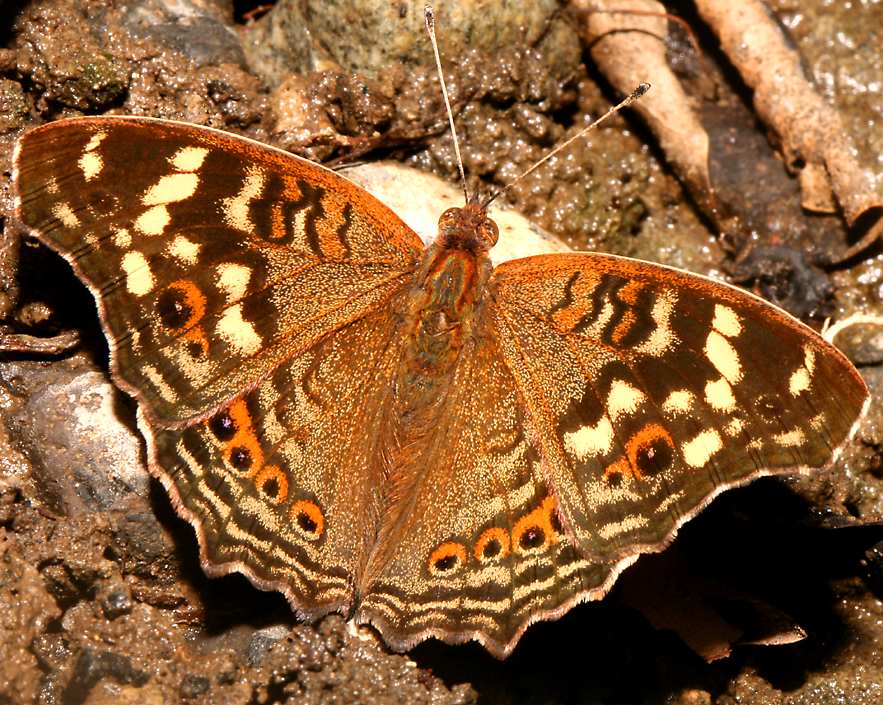
for everyone to like butterflies like this one I photographed in West Bali
national park, but some of the less cute critters drive people crazy.
Since I don't want to be held responsible for anyone's descent into insanity,
I've arranged this page in order of the cutest bugs to the freakiest, and
you can choose the point at which you want to bail out! |
 |
| I
photographed quite a few attractive butterflies, but this page has limited
space so I'll put those on a separate Butterflies of Indonesia page.
Instead, let's immediately move onto their cousins the moths, starting
with this weird apparition with clear windows in its wings.
With these windows the wings look like a face with eyes, which is probably
a ploy by the moth to scare away predators. |
 |
| I
saw enough of these critters in my three week trip to Indonesia to put
together an entire page of Moths of Indonesia. This one doesn't
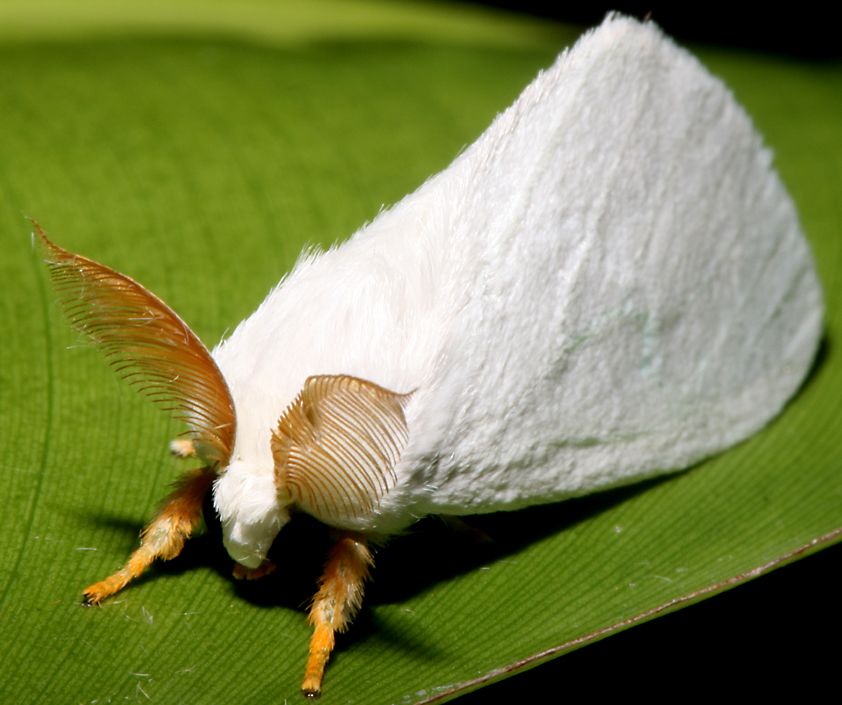
have interesting wings, but look at those antennae! This is
a male moth, and those giant feathery antennae are its means of sniffing
out the pheremones wafting from the female, which might be hundreds of
meters away, or even more distant. |
 |
| Although
I spent an entire week in Bali and Java, all of the moths on this page
come from a two day stay I had just outside the town of Tomohon in northern
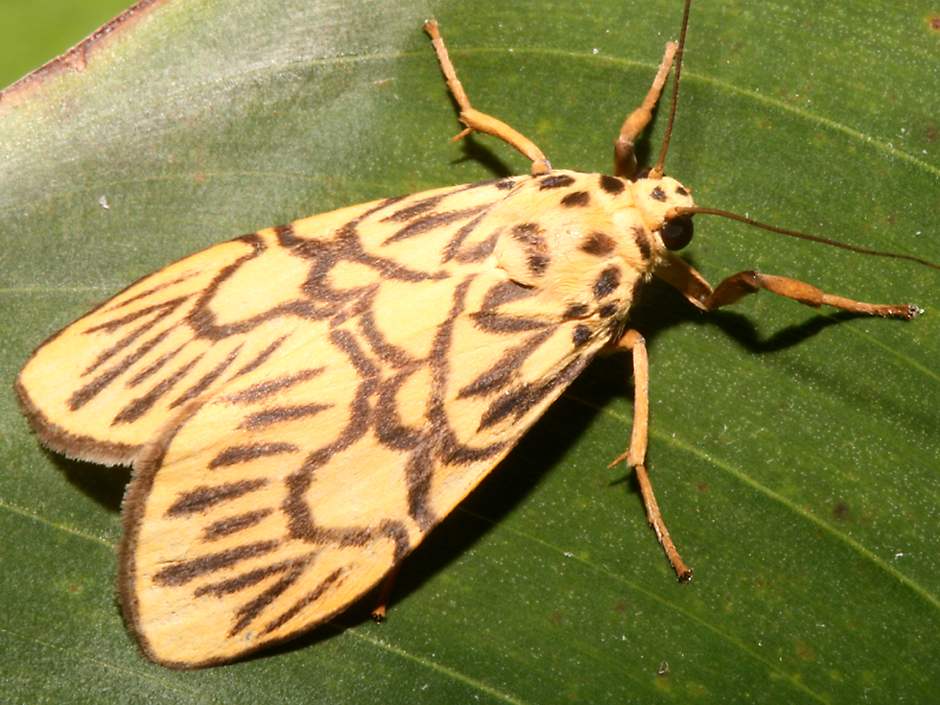
Sulawesi. This is one of the first interesting moths I encountered,
it was on the ceiling of the small restaurant in the resort I was staying
at. This extraordinarily patterned moth seems to be quite common
in these parts, I saw 3 or 4 individuals in my time there. |
 |
| This
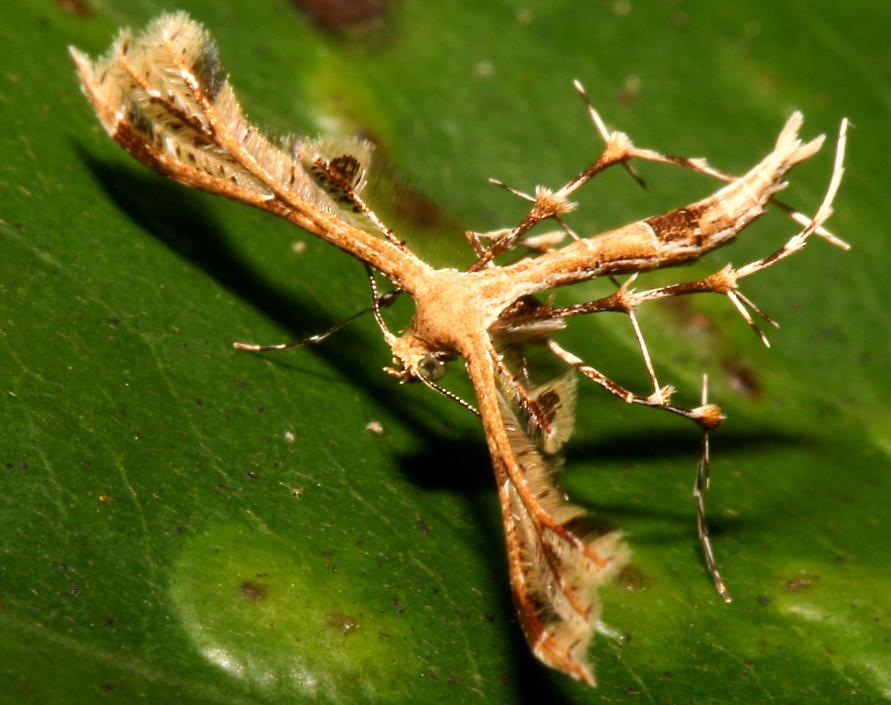
weird and wonderful looking thing is a plume moth, a member of a family
which gets its name from its bizarre feather-like wings. There
are about 1000 species of plume moth, with more species in a family called
"many plumed moths" because they have 12 to 20 separate "plumes" making
up the wings, instead of the 2 or 3 you see here. |
 |
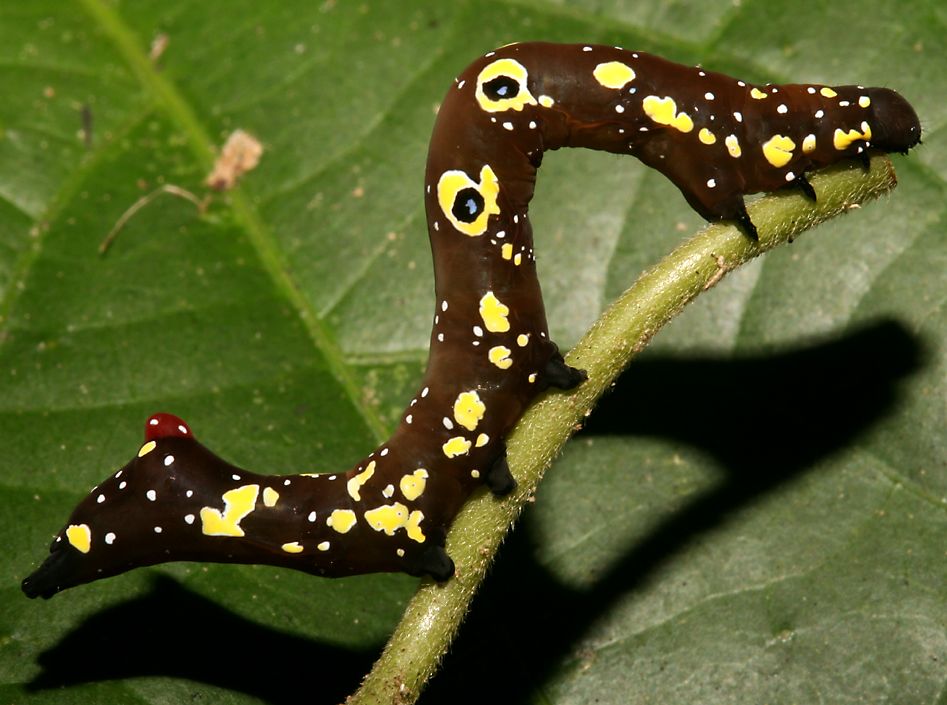
| The
raised tail of this attractive caterpillar is a giveaway that it belongs
to a family of moths called "prominents", which receive their name from
a very prominent tuft of hair which sticks up from the back of the adult's
forewings. Many adult prominent moths have no mouthparts and
don't eat at all during their short adult life. |
 |
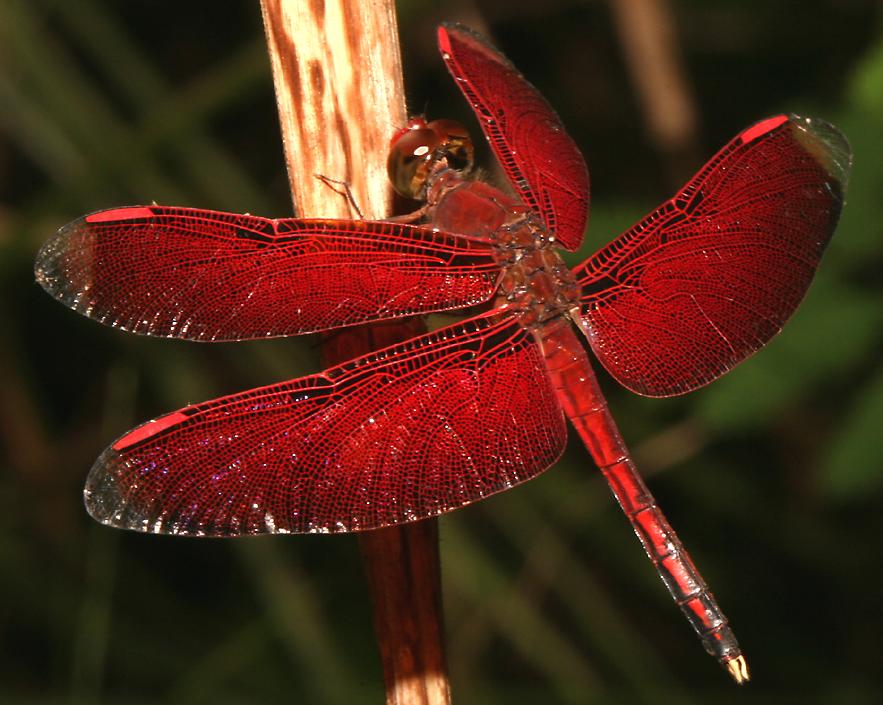
| After
butterflies, dragonflies like this one are usually the most socially acceptable
type of bug in western society, though some people do needlessly worry
about being bitten by them! Some have common names, but this
attractive dragonfly has to struggle through life bearing only the scientific
name Neurothemis terminata. |
 |
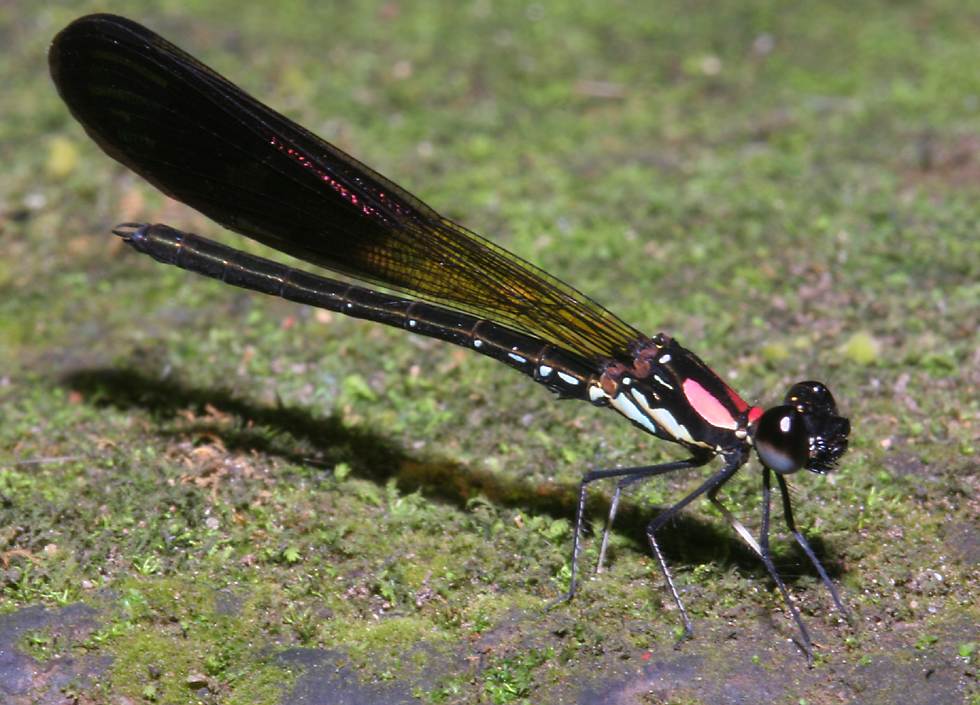
| There
are also many attractive species of damselfly, a close relative of the
dragonfly. And if you thought that the dragonfly had a hard time
with its name, then spare some pity for this wretched damselfly from the
Ubud monkey forest in Bali, which has the moniker Rhinocypha fenestrata
cornelii. Even his best friends resort to calling him "Hey
you!". And yes, the claspers at the end of the abdomen do signify
that this is a male. |
 |
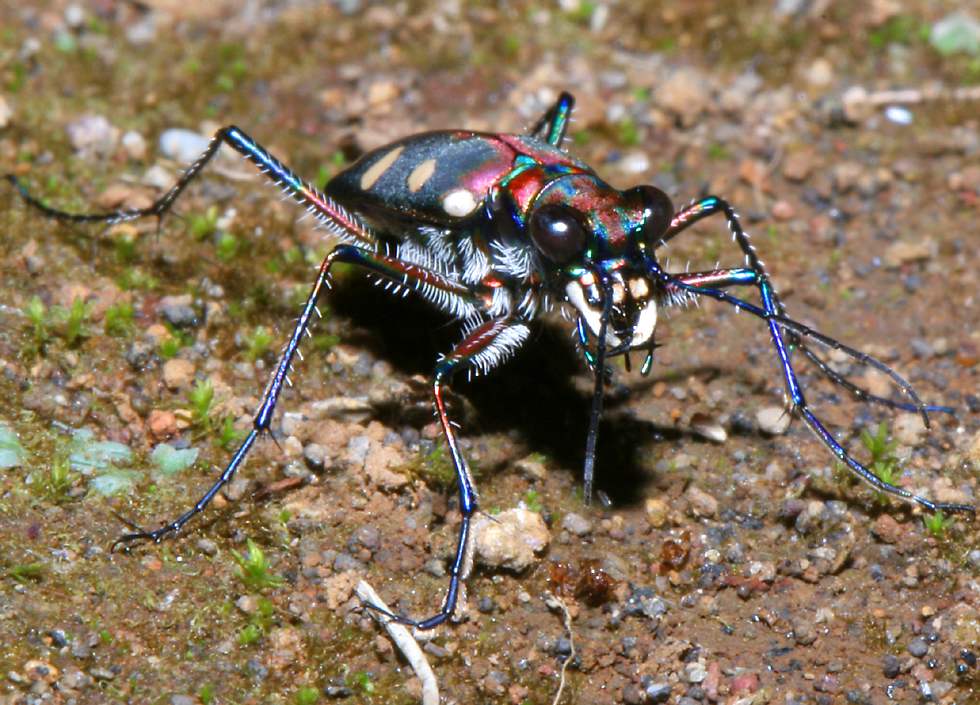
| One
step downwards, but what a doozey! This blue-spotted tiger
beetle is actually very attractive, but most people will probably only
notice those giant bug eyes and the wicked looking jaws. It
seems like those jaws have been busy, too, as evidenced by the small pile
of insect shell on the ground, and a small trace on the beetle's left pincer,
all probably the leftovers of an ant. An interesting feature of this
species is the pale colored hairs on the bottom half of its front legs,
which it probably uses as a brush to remove dust and grit from its eyes. |
 |
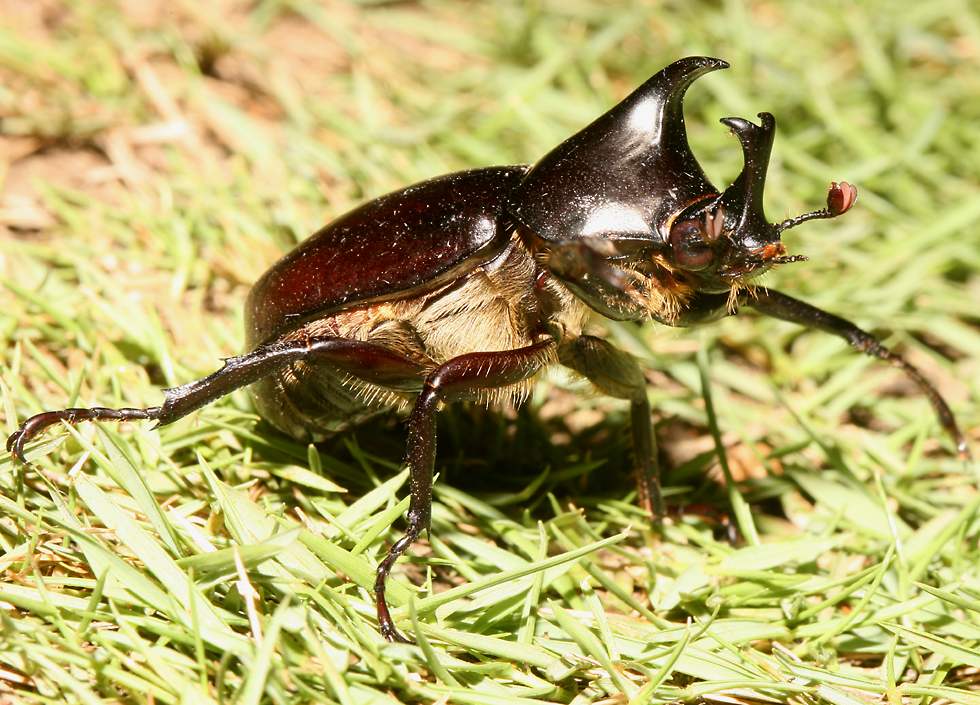
| This
coconut palm beetle belongs to the family of rhinoceros beetles, so named
because of their size and the large horns on their head. Male
rhinoceros beetles use these horns to fight against other males, which
leads to a favorite game of children throughout Asia - organized rhinoceros
beetle fighting! |
 |
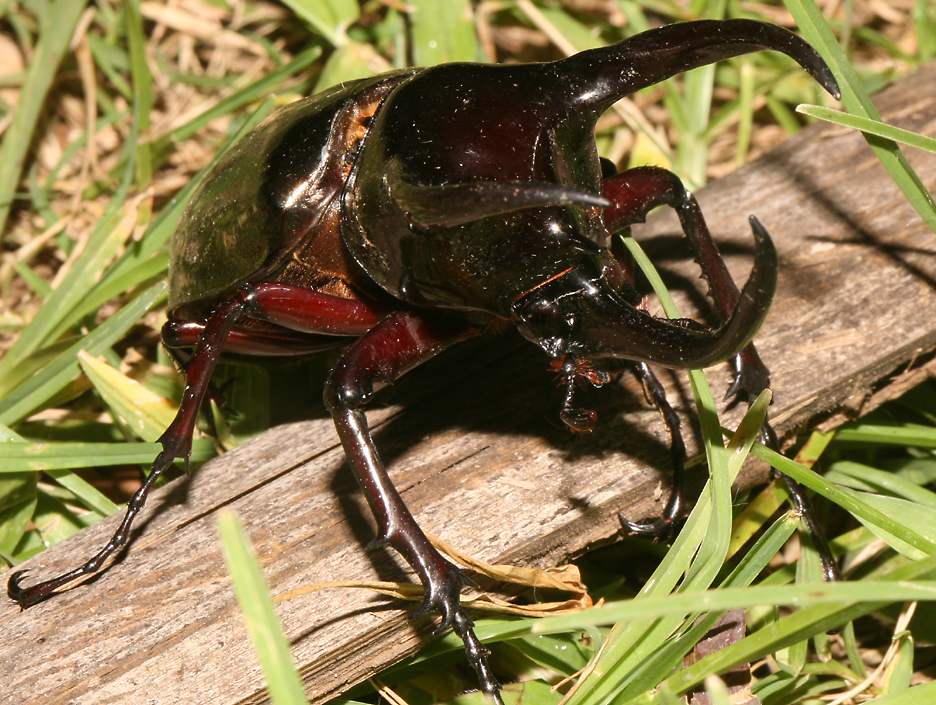
| This
Atlas beetle is an even larger type of rhinoceros beetle, with truly awesome
weaponry. This amazing animal can reach 14.5 centimeters in
length, which makes it all the more astonishing when it opens its wing
cases and flies away! |
 |
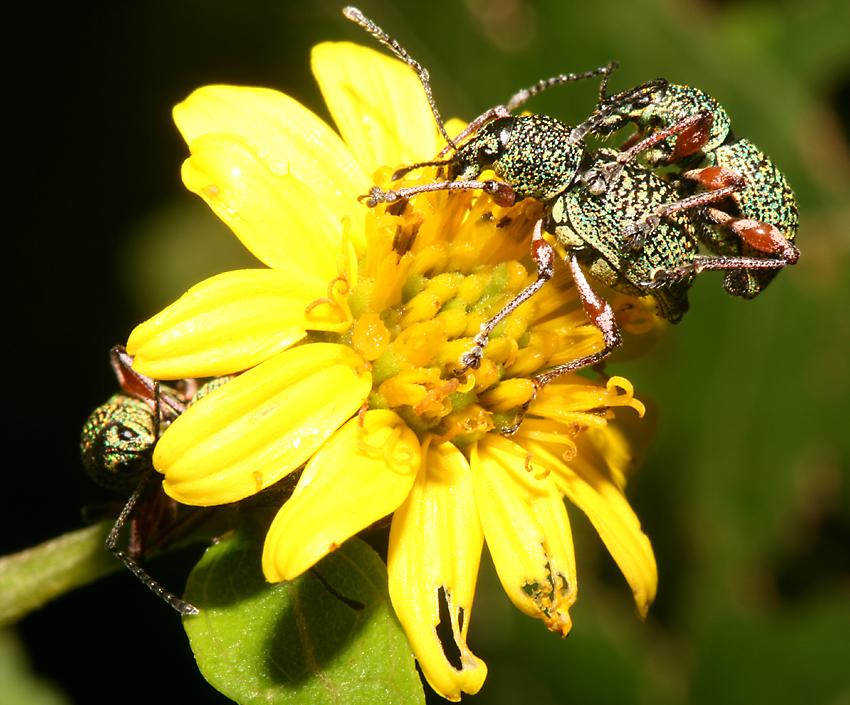
| An
attractive pair of weevils doing what comes naturally - eating and mating!
There are more species of beetle in the world than any other category of
animal, and more species of weevils than any other type of beetle, which
I guess makes weevils about the most successful type of animal on the planet.
With all of that eating and mating, and a complete absence of two-party
politics, weevils are probably also about the happiest creatures on the
planet. As you can see, the weevil community does suffer from
a certain amount of voyeurism, but surely that's the lesser of two weevils? |
 |

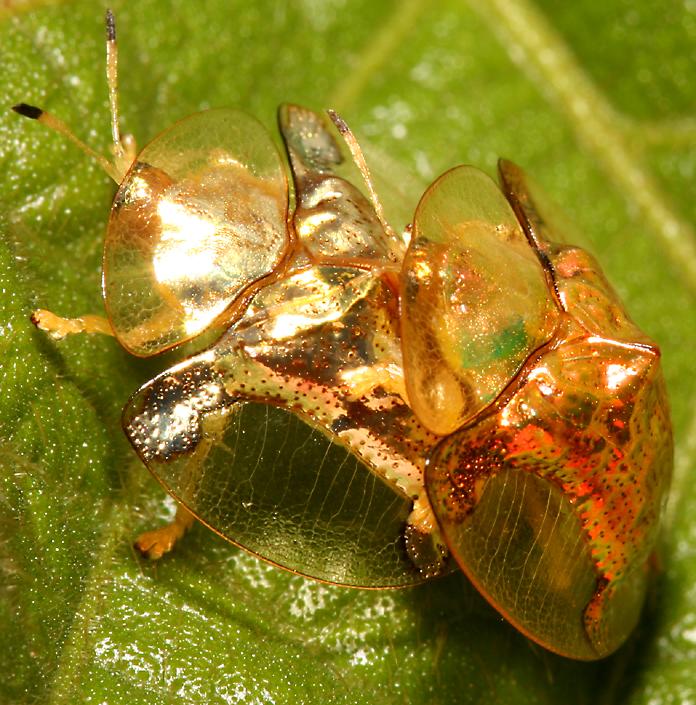
OK, be like that then.
I'll move onto a different topic, but not too different!
These amorous critters are tortoise beetles, so named because of the tortoise-like
shell which they can pull down very strongly to the surface of a leaf,
thereby avoiding the attentions of predators such as ants.
These tortoise beetles are a very attractive gold color, some species can
change color very rapidly when disturbed by adding or removing liquid from
immediately under their shell. |
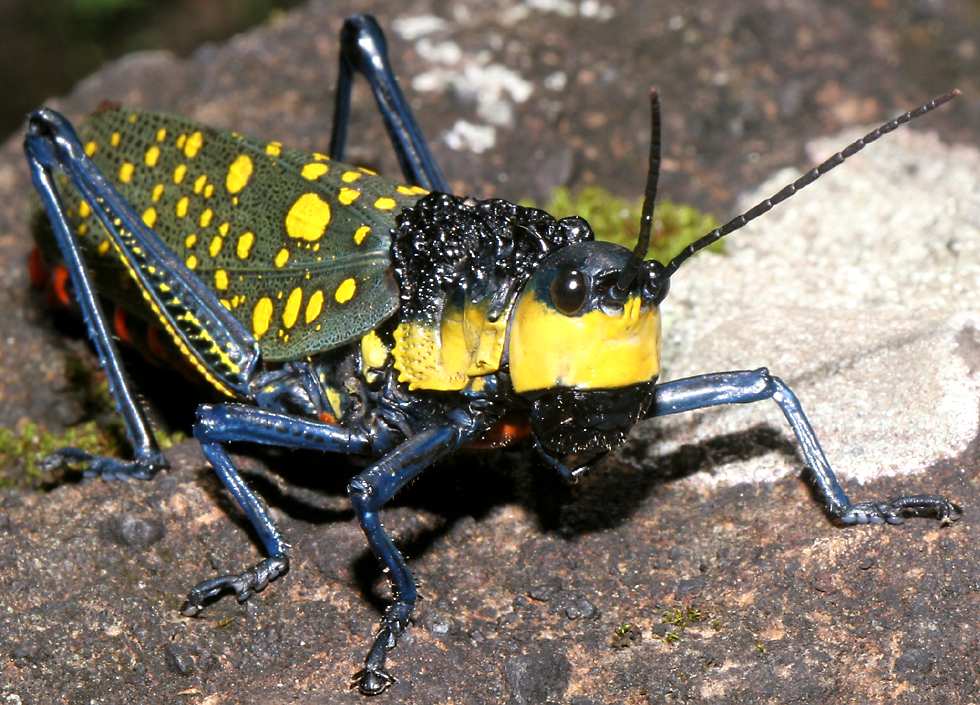
| This
grasshopper is by far the most attractive that I've seen anywhere, with
spectacular yellow markings and a bright red abdomen, all of which probably
signifies that it tastes really bad! I found it at the Hindu
temple Gunung Kawi on the island of Bali, along with some attractive dragonflies,
butterflies and jumping spiders. |
 |
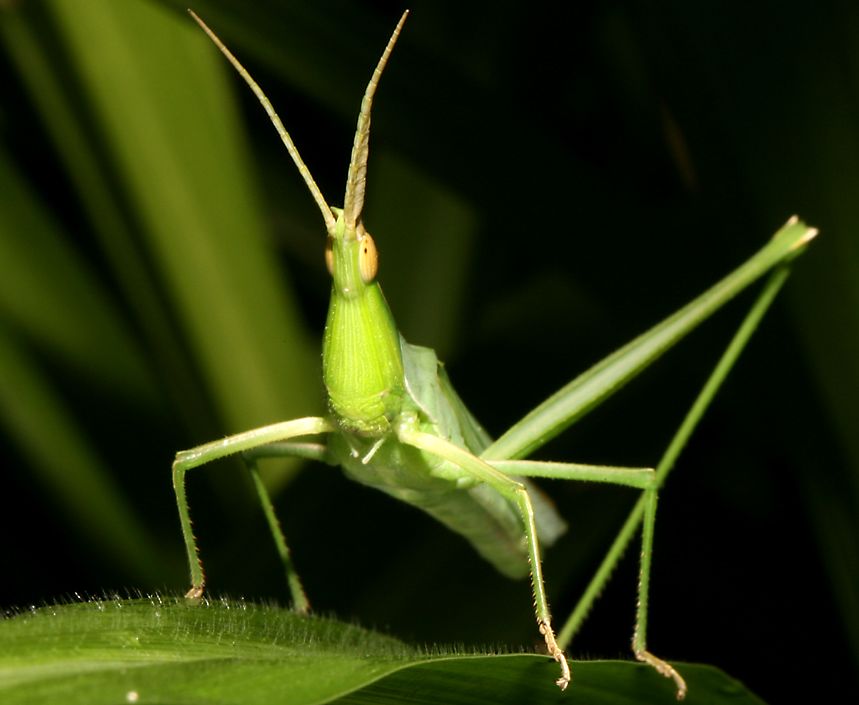
| This
conehead grasshopper doesn't have any interesting colors, but its shape
certainly makes it noteworthy. It was on a stalk of grass next
to a small river near the
Buddhist temple of Borobodur, I walked along the river for a few hours
at night using my flashlight to pick out all sorts of cool critters, including
two varieties of snake! Although they're called grasshoppers,
coneheads are actually a variety of katydid. |
 |
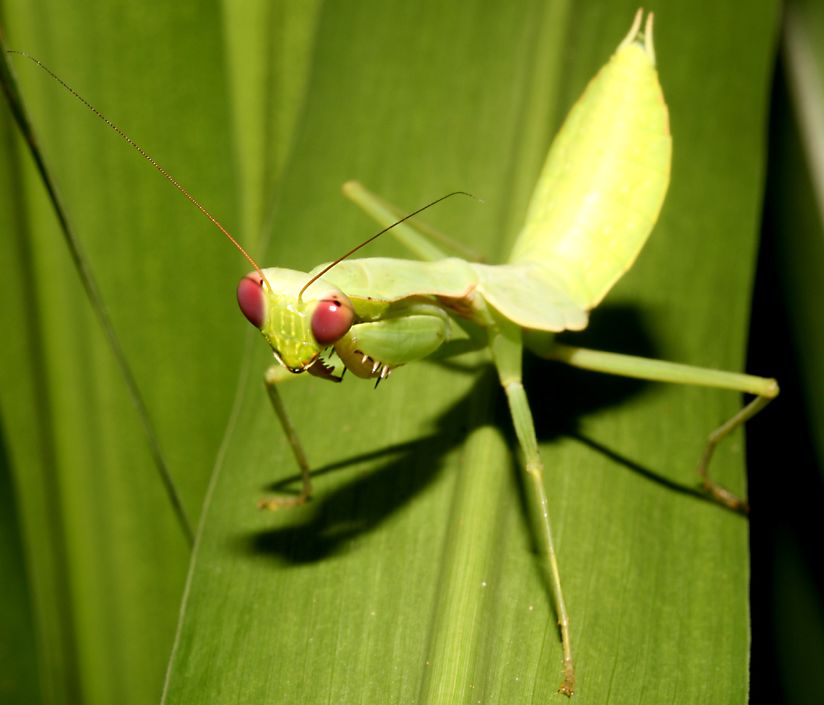
| This
mantis is another inhabitant of that Borobodur riverbank. Mantids
are visual hunters, so it's unusual to see this fellow out at night, but
maybe it was trying to sleep rather than trying to hunt. |
 |

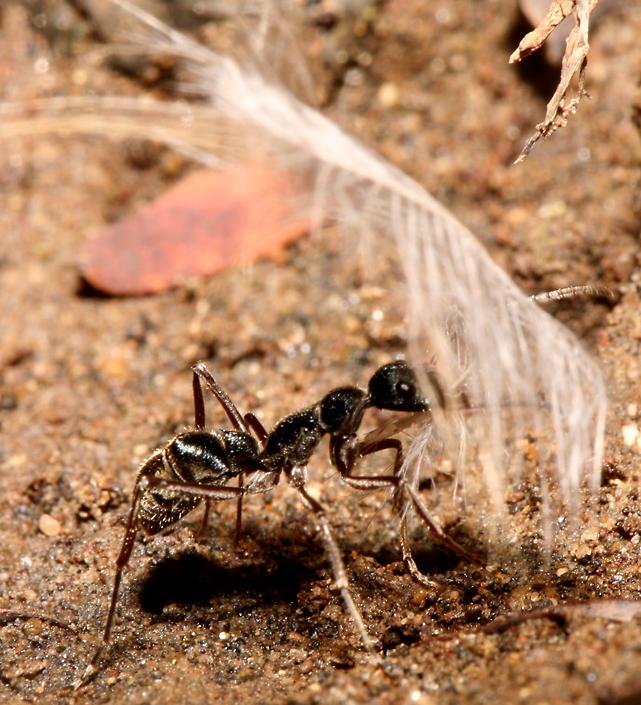
This ant walking along a riverbed in West Bali national park has found
a feather, which it's decided to take back to the nest.
I'm not quite sure what it expects to do with it back there, it can't be
eaten and I can't picture an ant using feathers to build a bed! |
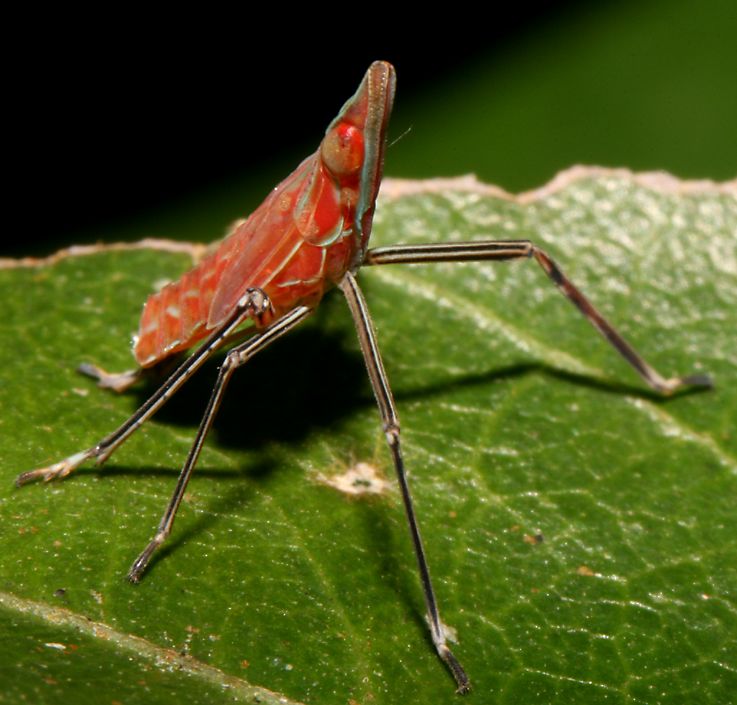
From bugs to true bugs.
Although most people refer to any sort of creepy crawly as a bug, scientists
use the term "bug" to refer to a particular group of insects, which is
distinguished from other insects by the presence of a "rostrum", or sucking
tube which is normally tucked under the head and body of the "true bug",
and swung out at feeding time. Scientists use the term "arthropod"
to refer to insects, spiders and the other critters most people think of
as "bugs".
Some true bugs are carnivorous, catching beetles, caterpillars and other
insects to eat, while many true bugs like this one suck the juices out
of plants.
There are over 80,000 different species of true bug, this one belongs to
the Cixiidae family of the Fulgoroidea super-family, the latter of which
is more commonly referred to as "planthoppers". Remember these
names well, because there's going to be a test at the end of this page! |
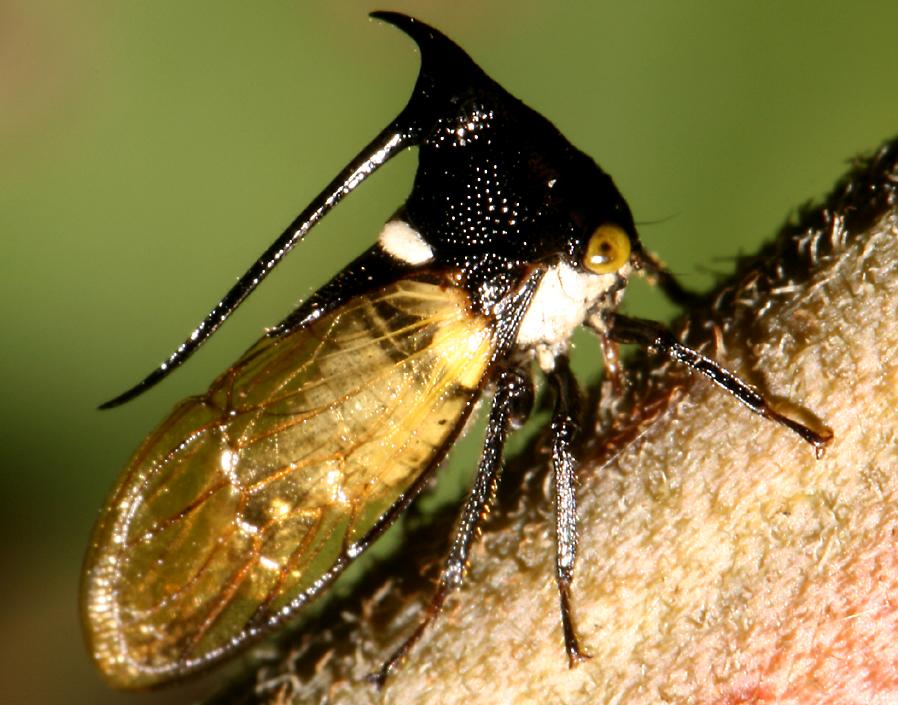
| This
weird looking apparition belongs to the "treehopper" family of true bugs,
some of which are shaped like thorns, and others of which have a crazily
shaped "pronotum" on top of their heads, like this one. This
individual was at the workers' camp a short distance below the
volcanic crater lake Kawah Ijen. The workers who saw me
taking photos of this bug thought I was crazy, until I showed them the
photo and then they started oohhing and aahhing and looking around for
it in the bushes, though by this time it had already bugged out. |
 |
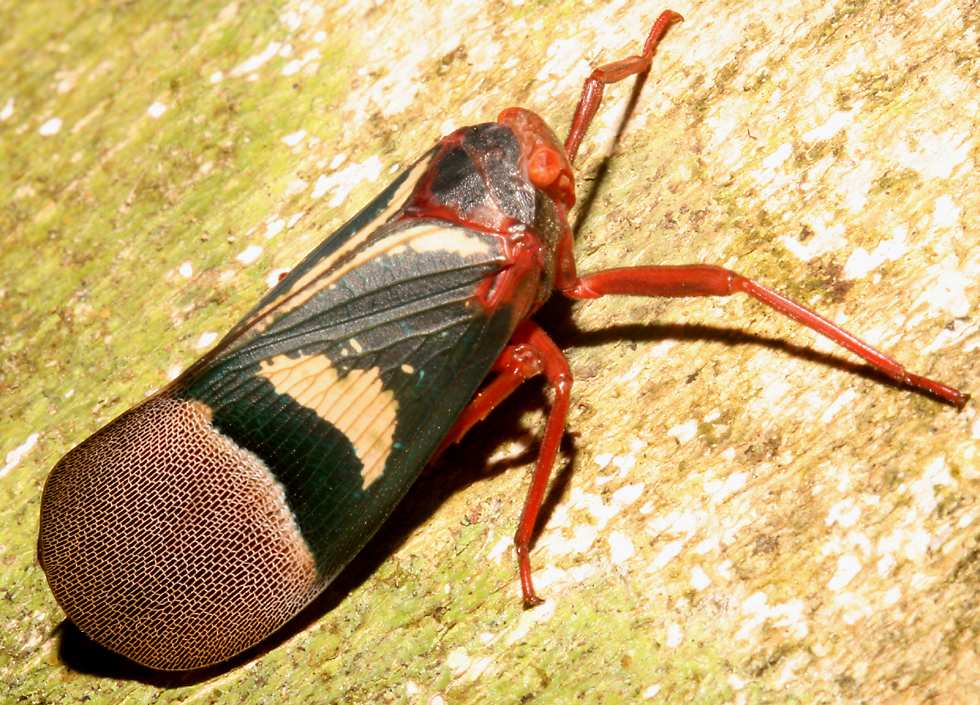
| I've
seen a true bug like this before, in Malaysia, and I thought it was a type
of cicada, but now I realize that it's actually a froghopper.
When they're young they're know as "spittle bugs" because they sit on the
stem of a plant sucking juices and surrounding themselves with copious
amounts of bubbling foam, as a means of keeping predators away.
And you thought you had an unpleasant childhood! |
 |
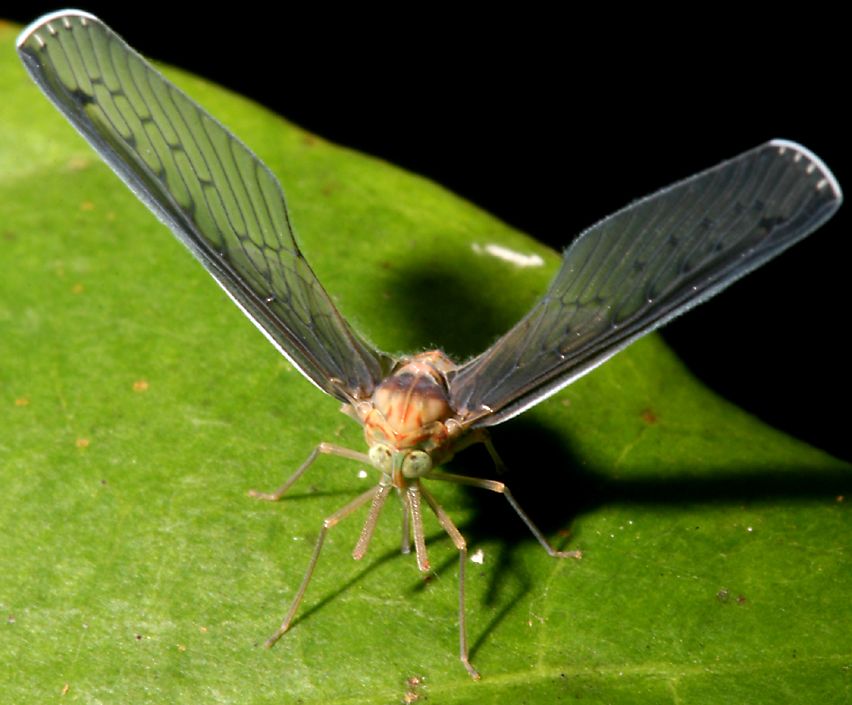
| This
comical looking creature with the oversized wings is another member of
the planthopper family, this time in a sub-family with the tongue-twisting
name "Dictyopharidae" (don't forget the test at the end of this page!). |
 |
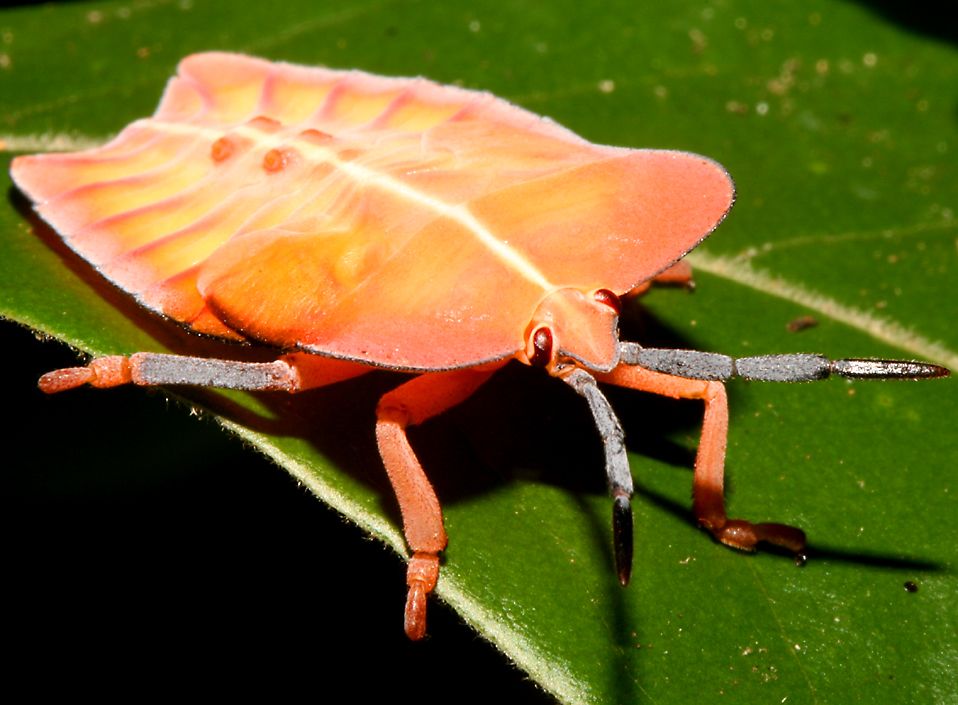
| This
is probably one of the last bugs you want to meet, a juvenile stink bug
- those four lumps on its back are the outlets of the stink glands, and
it didn't hesitate to use them on me! The juveniles or "nymphs"
of bugs are easy to recognize because they have undeveloped wings.
As a bug sheds its skin and goes from "instar" to "instar", the wings become
more and more developed until the final "instar" turns into the adult "imago". |
 |
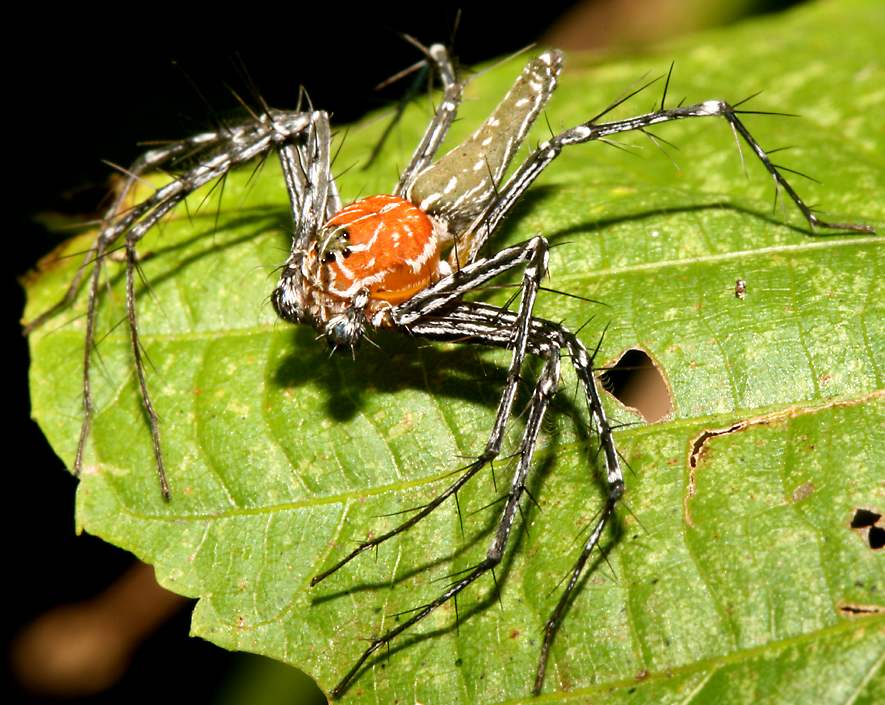
| OK,
let's crank up the Fear Factor with some nice spiders, like this very attractive
male lynx spider. There are 420 species of lynx spider in the
world, they're distinguished by having six of their eight eyes arranged
in a hexagonal pattern, and also by the large spiny legs they use to ambush
passing prey. As with many other spiders, males are recognized
by the bulb-shaped pedipalps in front of the head, which they use to siphon
up sperm for mating with a female. |
 |
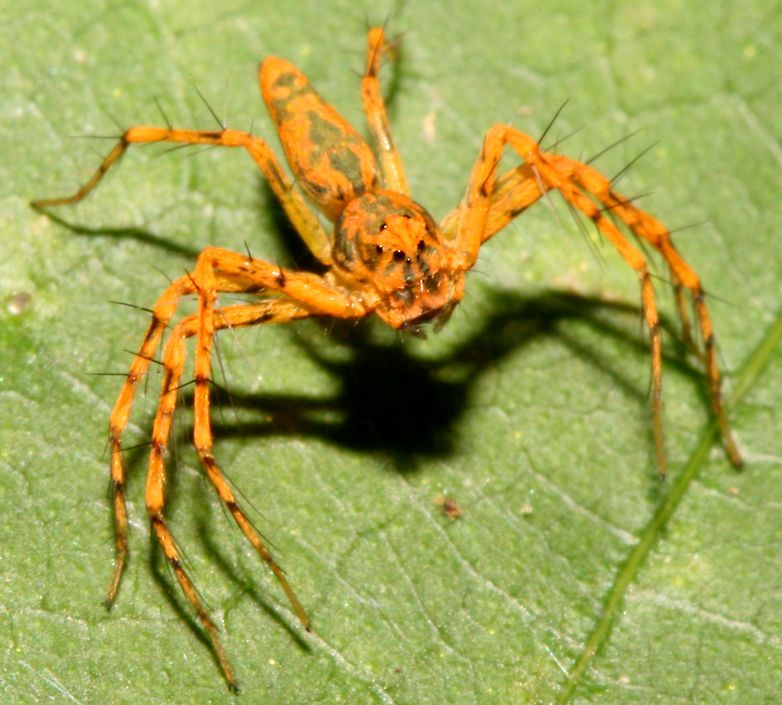
| I
don't know about you, but I find this lynx spider creepier than the last
one, even though it's quite a bit smaller. The color is certainly
unusual, but perhaps the creepiness is due to those two fangs sticking
out under its jaws. |
 |
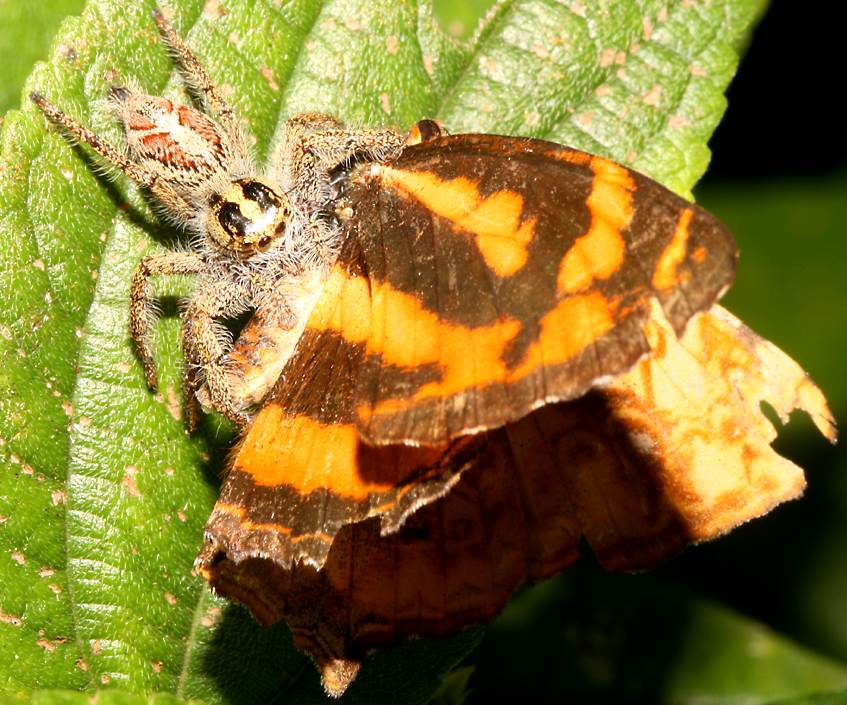
| Like
lynx spiders, jumping spiders don't build a web, instead they go out and
hunt their dinner. Lynx spiders have adequate but not spectacular
eyesight, but jumping spiders have excellent vision, allowing them to walk
around their environment and actively stalk their prey, rather than waiting
in ambush for something to come by. It's apparently a very
successful strategy, since jumping spiders comprise the largest family
of spiders, about 5000 in total, making up about 13% of the estimated 40000
spider species. |
 |
| They're
also some of the most beautiful of spiders with attractive, often metallic
colors, like this tiny female guarding her eggs. They have
great personalities, too - the two large main eyes which are a distinguishing
feature of the family make these spiders look more engaging, and unlike
almost all other spiders they'll actually turn and look at you.
If they decide you're a threat then they will often move to the underside
of the leaf they're on, otherwise they'll continue about their business,
stopping from time to time to check that you're not doing anything nefarious. |
 |
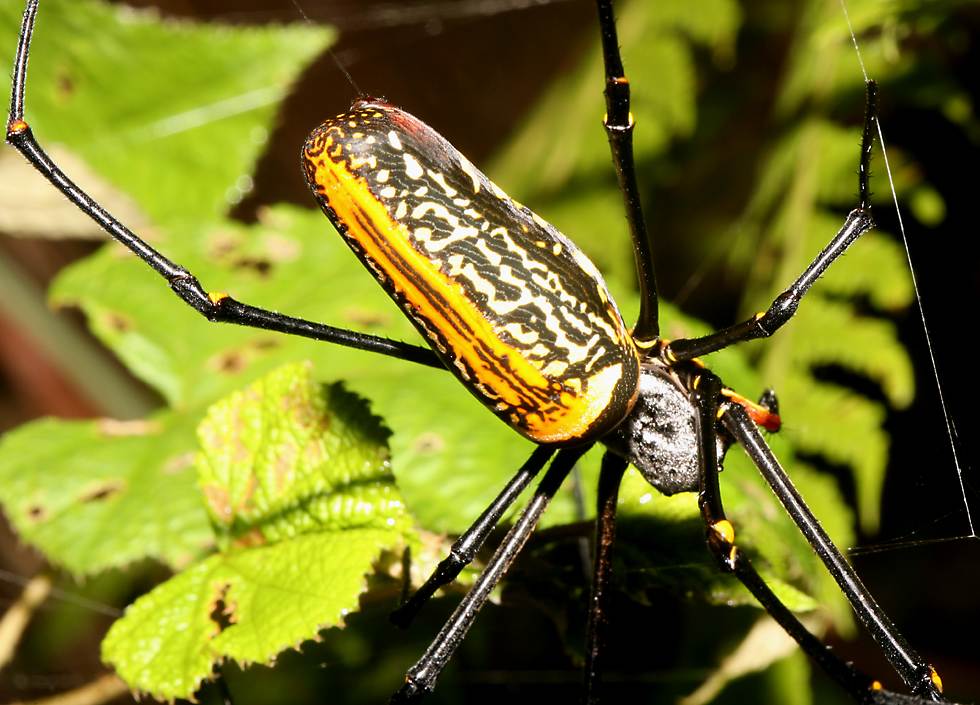
| This
giant wood spider has beautiful colors and shapes on her body, but sheer
size puts her into the "freakout" category for most people.
This species is common throughout Asia, from Japan all the way down to
Australia. They're harmless but seriously large, a full 20
centimeters from toe-to-toe! They make the largest web of any
spider, up to 2 meters across, and the silk is even strong enough to trap
small birds. The males are far, far smaller, measuring only
5 or 6 millimeters from end to end. |
 |
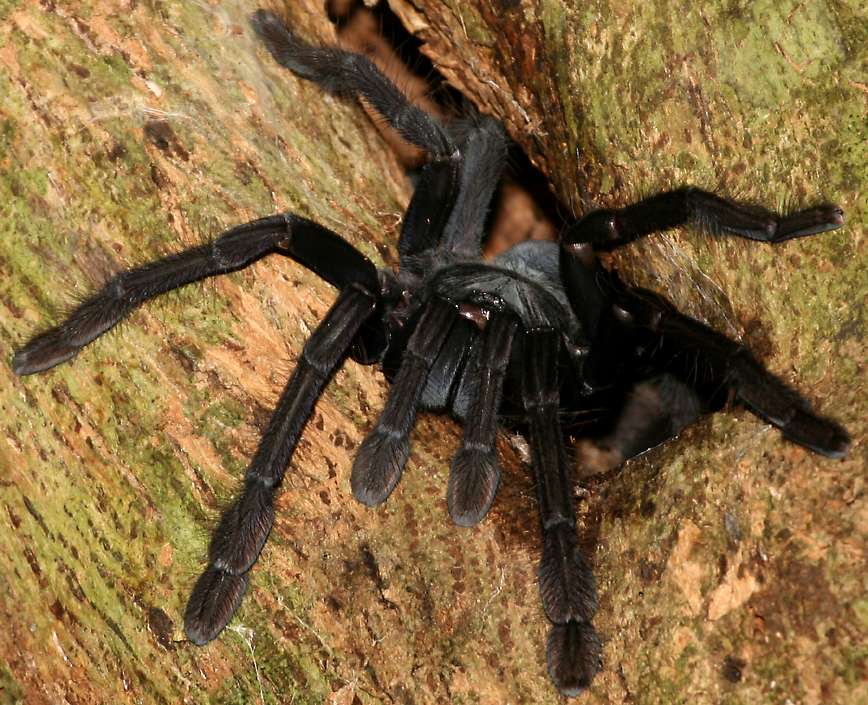
| The
giant wood spider is large, but this tarantula is just as big across with
much fatter legs and far bigger fangs! I took this photo at
night in Tangkoko nature reserve in northern Sulawesi. |
 |
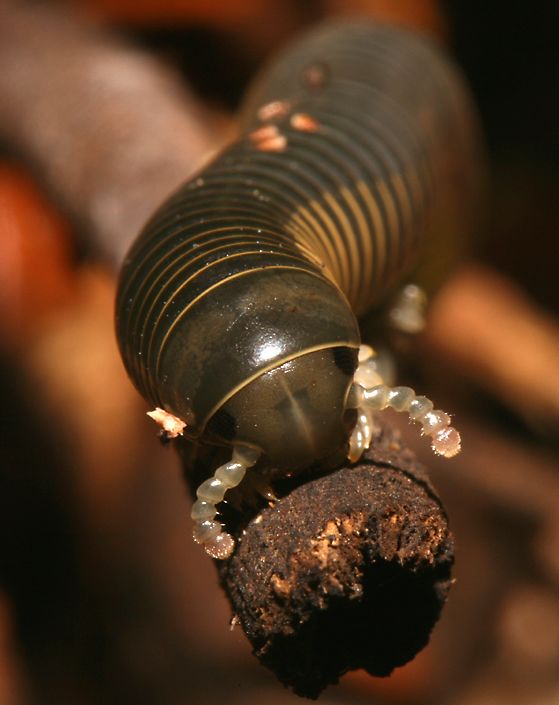
The forest floor at Tangkoko was pretty much covered with dozens upon dozens
of these millipedes.
Millipedes have the distinction of being the oldest known land animal,
a 428 million old specimen turned up just a few years ago in a fossil bed
in Scotland, which back then was in the tropics!
They're still going strong, with over 10000 species around the world, the
largest being an African giant which reaches a length of 28 centimeters.
In this photo it's possible to make out two oval shaped structures just
above the antennae called the Tomosvary organs, whose exact purpose is
uncertain but is thought to be either detection of humidity levels or chemoreception. |
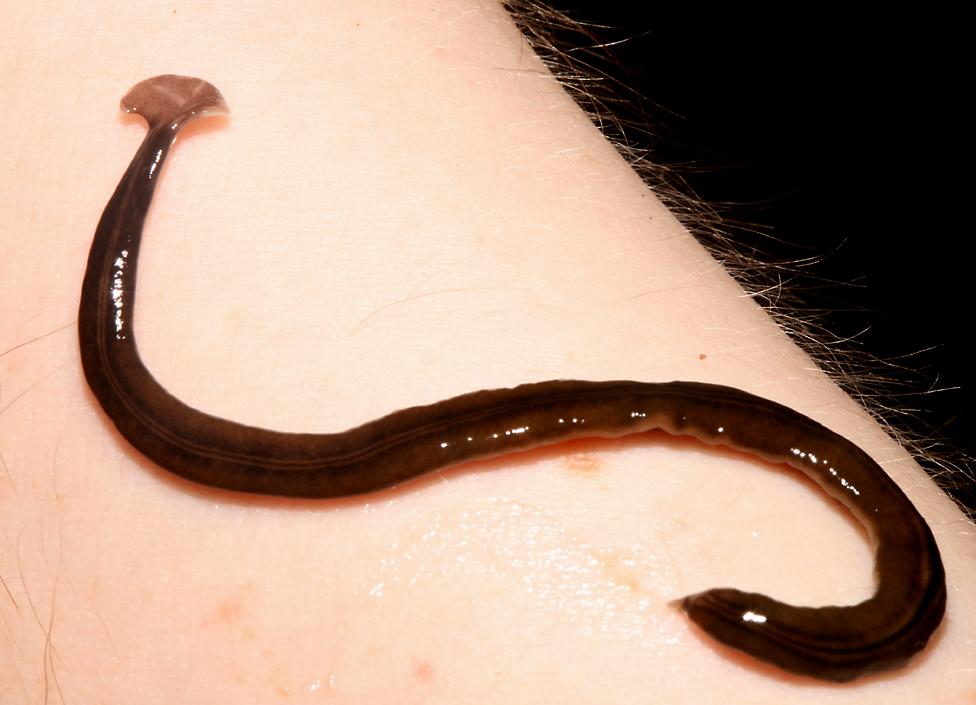
| You're
not freaked out yet - what's wrong with you people? OK, here's
my last shot. This is what I thought was a leech which I found
in Alas Purwo national park at the south-eastern corner of Java.
After being sucked nearly dry by leeches in Vietnam a couple of years ago,
I was very cautious about them in Indonesia, however I didn't find this
during the hours and hours I spent in the jungle, instead it was in my
rented car when I was leaving! Turns out though, that it's
not a leech, but a shovel-headed garden worm, which is carnivorous but
not at all interested in eating me. |
 |
I
dare you to check out the Cold-Blooded
Animals of Indonesia, the Spiders
of Vietnam, the Butterflies
of Vietnam, the Bugs of Russia
and the Wildlife
of the Philippines!
 |