
Bugs of Vietnam
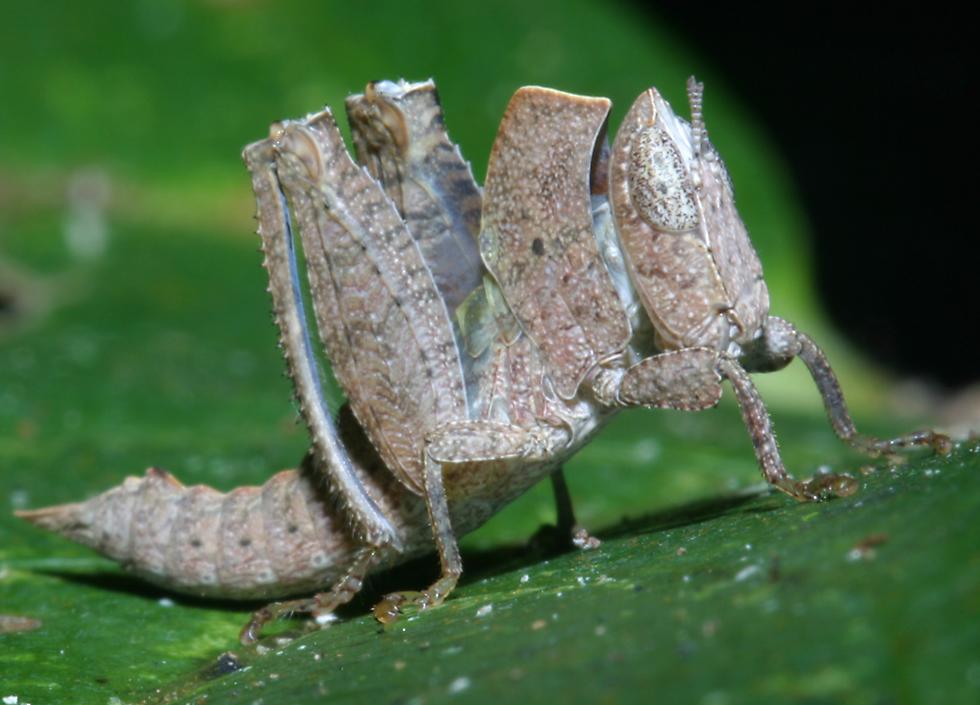
The bugs come weird and wonderful in Vietnam! This strange looking grasshopper was in Cat Tien national park, north of Saigon, where I spent two days and two nights. I'm not sure if the shields on its shoulders are meant to break up its appearance to camouflage it, or if they just make it harder to swallow. |
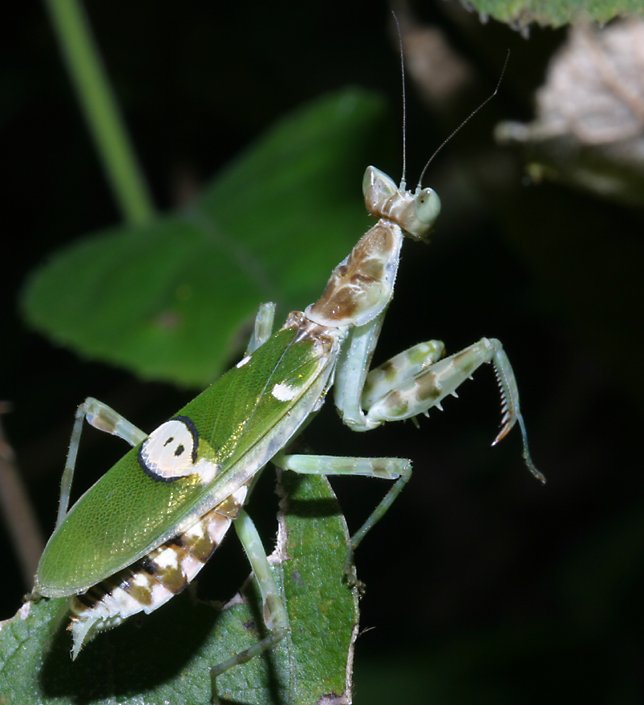
The interesting colors and unusual shape of the eyes of this jeweled flower mantis have made it a very popular pet in the western world, which unfortunately has led to a proliferation of common names for this species, including Asian flower mantis, Asia flower mantis, Indian Flower Mantis, Malaysian flower mantis, Malay flower mantis, Indonesian flower mantis and Thailand flower mantis! For the record, its scientific name is Creobroter gemmatus, which means "jeweled flesh eater", an appropriate name for this hunter. |
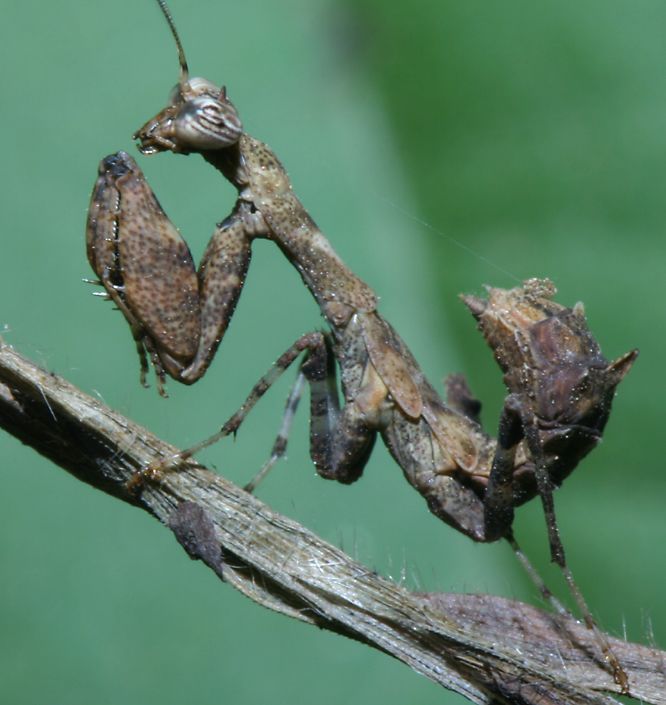
This small juvenile mantis was also at Cat Tien; you can see undeveloped wings just above its second pair of legs. It looks like it's mimicking a dead twig. The colors and the upturned abdomen combine to provide good camouflage both against whatever it's hunting and whatever might be hunting it. |
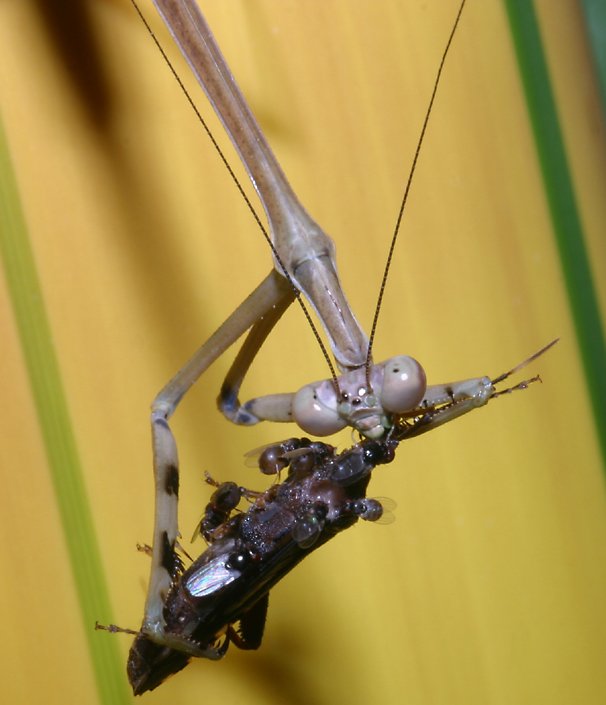
There are about 2,500 species of mantids scattered around the world. They all have excellent eyesight and are unusual among insects in being able to swivel their heads widely, so they can fix their eyes on their prey without scaring it by moving their whole body. They are very good at judging distances and have spiky arms to hold their prey securely. The one you see here was perched on a large bamboo trunk at Cat Tien, where it caught an assassin bug, itself an efficient predator. Six or seven tiny flies have detected the kill and joined the feast; one of them is right next to the mantid's mouth, apparently unconcerned about being eaten. |
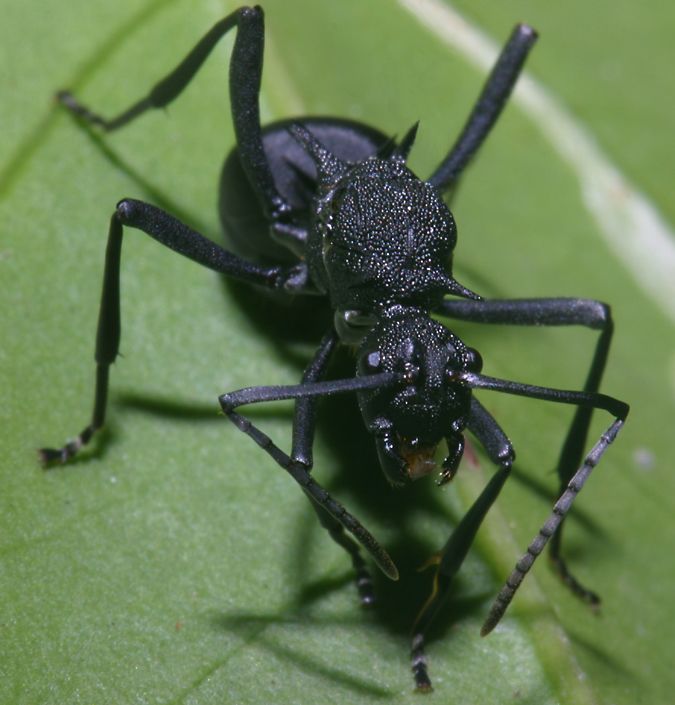
Talking about efficient predators, here's an ant nibbling away on something tasty that it found in its excursions. Ants are difficult prey because of their aggressive nature, strong biting jaws and chemical defenses. This one is even more difficult than most, with large spikes on its thorax pointing in every direction, which would make it very unpleasant to swallow. |
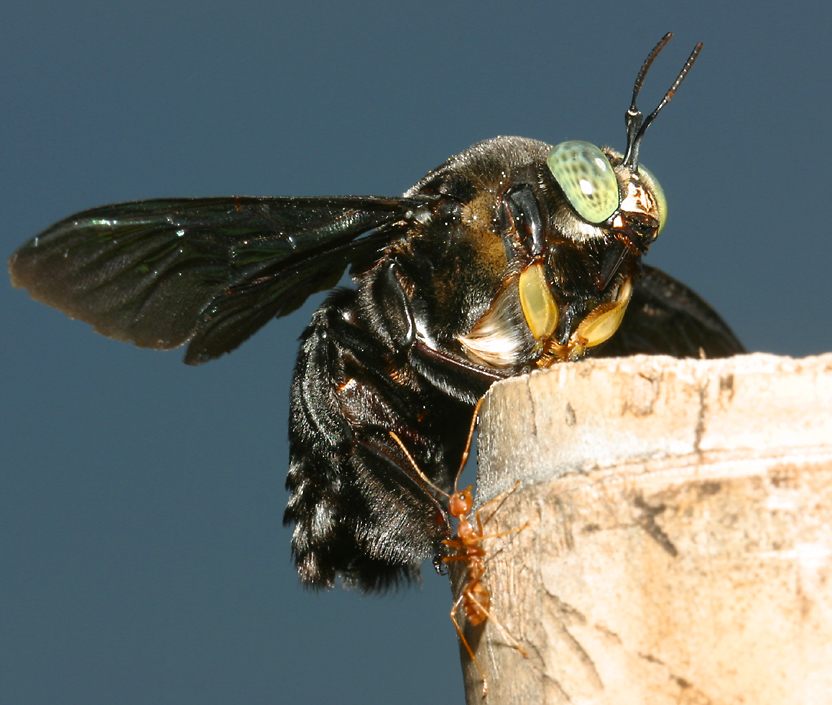
If you look closely you'll notice another ant in this photo, but for a long time I wondered exactly who the big guy was. It took me several years before I even knew what category of insect it is. The eyes and body reminded me of a beetle but the wings were obviously wrong; and it couldn't be a fly, because it has two sets of wings instead of one. In the end I gave up and just referred to it as the "jungle beach predator", because I photographed it at Jungle Beach north of Nha Trang. Well, I was wrong again, because I eventually found out that it's one of about 500 species of carpenter bee which inhabit different parts of the world. Carpenter bees are basically solitary, and despite their size they're harmless because the males don't have a stinger and the females, which do have stingers, aren't aggressive. They get their name from the way they chew up wood to build their nests, like some species of wasp. The females lay some of the largest eggs of any insect, and raise the young within the tunnels they bore into trees. The white face and very large eyes signify that this one is male and belongs to one of the species which hunt for females by sight, rather than using a pheremone to attract the female. |
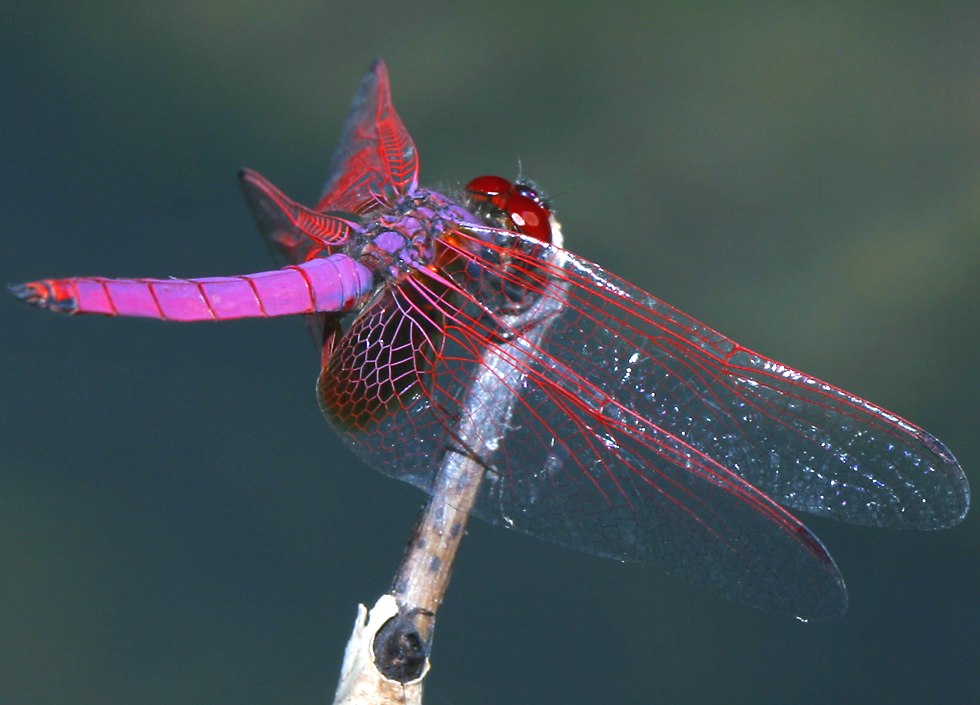
This male dawn dropwing dragonfly was near the stream at the south end of Jungle Beach, where several different species of dragonflies and their cousins the damselflies were going about their business. You can see a male dawn dropwing in Cambodia viewed from the front. |
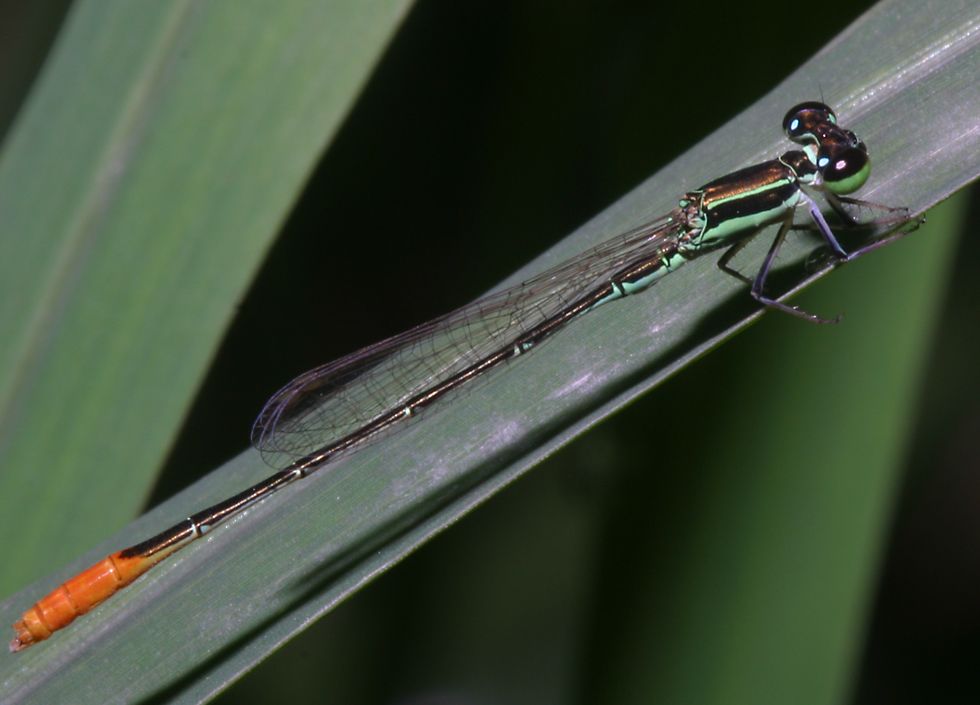
A nice damselfly amongst the tall grass in Cat Tien national park. |
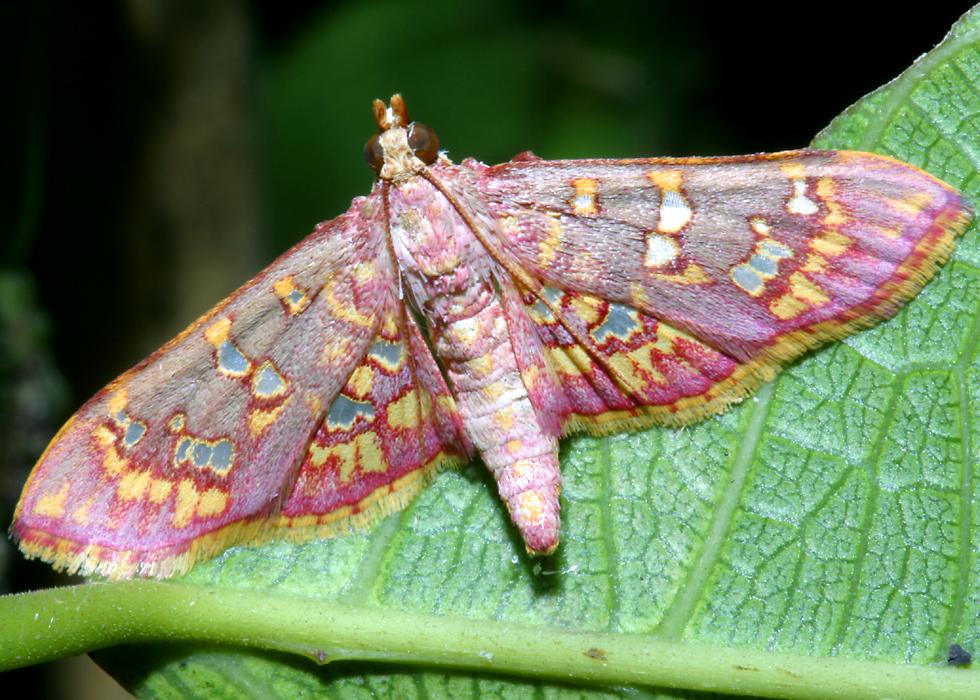
Talking about grass, here's a grass moth called Ischnurges gratiosalis. It's in very good condition, which probably means that it has only recently emerged from its chrysalis. It's really a very attractive creature, with delicate pink and yellow coloration on its wings and on its body, translucent windows on its wings, large scales which look like feathers on its shoulders and more large scales forming fringes on the rear edge of its wings. With so many interesting and attractive moths, I couldn't find space on this page for butterflies, so I put together a separate page of Butterflies of Vietnam. |
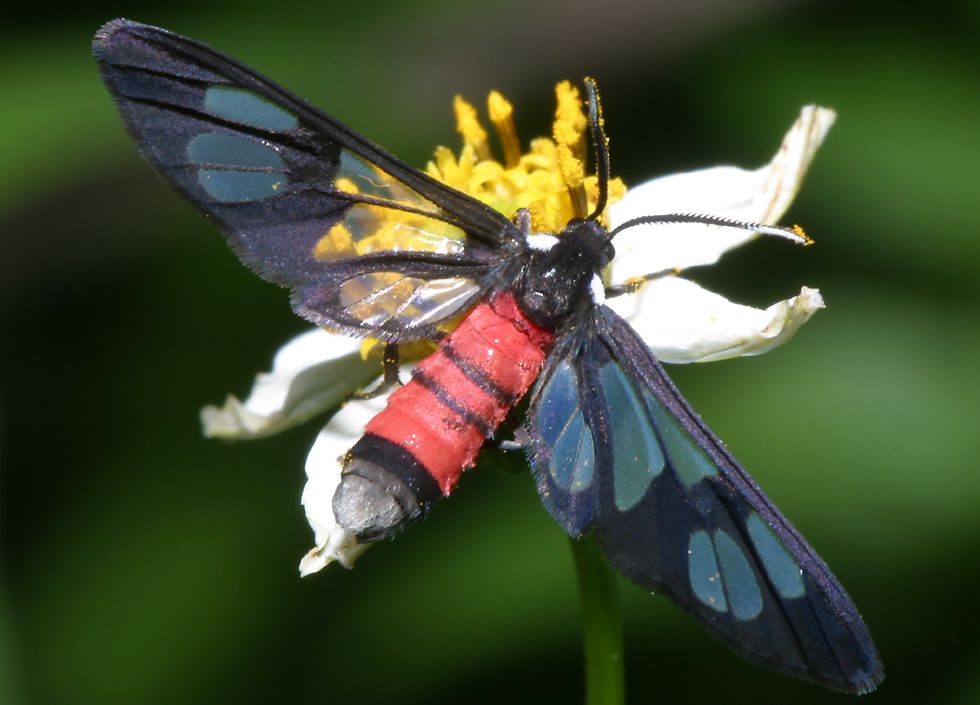
This moth has clear wings, but it's not a clearwing moth! True clearwing moths have a narrower body and look more like hornets, like this clearwing moth in Thailand. Instead it's a tiger moth flying during the daytime on the path up to the Perfume Pagoda, not far out of Hanoi. The colorful body and the fact that it's active in the daytime both suggest that it's toxic, or mimicking something toxic. Quite a few tiger moths have clearwings, like this pair of mating tiger moths in Australia. They can be difficult to identify, sometimes it's necessary to look at the number and shape of the clear windows on the wings. |
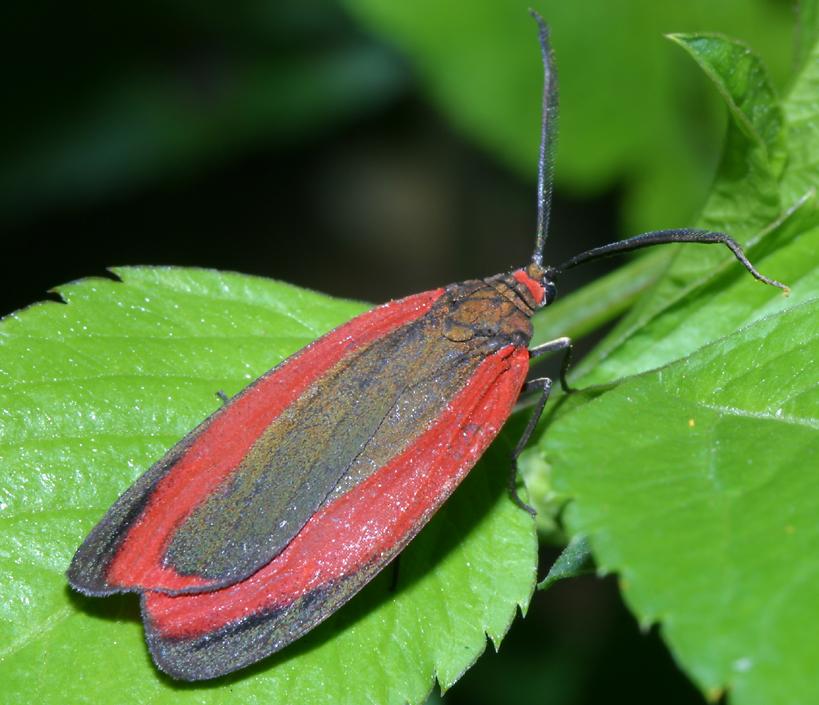
I haven't been able to figure out what the name of this moth is, though I think it might belong to a family called the "burnet" moths, also called "foresters". Whatever it turns out to be, I do like its combination of brown and red livery. |
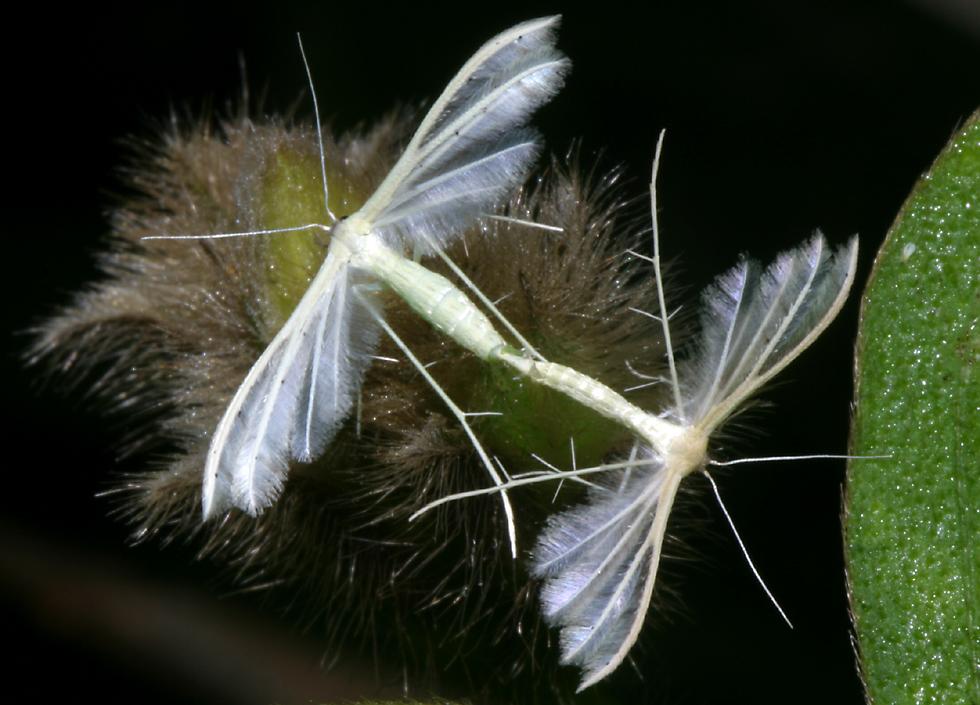
These weird looking animals are plume moths, named after their peculiar feather-like wings, which are quite unlike any other moth or butterfly wing. This is a mating pair and I'm guessing that the fat individual on the left is the female. She'll need that extra body weight to allow her to develop her eggs. |
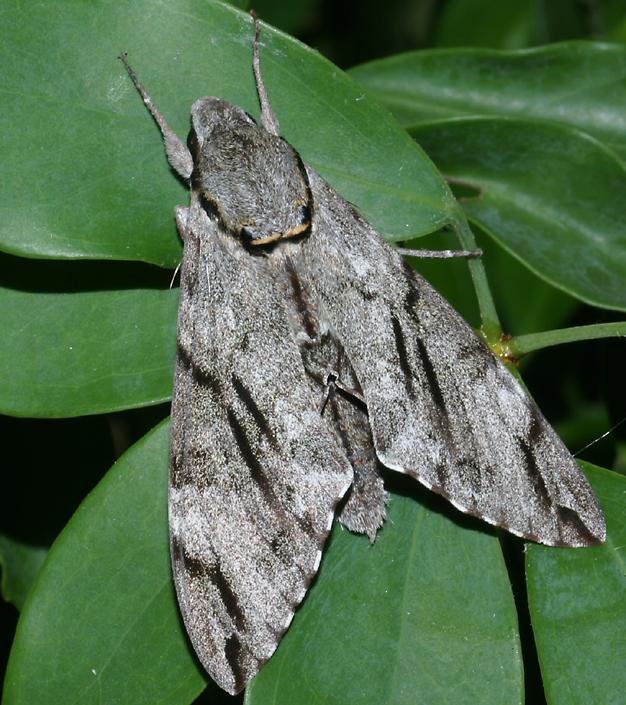
Interesting critters can be found in the strangest places. After flying down from Da Nang to Cam Ranh, we were bussed from the airplane to the terminal. When I sat down in the bus I noticed this sphinx moth on the floor, so I very gradually moved my finger underneath it and lifted it up. When I reached the terminal I took it inside and set it down on the large pot plant you see here. This moth is called Psilogramma increta, and if you look closely then you might notice something unusual about the area around its head - this moth is a spider mimic! The raised area behind its head has the appearance of the head a large spider which is looking backwards, complete with two large black eyes and smaller black eyes around the sides. |
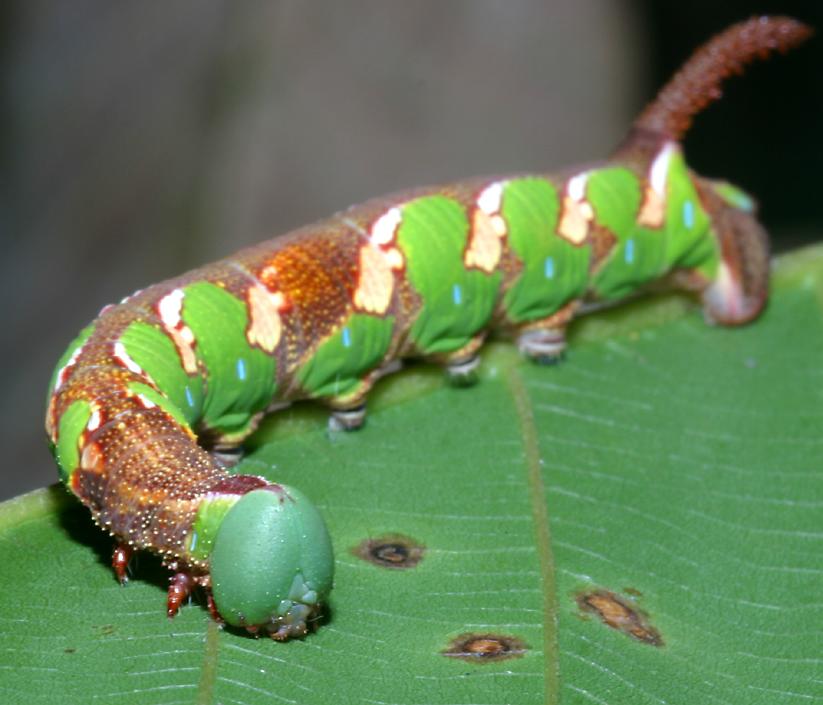
This very large and attractive caterpillar was wandering around at night in Cat Tien national park. The large tail at the rear end makes it look a bit like a puppy, and signifies that it belongs to the sphinx moth family. |
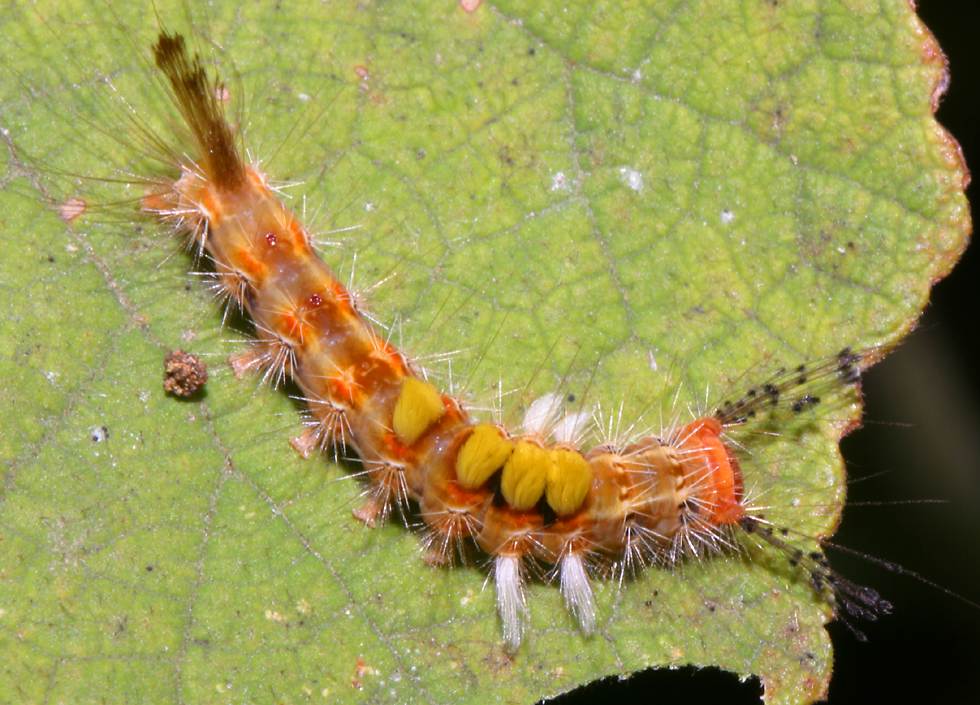
This is a painted pine moth caterpillar, also called a cocoa tussock moth or white-spotted tussock moth. Just as sphinx moth caterpillars can be recognized by their tail, so tussock moth caterpillars can be recognized by the tufts of hair on their back, in this case an attractive yellow color. If you look at the body segments near its tail, you'll see that two have bright red knobs like little light-emitting diodes. This reminded me of a white-marked tussock moth caterpillar I photographed in Illinois, and it turns out that both of them do indeed belong to the same genus even though they live on different continents! |
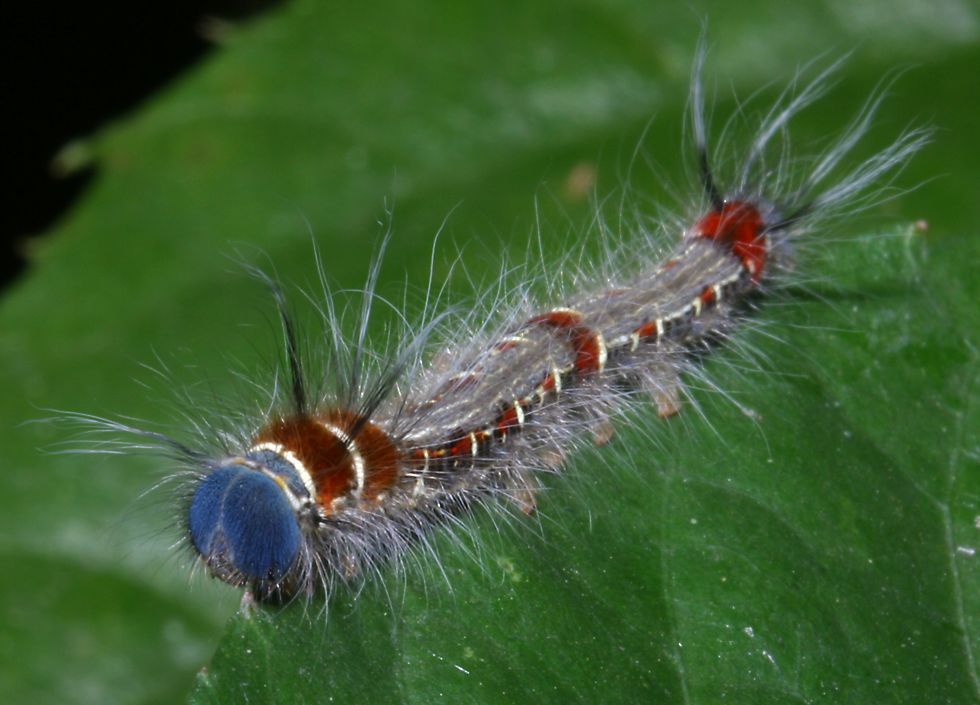
It's often hard to understand why caterpillars such as this one have such elaborate color and pattern schemes. Caterpillars are almost blind, only able to detect light and dark; they're often active at night when colors can't be seen, and they don't mate, which means they're not trying to attract each other. Perhaps the colors are intended to warn off their predators if the caterpillar is found during the daytime. That's certainly the case for the hairs, which are usually toxic and cause irritation to anyone or anything foolish enough to touch them. |
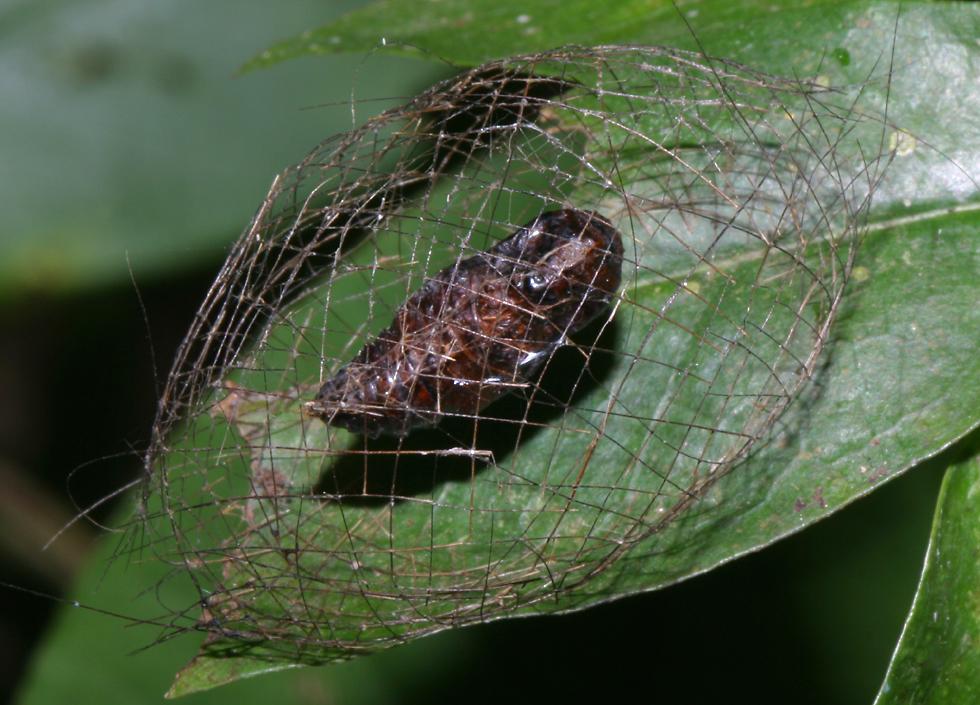
Caterpillars can be very beautiful, and there are some attractive chrysalises around, too. I wouldn't call this ordinary brown chrysalis attractive, but it's hard to deny that it's interesting! The caterpillar has selected a very open location on top of a leaf in Cuc Phuong national park to build its cocoon, but before pupating it has built an extraordinary cage around itself to keep predators away while it undergoes metamorphosis. |
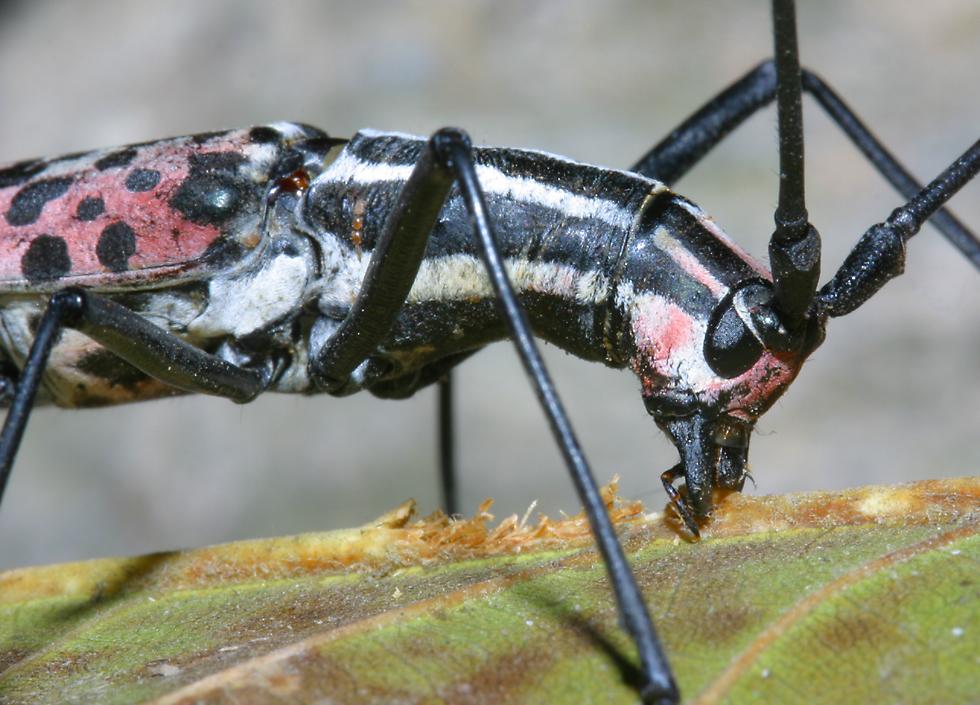
Here's a large long-horned beetle chewing its way through the tough stalk of a leaf. This species is called Macrochenus isabellinus, it's a favorite of collectors because of its attractive patterns and colors. |
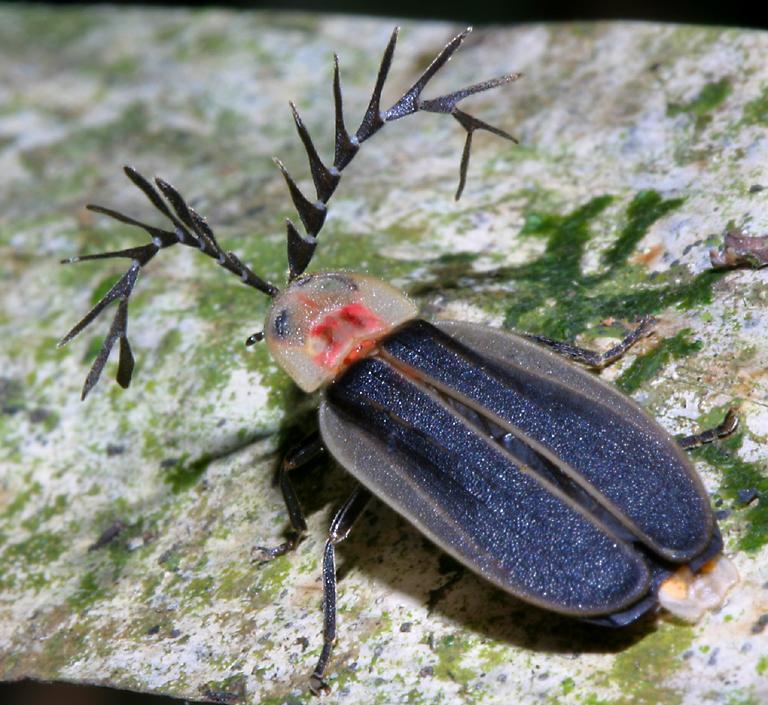
A firefly on a very beaten up leaf in Cuc Phuong national park. |
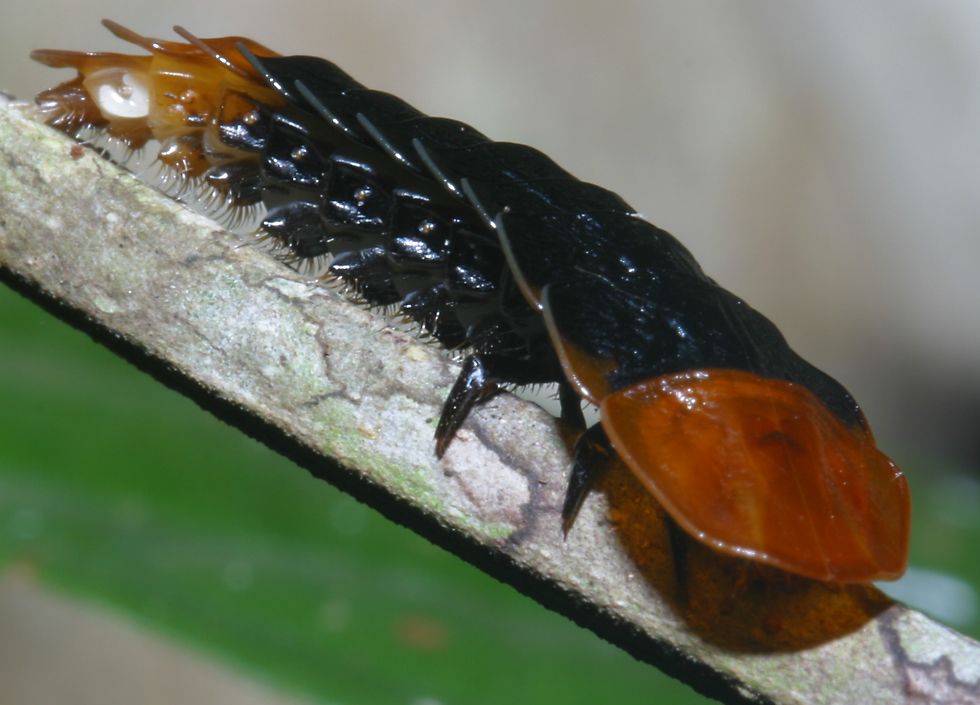
This extraordinary creature was wandering around at night in the trees at Cat Tien. I thought it was a firefly larva, but it's actually the female of a net-winged beetle in the genus Duliticola. They're sometimes called "trilobite larvae" because the plates on their back make them resemble the much larger trilobites found as fossils. You can see a similarly weird but non-glowing Duliticola net-winged beetle larva in Malaysia. Like fireflies they have light emitting organs under the tail - the comma shaped bright area which is clearly visible even in this photo taken using flash. Unlike fireflies, the light which is emitted is constant rather than flashing, and it was this peculiar light which I first noticed, moving in a most unfirefly-like way, because this critter was walking on the trees rather than flying. Maybe I should say that it was dragging itself, because all six of its legs are at the front, and it only has bristle-tipped stumps along the rest of its body. They hunt during the early part of the night and eat a variety of food, but particularly favor snails. Amazingly, the females never leave this larval form but the males, which are only one tenth the size, go through a partial metamorphosis and end up as ordinary looking beetles. When a female is ready to mate she climbs a tree, lights up and waits for a male to come to her - just like in a human singles bar, except for the bit about climbing a tree! |
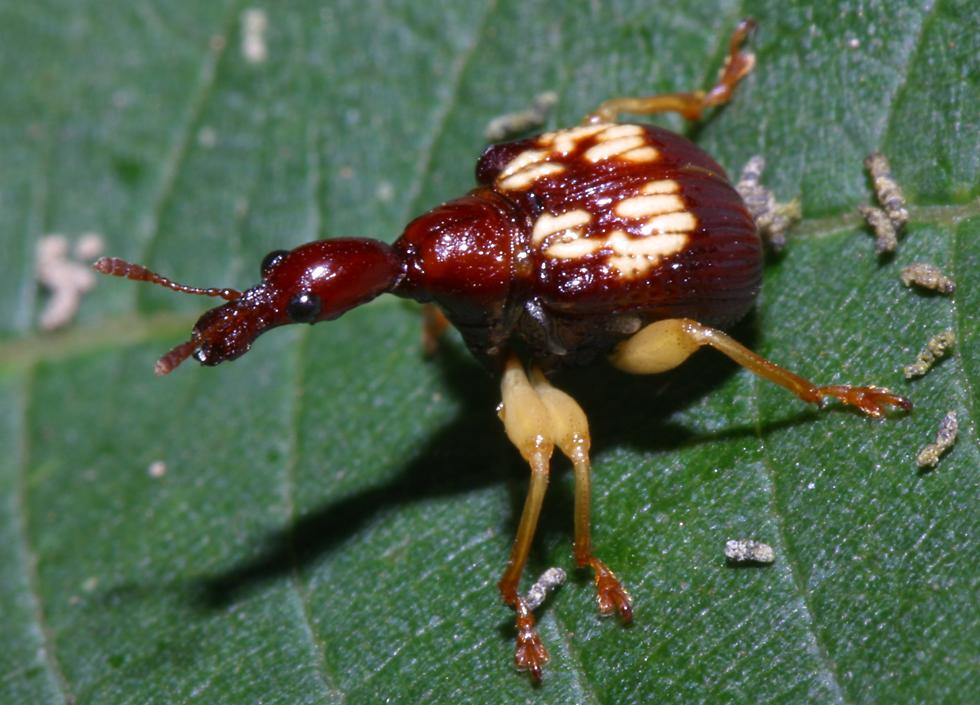
This crazy looking beetle with the strange head and Schwarzenegger thighs is a weevil. It seemed to be eating moss growing on the tops of the leaves, but I don't think that it was responsible for the poop scattered around it, that looks more like caterpillar frass. |
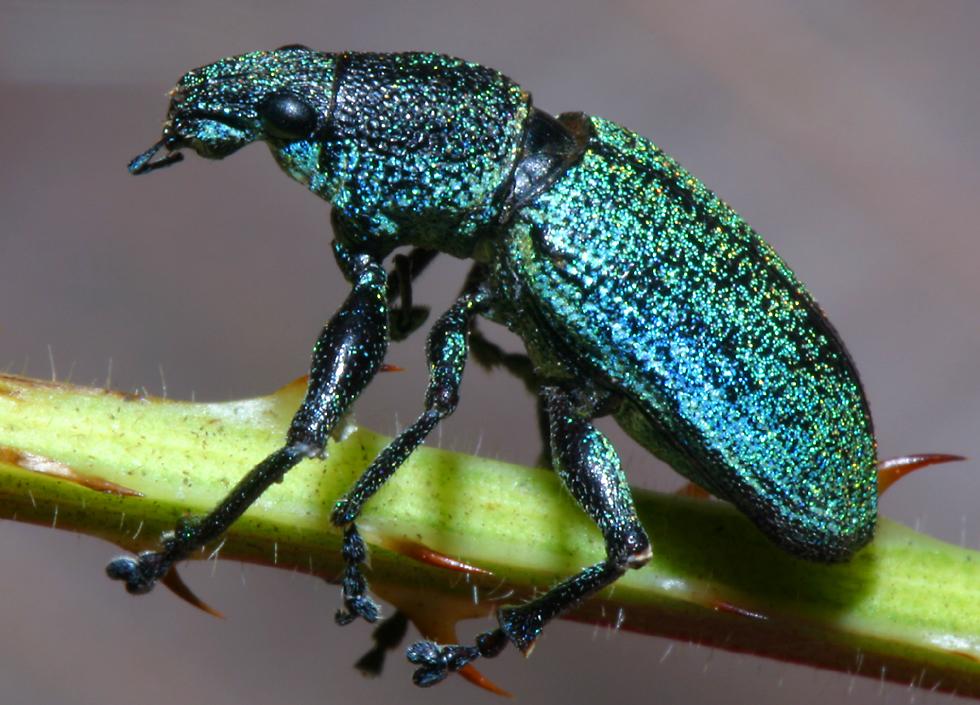
Ouch, sitting on a prickle! This is another weevil which I found at Cat Tien. Weevils are sometimes called snout beetles because of the distinctive elongated shape of their mouth parts. With over 60,000 species they're the largest family of animals on the planet, but their habit of eating grain and other human crops hasn't exactly endeared them to us. It doesn't help, either, that it's sometimes possible to catch diseases if you eat the contaminated food. |
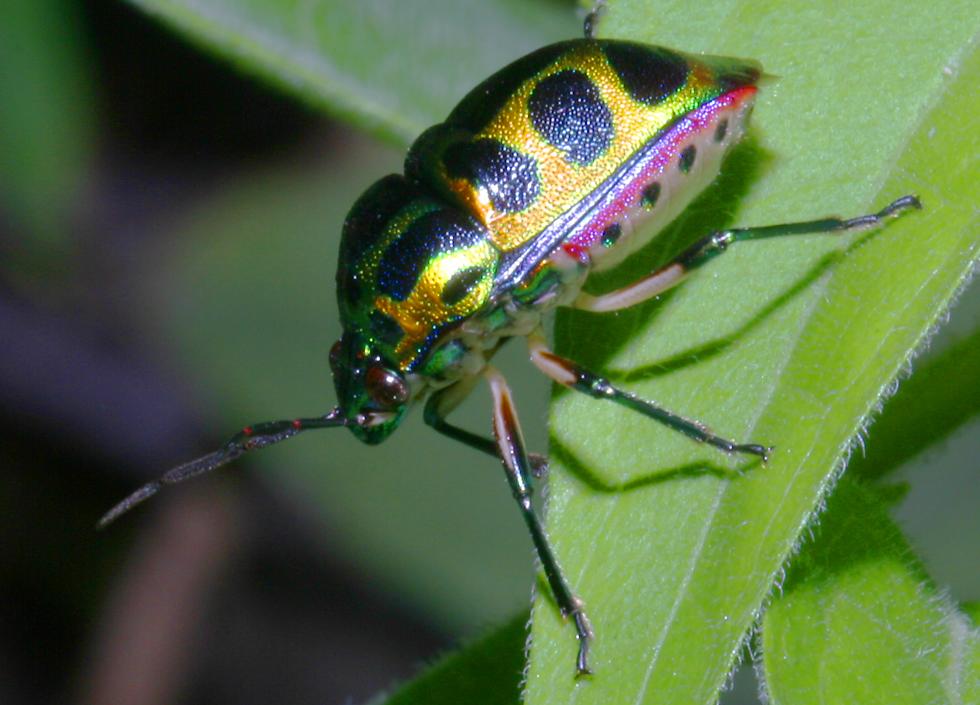
I originally thought that this insect I photographed near Nha Trang was another beetle, but it's actually a "true bug", in particular a jewel bug called Calliphara nobilis. True bugs don't have biting mouthparts like beetles, instead they have a straw-like tube called a rostrum which they fold under their body. When they want to eat they pull the tube forward and push it into their dinner, which is either a plant or another insect, in the case of predatory true bugs. |
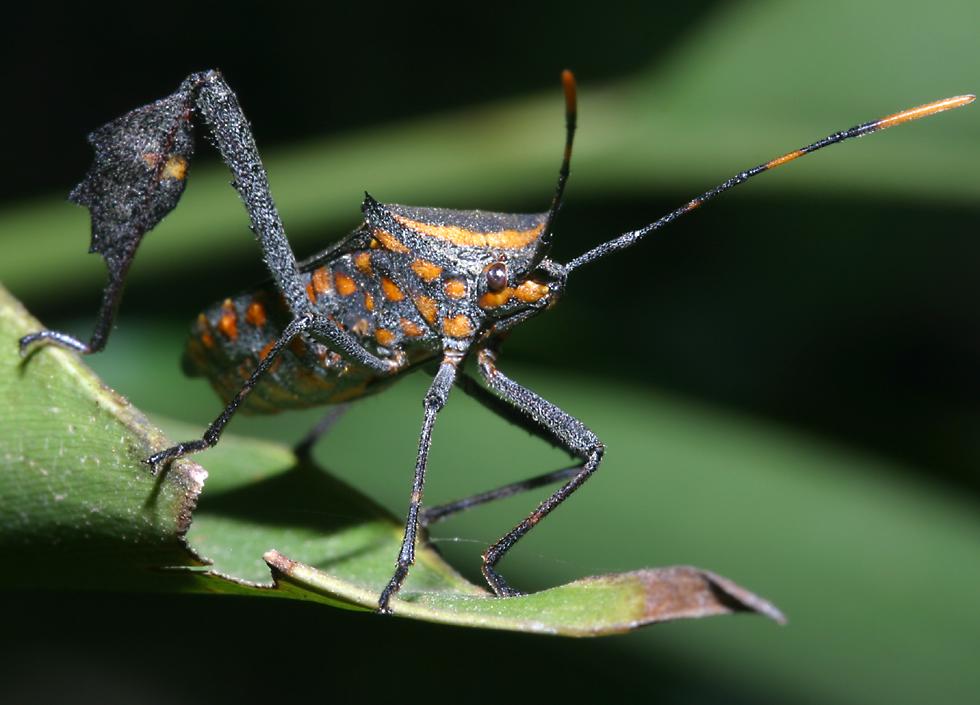
This is another true bug, a leaf-footed bug called the citron bug. Here it's doing a very nice little display of its "leaf foot", actually a flattened section on its hind leg. All the members of the leaf-footed bug family eat plants, but it's thought that the males of some species use their modified legs in territorial disputes with others of their own kind. |
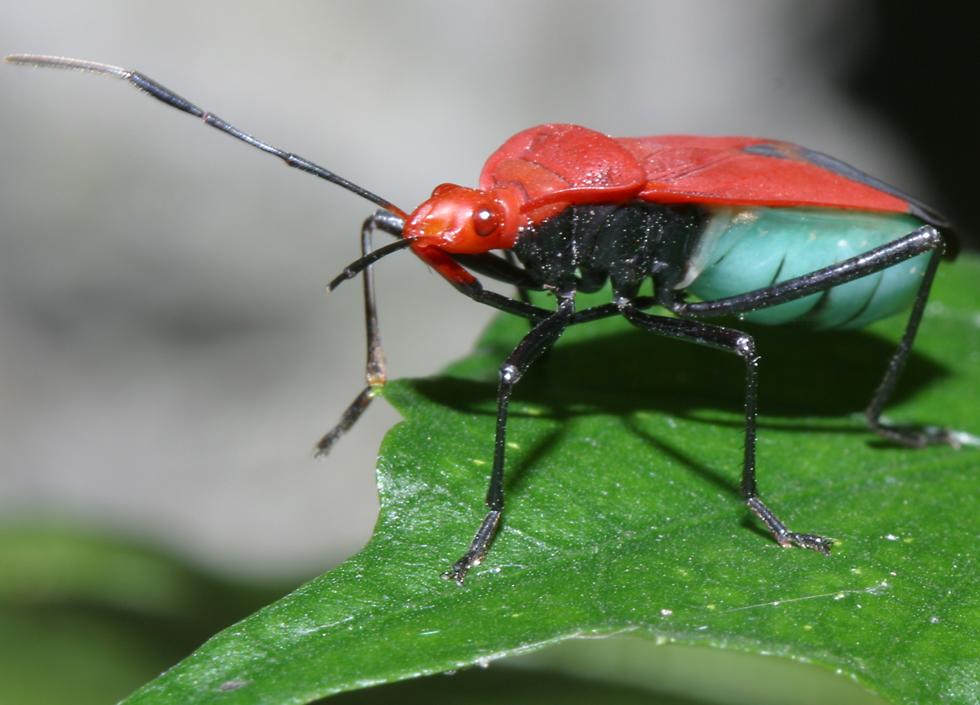
It's not often that you see green and red together on an insect, so this plant bug was a nice find. In this photo you can very clearly see the rostrum hinged down from the front of the head and then under the body. |
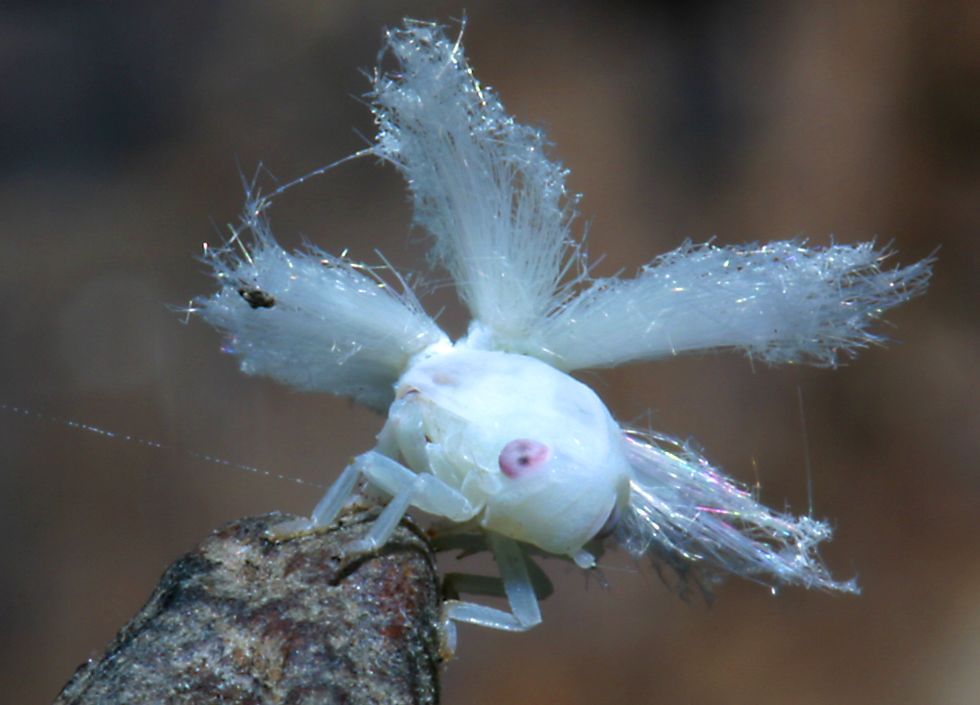
This juvenile planthopper looks much less like a beetle. The extraordinary shapes at the back of this insect are fibers which are extruded from organs at the tail. Perhaps they're intended to keep predators at bay, but they're obviously not entirely effective, because you can see another insect of this kind which is being eaten by a damselfly in Cambodia. |
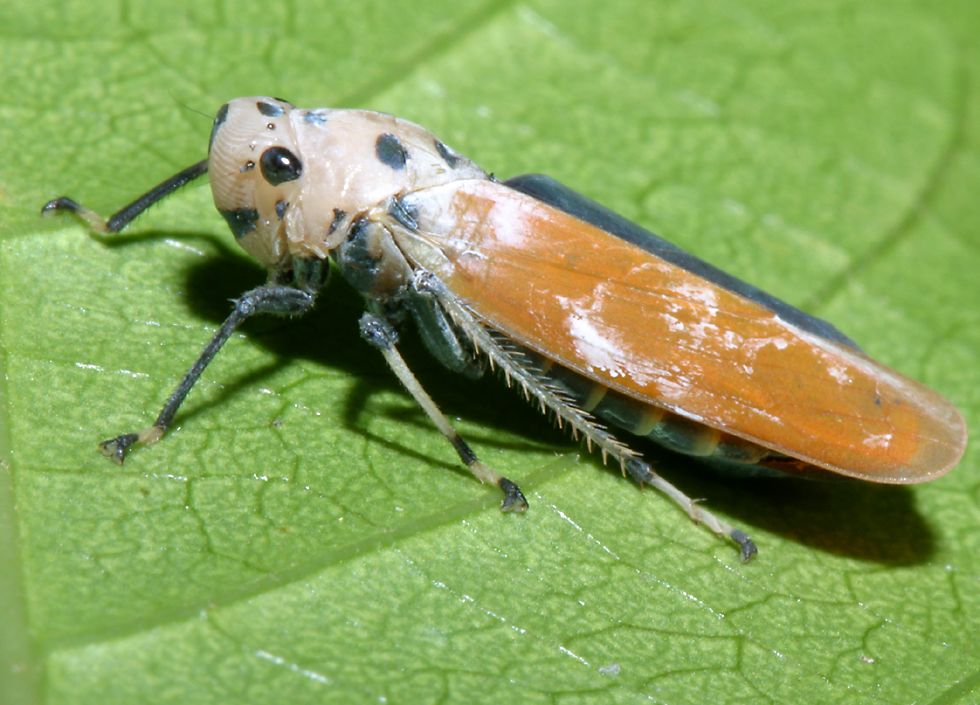
This is the black-tipped leafhopper, which belongs to another large family of true bugs. Many leafhoppers are very colorful and attractive but they're all quite small, only about a centimeter or so in length. |
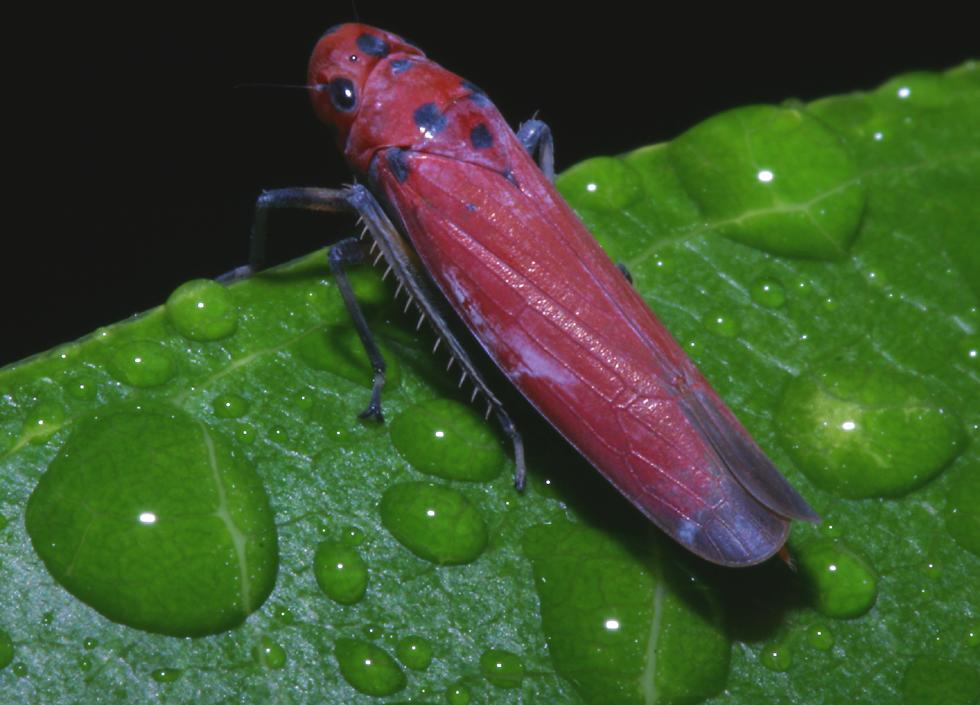
This red leafhopper (Bothrogonia indistincta) was in the rain at Bach Ma national park near Hue. I particularly like the way the red of this leafhopper contrasts against the green of the leaf, and the large raindrops add a lot of charm to this photo, too. |
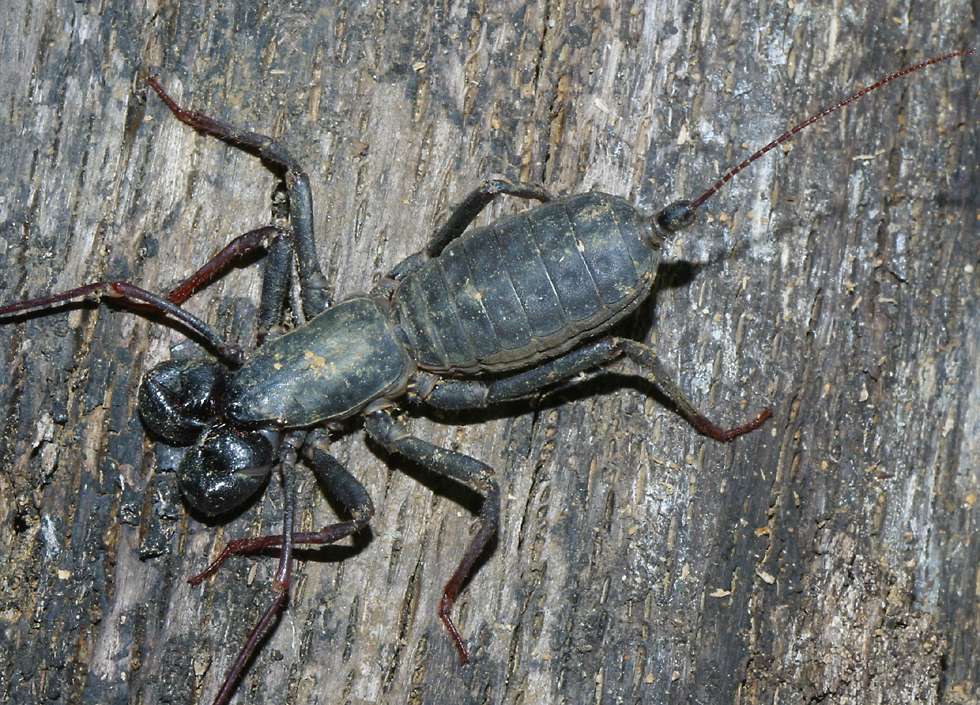
A whip scorpion which was under a log at Cuc Phuong national park. Whip scorpions are arachnids, but despite their name they're not poisonous, though they spray fairly concentrated acetic acid when disturbed. Because acetic acid is the main ingredient of vinegar, this has given them their common name "vinegaroons". |
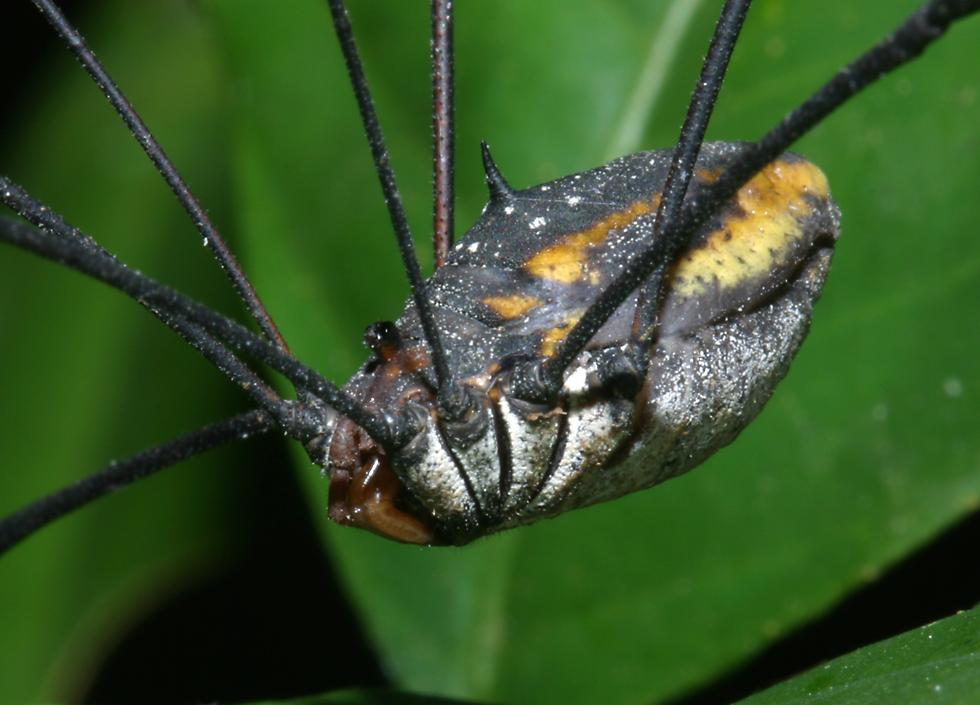
Here's another type of arachnid, this one's a harvestman, which many people mistake for a spider. However harvestmen don't spin silk, they're not venomous and the males have penises, something spiders lack. And if you're wondering where all of the spider photos are, there were too many good ones to put on this page, so I put together a separate page of spiders of Vietnam, which includes a tarantula on the attack, an ant mimic, a spitting spider, some attractive jumping spiders and a weird triangular spider with a clear window on its abdomen through which you can see its eggs. |