
Spiders of Vietnam
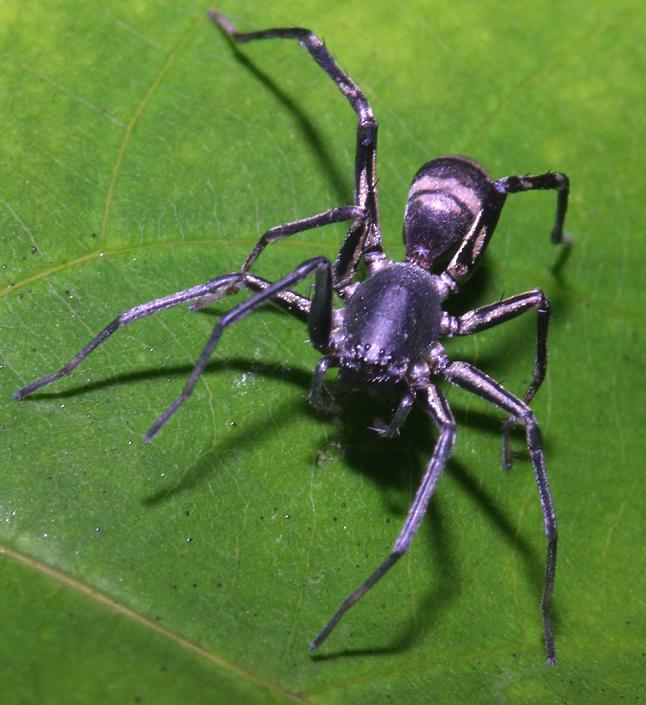
When I was in Australia a couple of years ago I came across a spider ant, which is a species of ant which mimics a spider. I'd heard that there are also spiders which mimic ants, and lo and behold when I was in Cuc Phuong national park near Hanoi I happened across one! You can see that it's captured the shape of the ant body perfectly, and even the stripes on the belly. Since then, I've also come across an ant mimic jumping spider in Thailand and one in Cambodia called the ant-like crab spider. I'm not really sure why a spider would want to mimic an ant, unless it makes it easier to sneak up on prey. For that matter, I'm not sure why an ant would want to mimic a spider, either - most animals avoid ants because of their powerful bites, so I can't imagine that it gets much protection from pretending to be something else which is also dangerous. I saw a couple of other interesting bits of mimicry while in Vietnam, including a very small spider which deliberately placed pieces of detritus in the middle of its web and then sat amongst it to make itself seem like just another piece of trash. There was also a small jumping spider which lay flat on a leaf and bent its abdomen to the side, probably to appear like a bird dropping, a trick also adopted by a moth I saw in Cuc Phuong. And while we're on the topic of moths, I came across one in - of all places - the bus at Cam Ranh bay which was ferrying passengers from the plane I'd just landed in to the terminal. What was unusual about this moth was that it was mimicking a hairy brown spider, with a large hump on its back in the shape of a spider's head, complete with dark "eyes". |

There were quite a few of these tiny little orange colored spiders on the underside of the leaves of trees growing beside the trails near the entrance to Bach Ma national park, near Hue. It looks like this one is putting its hand up in class to answer a question. Or perhaps it's just asking for more gruel. |
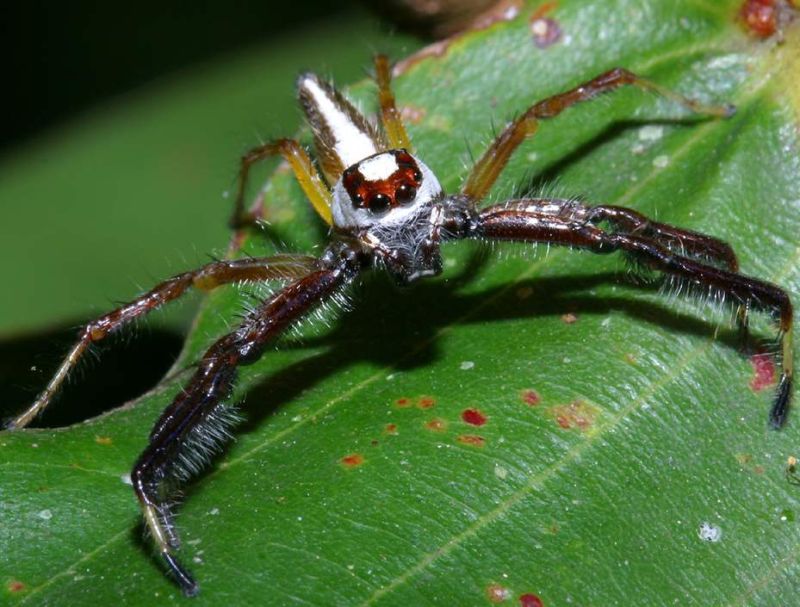
This extraordinary creature is a two-striped jumping spider (Telamonia dimidiata), the largest member of this family that I've ever seen. This colorful beastie, with legs more reminiscent of a crab spider than a jumping spider, was on a tree leaf in Cat Tien national park near Saigon. Although it repeatedly retreated to the other side of the leaf as I turned the branch this way and that, it didn't jump off and so I was able to get a large number of photos. |
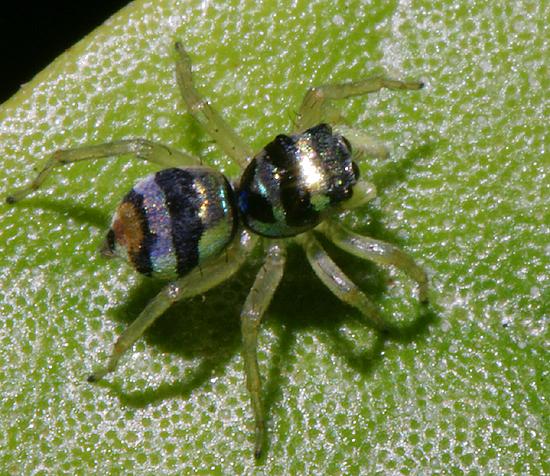
From a jumping spider giant to a jumping spider midget, this one was by far the smallest and also one of the most attractive I encountered. There's also a very interesting story behind this particular species. The banded phintella (Phintella vintata) is the first animal known to be able to see high-frequency ultraviolet light (UVB). In 2008 it was first reported that male banded phintellas reflect UVB from their bodies, and experiments confirmed that females are attracted to these ultra-violet markings. Jumping spiders often have metallic green or other coloring on their fangs, but the metallic stripes on this little fellow near the shore north of Nha Trang were just amazing. However it was so tiny that I had to use extension tubes in addition to my macro lens, and it was running around so quickly that I managed only one or two photos before it got away. |
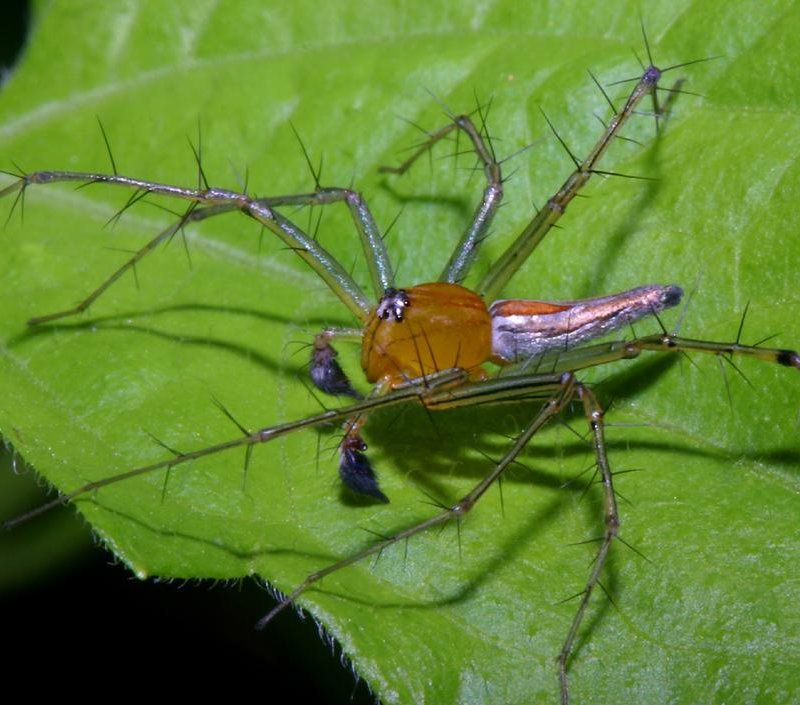
As well as the jumping spiders, there were also several lynx spiders in various locations, like this colorful individual at Cat Tien. Like jumping spiders, lynx spiders don't spin webs for hunting, instead they search for their prey on leaves and flowers. Jumping spiders have large eyes and excellent eyesight, but lynx spiders have small eyes and correspondingly poor eyesight. This forces lynx spiders to use a "wait and snatch" hunting strategy, rather than the jumping spider's strategy of walking (and jumping) around until they find something. The lynx spider strategy might also help to explain why most of them have long spines on their legs; as well as possibly allowing them to detect air movements and other hints of approaching prey, they might also help to corral their prey within the grasp of their long legs, before moving in for the kill. |
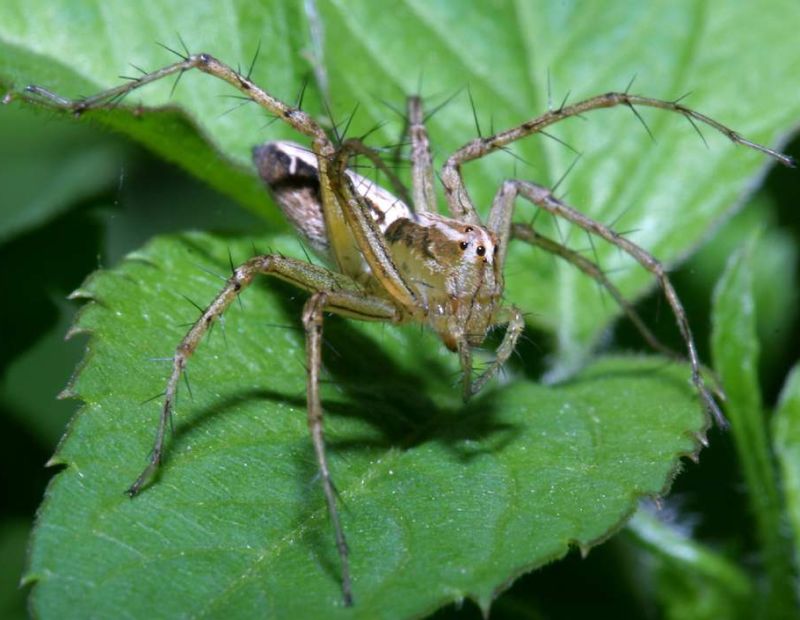
This lynx spider was inside the imperial city of Hue, poised in characteristic lynx spider style waiting for something tasty to walk past. There were three or four of this same species in a space with a diameter less than one meter. |
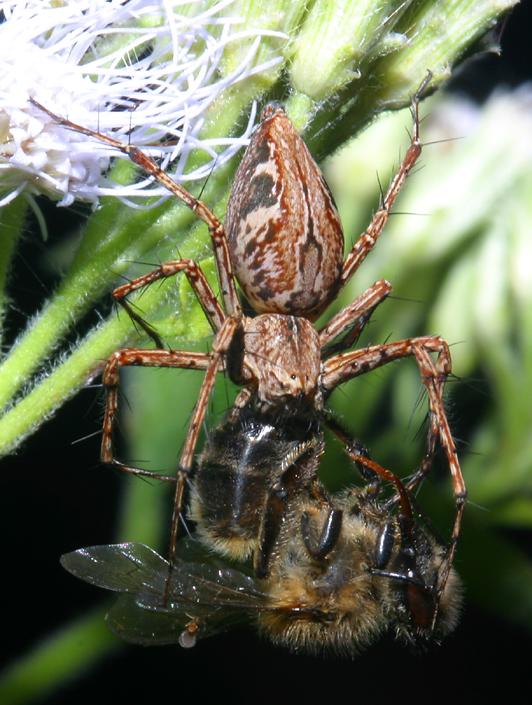
There were several other attractive looking lynx spiders around, including one I photographed on the same flower as a red base Jezebel butterfly; luckily for the butterfly the spider was a bit too small to tackle such a large item of prey. This bee was not as fortunate when it landed on a flower which was also occupied by a lynx spider. The ability to kill such a powerful and well defended insect gives a good indication of how effective these spiders are at what they do. It's said that if it weren't for spiders then we'd soon be knee deep in flies and other undesirable insects. Talking about flies, if you look very closely you'll see that there's a tiny fly on the wing of this captured bee. It's so small that it's in no danger of becoming the spider's next meal, and this family of flies does very well for itself by quickly finding and taking advantage of newly killed insects like this one. You can bet that the fly is not here just for its amusement, it's either going to eat scraps of the bee itself or more likely lay eggs on it so its young can feed on what remains after the spider is finished. |
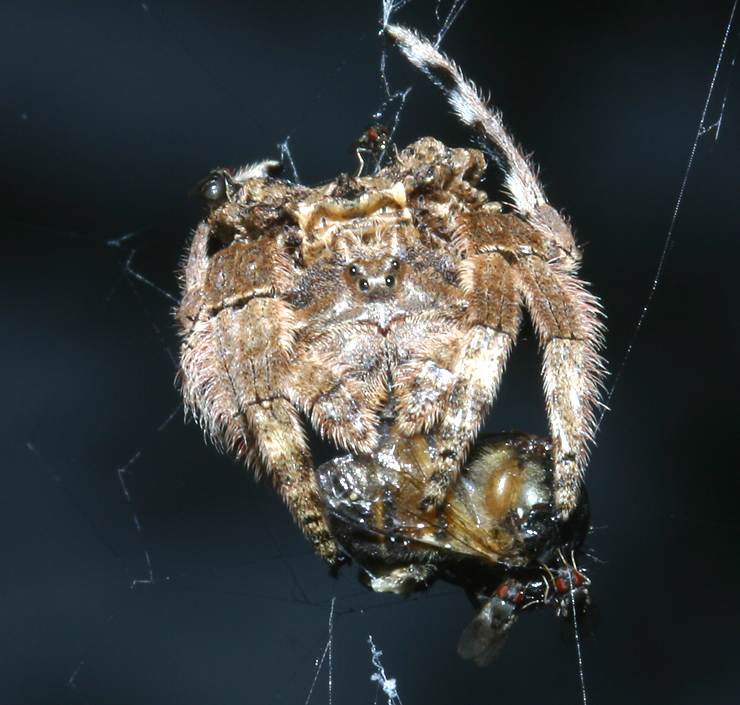
That spider's bee was recently caught, but this one has clearly been around for a fair while, and it's attracted quite a swarm of those tiny flies. As you can see, they have no fear at all and are perfectly happy to walk all over the spider. These is a rather oddly shaped spider, it was totally flat underneath, there was very little distinction between its cephalothorax and its body and most of the time it was holding its legs in very close to its body, unlike most web weaving spiders. I'd guess that it was doing this to make itself look as little like a spider as possible, in order to avoid becoming a meal for the next passing bird. If you want to see another oddity of this spider, just count its eyes. Spiders have eight eyes, right? But only four eyes are visible on this spider. Where are the other four eyes? Well, there aren't any more! Spiders can have either four, six or eight eyes, and the photos I took from different angles show that this one has only four. |
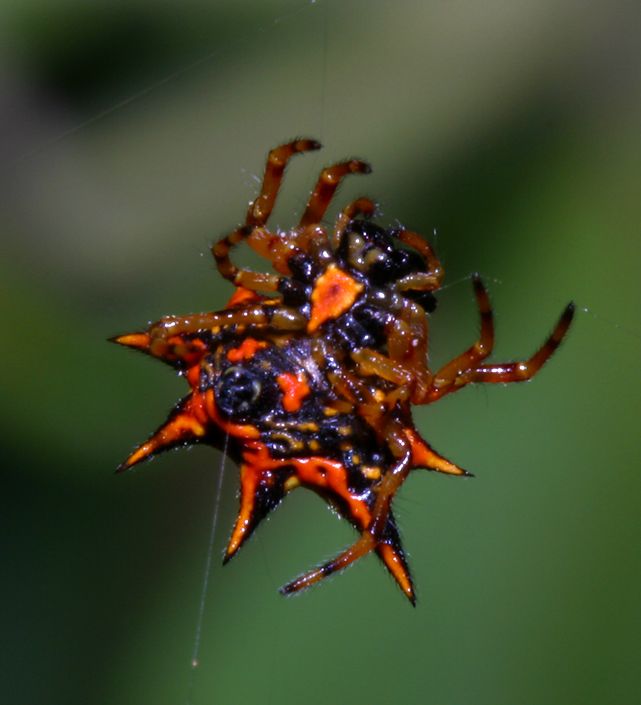
If that last spider was oddly shaped, then this one is even more so. However unlike the previous one, this one is making no attempt to be inconspicuous. It belongs to a family of spiders called "spiny orb weavers" (the genus Gasteracantha) which rely on their unwieldy shapes and hard spikes to make themselves a difficult, and potentially even painful, object to swallow. It might also be that this spider's orange and black coloring is a warning, since this combination of colors is used by many different insects and other arthropods around the world to indicate that they are toxic or distasteful. There are many critters that mimic their warningly colored relatives; if the mimic is itself distasteful or poisonous then it's called a Mullerian mimic, but if it's only pretending to be toxic then it's a Batesian mimic. You can see another spiny orb weaver called the horned spider, which I photographed in Malaysia. |
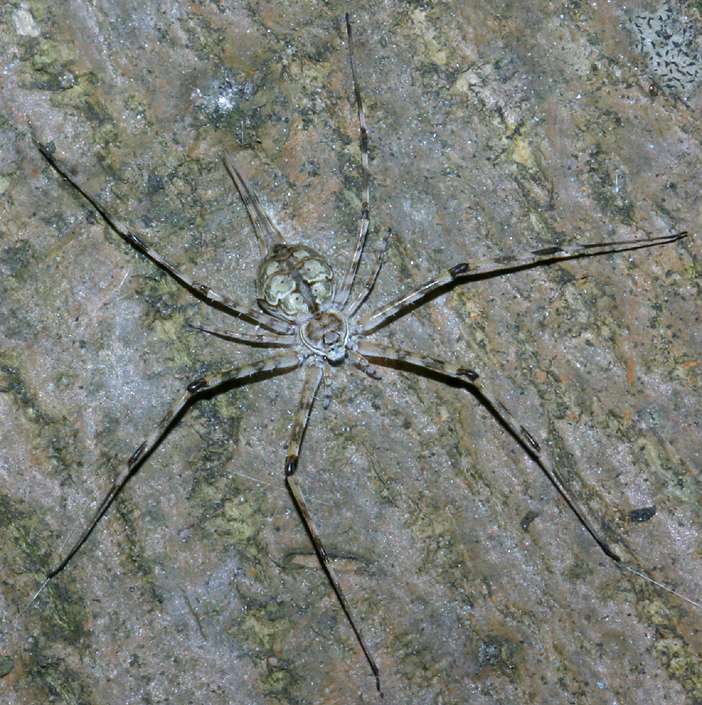
Spiders adapt themselves to all sorts of environments. Like the jumping spiders and lynx spiders, this two-tailed spider also hunts without benefit of a web, though it does have silk strands attached to several of its feet, perhaps as trip wires to warn it of the approach of items of prey or enemies. Unlike the jumping spiders and lynx spiders, this one was hunting at night on a tree trunk, and I suspect that its flat shape is an adaptation to allow it to hide under the tree's bark during the daytime. Another feature of this spider is the two long "tails" or cerci which you can see extending from the back of its body. Some spiders use their cerci to draw out and manipulate the silk which is extruded from the spinnerets on their belly (some silk is clearly visible coming out of the spinneret of the spider in the previous photo). However, these cerci are so long that I wonder if they can possibly serve this function. In contrast to those very long cerci, you can also see that this spider's third pair of legs is extraordinarily short, much shorter than its others. Again, I have no idea why that would be. |
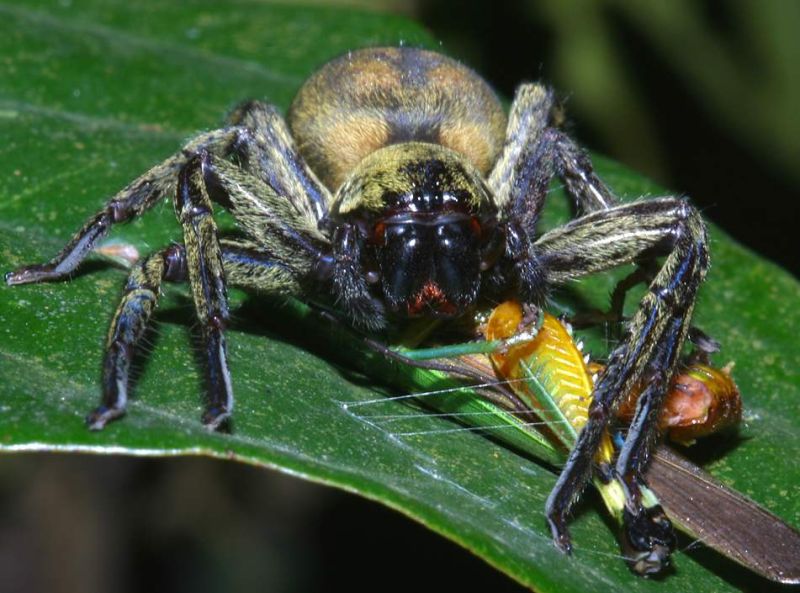
Another roving nocturnal hunter, but with a very different shape. It's come across a grasshopper during its wanderings and it looks like it's used its silk to pin it down, either before or after being injected with venom. Unusually, this grasshopper seems to have had chunks taken out of its abdomen. Since spiders tend to suck up the body fluids of their victims rather than biting pieces off them, this might be a sign either of incidental damage caused by the spider's fangs when it was pulping the grasshopper, or perhaps it might indicate that the grasshopper was already dead when the spider found it, and it's behaving as a scavenger. This seems unlikely, but of course web weaving spiders do wrap up their prey in silk and return to feed on them at a later time, so perhaps it's possible. |
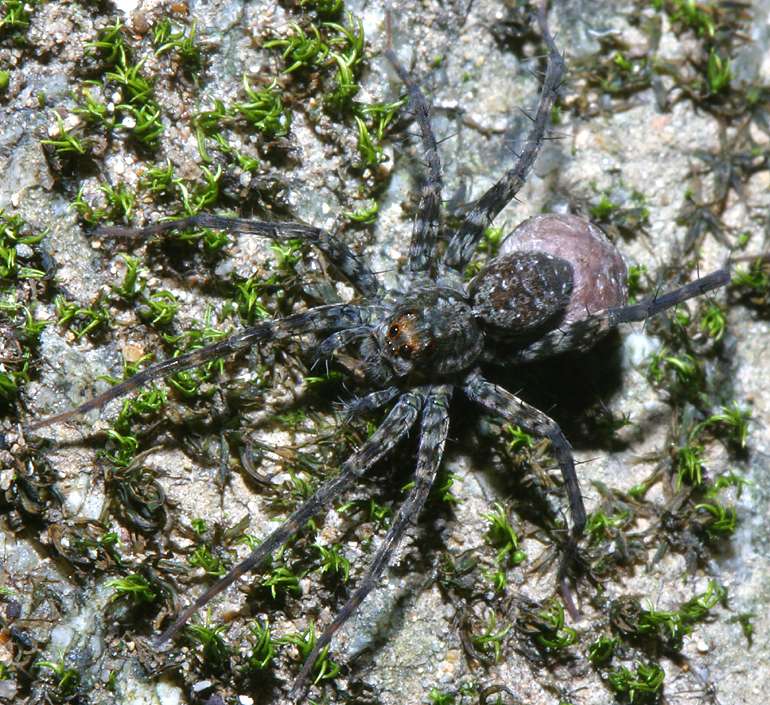
This spider has spiny legs like the lynx spiders and a pair of fairly large eyes like the jumping spiders. This is a wolf spider, prowling around looking for a meal. In this case it's a female, you can see the egg sac she's dragging around behind her. |
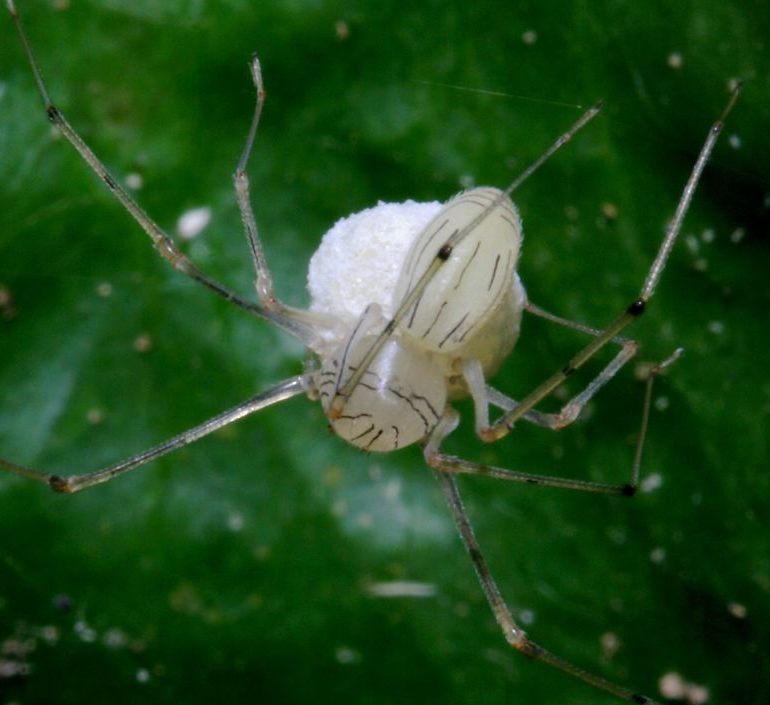
This pale spitting spider specializes in eating other spiders. It's a nocturnal hunter with very poor eyesight, but it leaves its nest at night to go hunting, catching its prey by spitting a mixture of sticky silk and venom from its fangs. Ironically, this species is preyed on by other spiders, and this particular individual is in an especially risky situation, since the famous Portia genus of jumping spiders is unusually partial to eating pale spitting spiders with eggs. You can see a Portia I photographed in Cambodia .
|
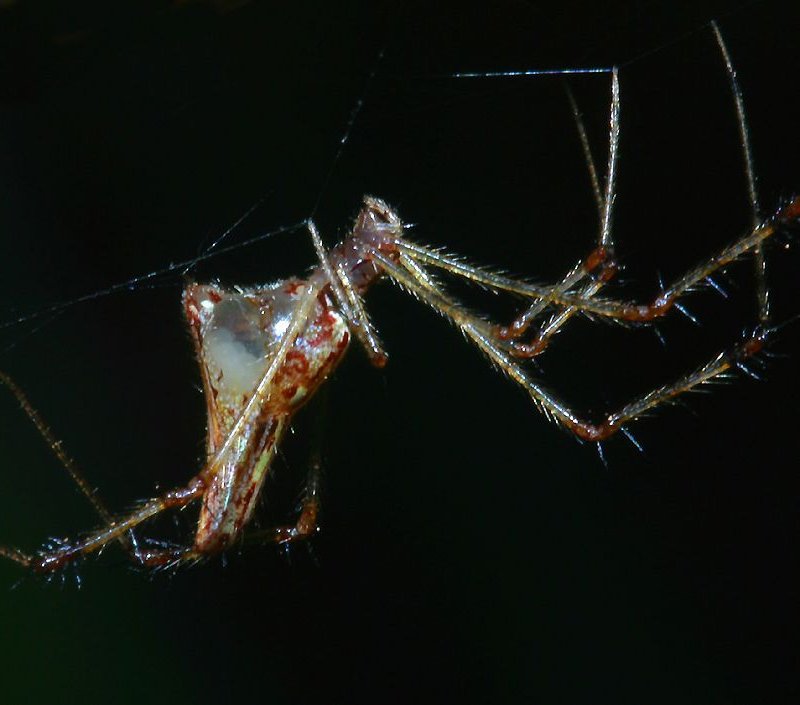
This is perhaps the most amazing spider I've ever seen. It was the strangely shaped abdomen that first made me take notice, and only when I got home did I notice the transparent window in the abdomen. It took a little bit longer before I realized what was visible through the window - eggs! This spider had several dozen babies with it on the web it had built on a wide piece of grass, and it looks like it has several dozen more eggs waiting to be hatched. I don't know whether it lays the eggs within the nest or whether it possibly gives live birth to the babies. |
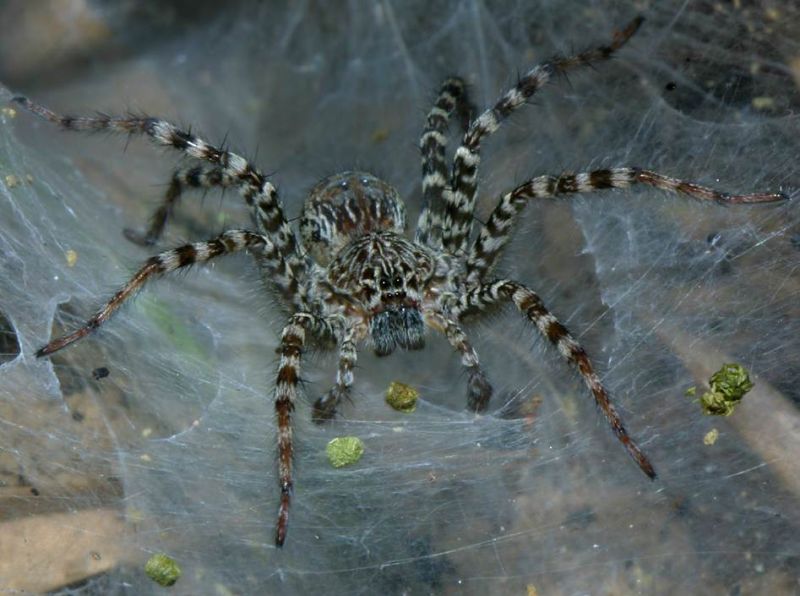
This spider looks very similar to the wolf spider earlier on this page, but it's actually a funnel web spider, with a serious frass problem. In case you don't know, frass is what a caterpillar leaves behind after a hearty meal - and since caterpillars are basically just eating machines it's no surprise that they're also frass factories. It's enough to drive a house-proud spider to tears, though the bulbous ends on the pedipalps at the front of this spider indicates that it's male, so maybe it's not too concerned about having a mess around the place. |
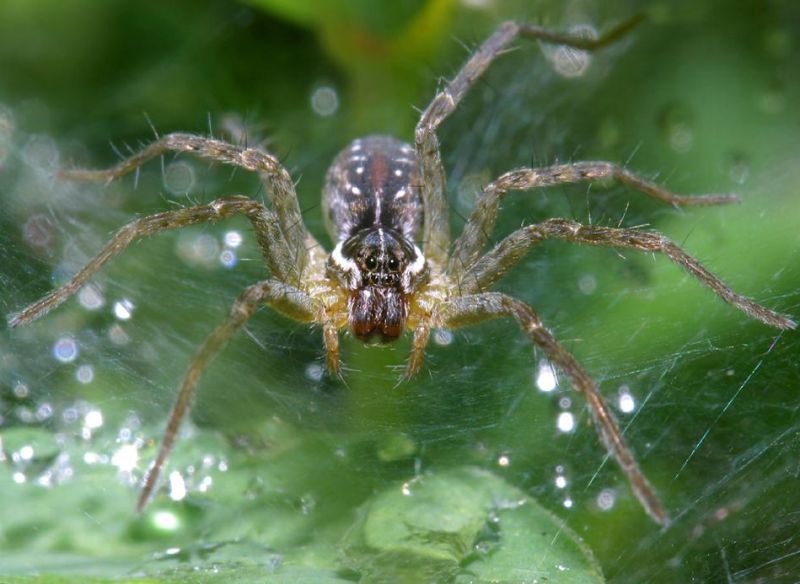
Another funnel web spider, this time in Bach Ma national park. It rained most of the time I was there, which is why there are so many drops of water visible in this photo. True to their name, funnel web spiders weave a funnel-shaped web which leads either horizontally or vertically inwards. As well as leading prey towards the spider, the web also provides a refuge into which the spider can retreat when danger threatens. |
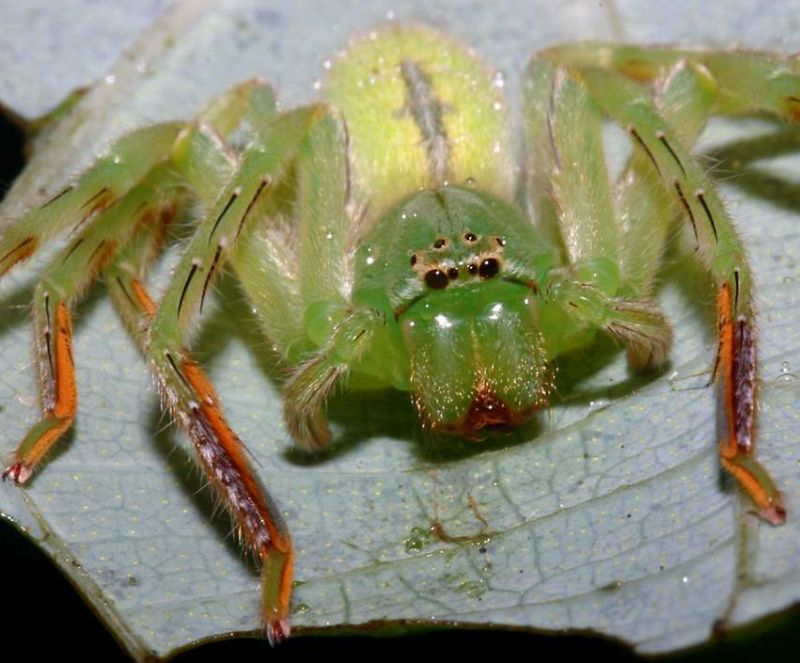
Another resident of Bach Ma, captured as the rain continued into the night. If I'm not mistaken it's a huntsman spider called the "football spider" (Neosparassus patellatus). This is a fairly good sized spider, and the slightly unusual green coloring makes it interesting, too. Notice the two little claws at the end of the foot on the left-hand side of the picture, which are almost identical in appearance to the two claws on the red lacewing butterfly I photographed at night in Cat Tien. In both cases the claws allow the critter to hang on to the edges of leaves, and to get their grip on other footholds. |
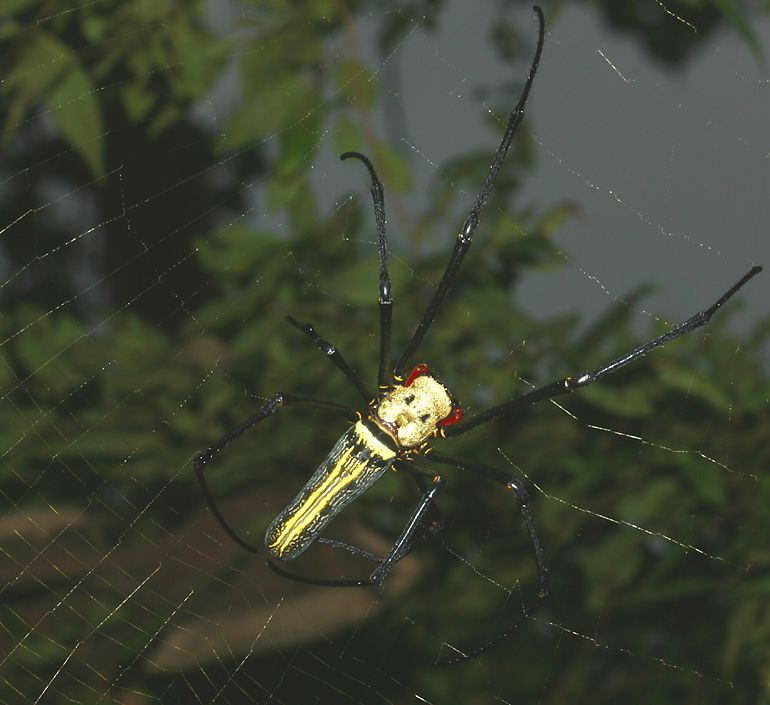
Here's a giant spider - a giant wood spider (Nephila maculata) to be precise. This hand-sized spider is harmless to humans but it spins the largest web of any species of spider. As you can see, this one is using its back legs to lay out silk across the radiating strands of the framework it's already created. You can also see a closeup of a giant wood spider in Indonesia, and male and female giant wood spiders in Cambodia. |
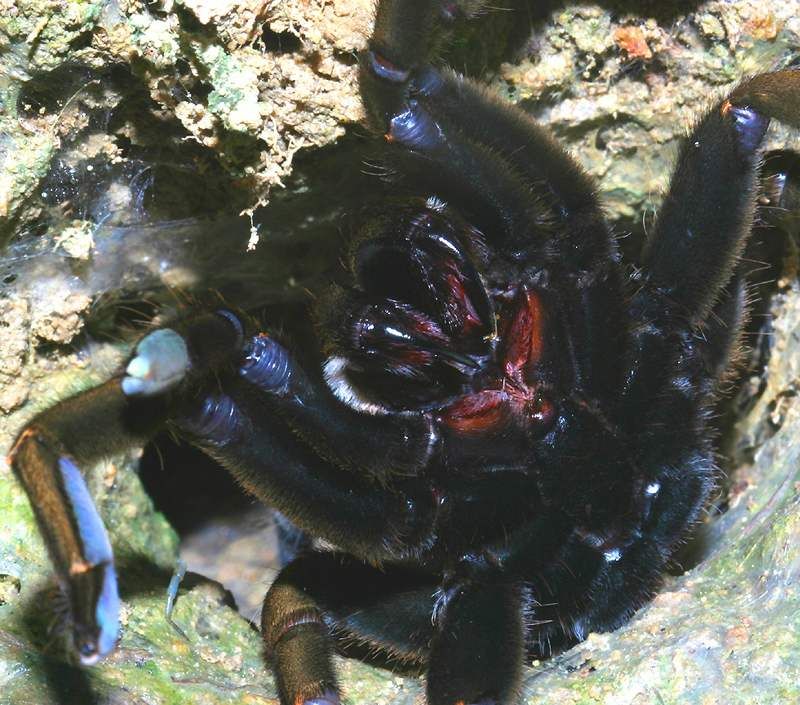
Giant wood spiders are quite large, but this Thailand black tarantula is a much more daunting prospect, with its large body, fat legs and enormous fangs. I was walking back down the road to the entrance of Bach Ma national park when I noticed this burrow in a dirt bank. It looked a lot like quite a few other burrows I'd seen, except that it was lined with silk. I had a pretty good idea what that meant, so I got a small stick and started poking the silk in a way that I hoped was reminiscent of an insect. I've done that sort of thing quite a bit in the desert in southern California and Nevada, but never with any success. This time however I got quite a response as this tarantula rushed out and reared up, making me jump quite some distance backwards! Theoretically I didn't have to do that, since most tarantulas are said to have a bite no worse than the sting of a wasp, but that sort of logical thinking didn't have much effect over the sheer tingly terror I was feeling! The spider retreated back into its lair but of course I wanted to get some photos, so I used the twig to bring it back out a few more times. I didn't get an opportunity to see its top side because of this pose that it adopted, but I wasn't too bothered because this view of its fangs is impressive too. A spider as large as this one can take some quite large prey, including lizards and mice; you can see the remains of a previous meal near the bottom left-hand corner of the photo, probably the leg or antenna of some hapless insect. |