
Bugs of Cambodia
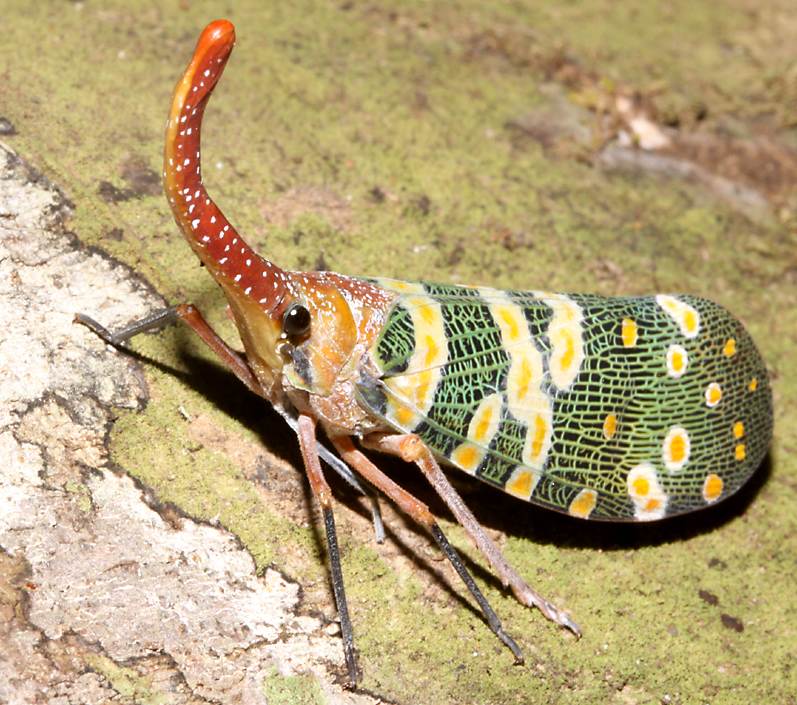
This extraordinary looking creature is a lantern bug called Pyrops candelaria. I've seen photos of this critter before but this was the first time I'd come across it in real life, so it was exciting to come across it below the lower tier of Bousra waterfall shortly after dusk. Early biologists supplied both the English and Latin names in the belief that the extraordinary appendage at the front emitted light. That turned out not to be true, but the names stuck. It's also sometimes called a lantern fly, but it's not a fly, it's a "true bug". The giveaway is the gray colored tube under its head, which is a straw-like mouthpart called a rostrum. All true bugs, whether herbivorous or carnivorous, have a rostrum like this, which they stick into plants, trees or other insects. This species of lantern bug is particularly fond of sucking the sap of lychee and longan trees. Lychees are a type of fruit which are very popular in Chinese restaurants in the western world, longans are related. Fresh lychees and longans both taste pretty good, dried lychees are also good, but dried longans taste a bit too much like fish! |
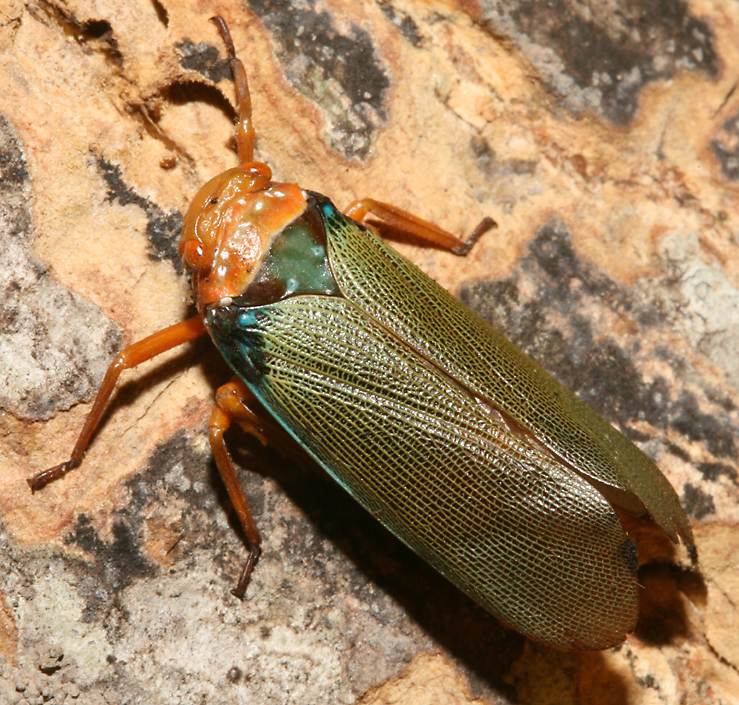
Here's another true bug, a lantern bug which I found at Angkor Wat. |
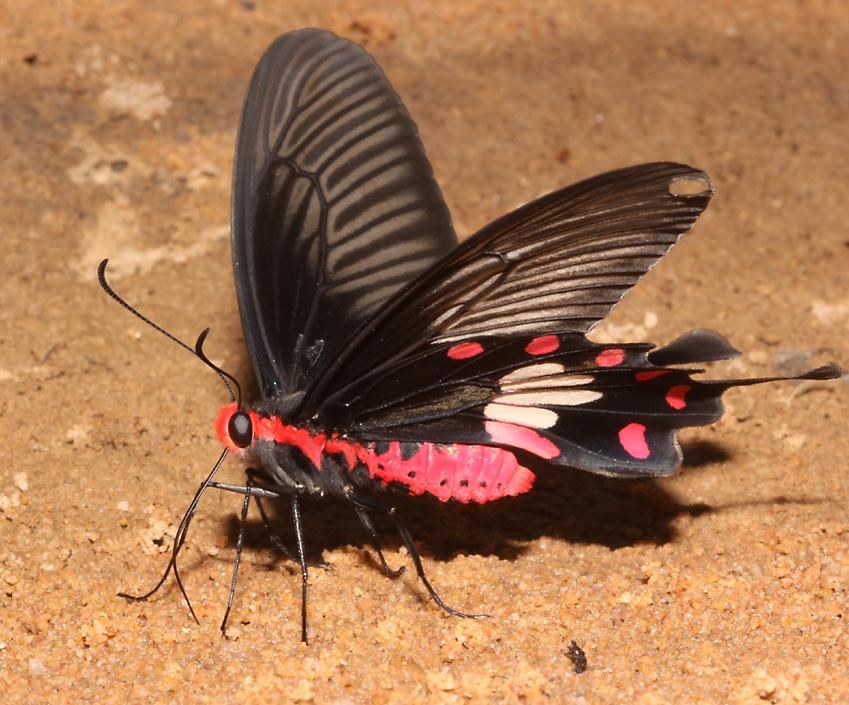
This is a common rose, a type of swallowtail butterfly. They earn their name from their wide distribution, all the way from Afghanistan to China, and from belonging to the genus Atrophaneura, the red-bodied swallowtails. In this case, the red body indicates to birds and other predators that the butterfly is toxic and distasteful to eat. There are about 550 species of swallowtail, scattered around the world. They're one of the most interesting and attractive families of butterfly, but they can be a bit difficult to photograph because most of them don't hang around in one place for too long. I found this one on the path to Chambok waterfall, near Kirirom national park. It's a male, "puddling" for salts on the banks of a small creek. It took me 30 or 40 minutes to get the photos, approaching glacially slowly, and then repeating the process over and over again when the butterfly flew away for a few minutes and then settled down again. |
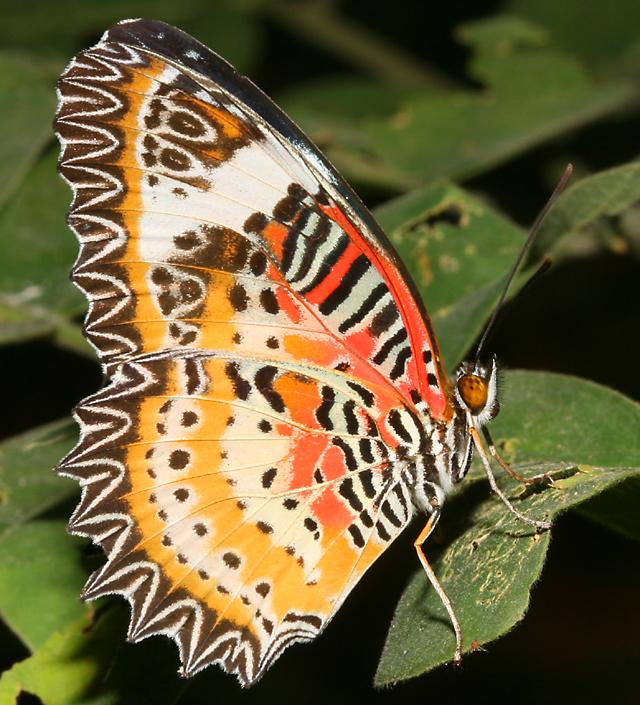
As you've already seen, I photographed some of the insects on this page at Angkor, where I spent the first week of my three week stay in Cambodia. The weather was almost uniformly overcast, which was very unhelpful for photographing the ruins, so I spent most of my time looking for wildlife. The first day at Angkor, I wasn't sure of the distances between the structures, so I walked from the southern gate of Angkor Thom all the way to Bayon temple, and back. It was quite a bit further than I thought, but I saw a lot of interesting bugs which made it very worthwhile. In one spot there were some flowers attracting a lot of butterflies, including this male leopard lacewing. This one was good enough to stop for a while so I could photograph the beautiful undersides of its wings. The leopard lacewing is a close cousin of the red lacewing which I photographed in Vietnam, except that the red lacewing looks like it has a full choir of ghostly figures moaning horribly, not just the two or three on the leopard lacewing's front wings. |
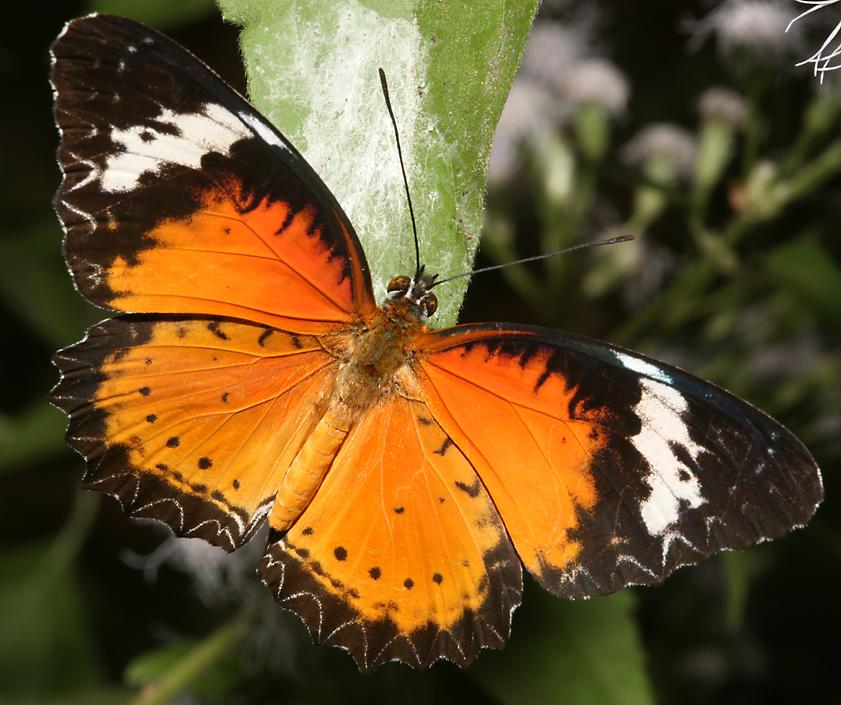
And here's another male leopard lacewing, but with its wings open. This one is investigating some bird droppings on the leaves of the flower bushes which had attracted the butterflies. It's doing this for the same reason as the swallowtail, to collect salts which it will pass on to the female when they mate. |
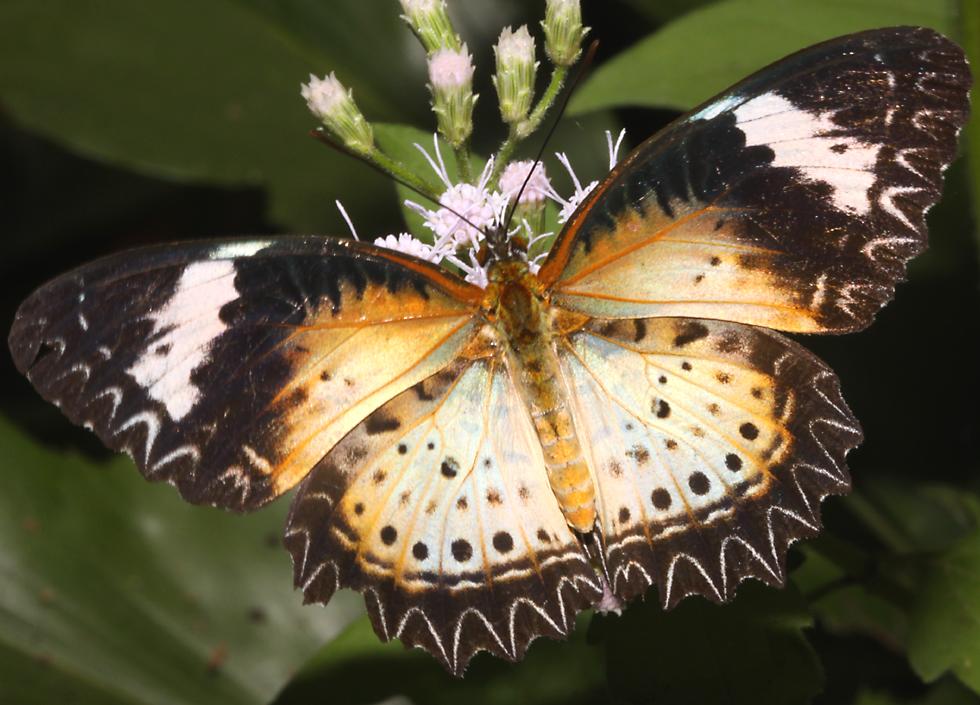
And here's the female, drinking from the same bush as the males. The colors of the female are a lot more muted than the male, but you can see the same overall pattern, including the scallop markings around the wing edges. |
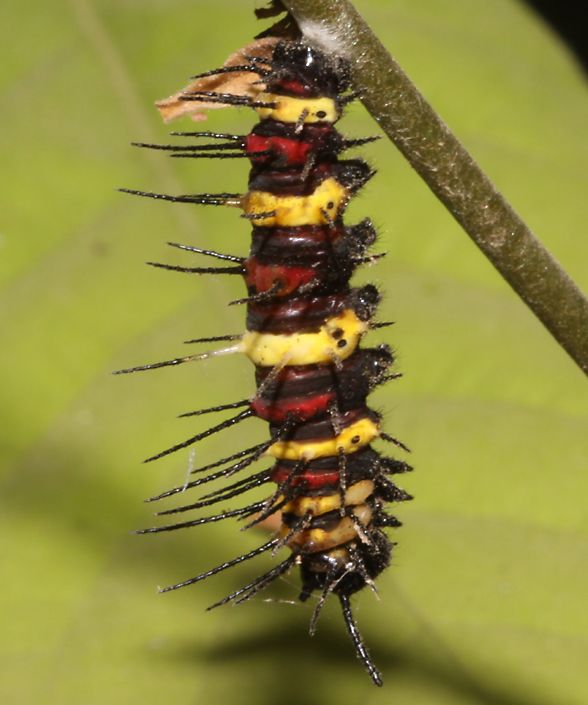
It's not often that I'm able to photograph both the male and the female of a butterfly, but this time I really hit the jackpot by also photographing a leopard lacewing caterpillar! This one is beside a path leading to one of the temples at Angkor, it's just attached itself to a vine stalk using silk, and soon it will start to pupate. Of course those big spines aren't going to fit too well inside a coccoon, so before it spins its new home it will shed its old skin and the spines along with it. |
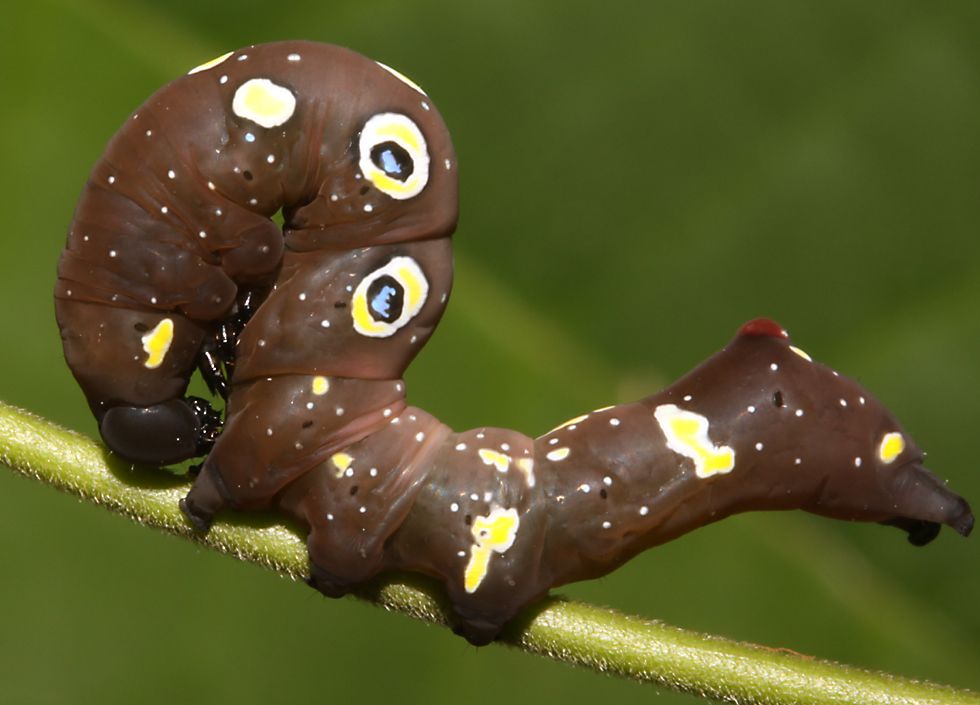
Here's another very attractive caterpillar, but this time it belongs to a moth. The way it's holding its tail up is very characteristic of a family called the "prominent moths", it could be that it's an effort to make any birds attack the back end rather than the vulnerable head. I'm not sure which species this is, but I think I might have photographed the same one in Indonesia, and I've also photographed the morning glory prominent moth caterpillar near Detroit. |
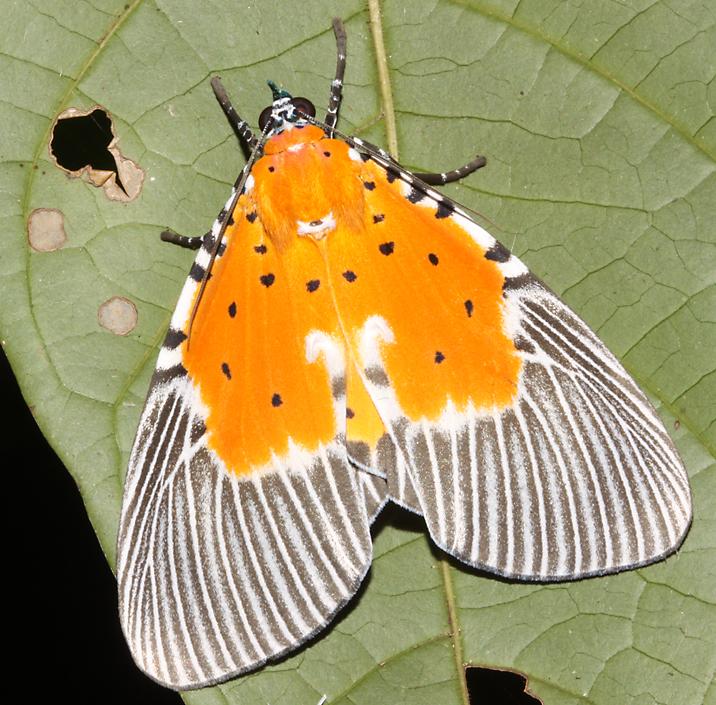
Moth caterpillars are often more attractive than the adult moth, but I found a lot of beautiful adult moths in Cambodia, like this one called Peridrome orbicularis, which belongs to a family called the owlet moths. I came across three or four species with the same shape and basic color scheme at this, but this is the only one whose name I could determine. It's also the most attractive of them, the bold orange contrasts nicely against the black and white wing edges, and I like the swirling white "swooshes" protruding into the orange area. Maybe this moth is where Nike shoes got their "swoosh" trademark from! |
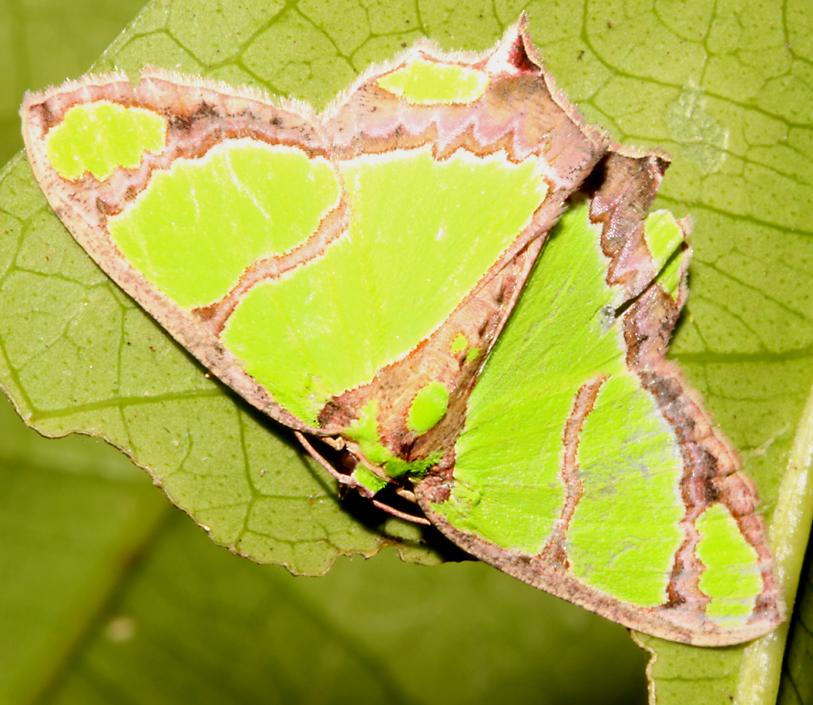
This is an emerald moth called Agathia carissima. It's a geometrid moth, a family whose caterpillars are called "inchworms". As you probably realize, green is not a common color for moths, and this sort of bright lime green is even more of a rarity. The brown trim makes it even more interesting. I found both this butterfly and the previous one while I was walking around with a flashlight in Kep national park. The emerald moth was under a leaf only 60 or 70 centimeters from the ground, but I was able to spot it because its wings were overlapping the edges of the leaf. Hiding under leaves was probably a good idea on that night, because there were quite a few bats flitting up and down the path, and they would certainly have made a meal of this moth, even if they had known what a beauty it was. |

This unusual moth is one of the microlepidoptera and it certainly lives up to the name, since it's only 5 or 6 mm long. The peacock-like way it holds its wings is characteristic of a genus called Brenthia, which is part of the metalmark family. Not only do they look like a peacock, they also display like a peacock, even when no other butterfly is present. It's thought that they might be mimics of jumping spiders, the metallic spots on the wings resembling the spider's eyes. It's not common for moths to mimic spiders, but in Vietnam I came across a sphinx moth called Psilogramma increta which has dark spots which look just like the eyes of a large spider. |
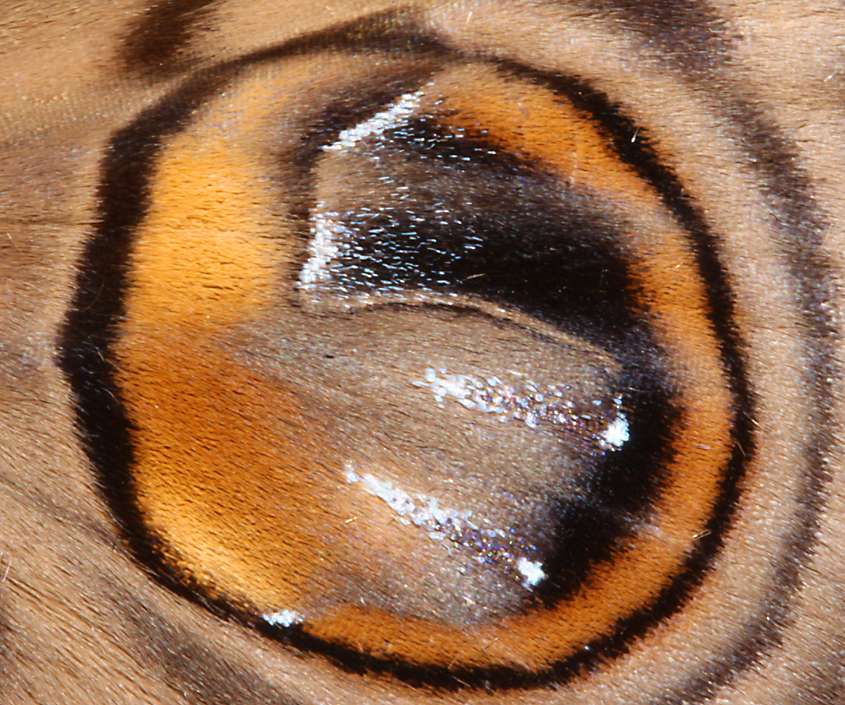
From the very small to the very large. The same night I found the lantern bug, I also came across a very large owlet moth called Erebus macrops. How large? Well, this is an eyespot on its wing. Together the wings can measure 120mm across, making it one of the largest of all the owlet moths. The moth had its antennae resting across the eyespots, but it allowed me to slowly lift one of them off to take this photo. It was even good enough to hold the antenna in the air while I took several shots. |
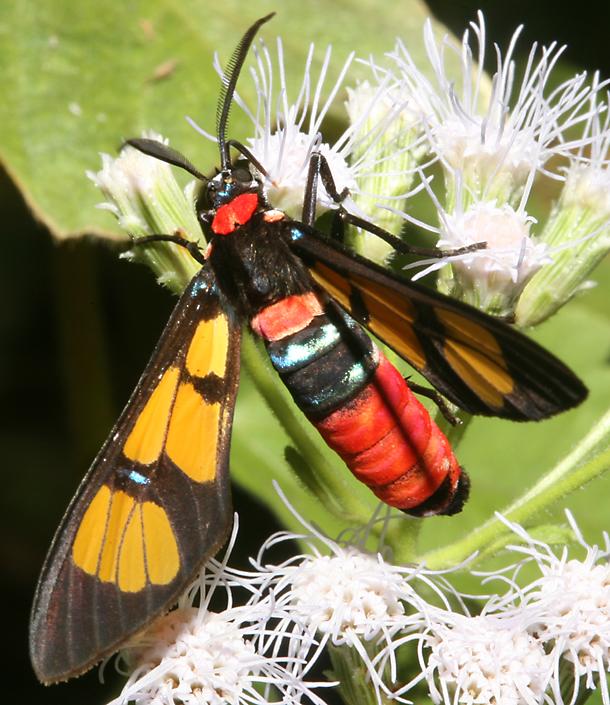
This beauty is Euchromia elegantissima which, if my Latin's any good, means "beautiful color, most elegant", a very fitting name. They're a type of wasp moth, in the tiger moth family, and the beautiful colors indicate that it's toxic. This allows them to fly around in the daytime without fear of being eaten. Unfortunately, flying is mostly what they were doing, about half a dozen were hovering around a large patch of these flowers at Angkor, fluttering around for five minutes or more on end without landing, so it took me several hours to get some reasonable photos. |

That's why I was so pleased when I noticed one sitting motionless among the flowers. It took me a little while to realize that it was sitting still because it had been caught by a large lynx spider, which obviously hadn't read about how toxic this moth is. After about ten minutes, the spider finally got the idea and let the moth go, which was cold comfort for the dead moth. There were several of these spiders hidden amongst the flowers, one of them even had a large egg sac with it. |
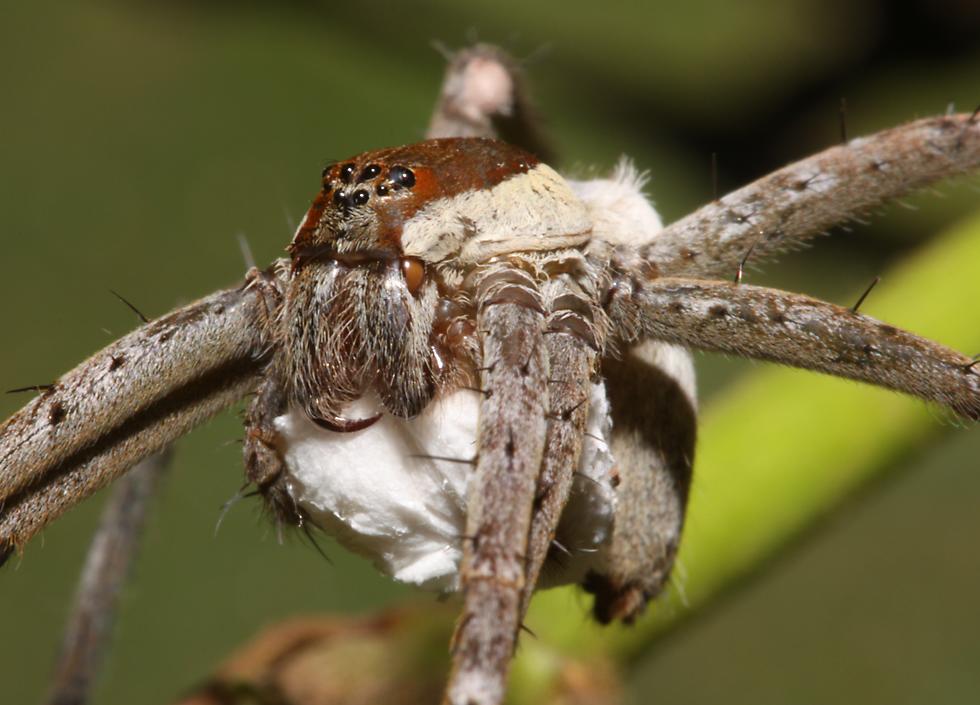
Talking about scary spiders with egg sacs, here's a female nursery spider cradling an egg sac along one of the paths at Angkor. Those wicked looking fangs add quite a bit of menace, but I was surprised to see it out in the open where it's vulnerable to predators like birds. Nursery spiders look a lot like wolf spiders, but the eyes of a nursery spider are all roughly the same size, and rather than three rows of eyes there are only two, the bottom row usually being curved rather than straight. There are about 330 species of nursery spider in the world, one group being called the "fishing spiders" because they wait at the surface of water for prey, sometimes even going underwater to catch bugs or very small fish. These fishing spiders are the source of the name for the whole nursery spider family, Pisauridae. |
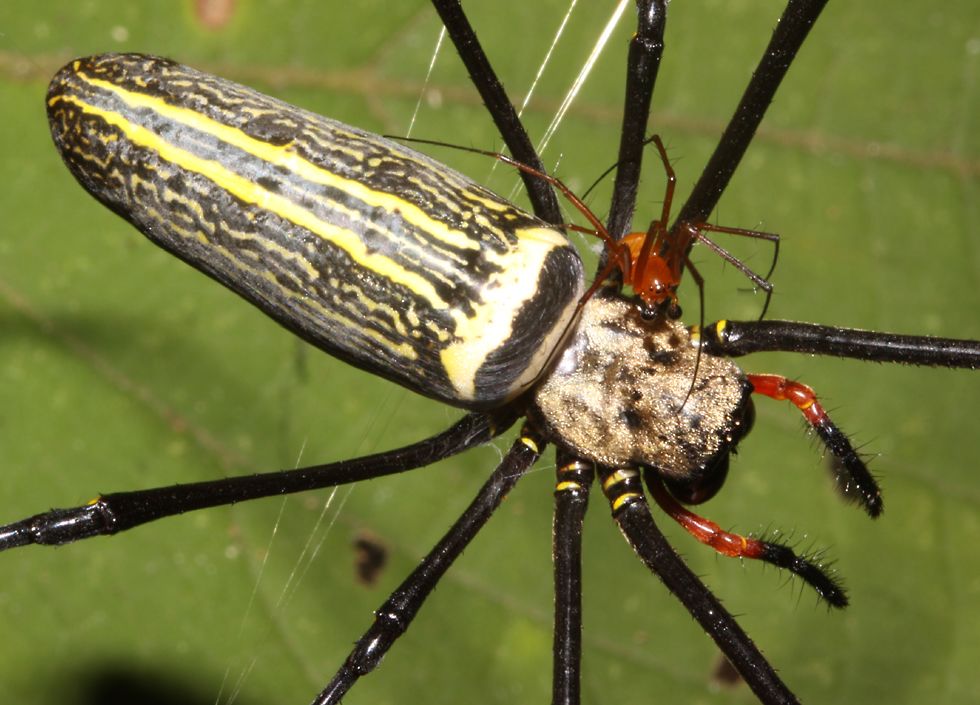
The last two spiders were fairly large, but this giant wood spider Nephila maculata is a monster, females like this reaching 20 centimeters from toe to toe. They're not the largest spider in the world, but they do build the largest and strongest web of any spider. It can stretch six meters by two meters, and is strong enough to capture small birds. Many spiders rebuild their web every night, but the webs of giant wood spiders can last several years when regularly maintained. This specimen on the Chambok waterfall path has attracted the attention of a male, who is dwarfed by his love interest. He lives on her web and steals food from it. After mating she digs a hole in the ground, lines it with silk and lays her eggs in it, before covering it with soil. You can also see a giant wood spider building her web in Vietnam. |
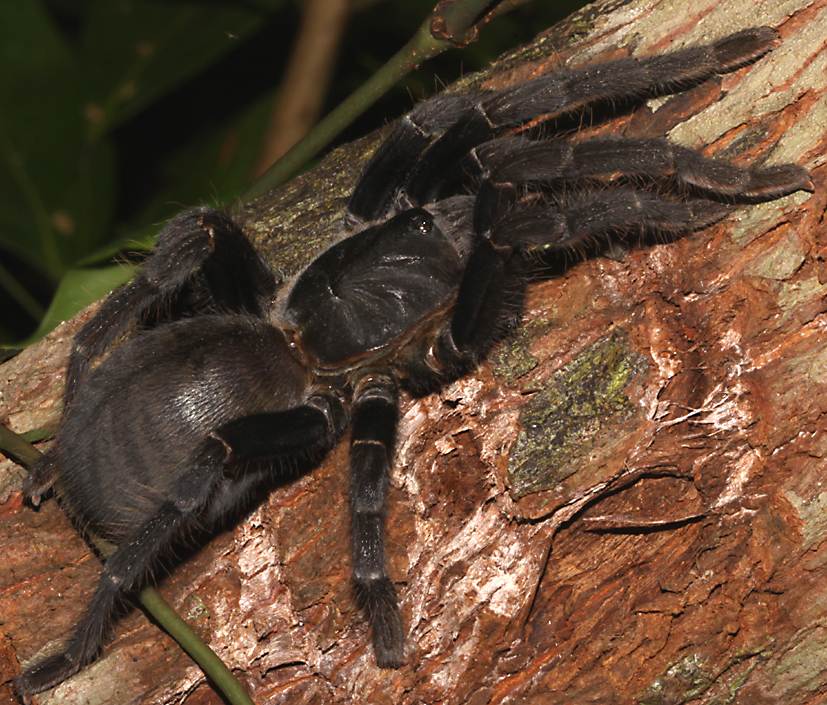
The giant wood spider has nice colors and doesn't seem intimidating, but for most people this tarantula is much more menacing. It doesn't help that the tarantula has no bright colors, and it also doesn't help that it's so hairy and has such fat legs! Unusually, this one was sitting out on a tree trunk during the daytime, something I've never seen before. Tarantulas are usually nocturnal, like the one I saw in Tangkoko national park in northern Sulawesi. The only other one I've seen in the daytime came out because I coaked it out by imitating an insect caught in its silk-lined burrow. In Cambodia people eat tarantulas, and the small town of Skuon is famous for selling deep-fried tarantulas in its marketplace. People also eat tarantulas in the Amazon, and in New Guinea tribespeople eat giant wood spiders, though I imagine there's less meat in its legs! |
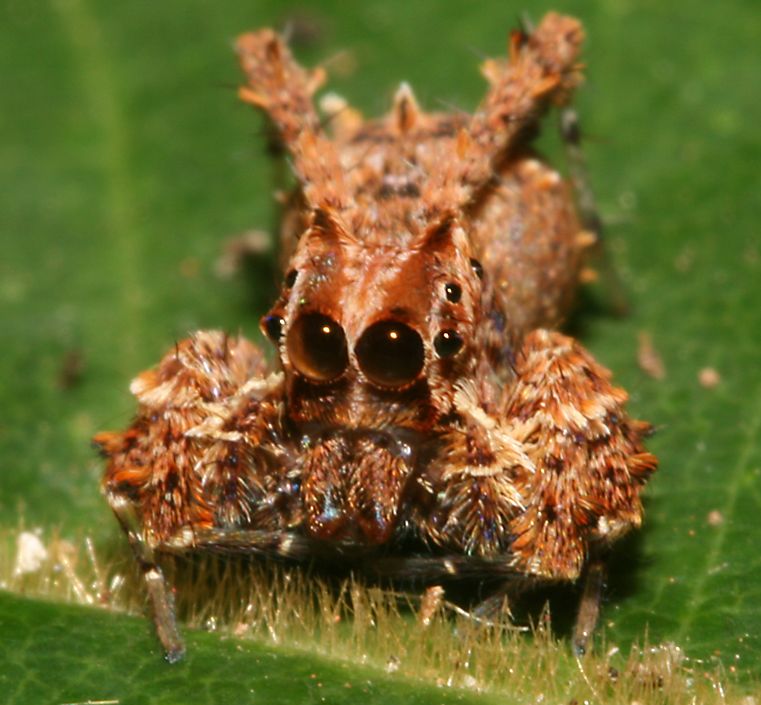
This tiny spider was one of the highlights of my walk from the southern entrance of Angkor Thom to Bayon temple. It belongs to a jumping spider genus called Portia, which has 17 members scattered across Africa and Asia. The Portia spiders hunt other spiders and they're famous because they have some abilities which are unique among bugs. One of their favorite targets is the spitting spider which, as its name suggests, spits venomous silk at its prey or any threatening predator. Normally, Portia approaches these spiders from behind, but if it's a female spitting spider with eggs then it approaches head-on, because females in this state can't spit their silk. Portia spiders have an extraordinary ability to memorize a path from their current location to a new location. If it sees a spider on another bush which it wants to hunt, it can spend several hours slowly scanning the entire area with its large main eyes, evaluating every branch and leaf between it and its prey. It then follows the path it figured out, and it continues to follow it even though it has to go out of sight of its target and other parts of the path. Once it reaches its intended prey, it then works out how to tackle it. Nature has made it look like a bit of trash on a leaf, but it has also given it an ability which is almost unheard of in the bug world, to improvise a plan of attack and modify it if it isn't working. For instance, if its prey is sitting on a web, Portia will vibrate the web in order to coax the spider into striking position. If this doesn't work, Portia will vibrate the web at different frequencies until it finds a pattern that works, a process that might take several hours. If that doesn't work then it will sometimes walk along a stick above the web, and drop down on a piece of silk into a position where it can attack the web's owner. These problem solving and learning abilities are usually only found in much larger animals, and it's remarkable that a miniscule spider like this should have the brain power to achieve all of this behavior. |
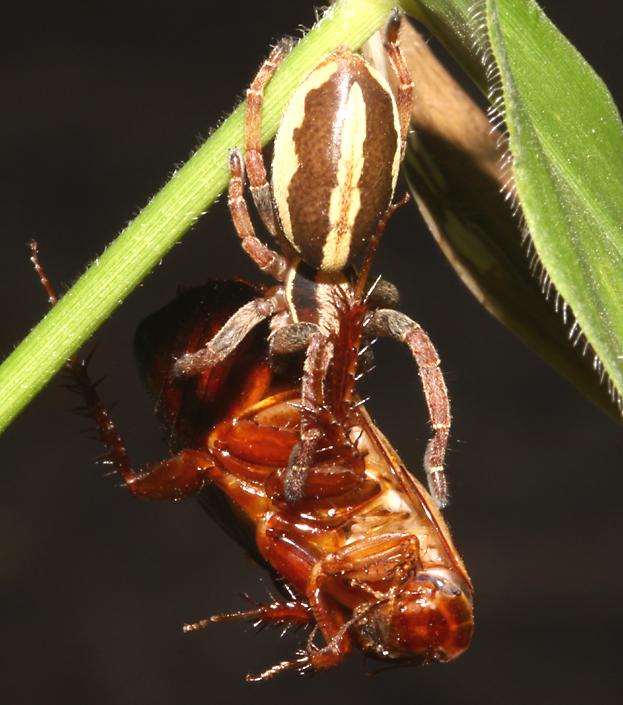
Portia is very particular about who it eats, but some spiders will eat just about anything, including this cockroach! I took this photo in the hills of Kirirom national park, but I saw the same species down on the south coast at Kep national park, perched on a piece of wood covered in pink fungus or slime mold. |
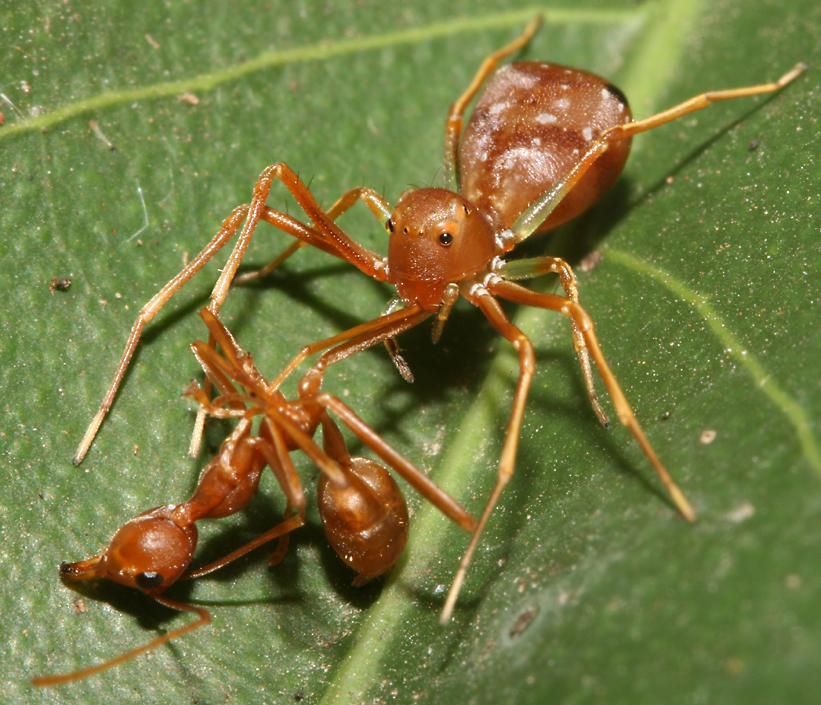
Another feast, but on a much smaller scale. The tiny spider you see here is called the ant-like crab spider, or Amyciaea lineatipes to its Latin friends. The ant-like crab spider is one of a number of spiders which mimic ants, others being the weirdly shaped Myrmarachne maxillosa of Thailand, and the more conventional looking unidentified ant-mimic spider which I saw in Vietnam. There is even an ant in Australia which mimics spiders! Since most predators won't attack ants, looking like an ant is a good way to avoid being eaten, but I don't know what an ant gains by looking like a spider. Like the other ant-mimics, the ant-like crab spider moves in a jerky fashion like an ant and waves its two front legs in the air like an ant's antennae. It also has two black spots on its rear end which have the appearance of eyes, and it has an unusually highly domed head, which also makes it look less like a spider. Unlike the other ant-mimics, Amyciaea lineatipes also hunts and eats ants, specializing in the very common weaver ants (Oecophylla smaragdina). It's no easy task considering the spider's small size, the ants' large pincers and their use of formic acid as a defense. This spider is supposed to hunt during the night, but I found this one near the same patch of flowers at Angkor where I photographed the lynx spider which had caught that beautiful tiger moth. |
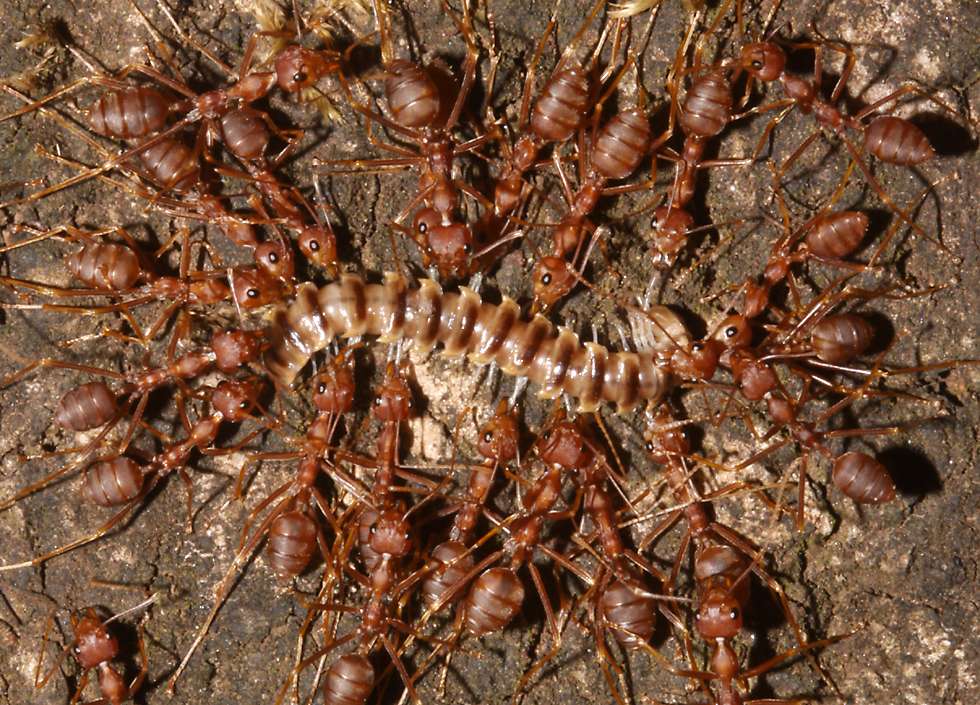
Of course ants aren't exactly innocent when it comes to harming their fellow creatures. Here's a whole group working together at Bousra waterfall to capture and kill a harmless millipede which just popped out for a nighttime stroll. |
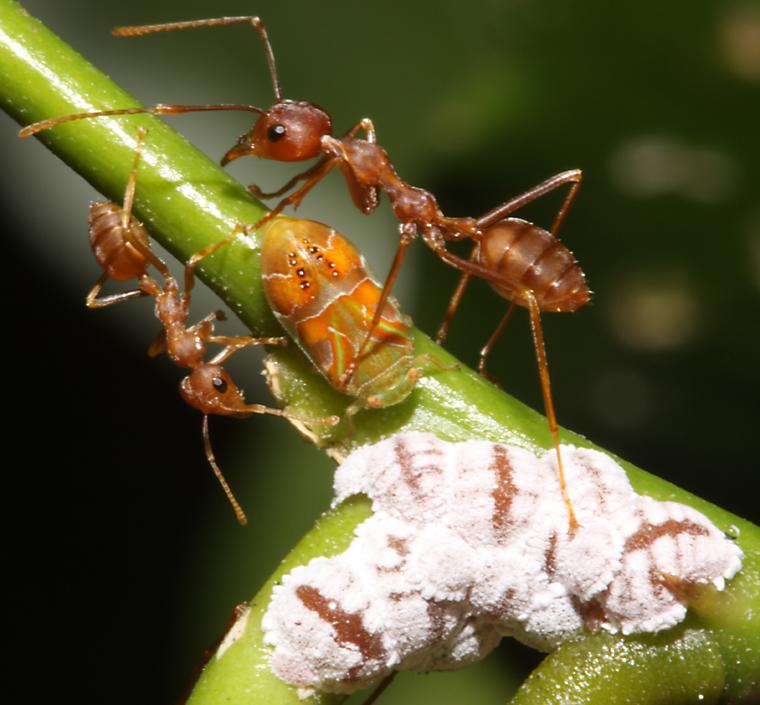
Ants often protect other insects, like these weaver ants herding a Tettigometrid nymph and a group of scale insects at the Choeung Ek killing field. All of the insects in this photo are true bugs living on the sap of plants. This sap is rich in sugars, but it doesn't have much protein, so the bugs have to consume large quantities of sap to get what they need. They then excrete droplets of the leftover fluid, as you can see on the far right of the photo. That's where the ants come in. As predators, they can easily obtain protein from the critters they eat, but they can't easily obtain sugar on their own. Instead, ants all over the world farm bugs like this, protecting them from animals which would otherwise kill them. They then gather the droplets of fluid, which is called honeydew, and take it back to the nest. |
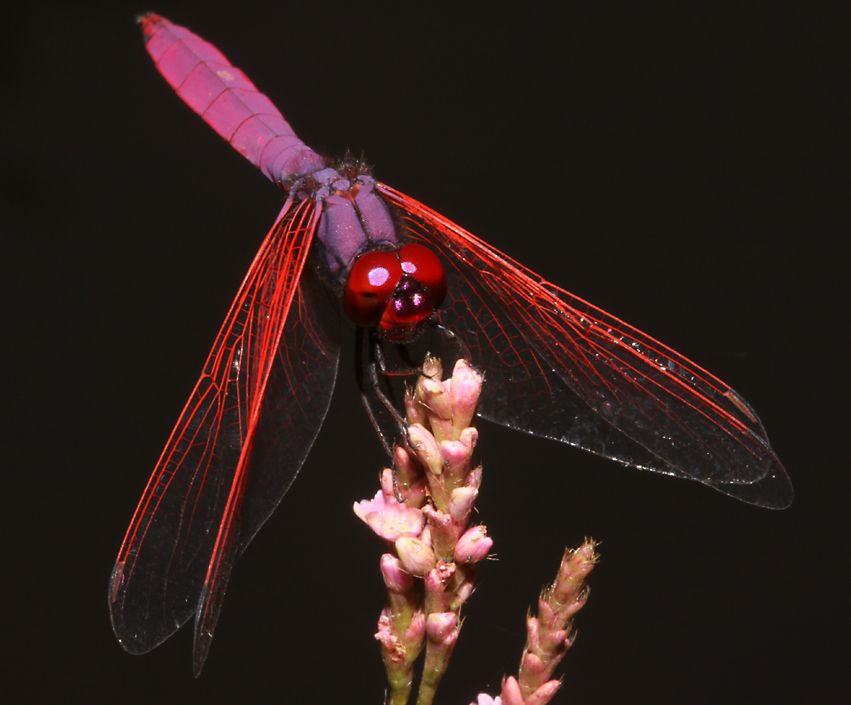
This attractive dragonfly is called a dawn dropwing. Despite appearances I photographed it during the daytime, below the upper tier of Bousra waterfall, where there were many other dragonflies, damselflies and butterflies. |
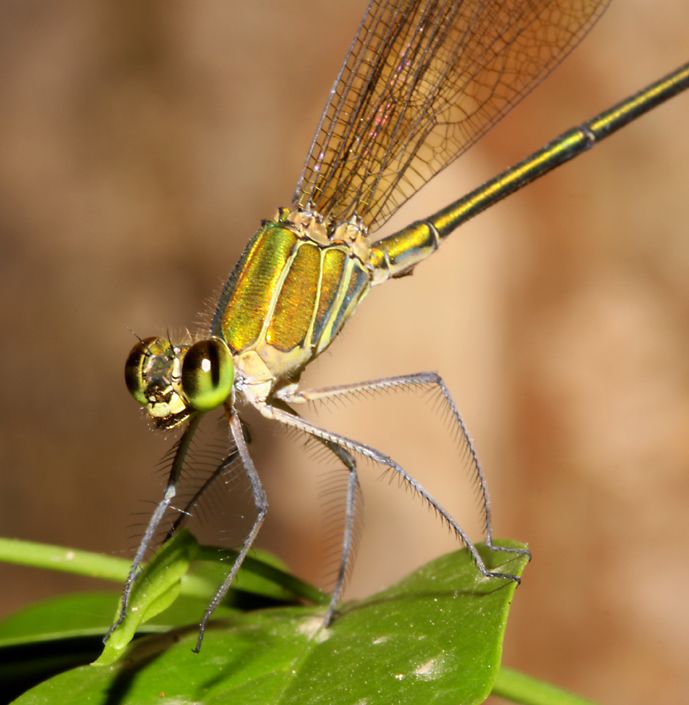
I haven't been able to track down the name of this damselfly which I photographed at Kbal Spean. It's very surprising, considering how large and attractive it is, and also how common it is; I saw them in several places around Cambodia, including a group of 10 or 15 in one small area at Kep national park. |
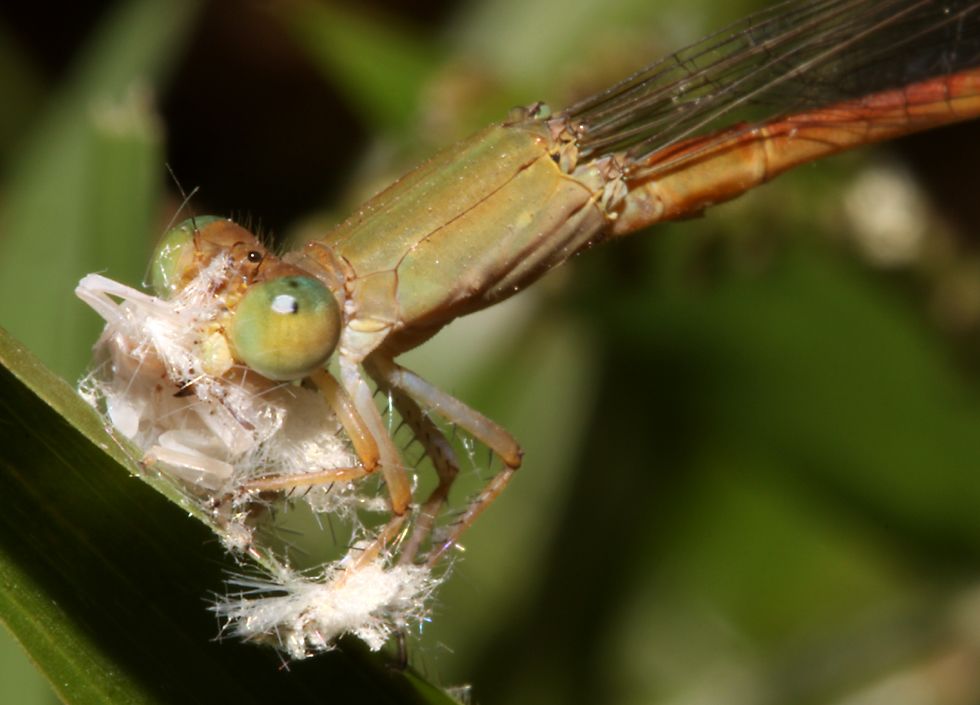
Here's another damselfly at Kep. I had previously photographed this same species at night and concluded that its dull coloration was probably only in evidence after dark, but the one you see here was photographed during the daytime, so this is obviously just a boring looking damselfly! This one's eating another sap-sucking true bug, but one which obviously wasn't protected by ants. I photographed this type of bug in Vietnam, it's usually protected by a dense covering of white filaments, but it looks like the damselfly was easily able to brush those aside. I'm quite surprised that a damselfly would eat one of these bugs, because dragonflies and damselflies both usually target flying insects, not insects which are stationary on a leaf. |
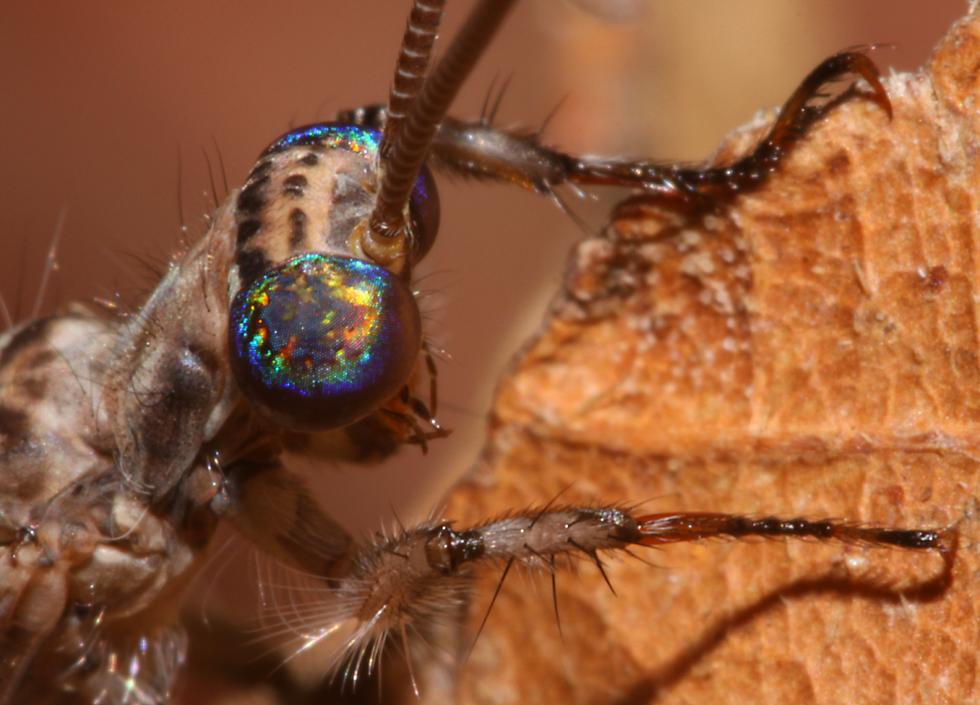
Here's a bug with stars in its eyes! It's an antlion lacewing which I photographed in Kirirom national park. There are about 2000 species of antlion distributed around the world. The adults look somewhat like dragonflies or damselflies but they have large antennae, which makes them more similar in appearance to owlflies, and in fact they do have a close relationship to this last family of insects. The nymphs of this family are called antlions or doodlebugs, they sit at the bottom of conical holes in sandy areas and wait for an ant to fall in, at which point they inject venom into the ant and eat it with their vicious looking jaws. It's no wonder that the Japanese and Koreans apply the name "ant hell" to these traps, though actually antlions also catch and eat other insects and even small spiders. Unusually, the larvae have no anus and they don't defecate until after they've pupated and become adults. The adult antlion lacewings are considerably larger than the larvae, a feat achieved by having a very flimsy exoskeleton. |
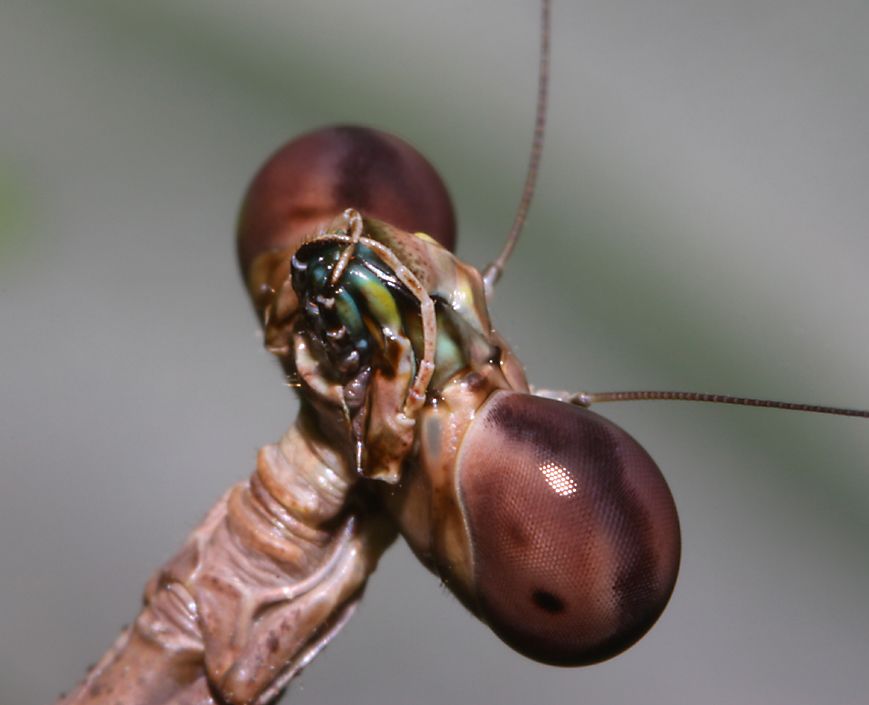
The eyes have it! This is a mantis which I photographed at night in Ream, where I took a very fruitful walk down a pathway leading down to the ocean. |
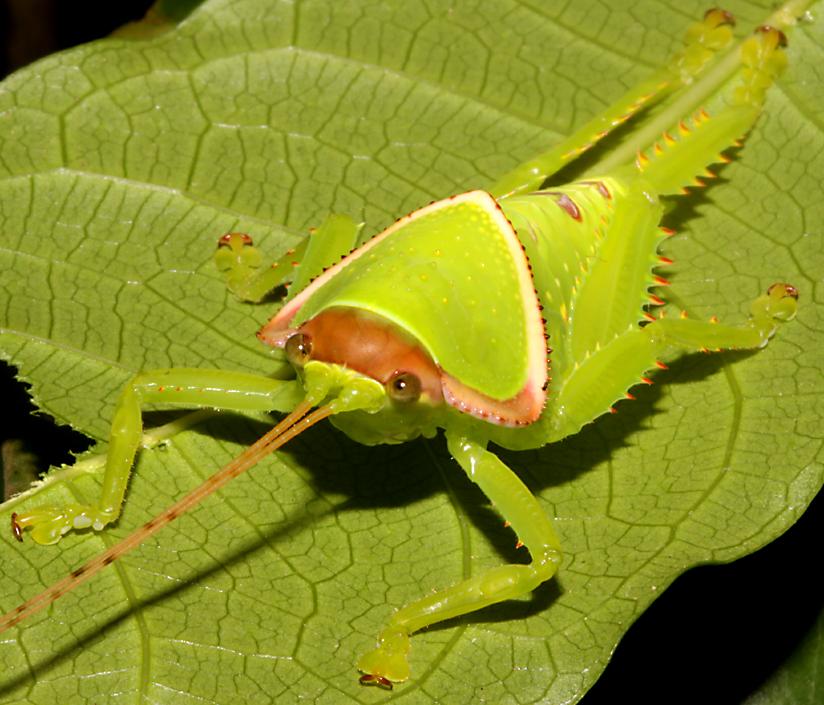
This bush cricket is another outcome of that walk. I haven't been able to track down its name, but I love the shield it has around its head, and the red and yellow spines along its legs. |
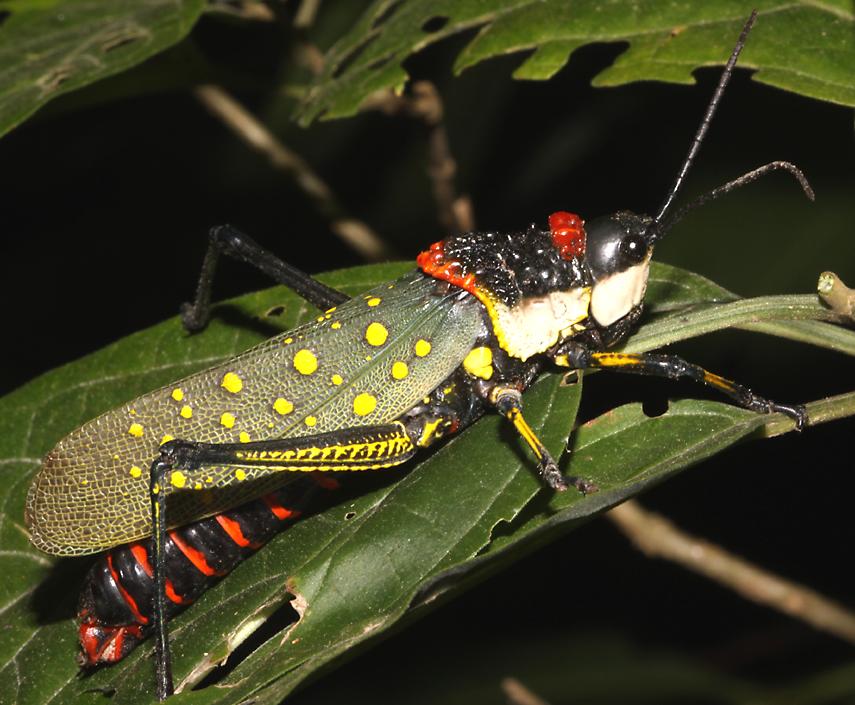
Another night, another orthopteran. This is a northern spotted grasshopper, which I photographed at night along the trail to Chambok waterfall. In Thailand it's called a ghost grasshopper. The bright colors are a warning that the grasshopper is chemically protected, so I'm surprised that it wasn't active during the daytime. I saw a very similar grasshopper during the daytime in Indonesia, though it lacked the white and red coloration on the head, and its legs were blue rather than black. The northern spotted grasshopper exudes a toxic foam when it's attacked, which apparently is a good way of keeping tarantulas and other large spiders at bay. It's a type of locust, and at times it can occur in numbers large enough to cause a significant amount of destruction. It's also fairly indiscriminate in the crops it will chew through. Unlike other locusts, they're no good for people to eat, though their attractive appearance probably does give some consolation to the people who are starving to death. |
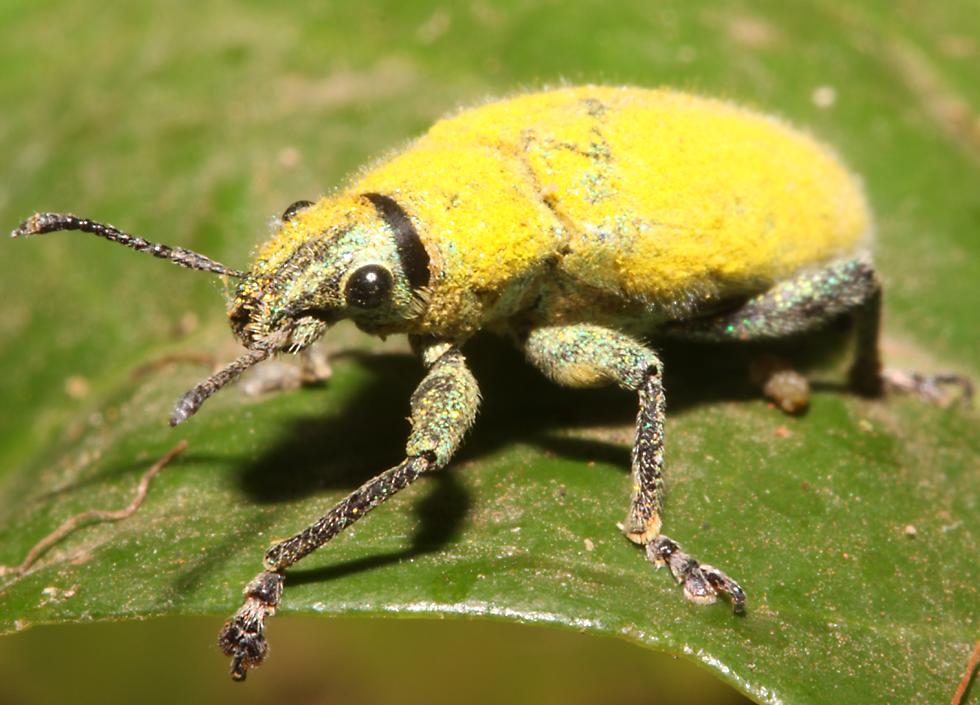
Beetles are the largest of all groups of insects, and they come in a huge and fascinating array of shapes and colors. Having said that, I'm usually somewhat disappointed by how few I actually see, and the frequent dullness of the ones I find. This weevil isn't too bad a catch, it was along one of the paths leading to a temple at Angkor. I'm especially struck by its yellow fur, something I haven't seen before, and by the iridescent green scales scattered over its body. Weevils are the largest family of beetles, which makes them the largest family in the largest group of all animals. One final and very important thought: if you ever have to make a choice between eating a large weevil and eating a small weevil, then you should always eat the small weevil, since it's the lesser of the two weevils. |