
Butterflies of Vietnam
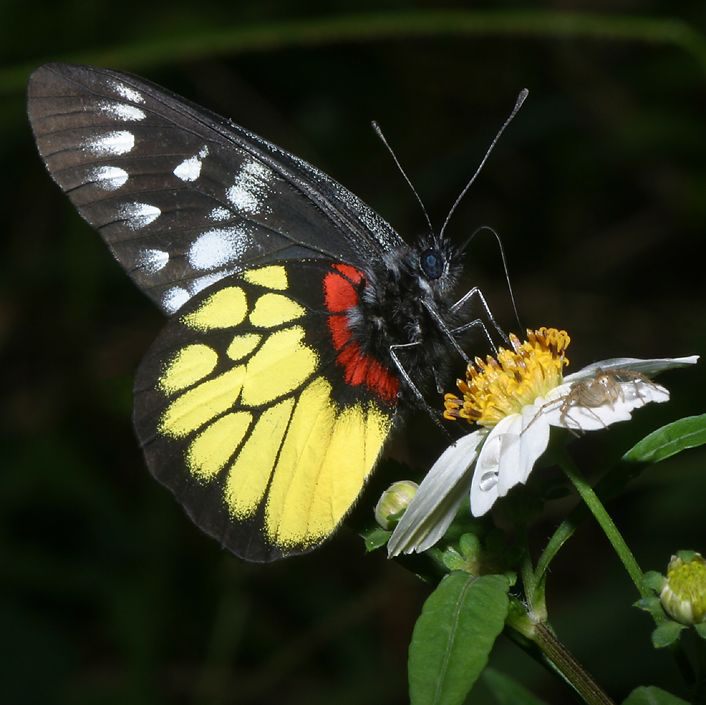
This very attractive red base Jezebel was enjoying a pleasant breakfast on the flowers growing outside the accomodation area in Bach Ma national park near Hue. What the butterfly didn't realize was that danger was near at hand. Observe closely and you'll see another little critter looking for breakfast on the far side of the flower - a small lynx spider! Butterflies need to watch out for spiders lurking near flowers because the larger ones do eat butterflies, however this spider is probably too small to tackle something so large and it paid no attention at all to the butterfly. |
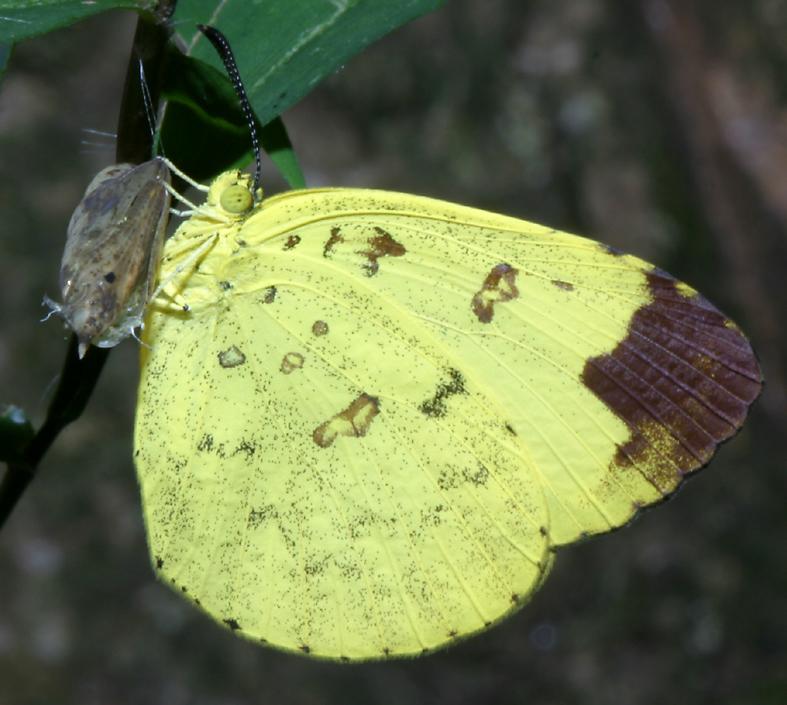
Jezebels are one of the most spectacular members of a family of butterflies called the Pieridae, more commonly called "whites" and "yellows". The family's most notorious species is the cabbage white butterfly, whose caterpillar is a rampant destroyer of cabbages. This chocolate grass yellow is a more typical member of the family. It looks like this individual is still standing on the cocoon from which it has just emerged. |
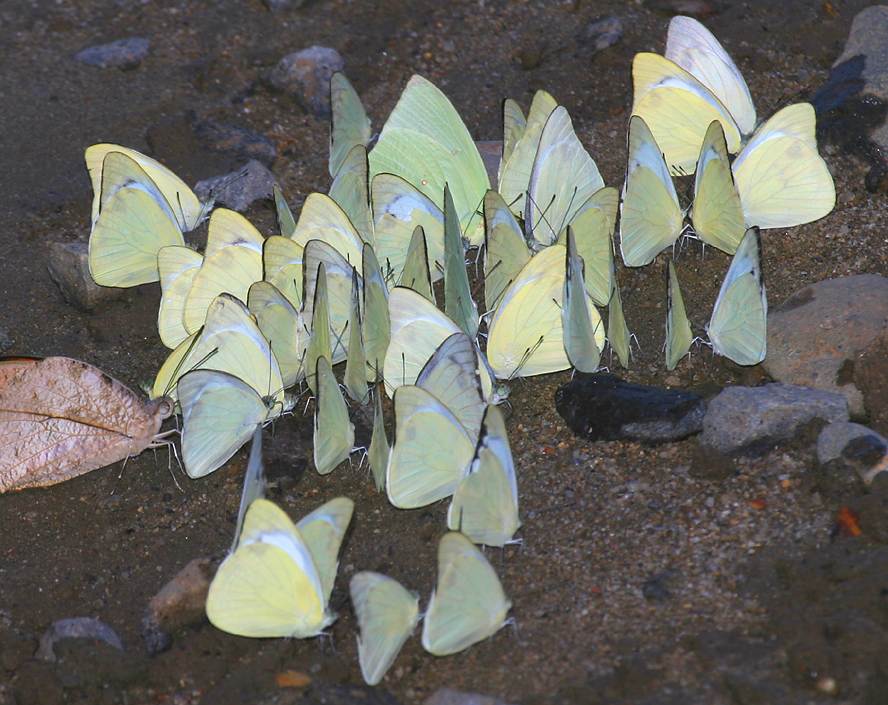
Here's a whole crowd of Pieridae butterflies "puddling" beside the river that flows through Cat Tien national park. There are at least three different species here, the yellowish ones, a greenish individual with a light spot near the center, top of the photo and a dead leaf mimic on the left-hand side. However, it's a very good bet that every butterfly you see here is male, because it's the male butterflies which engage in this behavior in order to obtain the mineral salts which they pass on to the females at the time of mating, which are required for the eggs to develop. |
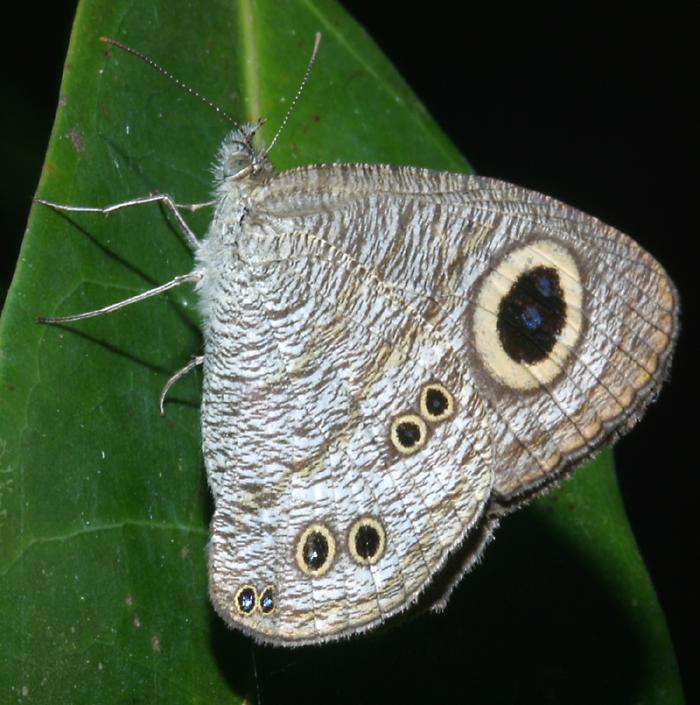
Pierids are called "yellows" and "whites", but this common five ring belongs to a family called the Satyridae, which are known as "browns". Many of these browns have eyespots similar to the ones on this butterfly, and the members of the Ypthima genus are usually named after the number of spots on the wings. The more observant among you will now be wondering why this butterfly isn't called a common seven ring! It's because the large spot on the front wing isn't counted, and the two small spots on the hind wing are counted as a single ring. No-one said the numbering system had to be logical! |
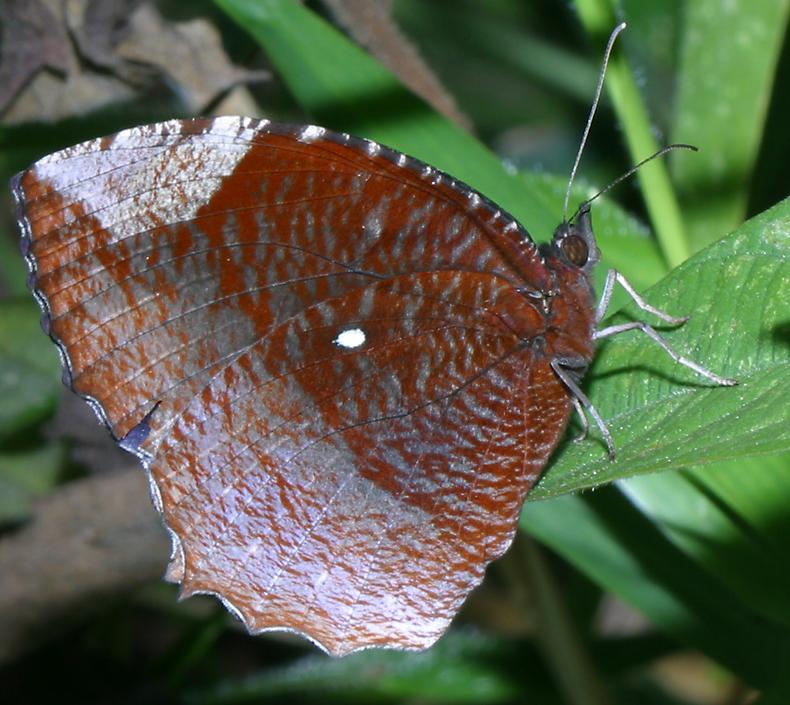
This common palmfly is another "brown". As the name suggests, the larvae of this butterfly feeds on different types of palm tree, including the awful oil palm which was imported from Africa but now covers large swathes of south-east Asia because of the usefulness of its oil. |
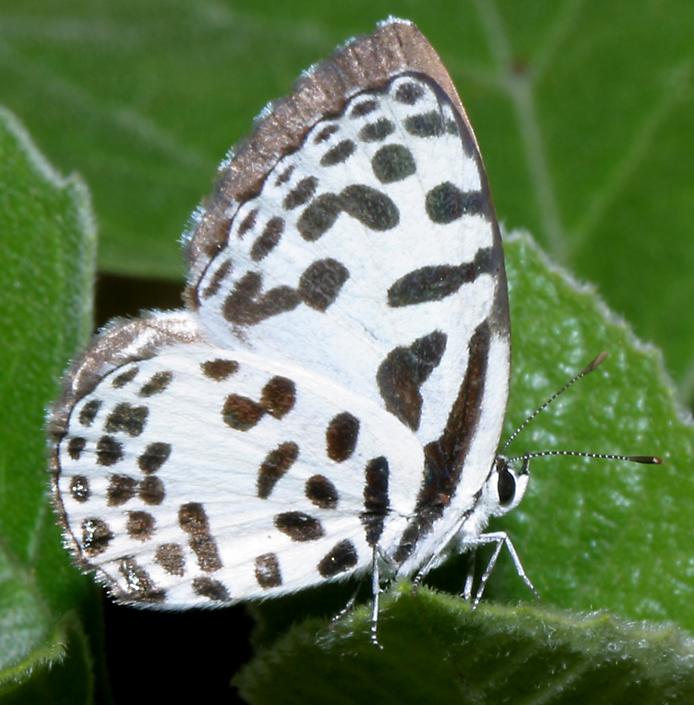
This common pierrot belongs to yet another sub-family of butterflies, this time called the "blues". There are several different types of pierrot butterfly, though they're all very recognizable because they share a basic white-and-brown color scheme. You can also see some straight pierrots in Thailand - I guess they haven't heard of lady men! |
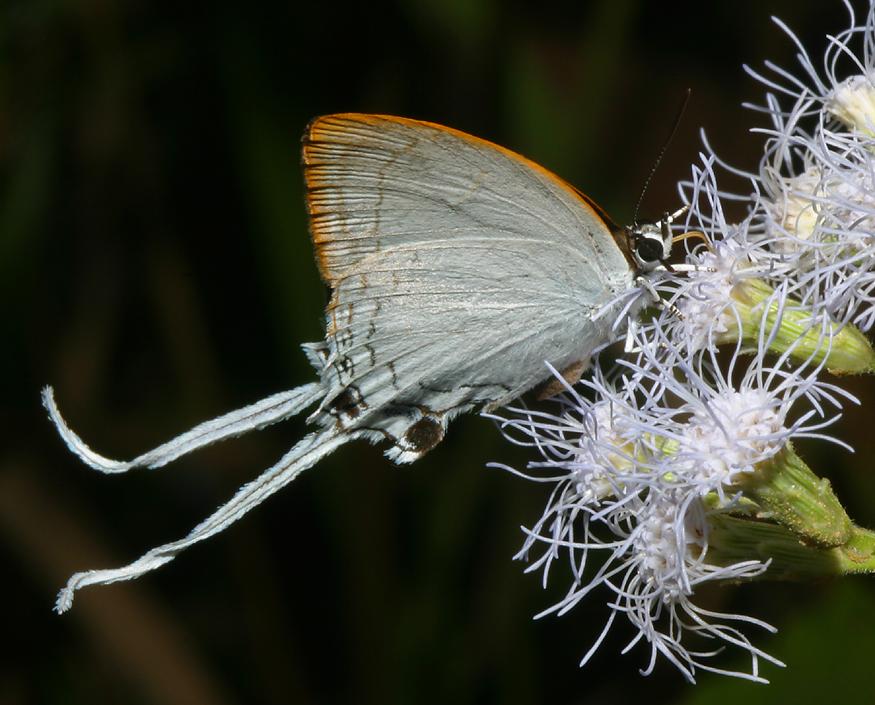
This common imperial has a pair of tails almost as long as its whole body. It is also a "blue", but it belongs to a genus all of its own. |
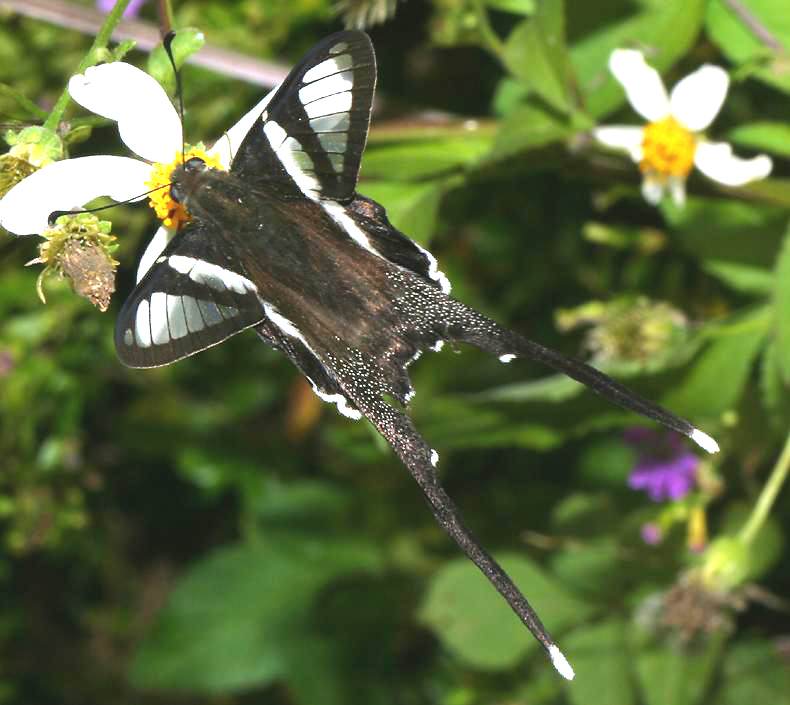
This white dragontail shows tail length taken to an even greater extreme; the hind wings have become largely non-functional vestiges in support of the tails. Despite this degree of ornamentation, this butterfly flies extremely well, hovering over the flowers like drab little hummingbirds, or like their sphinx moth cousins. The colors are a little dull, but the frilly white edging and those see-through wings give it a charm all its own. There were many of these dragontails in Bach Ma national park, and in Cat Tien national park I saw a green dragontail which does indeed have small green patches on its wings, but it was very skittish and in spite of several attempts it didn't allow me to get close enough for a photo. The white dragontail is a type of swallowtail butterfly, but it's a very untypical swallowtail. Most of them have the same shape as a regular butterfly except for two or more short tails on the hind wings, they're often very colorful and they don't normally have transparent wings. |
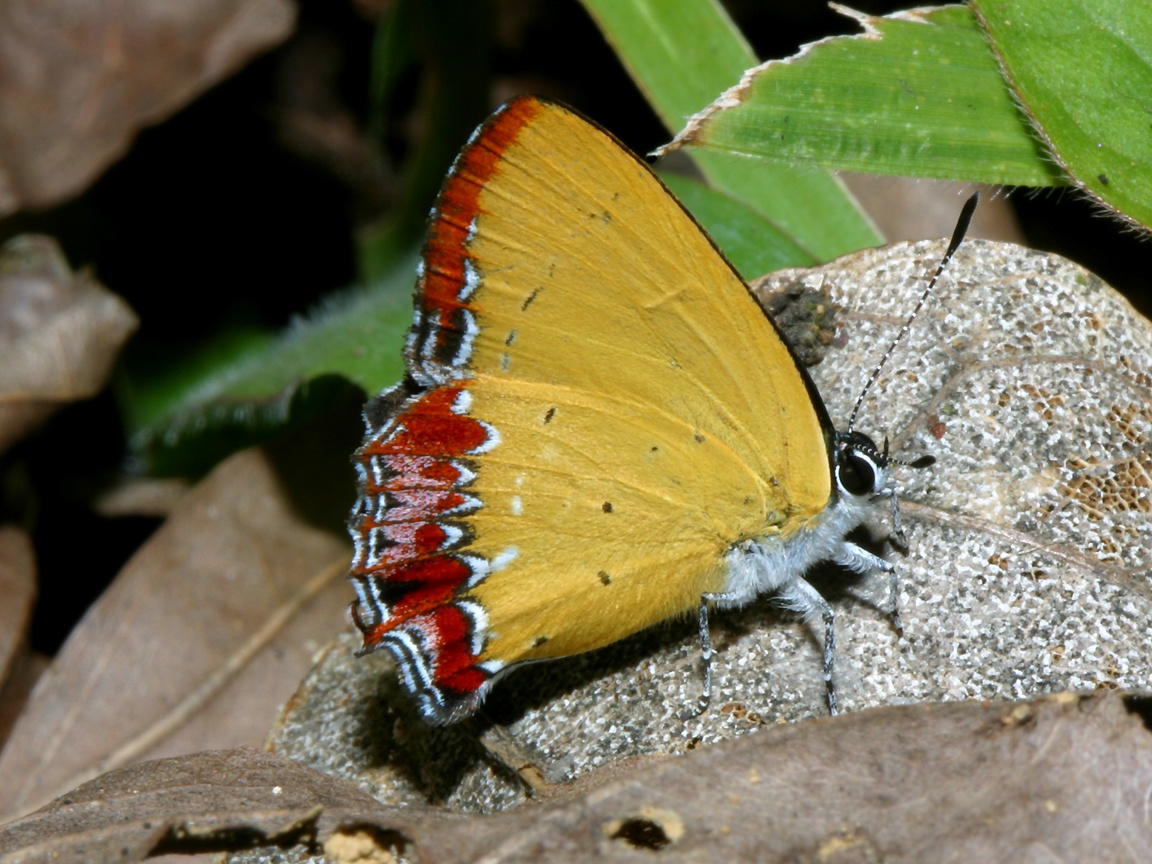
If it were in prime condition then this purple sapphire would have little tails on its hind wings, but this individual has lost them. Maybe this happened when a bird attacked or maybe they just wore out and fell off. Such tails are characteristic of the "hairstreak" sub-family of butterflies, but the purple sapphire actually belongs to a different sub-family of the gossamer-winged butterflies, in this case the "coppers". Like hairstreaks, purple sapphires use these little tails as imitations of their antennae and go as far as moving their closed hind wings up and down to make the imitation antennae move up and down just like the real ones. All of this behavior is done to confuse sharp-eyed birds into believing that the imitation head is the real thing. If the bird attacks the imitation head then it gives the butterfly an opportunity to escape, and a small peck out of the wing has almost no effect on its ability to fly. The purple sapphire is a beautiful butterfly but at first glance the name seems wildly inaccurate, since there's no purple coloring visible anywhere. However the mystery is solved when it opens its wings to reveal an iridescent purple pattern on a dark brown background with red trim. A purple sapphire I photographed in Thailand showed off its tails as well as the purple on the top-sides of its wings. |

This is one of the glassy tiger butterflies, sipping on a flower in Cat Tien national park. I'm not sure which of the glassy tigers this is, I'd need to spend more time studying other photographs to match the patterns on the wings. |
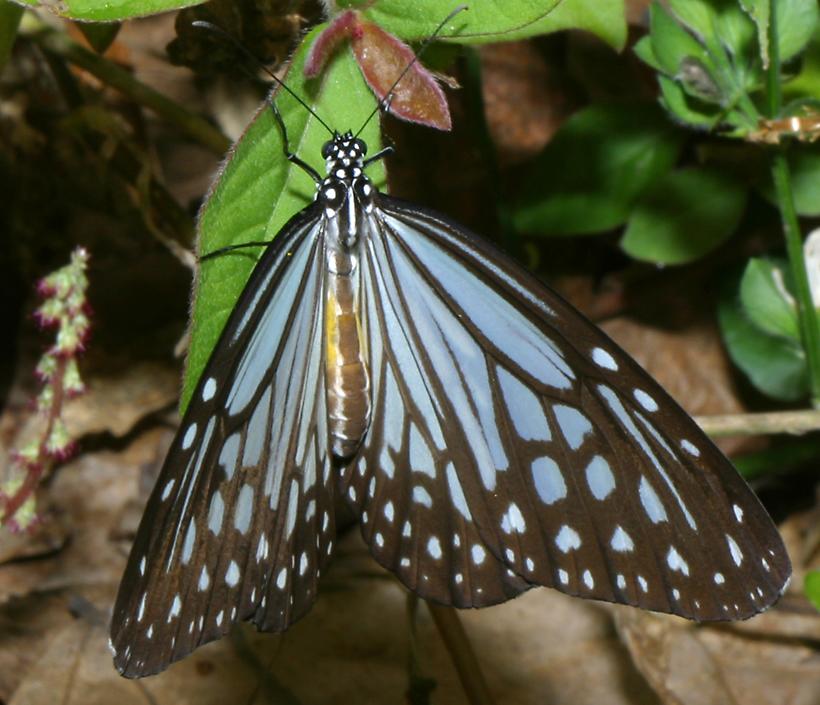
Another glassy tiger, but this time showing its wings and its body, which has a nice yellow flush. When hanging like this the butterfly appears to have a face pointing backwards with two eyes and a long nose. This might be intended to startle possible predators. If that seems surprising, then you should a Cambodian dark glassy tiger which has surprises coming out of its wazoo! |
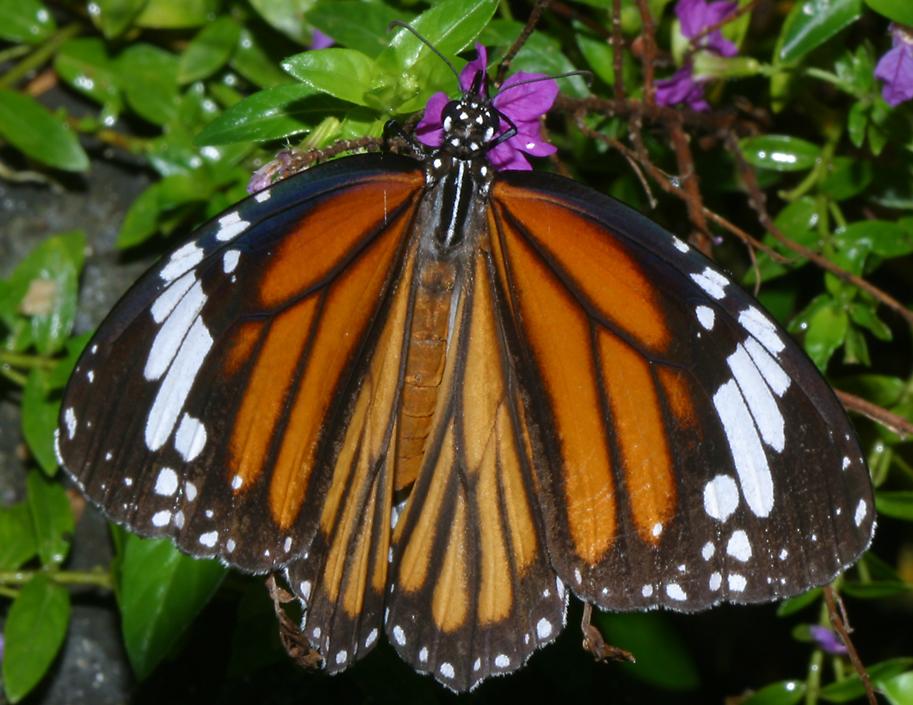
And here's the same face again! This might look like the monarch butterfly of North America, but it's actually a different species called the common tiger. It's a close relation of the monarch, and also of the glassy tigers. |
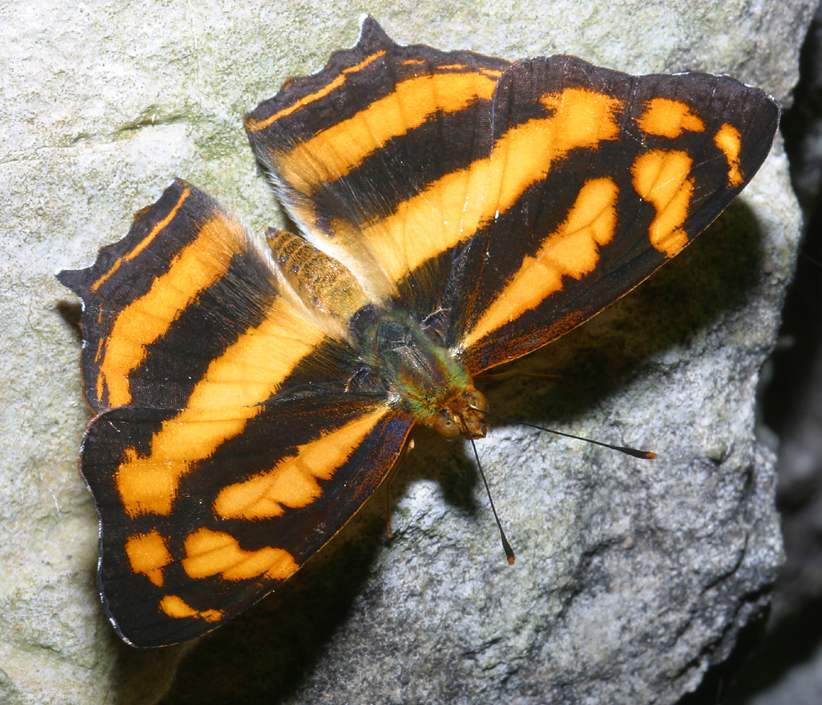
This common jester was flitting around beside the long path up to the Perfume Pagoda, near Hanoi. Like most butterflies, it wasn't particularly eager to have me approach but I was still able to get close to it by coming in very, very slowly and pausing whenever it seemed nervous. By the time I'd spent 5 or 10 minutes nearby it was totally habituated to my presence, which is a good thing because when it landed in the position you see here it was directly on top of a dried piece of grass. I brought my hand in very slowly and pulled the grass to one side. It lifted its legs to let the grass get past, but remained in place. The orange and black stripes you see here are a very common pattern adopted by insects all around the world to warn predators that they're toxic and distasteful - or pretending to be toxic and distasteful. It's interesting to see that the patterns on the wings of this butterfly are also carried over to the body. |
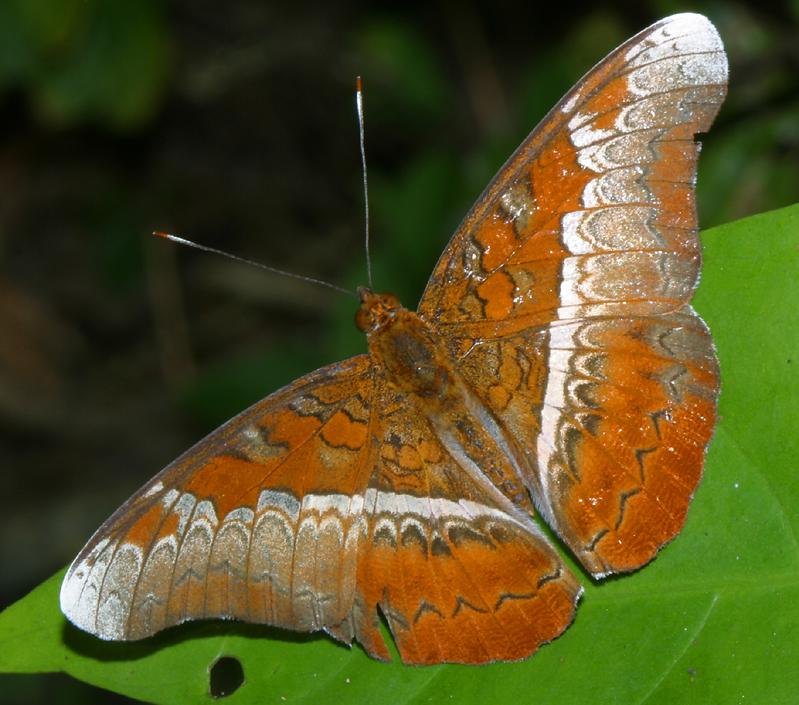
Like the jester, this knight butterfly also belongs to a group of butterflies from different families which get their common name from courtly titles. The most well-known member of this group is the monarch butterfly, but there's also the queen, viceroy, alderman, soldier, sergeants and barons. If you get enough of them together then you could probably have a game of chess! This butterfly has an interesting pattern of damage on its wings. The chunk out of its left, hind wing might be from a bird pecking it, a fairly common occurrence. In addition, if you compare the left wings against the right wings you can see that there are far more white spots on the right wings. This is probably because some of the colorful scales have been lost from the right wings, allowing the white substrate to be seen. This type of damage can happen if the butterfly blunders into a spider's web - the scales adhere to the sticky web, allowing the butterfly to escape. |

Continuing the theme, here's a grey count! It isn't closely related to the knight or the jester, but it belongs to a sub-family of butterflies called the Limenitinae which has many courtly names, like the "commanders", "commodores", "dukes" and "marquises". |
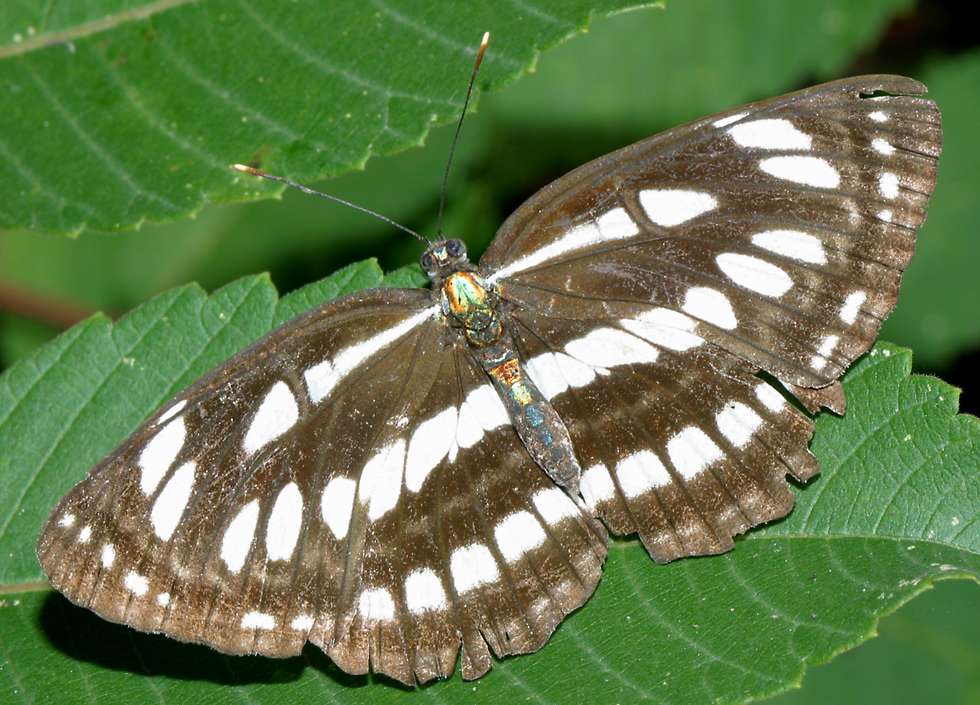
It's a very different looking butterfly, but this common glider is actually in the same sub-family as the grey count, and even the viceroy of North America, which is an extremely good mimic of the monarch. This one is a bit tatty and the colors on the wings are nothing to write home about, but I do like the iridescent patterns on its body. |
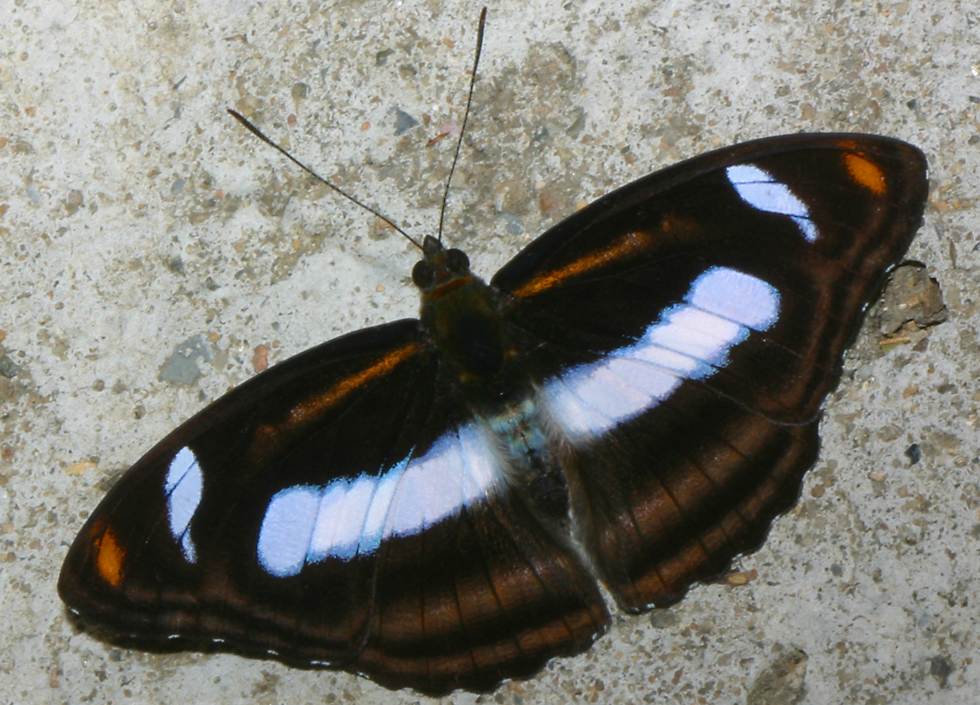
This orange staff sergeant (Athyma cama) has a similar shape to the common glider, but its colors are certainly much more attractive. |
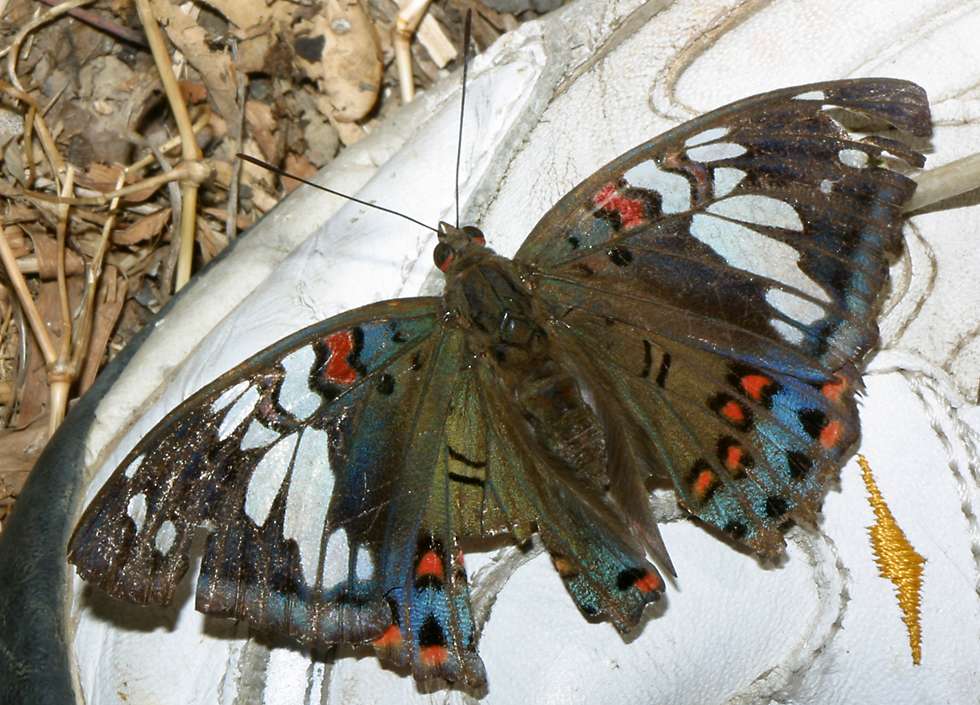
A very chewed up gaudy baron, another member of the Limenitinae. It's a shame that it's in such bad condition, because it's one of the most beautiful butterflies in south-east Asia, and this is the only time I've ever seen one. It's often very difficult to get close enough to a butterfly to get a photo, but from time to time they come to you! This gaudy baron landed on my shoe, but I've had others perch on my hat, my bag or even my arm. Sometimes the butterflies that approach closely are very territorial and are defending their patch, but other times it seems like the older and tattier the butterfly is, the more likely it is to let you get close. Perhaps they just don't have the energy left to care about escaping. |
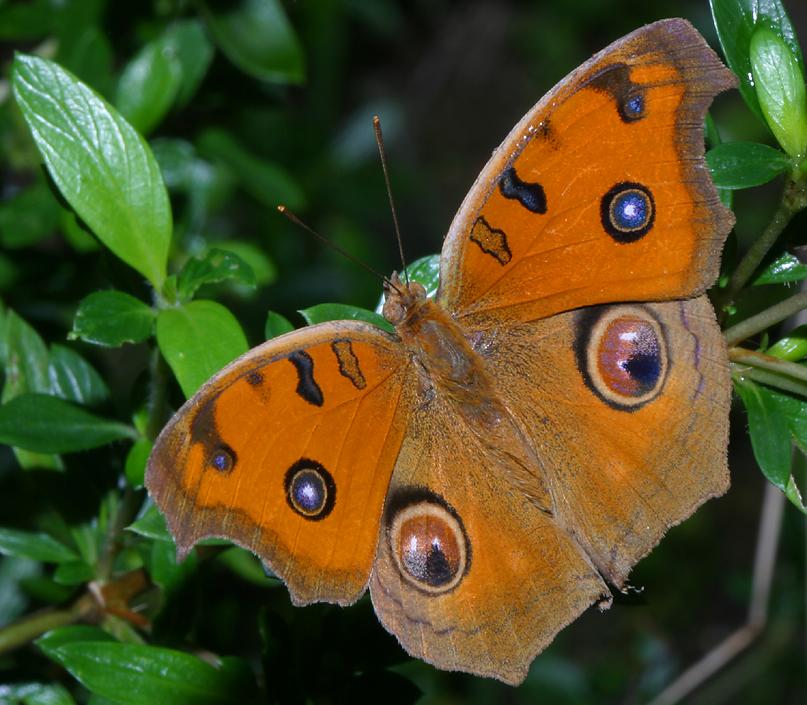
One of the best places I found in Vietnam to photograph butterflies was a small garden in the grounds of the tomb of the emperor Minh Mang near the old imperial city of Hue. The small formal garden around the stairs leading from the Sung An temple down to the lake was attractive to more than just butterflies; there were also a number of colorful dragonflies as well as spiders and a praying mantis. I missed out on finding any nice gaudy barons, but this peacock pansy is every bit as attractive. The large round eye spots on both its front and hind wings aren't there for aesthetics, they're used to scare off any birds which might attack. Not only do these eyespots have imitation pupils, they also have imitation "catch lights", just like real eyes! This butterfly has quite a large range throughout Asia, and I've been lucky enough to see it once before, in Japan. |
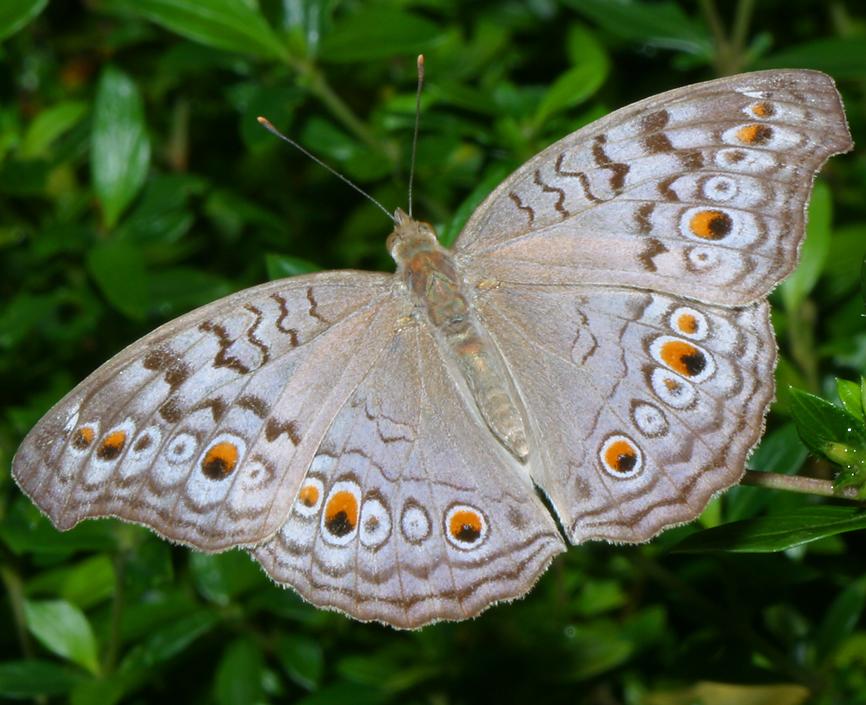
The same garden, the same epaulettes, the same genus and another butterfly called "pansy", in this case the grey pansy. The pansies belong to the genus Precis (until recently called Junonia), which includes the buckeye butterflies which live in the Americas. Gray pansies are very common, they can be found throughout south Asia and south-east Asia. |
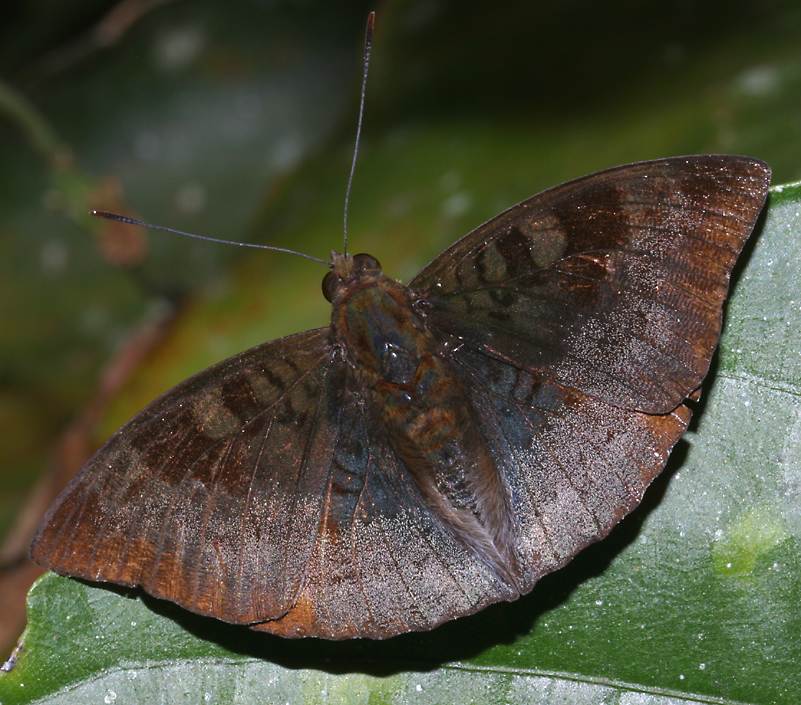
This one also seems to have faint epaulettes, but I'm fairly sure it's not a pansy of any type. I thought initially that it was some type of skipper butterfly, it's the right size and has a typical skipper body and dull coloration; but the shape of the wings just doesn't seem right. |
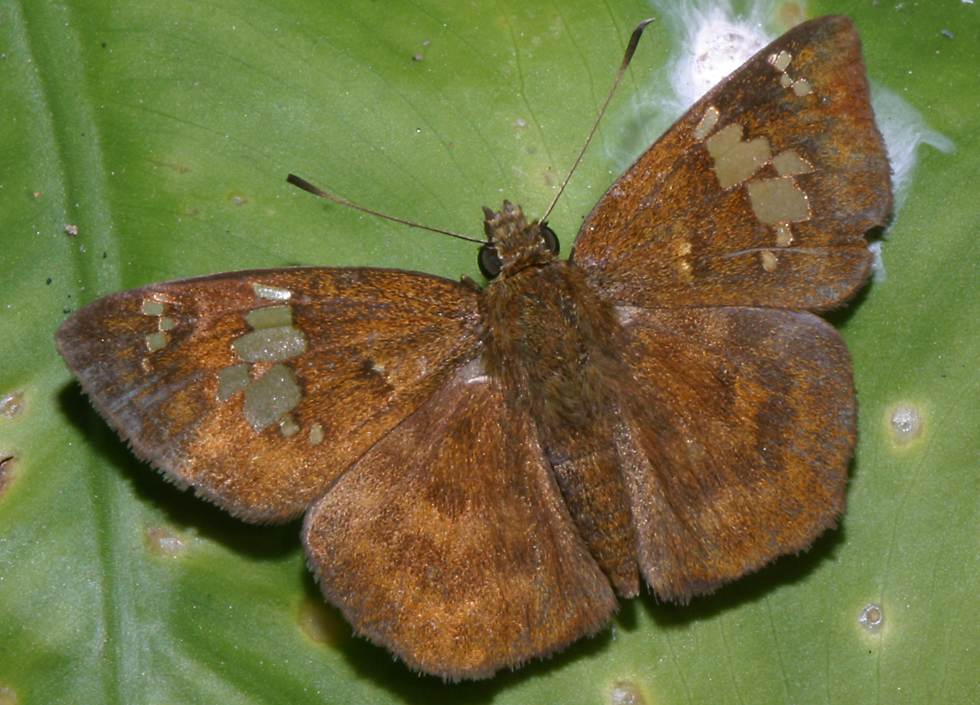
This one definitely is a skipper, I believe it's the fulvous pied flat. The colors are dull, but the translucent windows on the wings are interesting. |
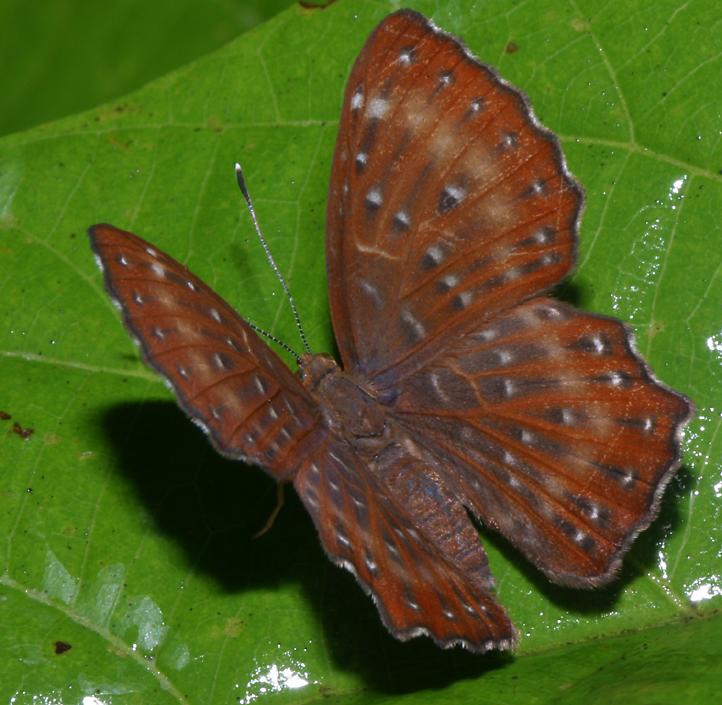
This is a punchinello butterfly, named after the "Punch" character in old-time "Punch and Judy" puppet shows. Punch and Judy was certainly popular when I was a small child, but I imagine it's probably gone out of fashion now. It certainly was politically incorrect, because Punch constantly carried a large stick which he used to beat his wife Judy, his baby and other characters in the show, including the devil, who is frequently killed. Our Punchinello is a much more pleasant and harmless character, it's one of the more attractive members of the "metalmark" family of butterflies, though it's outshined by the even more attractive Malay red harlequin and the white-tipped pixie of Mexico. It's very typical to see them perched like this with their wings half-open. |
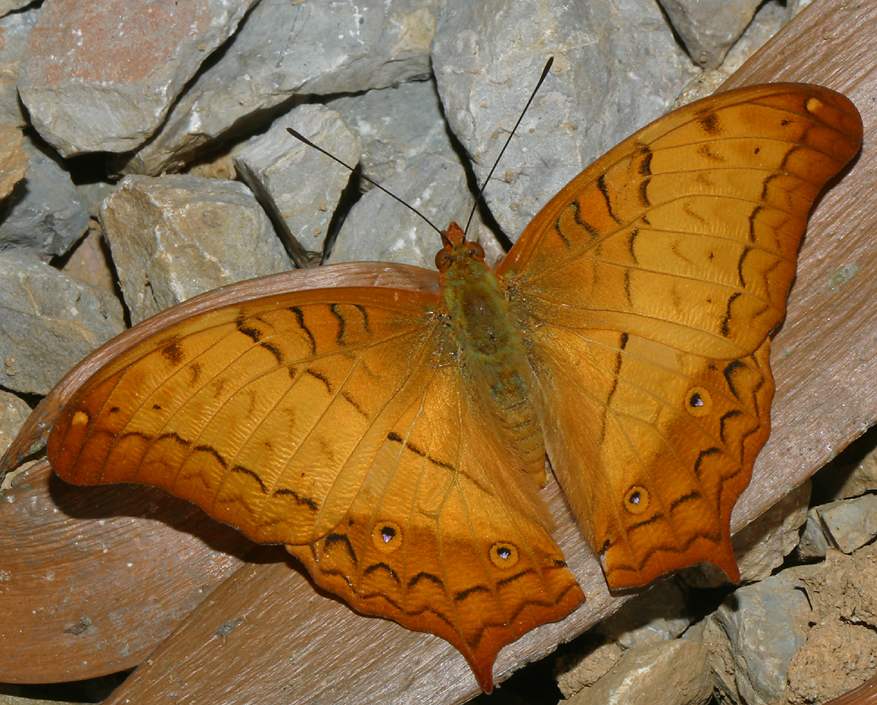
A common cruiser displays its understated elegance in the sunlight near the ranger's station at Cuc Phuong national park, near Hanoi. This one is a male, the females are much duller and browner. As the name indicates, cruisers are strong fliers, which has enabled them to colonize some fairly isolated Pacific islands, where they've developed into distinct sub-species. |

The best time to look for butterflies is the daytime, and for most species the sunnier it is the better they like it. However butterflies don't just disappear from the face of the planet when it's cloudy or the sun has gone down, though it might sometimes seem that way. If it's nighttime or raining then they can sometimes be found sheltering under leaves, waiting for the sun to come out so they can return to their regular occupation of drinking nectar and looking for a mate. Some of them even return each evening to the same communal roost, though unfortunately I've never seen one of those. This red lacewing with its spectacular colors and patterns was spending the night in Cat Tien national park near Saigon by roosting under a piece of grass beside a trail. You can see the pair of sharp little claws on the end of each foot which it uses to hook onto the foliage without expending any muscular effort. Perhaps these hooks are the reason why this butterfly chose a narrow piece of grass to shelter under rather than a leaf, which would seem to offer better protection from any rain which might happen. In Cambodia I came across the very similar leopard lacewing, flying during the daytime. |